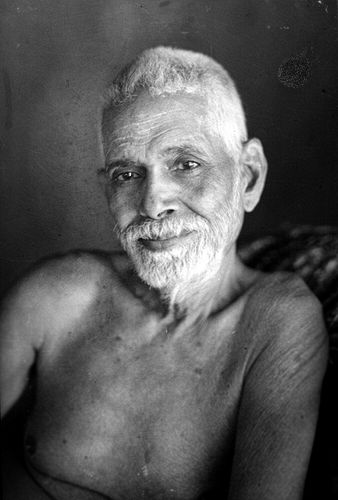
Ramana Maharshi: Once you realise the Self, it becomes your direct and immediate experience. It is never lost.

Ramana Maharshi sitting
‘Once you realise the Self, it becomes your direct and immediate experience. It is never lost.’
Ramana Maharshi

Time and time again I hear from spiritual seekers that they glimpsed the Self, they experienced that ecstasy, but it slipped through their fingers and fell away. Their question to me is how to get it back again. This is the wrong question, this is the wrong way, as it is based on a fundamental misunderstanding of the path.

Everything that comes can also go. Everything that comes, all experiences that have been attained, are not the Self.

The Self is no particular experience. It is always here, fully manifest, fully evident. Everything that is perceived is It. It is not different from whatever is being perceived to be happening.

Realising that ‘this is It’ is Self-realisation. It is simply seeing what already is the case. When it is seen, there is no desire to reach a new experience, and a seeing that everything happens spontaneously without the presence of a separate doer-entity. Here suffering falls away as the simple truth of no-doer is seen.

Actions, thoughts and desires continue to manifest themselves, spontaneously, but there is nobody doing it, just like the wind blowing or digestion happening. Things happen, no doer.

As long are you are alive, you always are, you always exist. No matter what happens, you are. This knowledge of (your) being is Self-knowledge. It is not something to attain, just something to be ‘acknowledged’. It is not separate from whatever is perceived to be happening. How can this ‘knowledge’ be lost?

Spiritual knowledge cannot be learnt

green sloping hills.jpg
“There will come a time when one will have to forget all that one has learned.” 
from ‘Who am I’ by Ramana Maharshi

Ultimate truth is simply that which never changes. It is here, now, everywhere and always already in its full glory. It is not separate from whatever is happening or from what is currently being experienced. Ultimate truth does not require you to believe in it or even do anything for it. Just drop all wrong thoughts and whatever remains is It. It cannot be caught in concepts.

The main role of the spiritual path is not to learn about ultimate truth, as it cannot be accumulated, but to discard falsehood. Seeing through false assumptions is what is called ‘spiritual knowledge’. It is not knowledge in the conventional sense at all really.

Conventionally speaking, learning is about accumulation of knowledge, but spiritual learning is more like pruning a hedge or chipping away at a block of stone to reveal a beautiful sculpture beneath. Put simply, spiritual learning is unlearning. Spiritual knowledge is seeing through false ideas.

“The state of Self-realisation, as we call it, is not attaining something new or reaching some goal which is far away, but simply being that which you always are and which you always have been. All that is needed is that you give up your realisation of the not-true as true.”
Ramana Maharshi

Anything that is learnt as being true is in the realm of relative knowledge. Anything that is learnt can also be forgotten whereas the Ultimate neither comes nor goes. Any statement posited as being true can be questioned and doubted leaving with it the bitter taste of uncertainty.

The Ultimate cannot be conceptualised. Conceptualisation itself relies on the Ultimate for its existence. All statements of truth rely on supporting structures and logic, eg. underpinning scientific or philosophical reasoning. The Ultimate truth stands by itself without needing outside support. It is none other than what you truly are. Look and you shall see.

Ramana Maharshi: To remain as you are, without question or doubt, is your natural state

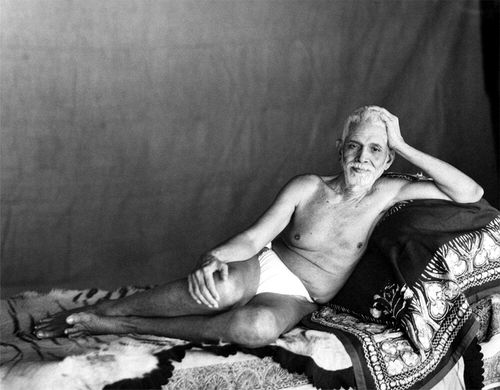
Ramana reclining

To remain as you are, without question or doubt, is your natural state
Ramana Maharshi

This is still an instruction for the spiritual seeker: ‘to remain as you are’.

With liberation, questions and doubts are irrelevant, as the natural state is simply whatever is. Nothing can obstruct it. It is always here and manifests as whatever is arising. It can never be obstructed and is always in plain sight.

However for the seeker, ie. the person that takes themselves to be the author of their thoughts and actions, the instruction to remain as you are and not worry about or get entangled with thoughts, questions and doubts, is one of the highest and most refined spiritual teachings available.

Be still, forget all concept of who you are, notice things as they happen. Regardless of what is happening, you know that you are, never what you are, only that you are.

When the mind and its concepts are no longer being believed, what use is there to talk of separation or no separation, self or no-self?

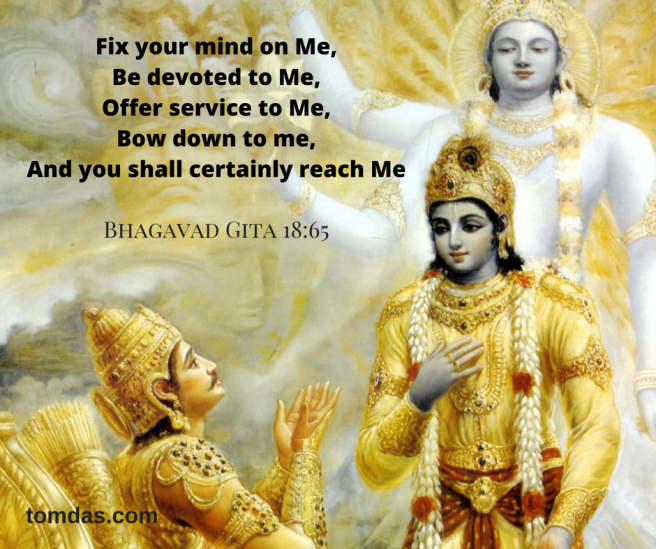
Bhagavad Gita: the most secret teaching

BG fix your mind on me.png

Lord Krishna states this is his most secret teaching: to love Him, to devote ourselves to Him, to be with Him knowingly.

He is already in each of our hearts, He is already everywhere and everything, everything is already done by Him.

Here knowledge, scripture and philosophy all crumble as, through our devotion, the heart opens. All are consumed by Him, and all we are left with is Him in all His glory.

We never were. All there ever was was Him.

❤ ❤ ❤

As Jesus said when asked:

“Teacher, which is the great commandment in the Law?”
And he [Jesus] said to him,
“You shall love the Lord your God with all your heart and with all your soul and with all your mind.This is the greatest and first commandment.”

Matthew 22:36-38

❤ ❤ ❤

Also, as Shankara sung in his Bhaja Govindam:

“Worship Govinda, worship Govinda, worship Govinda,
Oh fool! Other than chanting the Lord’s names, there is no other way to cross the life’s ocean.”
(Govinda is another name for Krishna. Literally it means ‘protector of cows’ referring to Krishna’s youth as a cow herd.)

❤ ❤ ❤

So, all that’s left for me do to is bow down and praise Him

❤ ❤ ❤

Hare Krishna!

Om Namah Shivaya!

May all beings be happy and well!

Praise be to God!

❤ ❤ ❤

See also:

Was Jesus ever born?

The pre-eminent form of worship


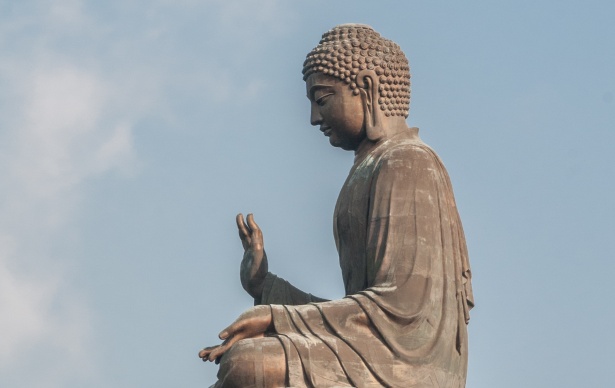
Buddha: Why do spiritual people fight with each other?

buddha side.jpg

“Why is it that, Master Kaccana, that ascetics fight with ascetics?”
“It is, brahmins, because of attachment to views, adherence to views , fixation on views, addiction to views, obsession with views, holding firmly to views that ascetics fight with ascetics.”
Anguttara Nikaya

Today’s spiritual scene is in many ways the same as it has always been: while some people wake up to things as they are and go beyond words and scripture, others stay fixed in their views, cling to their scriptures and concepts, and in doing so remain stuck in suffering and samsara.

So, why are so many spiritual people arguing with each other? Master Kaccana was one of the Buddha’s main disciples and was said to be the most skilled in espousing the dhamma (the teaching). He says it simply: people are wedded to their concepts, their views, their scriptures and their ideas, and that is why they fight with each other.

The true dhamma cannot be spoken. The true teacher knows their words are ultimately untrue and that words are merely conceptual pointers, indicators, and not descriptions of what is. The true teacher is not wedded to a particular teaching method, or a particular form of words, and naturally adapts the teaching to the situation at hand. A single word, a prescription for practice, a gesture, a glance, a lecture: the teaching comes to us in many forms.

If we truly listen, the living teacher constantly teaches the living teaching. The teaching is inseparable from our hearts and the life we find ourselves living: it is none other than daily life.

The teaching is here, already. Are we open to it?


Poetry: the all knowing ego

Punch and judy.JPG

The ego thinks it has all the ‘answers’,
Thinks it knows exactly how the enlightenment game works,
Thinks it knows which practice is best,
All its concepts lined up.

Of course it has no clue.

Pride means it pretends to know what it doesn’t,
Clinging to what it hopes will work,
According to its limited understanding.

Who can blame it?

My advice: realise first, talk later.

Spiritual Relationships & Gurus

swan heart

In my life I’ve encountered lots of different spiritual practices and philosophies, from New Age and Self-Help to Theravada Buddhism and Kashmir Shaivism. I’ve gained from almost every teaching I’ve read, some more so than others of course. But spiritual teachings have not been the things that I have found most healing in my life – it was my relationships that really helped me grow and feel whole. Specifically it was a long-term, loving and supportive relationship that helped me grow the most.

Sure, the spiritual teachings gave me insights, transcendental experiences and made me feel happier in many ways, but it was through a caring and trusting relationship that I allowed myself to open up, love and forgive myself. I was accepted in the eyes of another, and that allowed me to accept myself, to love and be kind to myself.

I was accepted in the eyes of another, and that allowed me to accept myself, to love and be kind to myself.

Much of our self-image is created through our relationships. Children learn about what is good and bad behaviour from what other people say to them and how other people react to them. They learn if they are beautiful or ugly, too fat or too skinny, clever or stupid, naughty or polite, ‘good’ or ‘bad’ – all these are learnt through what other people have fed back to them. Relationships create self-esteem – both high and low.

It seems fitting therefore, that if relationships and interactions with people can destroy a sense of self-worth, that relationship can also be beneficial in repairing a negative self-image which in turn can repair all sorts of resultant negative self-isolating coping strategies.

…if relationships and interactions with people can destroy a sense of self-worth…relationship can also be beneficial in repairing a negative self-image

In a spiritual context, I think this is where the Guru-disciple relationship traditionally has been so powerful. For those who don’t know, a Guru is simply the Sanskrit word for a spiritual teacher. Literally the word means ‘heavy’ (heavy with spiritual teaching), but a more creative etymology states that guru means ‘dispeller of darkness’ or ‘bringer of light’.

Whilst I have never had a guru (I consider life to be my guru – how new-age!), I can see how the dissemination of a spiritual teaching tradition in the context of a caring supportive relationship with a Guru could work wonders. I was always reading books in order to understand the spiritual stuff and never had that opportunity to learn at the feet of a guru – and when I did I never really trusted them anyway. In fact being near a guru, especially their feet, was the last thing on my mind in my journey. And the ones who demanded unconditional faith – that set my alarm bells ringing straight away. There have been so many gurus, both East and West, that have used, abused, manipulated and extorted their followers that it’s difficult to keep count of them.

There have been so many gurus, both East and West, that have used, abused, manipulated and extorted their followers that it’s difficult to keep count of them.

But there have been countless examples through the ages of how spiritual seekers, through simply trusting their guru, went on to attain liberation. The example of Nisargadatta Maharaj springs to mind – he trusted his guru’s advice to remain in the ‘I AM’ and after 2 years or so he was apparently self-realised or enlightened.

Traditionally in the Indian subcontinent, a guru may be someone who the family knows quite well. They would usually be male, but not always. In more ancient times the spiritual seeker would often live with the guru, perhaps even for several years before the actual spiritual teaching was taught. Up until that point they would be simply living in the forest with each other: talking, cooking, eating, working the land. They would know each other as brothers would, and in that context there was time for respect, trust and mutual affection to develop. The spiritual aspirant would be able to scrutinise the Guru and see if he truly lived his teaching, or if he only spoke of the Holy but did not embody it.

I feel nostalgic for that kind of ancient exotic guru, someone versed in the highest spiritual and meditative teachings, someone who deeply cared for me and I also cared for, someone I could give myself to and in whose love and spiritual presence I could heal myself.

But that was not, and is not my life. Instead I am thankful for my soulmate and wife, and the healing she has brought me through both the ups and downs of our relationship. Yes, I said earlier that life is my guru, but so is my wife.

Do you have a ‘guru’? Or have you had many ‘gurus’ in your life? Remember, a guru doesn’t have to be a person.