Ramana Maharshi: the method of wakeful sleep (Jagrat Sushupti) to attain liberation

Also see:

Deep Sleep and Self-Realisation

The Essence of the Ribhu Gita

Deep sleep is Brahman – the three states according to the Birhadaranyaka Upanishad with commentary by Shankara

The the following talks, Bhagavan Sri Ramana Maharshi outlines a very simple but powerful teaching, that of wakeful-sleep or Jagrat-Sushupti (Jagrat means the waking state, Sushupti means deep dreamless sleep). This teaching in essence is no different to the other teachings of Sri Ramana Maharshi, and is also no different to the great Vedanta teachings (this teaching is also found in the Upanishads – see the end of this post), but is just another way of expressing the same principle.

The method consists of noting that in deep dreamless sleep the mind is still and there is no suffering, but there is also no awareness of this fact at the time. In the waking state we are presently aware, but thoughts and suffering also exist.

Therefore the method is that of remaining awake but with the thoughts stilled. Ramana says this is the state of Jagrat-Sushupti, which is also the state of the Jnani (the knower of truth or the enlightened sage). Ramana states this jagrat-susupti is also called Samadhi (talks 286, 313) and that it is also Mukti (liberation, talk 311) and bliss (talks 609, 372).

I will start with an excerpt from Talk 609 as this goes into the most detail, and the opening paragraphs alone contain many gems that should be carefully contemplated on. Thereafter the talks are chronological, with bold added by myself for emphasis.

Wishing you the eternal peace that is already ever-present

Tom

201908


From Talks with Sri Ramana Maharshi, talk 609:

The incentive to realise can arise only in the waking state and efforts can also be made only when one is awake. We learn that the thoughts in the waking state form the obstacle to gaining the stillness of sleep.

“Be still and know that I AM God”.

So stillness is the aim of the seeker. Even a single effort to still at least a single thought even for a trice goes a long way to reach the state of quiescence. Effort is required and it is possible in the waking state only. There is the effort here: there is awareness also; the thoughts are stilled; so there is the peace of sleep gained. That is the state of the Jnani. It is neither sleep nor waking but intermediate between the two. There is the awareness of the waking state and the stillness of sleep. It is called jagrat-sushupti.

Call it wakeful sleep or sleeping wakefulness or sleepless waking or wakeless sleep. It is not the same as sleep or waking separately. It is atijagrat (beyond wakefulness) or atisushupti (beyond sleep).

It is the state of perfect awareness and of perfect stillness combined. It lies between sleep and waking; it is also the interval between two successive thoughts. It is the source from which thoughts spring; we see that when we wake up from sleep. In other words thoughts have their origin in the stillness of sleep. The thoughts make all the difference between the stillness of sleep and the turmoil of waking.

Go to the root of the thoughts and you reach the stillness of sleep. But you reach it in the full vigour of search, that is, with perfect awareness. That is again jagrat-sushupti spoken of before. It is not dullness; but it is Bliss. It is not transitory but it is eternal. From that the thoughts proceed. What are all our experiences but thoughts? Pleasure and pain are mere thoughts. They are within ourselves. If you are free from thoughts and yet aware, you are That Perfect Being.


From Talks with Sri Ramana Maharshi, talk 286:

Sushupti continues in this state also. We are ever in sushupti. That should be consciously gone into and realised in this very state. There is no real going into or coming from it. Becoming aware of that is samadhi.


From Talks with Sri Ramana Maharshi, talk 290:

Bring sleep into the waking state (jagrat sushupti) and you will be all right.


From Talks with Sri Ramana Maharshi, talk 311:

The Self who was undifferentiated in sleep is differentiated in the present state, and sees the diversity. The Real Existence is the only One devoid of objective knowledge. That is absolute consciousness. That is the state of happiness, as admitted by all of us. That state must be brought about even in this waking state. It is called jagrat sushupti. That is mukti.


From Talks with Sri Ramana Maharshi, talk 313:

Take another example: A passenger in a cart has fallen asleep. The bulls move or stand still or are unyoked on the journey. He does not know these occurrences, but finds himself in a different place after he wakes up. He has been blissfully ignorant of the occurrences on the way, but his journey has been finished.

Similarly with the Self of the person. He is asleep in the body. His waking state is the movement of the bulls, his samadhi is their standing still (because samadhi = jagrat sushupti) i.e., to say, he is aware of but not attached to actions. So the bulls are in harness but do not move. His sleep is the unyoking of the bulls, for there is complete suspension of activities corresponding to the release of the bulls from the yoke.


From Talks with Sri Ramana Maharshi, talk 372:

D.: Sleep state is said to be the experience of Bliss, yet, on recollecting it the hairs do not stand on end. Why should they do so, if the samadhi state is recollected?

M.: Samadhi means sleep in waking state (jagrat sushupti). Bliss is overpowering and the experience is very clear, whereas it is different in sleep.


From Talks with Sri Ramana Maharshi, talk 601:

Someone: The limitation (upadhi) of being a man cannot be got rid of.

M.: How were you in deep sleep? There was no thought of being a man.

Another: So, the state of sleep must be brought about even when one is awake.

M.: Yes. It is jagrat-sushupti.


Tom: Ellam Ondre is a text that Bhagavan Ramana Maharshi highly recommended. It states in Chapter 4, verse 1:

What is peace? Although the world persists when a man is in deep sleep, does he have any cares concerning it? His mind is tranquil and refreshed. Should his mind be in the same degree calm and refreshed even when he is face to face with the world and is active therein, then there is peace.


The Upanishads

We see the same teaching of Jagrat-Susupti in the Upanishads too. Here is a quote from the Annapurna Upanishad 2.12 and 2.13:

2.12. The quiescent state of the attenuated mind, free from all objective reference, is said to be the deep sleep in wakefulness (Jagrat- Sushupti).
2.13. This state of slumber, O Nidagha, fully developed through practice, is styled the Fourth (Turiya) by the best knowers of Truth.

Tom: note the term Turiya, or The Fourth, means the state of being the Self, also known as Moksha or Jnana.


Ribhu Gita

We see the same teaching of Jagrat-Sushupti in the Ribhu Gita, Chapter 16 verse 7:

16.7 There is no such thing as the troublesome mind, no world of names and forms, not the least bit of ego. All these are nothing but the perfect Brahman-Self, which I am. In this conviction one should abide firmly, until one achieves the state of sleepless-sleep which is alert-peace-eternal.

Abuse, Crazy Wisdom and Asshole teachers

Teachings/teachers which do not stress purification prior to or after awakening tend to be the ones in which you get the abuse scandals and the crazy-wisdom teachings in the worst cases. In better cases the teacher may just be a bit of an asshole at times, which is not the worst thing in the world, and to be honest, who isn’t an asshole at times? We are all human, after all (apparently), but it is a matter of degrees. With sattva, the chances of being rude, ignorant, abrasive and uncompassionate vastly decreases, but of course can occur from time to time, usually without the teacher intending to be offensive. When tamas and rajas predominate in a teacher, the distortion will be apparent in the teaching and its energy, and the teacher will likely act out their egoic vasanas from time to time and cause suffering to themselves and others accordingly.

You can often sense the energy of a particular teaching from energy the group of long-term seekers who are keyed into that particular teaching. Some teachers attract tamasic seekers, others attract rajasic ones, and others sattvic ones. Of course it doesn’t always work exactly like this – these are just general rules.

Take in these teachings, and see if they are true for you.

The above text was taken from a longer article which explains this in more detail.


Happy Easter/ In Christ I Trust

Jesus In Christ I Trust.png

In Christ I Trust

He is with me

Always

Always with me

My Constant Companion

Love Abound

Gazing at me

With constant Loving Gaze

Watching over me

Guiding me

My Counsellor

In times of need

A Joyous Reminder

In times of joy

My Love

My Life

My God

Everywhere

Everything

Divine Oneness

Divine Presence

My love to You

My love to You

My adorations to You

How I love You so

How I love You

My Gratitude to You

Forevermore.

Amen.

You are innate divine power

You are innate divine power. You are naturally free. You are self-fulfilled: You need nothing to complete You.

Nothing can harm You. You, the essence, ever remain the same, unacting, unmoving, whole, unscathed and untouched.

You, pure consciousness, are one with everything and all-pervading, yet no individual object is You, the divine essence.

Discerning self from non-self, knowing this, realise your true nature as You. Then rest here, as the unacting, all-pervading, untouchable, self-fulfilled Self.

When this knowledge is firm, letting go of all thoughts, even thoughts of ‘I am That’, etc, simply be still and abide as the Self (ie. that which is denoted by ‘You’ above).


In the above lines, the first 3 paragraphs are when the teaching is verbally explained and listened to by the seeker (Sravana, which means listening in Sanskrit). This is the first step of the teachings in which the concepts of the teachings are delivered and explained by a teacher and thereafter retained by the seeker.

In the 4th paragraph the verbal teachings are contemplated (Manana in Sanskrit) by the seeker. This is the second step of the teaching and this eventually culminates in an experiential realisation or understanding of what the teachings are pointing towards. The conceptual understanding that occurs through Sravana of ‘Tat Tvam Asi’ (You are That) has now been transformed into a direct experiential understanding through examining ones direct experience in light of the conceptual teachings.

In the last paragraph the verbal teachings themselves are transcended once the ‘I am the body-mind’ concept is no longer present, and the instruction is simply to remain as That (Nididhyasana or meditation in Sanskrit).

It is this last stage that leads to lasting fulfilment and the end of suffering through (1) destruction of the habitual tendency (Vasana in Sanskrit) to identify as a limited entity (ie. ignorance or avidya in Sanskrit) ie.the body-mind) and (2) destruction of the egoic tendencies to seek pleasure and fulfilment through objects (Vishaya Vasanas in Sanskrit), including subtle objects such as experiences and knowledge /understanding /insights /intuitions, all of which are transient and so never lead to lasting satisfaction or lasting peace.

When suffering is no more, this is also known as ‘understanding’ or ‘knowledge’ or wisdom (Jnana), and it is also the culmination of devotional love (Bhakti) and the culmination of the path of meditation or yoga. It is also known as Self-realisation or liberation (Moksha).

Q. This understanding stays for a while and then gets muddled…how to get back to the clear state?

Questioner: Usually this understanding stays for a while and then again gets muddled or covered by personality and it’s needs. How do we keep going back to the clear state…Although there is nothing called going back.

Tom:  This is not a trick question: what covers up the ‘clear state’?

Q. The personality and it’s story.

Tom: Does it really get in the way? If so, how? If not, how?

Q. It’s like a forgetting of the clear state and thinking of ourself as a personality and the story it carries. This is taken as real and suddenly we are captured by it’s momentum unless some teaching or saying re-points to the clear state again. There is forgetting of the clear state.

Tom: Exactly. There is your answer. The force of habitually taking yourself to be a ‘me’ or a body-mind is ignorance. Letting that subside or seeing through that is enough. Eventually the habit will reverse and ignorance won’t reappear. It never really appears anyway. Namaste.

Do all practices reinforce the ego and duality?

Many claim that to advise any kind of practice is to reinforce the ego and duality, and is therefore a dualistic expression. Now there is much truth in this. However to use the same logic against itself, isn’t this in itself a duality, distinguishing between dualistic and nondualistic expressions?

Ask yourself, what is more important to you: concepts of duality/nonduality or the cessation of suffering?

Ultimately the ‘truth’, so to speak, is not to be found in concepts of any kind, and is not really truth at all but simply the end of suffering.

Many expressions can help towards this end, both so-called dualistic and nondualistic expressions. To think otherwise is to artificially restrict yourself and close yourself to the endless variety of ways life teaches and guides us home – the home we never really left – you could even say the home we always already ARE.

While there is nothing wrong with discussing teachings (it can appear to be very helpful depending on where the seeker is – although a duality is also implied in the very discussion) – to argue endlessly about conceptual teachings often implies an egotism that is attached to certain expressions (ie. teachings), and this too can be an unhealthy source of egotism and suffering.

So if you find yourself tangled up in teachings and seeking, a suggestion is to simply relax and be as you are, free from worry, free to worry.

🙏❤

Q. Hypothetically speaking, if you were to start seeking Liberation all over again, what potential mistakes would you avoid this time?

Q. Hypothetically speaking, if you were to start seeking Liberation all over again, what potential mistakes would you avoid this time?

Tom: I would relax more, much much more, and trust my own intuition in Silence, knowing that I already know this, what I am looking for is already totally and fully known, not with the mind, but intuitively effortlessly ‘known’. It is nothing else but my very BEING.


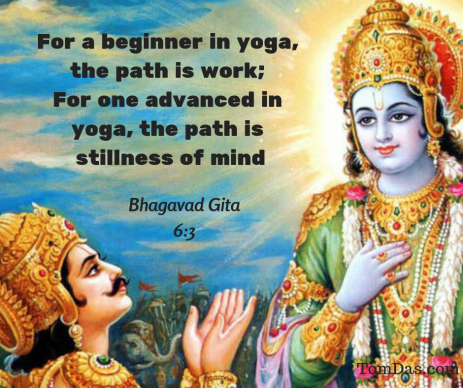
Bhagavad Gita – how to advance in Yoga

Gita the path is stillness.png

In the original Sanskrit, the word translated here as ‘work’ is ‘karma’. In the the preceding chapters Krishna has taught Arjuna about spiritual practice during activities, ie. karma yoga, in which the mind is made calm during activities by various means.

Now, in Chapter 6, Krishna teaches Arjuna that eventually the path of work leads to the path of stillness, and it is through stillness of mind that one advances in yoga. The rest of Chapter 6 explains in more details how this is to be done.

Be still and abide as the Self

Gita step by step he should become still.png

Whilst everything is nothing but the Self and nothing is ever apart from the Self, the Vedanta texts often speak of abiding as the Self.

This means to still the mind so that it is undisturbed and lose any notion of being a separate ‘I’ or ‘me’. Here we just abide as pure consciousness or pure knowingness, devoid of thoughts and phenomena, devoid of egotism.

This is pure ‘knowledge’ beyond knowledge, direct ‘experience’ beyond experiences, the ‘peace’ that passeth all understanding, Silence, beyond words and chatter.

❤️🙏

Question: Hi Tom, I can see that there is no self, but if there is not a doer, what do you do when is time to take a decision that seem to be very important, like calling or not calling a woman you like?

Question: Hi Tom, I can see that there is no self, but if there is not a doer, what do you do when is time to take a decision that seem to be very important, like calling or not calling a woman you like?

Tom: Thinking just happens when it is needed.

You can conceive of it this way: the heart is an organ in the body, and its function is to pump blood around the body. When you exercise, the natural intelligence of the body means that it pumps faster.

Now see the brain and thinking in the same way. The brain is an organ and (one of) its function is to think. When thinking is required, eg. when making a decision, the natural intelligence thinks out a decision based on the information available to it at the time. It happens by itself, as it has always done.

Of course, as with all skills, one can learn to make better decisions, and both learning specific techniques and having experience in making decisions can aid this process.