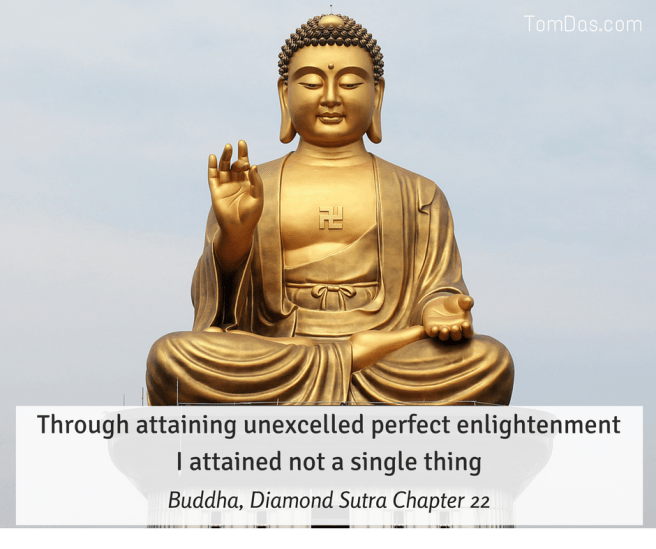
Find more quotes at tomdas.com/quotes/
To join me at one of my meetings see tomdas.com/events/

Question: I find surrender is easier. I want to adopt that path.
Ramana: By whatever path you go, you will have to lose yourself in the One. Surrender is complete only when you reach the stage ‘Thou art all’ and ‘Thy will be done’. The state is not different from jnana (knowledge or understanding).
In soham there is dvaita (duality). In surrender there is advaita (non-duality). In the Reality there is neither dvaita nor advaita, but That which is, is.
Surrender appears easy because people imagine that, once they say with their lips ‘I surrender’ and put their burdens on their Lord, they can be free and do what they like. But the fact is that you can have no likes or dislikes after your surrender and that your will should become completely non-existent, the Lord’s Will taking its place.
Such death of the ego is nothing different from jnana. So by whatever path you may go, you must come to jnana or oneness.
Taken from Day by Day with Bhagavan, p.85
Tom’s comments:
Ramana states that the path of surrender and the path of knowledge (Jnana) lead to the same goal.
They lead us not to some state of duality or non-duality, but to ‘that-which-is’, ie. what is already here. This place is simply what is beyond concepts such as duality or non-duality, or indeed other concepts such as self/no-self, consciousness or even oneness.
He states that Jnana is simply the death of the ego. This is not some knowledge of metaphysics or consciousness, but the loss of the ego-illusion. What is the exact illusion that is lost? It is the loss of the illusion of doership and the self-centred compulsive desires that flow from that illusion. This is what is meant by ‘death of the ego’.
This understanding can be ‘gained’ through the path of surrender, or through self-enquiry: either give yourself to the Lord (surrender) or see that the doer is a fiction (through self-enquiry) and end up with Understanding (Jnana).
❤ Om Namo Bhagavate Sri Ramanaya ❤

In my previous two posts (here and here) I’ve described the aims of the of yoga as being twofold:
Each of these two aims of yoga are there to solve a basic problem. First, as long as you take yourself to be a doer, you suffer. This is corrected with Knowledge as defined above. Note that this Knowledge is not knowledge of something new (additive or positive knowledge) but it is realising something is false (negative knowledge).
And second, as long as you are a slave to compulsive desires, right action (ethical and intelligent action in accordance with natural law or dharma) will not fully manifest, and the flow of the innate natural intelligence will be impeded and distorted by these addictive and compulsive tendencies (vasanas). This is corrected by becoming sattvic (peaceful).
There are many forms of yoga and some can be very technical and detailed. However in general, some yogas work upon the body, others on the breath/voice, and some focus more on the mind. However the main purpose of yoga is to affect the mind, as this is where the core problems described above lie. Those yogas that work primarily upon the body, voice or breath do so in order to directly or indirectly effect the mind to which they are connected.
Each type of yoga strives to achieve the two points mentioned above in a slightly different way. Often there is a conceptual framework within which the yoga operates. When the aim of the yoga has been achieved (ie. by achieving the two points above), then the conceptual framework within which the yoga operated can be dismantled and left behind.
Let’s give a simple example of how concepts, even when false, can aid us. If you want to improve your posture an expert may recommend you imagine a length of string attached to the crown of your head, pulling the top of your head upwards towards the sky/ceiling. When you imagine this, you naturally straighten your posture in line with the visualised imaginary piece of string.
After practicing this for sometime, your posture improved and now you no longer have to imagine a piece of string. At no point did you actually thinks there was a piece of string actually there, but you can see how this concept was useful to correct your posture.
Lets take a look at some of the main traditional forms of yoga to see how this works. In the sections below there are many aspects of the yoga I have not gone into, as the purpose of this text is to demonstrate how yoga can use concepts to achieve the two goals mentioned above, and then the concepts can be thrown away, to be picked up again only when this needs to be taught to someone else.
Jnana means knowledge in Sanskrit, and Jnana Yoga is the Yoga of Knowledge.
In this yoga the concept of Brahman is introduced and is initially equated as being being-consciousness-bliss (sat-chit-ananda). Brahman is initially defined as being our basic sense of presence-awareness and the teachings show this to be (apparently) Unchanging, Ever-Present/Permanent, Eternal, Infinite and Indestructible. This is stark contrast to the subtle and gross objects that appear within it which are ever-changing, temporary, transient, limited and subject to creation and destruction.
The Jnana yogi is taught to identify him/herself as that Unchanging Absolute Brahman and not to identify as the ephemeral objects. Through this process of de-identification with the body-mind and identification with that which does not change, insight into experience occurs.
We start to realise that the body-mind entity that we formerly took ourself to be actually is not us at all. We thought that we we responsible for our thoughts and action, whereas from the point of view of Brahman or Absolute Consciousness, it is seen that there is no doer and the body-mind-entity functions by itself. At this point the doer-entity is seen to be non-existant, and Knowledge as defined above in objective (1) arises.
At this point the essential job of jnana yoga has been completed, and the concepts of Brahman as being an unchanging essence can then be dropped and life goes on, living itself. There is no attachment to concepts such as the relative and absolute or concepts of the infinite, all of which are ultimately unverifiable in our experience.
Incidentally, once the doer has seen to be non-existent, sattva tends to arise over time as the processes that fuel compulsive desires are slowly wiped away, and so objective (2) is also indirectly achieved.
We can see that in Jnana yoga the concept of an Absolute Brahman has been useful to us to serve a purpose. However ultimately we cannot know for sure from our experience alone that there is such as thing as the Absolute Unchanging Brahman. Because Knowledge, ie. seeing through the doer, has occurred, Freedom is innately realised, and concepts are not clung to, and no beliefs are required.
Karma means action in Sanskrit, and Karma Yoga is the Yoga of Action.
There are a few ways karma yoga can be performed according to the traditional scriptures, but one of them is to set up the concept of a personal God, an all-powerful entity that is responsible for everything and every action in the universe. The Karma yogi is taught to realise that it is this God that ultimately has control and not the limited body-mind that it thinks itself to be.
The karma yogi therefore practices gladly accepting everything that comes his or her way as a gift from God, working to the best of their ability, but not being attached to the results of their actions.
As the Karma yogi starts to learn to be happy regardless of what is happening, this has the direct result of eroding away compulsive desires, converting them into non-compulsive desires, and so eventually objective (2) is achieved.
Thereafter, over time, the sense of identification with the body-mind entity loosens and is seen through. It can become apparent to the Karma yogi that actions happen by themselves: thoughts happen by themselves, but there is no thinker, just a spontaneous thought occurring, one by one, in quick succession. Similarly actions happen by themselves: limbs move, lips speak in the same way that dogs bark, leaves rustle and clouds float by – all happens spontaneously, and there is no doer. Here Knowledge arises.
Now the yoga has completed its aims: Freedom has been realised and we are seen to be free from suffering – we are seen to have always been free from suffering and the world. Now we no longer have to worry about concept of an infinite all-powerful personal God that is ultimately unknowable and unverifiable.
Again, the concept of the infinite God, as with the concept of the Unchanging Indestructible Brahman for Jnana yoga, can be seen to have been a useful tool, aiding the seeker to attain Liberation, but now no longer needs to be believed in.
So here are just two examples of how concepts are utilised in yoga to achieve a greater end than perhaps could have been achieved without them.
Remember, don’t cling to concepts, beliefs and ideas. Use them by all means, but when you no longer need them, let them go. Ultimately, stay with what you know, stay with what’s true, question your beliefs, be unafraid to admit if you’re wrong, and don’t pretend to know something you don’t. Keeping to these guidelines will safeguard you from dogma, and the suffering that results from it.
Also see:
How spiritual teachings work
The essence of yoga
The paradox of yoga
Can you know something is infinite?

Just a reminder that I hold meetings weekly, both in London (UK) and online. The next meeting is today (Thursday 24th November 2016). Please see one of the links below for details:
http://www.tomdas.com/events
http://www.meetup.com/Non-duality-Kingston-London

Feel free to substitute ‘Dear Universe’ in place of ‘My Lord’.
Many spiritual teachings talk about the infinite. They talk about the eternal, the everlasting, the unborn, the indestructible, the infinite bliss and that which is limitless. All these are variations on the concept of infinity.
And there are different types of infinity. You can can infinity in terms of the three dimensions of space: infinitely tall or infinitely wide or both, ie. spatially limitless. You can have infinity in terms of time: something that is eternal or lasts forever, or something that has no beginning and is unborn. You can also have infinity in terms of power and knowledge where something is infinitely powerful or infinite in its wisdom. Both power and knowledge operate within space and time, and you can have infinities that apply to many other phenomena within space and time. There are still other types of infinity, but these are more in the realm of mathematics and we can set these aside for the purposes of this post.

Some people use the word infinity in a slightly different way. They say there is the transcendental type of ‘infinity’, that which transcends time and space, that which is timeless, spaceless, that which time and space do not affect. This is different to saying something is infinite in space and time. Instead they are saying this is something in a different dimension, something qualitatively different to space and time. This is not really infinity per se, but a creative use of the word ‘infinity’ to indicate transcendence and something that is unaffected by the forces, energies and rules of what we take to be the world around us.
So the question is, can we actually know something to be infinite? My contention is that you can’t, and I’ll explain why. But before I do, let me say that this doesn’t mean that teachings that talk about infinity are not useful. They often are very useful, but ironically, in my view, their use is limited and ultimately these concepts of infinity can be a prison to keep us trapped. They can keep us from realising our own inherent freedom that is already here and already fully realised because we think that whatever is here and whatever we are is certainly not that great infinite thing spoken of by the sages and texts throughout the ages past and present.
Before I explain why you can’t know if something is infinite, let me briefly explain how these teachings can be useful. Firstly, such grand concepts of infinity can be motivators to start seeking for something more, and can encourage people on their spiritual journey. Secondly, if you are feeling low in some way, eg. low in mood, low in confidence, low in energy, low in inspiration or low in self-esteem (in vedanta teachings this low energy is called tamas or tamo-guna), visions of the infinite, the divine, the omnipotent and the eternal can be hugely uplifting and inspiring. Combined with the message that not only does this divinity exist, but you are also by nature divine, this message has the potential for profound benefit. It can raise the spirits of the depressed and disillusioned and inspire them and give them direction.
In fact in the Bhagavad Gita, in then end of Chapter 1 and start of Chapter 2, the protagonist Arjuna is feeling dejected and tamasic (dull and low). His body is weak and slumped and his limbs are quivering. He is the best archer in the entire universe and he has dropped his bow on the ground. His mind is confused and he is consumed with negative thoughts whirring around his mind, he has lost all idea of what to do and he is completely disillusioned with life. His friend, Krishna, who luckily happens to be a divine incarnation of God, calls Arjuna to pick up his bow, stand up and no longer be confused. How does he do this? Krishna’s first teaching is to tell Arjuna not to worry and inspire Arjuna with a vision of infinity, something that will raise Arjuna’s spirit, something that will motivate and energise Arjuna and take him out of this depression. He teaches Arjuna of ‘THAT’ which is infinite, eternal, indestructible and inconceivable.
If this is where you are, if you are following a teaching that talks of the infinite in some way and is bringing you positivity, energy and joy, then you don’t have to read any further. Continue on your path. If you find that this path is no longer serving you, or if you find you are interested to learn more, then read on.
Infinity is a concept. It’s an idea, born out of the human mind. The human mind has an ability to see things around it and then take aspects of what it sees and alter it. We call it human imagination or creativity. We see something really big, like a tall tree, then we imagine a tree that reaches into the sky, like in the fable of Jack and the Beanstalk. We see a horse and a rhino, and combine elements of each to imagine a creature such as a unicorn. We see death and imagine deathlessness. We see suffering and imagine eternal joy. This is how the concept of infinity is created.
Now let’s come to the basic reason why it’s impossible to know that anything is infinite. Lets take the example of a very very long rope. Imagine you came across such a rope and you had to find out if it was infinitely long or just very very long. How would you do it? You may walk alongside the rope for days and days and see that the rope never ends. You could therefore justly conclude that it is a very very long rope (relatively speaking). However, and here is the crux of the matter, you have no way of knowing that the rope doesn’t end further along. You have no way of knowing that it is infinitely long.
And this is true for all the infinities mentioned at the start of this post. Just by firmly grasping this simple example of the ‘very very’ long rope, you will be able to see why it is impossible to know whether anything is infinite or not.
How can you know something is infinitely powerful or that it will last forever (ie. an infinite amount of time)? Just because it is very very powerful or has lasted a very very long time, doesn’t mean it is infinite in those dimensions. Similarly, just because something has been around for a very very long time or just because you can’t remember something beginning, doesn’t mean it was never born. Maybe it is very very old, but you have no way of knowing if it was infinitely old.
If you think something is infinite in some way, then I would say that’s a belief. Infinity is a concept, and we have no way of knowing if anything infinite actually exists at all.
So far I have only talked about the non-transcendent forms of infinity. The same logic also applies to ‘transcendent infinity’, which as I said before is a creative use of words, as it is not what most people would ordinarily take infinity to mean.
The transcendent form of infinity essentially refers to something that is untouchable, un-stainable and indestructible. It is something that remains constant and unchanging amidst this world of ever-changing things. Again, for the same reasons it’s impossible to know this for sure. You may be able to say that something is relatively permanent or relatively unchanging, like a mountain or the world map, and that has some use, but you can never know for sure that something will never change.
Again, this is not to say that these teachings have no use. If you realise that your awareness/consciousness, for example, is relatively unchanging in that as long as you are in the waking or dream state it is there, this can provide huge amounts of relief and alleviation of suffering. It can also form the basis by which the mind (or subtle body in vedanta, suksma sarira in Sanskrit) can be purified and be released from the bondage of thinking ‘I am a doer’. This is the essential method of many schools of Mahayana and Tibetan Buddhism and also of Shankara’s Advaita Vedanta or Jnana Yoga, and for me was a very liberating teaching on my journey.

In summary, my advice is to take teachings that talk about infinities in any form with a pinch of salt (or perhaps a large dollop of salt, depending on your inclination). Infinity, in all its various guises, can be useful to inspire, motivate and even purify our minds, but ultimately these concepts are not helpful as it is impossible for us to know for sure if they are true. Don’t let these grandiose concepts take you away from acknowledging the Freedom that is already here, right now, in everyday ordinary life.
See that the true teachings are not in elaborate words or clever definitions, but that they are pointing to something that is already present, here and now. The true teachings always eventually point you back to ordinary experience, life as it is.
❤
The other aim of yoga, in addition to seeing through the false concept of being a separate doer-entity described in my previous post, is to remove compulsive desires. When these have been removed, the result is peace of mind which in turn leads to the ending of suffering and moksha (freedom, liberation).
We could classify desires into two types, compulsive and non-compulsive. Compulsive desires are ones that you feel compelled to enact. Your happiness depends upon fulfilling these desires. Non-compulsive desires are ones which you could take or leave. While you may enjoy the consequences of acting out and fulfilling a non-compulsive desire, your sense of happiness and wellbeing does not depend on it. You could call non-compulsive desires preferences.
When a compulsive desire is not fulfilled, suffering is the result. When a non-compulsive desire is not fulfilled, it’s ok. You may have wanted it to pan out a certain way, but it’s fine that it didn’t happen the way you wanted it to.
When compulsive desires have been rooted out, our happiness no longer depends on objects, and the mind becomes peaceful (sattvic).
In the Bhagavad Gita, Krishna repeatedly advises Arjuna to practice yoga. By this Krishna means to practice not minding what happens regardless of the outcome of a situation. In his first lesson to Arjuna on the subject of yoga, Krishna defines yoga as follows, a definition that is often repeated in various ways throughout the text:
So in summary, what is the essence of yoga? Well according to the Bhagavad Gita, yoga essentially means ‘evenness of mind’, or as I put it, not minding what happens. Practice of this leads to having a peaceful (sattvic) mind. All forms of yoga have this sattva and peace as their aim, with the exact methods and mechanisms varying depending on the type of yoga.
Also see:
How yoga works
The paradox of yoga
Ramana Maharshi: The 4 paths to freedom (the 4 yogas)

Lots of spiritual teachers and teachings seem to be saying all there is is consciousness. But is this really true? And even if it was true, would we be able to know this as being true?
Firstly, from the point of view of our experience, yes, everything is consciousness. Whatever you look at, smell, see, touch, feel, think or imagine, etc, appears within your consciousness or awareness. And all these things appear as modulations of that consciousness, so in effect, our entire experience is nothing but consciousness.
Also we cannot directly know or experience anything or go anywhere that is not within our consciousness. If we did then we would, by definition, be conscious of it, and so our experience of it would be consciousness.
Everywhere we go, no matter what we experience, consciousness is, it is always present, effortlessly shining.
So, there we have it. Everything is consciousness. Right? Well…
Just because everything you experience is consciousness, doesn’t mean that everything is consciousness. You see, in one way this is just a play on words. In the way we are using the words, experience and consciousness are synonyms. You cannot have experience without consciousness. If you are conscious you are experiencing. Think about it. Can you have one without the other? So of course, in terms of experience everything is consciousness. But it’s a bit like saying in terms of vision everything is seeing.
You don’t have to be a genius to realise there may be things going on that we are not conscious of, and perhaps we will never be conscious of. From what we know of the universe (via our consciousness!) we know it is vast and complex. Of course all this vastness could be just all happening within our consciousness only, but we don’t know that for sure. It is easily foreseeable that there may exist something beyond our consciousness, something we can never sense (be conscious of) or understand.
From the point of reality, we do not know if all there is is consciousness, and to say that everything is consciousness is going too far. We can only say everything is consciousness in terms of our own experience, but not in terms of reality. If you think that everything is consciousness (and by implication that nothing exists outside of consciouness), I would say that is a belief. Ask yourself, do you know that for sure? How can you know that for sure?
Does this actually matter? If all we experience is consciousness, then does it matter? If there is something beyond consciousness but we are not aware of it, who cares, right? Well, to me at least, it does matter. If you are interested in what’s true it does matter. If you are a spiritual seeker trying to figure this all out and it doesn’t make any sense, then it does matter. If you are interested in seeing through all false beliefs and discovering a genuine freedom, then yes, it does matter. And if you are interested in science and reducing human suffering through technology based on scientific discoveries, then yes, it does matter.
False beliefs breed suffering as they inevitability conflict with what is true, and false beliefs impede genuine philosophical, ethical and scientific inquiry. Beliefs like this affect how we approach and respond to life and how we treat each other. It affects the philosophical basis upon which scientific progress is made, and so it can affect the technologies we develop and how we develop them. The overall result of clinging to false beliefs is to the detriment of us as individuals and our society at large.
So, back to consciousness. Does that mean that not everything is consciousness? No! Perhaps everything is consciousness! Perhaps it isn’t. The point is that we do not know. Everything may or may not be consciousness. We don’t know. It’s actually a scientific question and we currently don’t have the evidence either way. It may be impossible to know, as how would you know that there is nothing beyond consciousness?
The point is we should be honest, with ourselves and each other, and not cling to beliefs unnecessarily and unknowingly. Whilst beliefs can be used to make us feel better and give us strength during hard times, clinging to them and thinking they are definately true and that we are definately right causes more suffering in the long term, both for us and often for those around us.
Ironically, yes. Even though ultimately we don’t know, the teaching that everything is consciousness can still be useful. How so? Well the teachings aim to undermine the belief in a separate self, or the notion of being an independent doer-entity, and in that regard this philosophical idealism of everything being consciousness can be useful. The idea is that the teaching is an antidote to a fixed belief. More on how that works here. The key is that once the job of the conceptual teaching is done, we don’t cling to this new concept which simply becomes a new problem and a new way of perpetuating the ego.
The consciousness teachings or awareness teachings, as I call them, can also point to a still-point in our experience that is always present, at least whilst we are awake. It is that which never changes and is always ever-present, un-touched and ever-aware. Recognising this aspect of our being can be very liberating and can give us the emotional security to open up to our thoughts and feelings, and allow our emotional-spiritual hearts to open, and can allow us to feel happier and whole.
So if we don’t know whether or not everything is consciousness, what do we do now? A part of Freedom, which is already here, is that everything is allowed. It’s ok to not know. That’s ok. There are lots of things we do not know, many things we will never know, and probably many things that are impossible for us to know. Freedom doesn’t mind. It’s just the way things are.
❤
 Tom Das