So I’ve just started using twitter…@tomdas

Hi everyone,

So I’ve decided to try to embrace social media and think I’ve got this twitter thing sorted out. Well, the basics at least anyway 🙂  Are any of you out there on Twitter? Please let me know or find me @tomdas. I’m regularly tweeting for now – let’s see how long it lasts for! Do you use twitter? What’s your experience of social media been?

I’ve also used a wordpress widget to add a twitter feed to the sidebar – please let me know if there are better ways I can use social media or twitter, etc, many thanks

Love, peace and joy to you all

❤ ❤ ❤

God is everywhere

Maple leaf on stones.jpg

God is everywhere

– where is She not?

All there is is God. It is not right to say God is in all things, for that implies a duality between things and God. It is not right to say God is in you, for that implies you are a container for God and different to God.

There are no things, only God. The idea of separate things is illusory. There is just an interconnected whole. Call this wholeness God, or Life, or The Great Spirit, or anything you like. There is no room for anything else. Only God. No ‘you’, no ‘I’, just ‘Him’.

Is there even a single particle where ‘She’ is not? (Is She not omnipresent and infinite?)

Everything moves and has its being in Him. Everything that moves and has being (exists) is also Him.

All there is is God. All is God.


The Drama

Here’s an article I wrote for naturalhealthstar.com about the stories we tell and how to deal with ‘drama’:

www.naturalhealthstar.com/general-wellness/the-drama/

[Update: the above link no longer works so I have posted the article in full below:]

I remember a great piece of advice a friend gave to me: “Drama” she said “Don’t go there. Just don’t go there. Always stay out of the drama!”.

And it was good advice. Another word that could have been used instead of drama is the word story. It’s easy to get caught up in someone else’s story or narrative. We often tell each other stories: in our interpersonal relationship, in the workplace and in the media where it is often exaggerated as spin. I’ve seen so many relationship issues that are caused by the stories people tell about each other. There is the story of blame, the how could she/he do that to me story. There is the you are a bad person story. There is the I am a bad person story, the nobody could like/love me story and the once I get promoted I’ll be happy story. Of course you could replace promoted with a few hundred other things. There is the story of victimhood , the story of perpetration, and the story of being a helper or rescuer.  I could go on.

Now, that is not to say that there are never perpetrators or victims, or that people are never to blame. There clearly are victims sometimes and sometimes people are incompetent and need to be held responsible for their actions. But being a victim, for example, is different to the drama or story of victimhood. These stories we so often tell ourselves and each other serve no useful purpose, but we can sometimes feel a sense of strength and certainty when we cling to them.

Who would we be without those stories? Would people walk all over me? Would anyone pay any attention to me? Would anyone love me?

Are any of these stories true? If so, where is the evidence, and if there evidence then is this evidence just another story? (Maybe it isn’t a story – only you know the correct answers to these questions)

So let me ask you: who would you be without your stories? Can you spot the times that you enter into other people stories about you and, for example, start to defend yourself? What stories do you tell about other people? What stories do you have about yourself?

Roadmap to enlightenment: a (fairly) comprehensive guide to spiritual practices

This is one of a series of introductory articles – please see the homepage of tomdas.com for more introductory articles. Also see:

In Brief: how to attain Liberation

The entire path explained: the Path of Sri Ramana (Parts 1 and 2; PDF downloads)

This is one of the most important posts I have written – it condenses years of spiritual seeking which has involved exploring dozens of spiritual teachings, reading hundreds of books and texts from spiritual teachers and spiritual traditions across the world, undergoing all sorts of spiritual practices and meditations over the years, entering samadhi’s and experiencing visions of infinite oneness, and a genuine realisation of the Freedom-that-already-is.

The aim of the post is to guide you to a Freedom beyond words, but also stay concise. For all those people who have asked me: ‘That’s all very well but how do I actually become enlightened? How can we free ourselves from suffering? What do we do?’, this is for you, and others like you.

Continue reading

Nisargadatta Maharaj: Ignore your thoughts

Nisargadatta_Maharaj

“It is the mind that tells you that the mind is there. Don’t be deceived. All the endless arguments about the mind are produced by the mind itself, for its own protection, continuation and expansion. It is the blank refusal to consider the convolutions and convulsions of the mind that can take you beyond it.”

Nisargadatta Maharaj, I Am That

My comments:

The word ‘mind’ in the above quote is synonymous with the false sense of individual separate self. This self, this ‘I’, is just a notion, an idea reinforced by the mind. The ‘I’ is a thought, and it is reinforced by thoughts.

Trying to figure this all out (ie. more thought) is a function of the same mind that is ultimately false, imaginary: it is a fruitless endeavour.

A particularly effective sadhana (spiritual practice) is to ignore the content of thoughts as they appear within our consciousness. The energy of the sense of ‘I’ then begins to loosen and its mechanics are exposed and revealed. We can then start to see things as they actually are.

There are broadly two ways this can be done:

1) by concentrating on something else such as a mantra, the breath, or by chanting, etc – ie. a distraction from thoughts;

2) by allowing thoughts to wash past you like clouds in the sky, and in so doing not paying attention to the content of thoughts, eg. a surrender, acceptance, gratitude or mindfulness practice.

When looking for a sadhana, you will naturally be able to find the one that works for you by looking to see which one gives you greatest sense of peace and relief, and by seeing which practice you are naturally inclined towards.

For more about spiritual practices and how they work click here

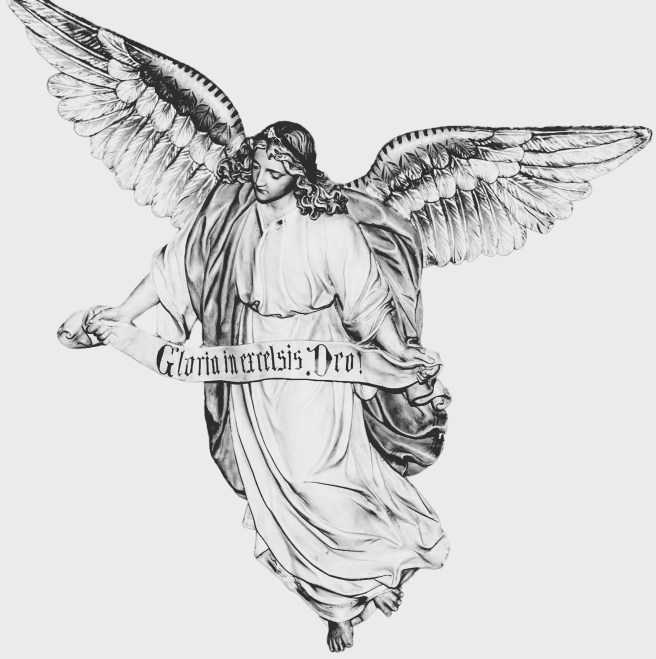
A Christmas message: was Jesus ever Born?

Glorio in excelsis deo.jpg

The true light that gives light to everyone was coming into the world. He was [already] in the world, and though the world was made through him, the world did not recognize him.
John 1:9-10

Christmas is meant to be about celebrating the birth of Jesus, and the above bible verse tells of his coming. But was Jesus ever born? I’m not asking whether or not he existed, I’m asking was Jesus an entity that was born into this world, or was Jesus something else?

In John’s gospel the opening chapter proclaims the coming birth of Jesus Christ. But in verse 10 (above) it clearly states that Jesus already existed prior to his birth, and prior to the existence of the world: he was already in the world, the world was made through him, but the world knew him not.

This is not referring to the human Jesus made of flesh and blood, but something else, something deeper, more subtle, more universal and more potent. This Christ is the True Light, as per verse 9 above, the deeper essence of Christ. A few chapters later in John’s Gospel Jesus himself testifies that he was never born:

Jesus said to them, “Truly, truly, I say to you, before Abraham was, I am.”
John 8:58

Note, Jesus doesn’t say ‘I was’, he says ‘I AM‘, again indicating he is and always has been beyond the notion of time. Anyone who has studied vedanta and other spiritual traditions would be familiar with similar sayings espoused by countless sages in ages gone past.

Jesus is not identifying himself as the body-mind entity, but as the Absolute, the Father, the unborn, that which always IS, that which is never not.

So here’s to wishing you all a very Merry Christmas, and when we come together to celebrate Jesus’s birth, let us remember the deeper import of Jesus’s teachings: to be with the Father, the Absolute, that to which we are all slaves whether we know it or not.

“Teacher, which is the great commandment in the Law?” And he [Jesus] said to him, “You shall love the Lord your God with all your heart and with all your soul and with all your mind.This is the greatest and first commandment.”
Matthew 22:36-38

And it is in discovering this slavery that we actually ‘become’ free.

So Jesus said to them, “Truly, truly, I say to you, the Son can do nothing of his own accord, but only what he sees the Father doing. For whatever the Father does, that the Son does likewise.”
John 5:19

Merry Christmas everyone!!!

❤ ❤ ❤

Direct ‘perception’

landscape-192987_1280.jpg

The mind cannot get this,
Just as it cannot deduce the existence of a tree.

The tree is perceived directly,
This is perceived directly.
Whatever is perceived is this.

Perception is just an idea,
That implies the existence of a perceiver,
A perceiver with some physiological apparatus.

There is no experience of perception,
Only an inference,
An inference based on the idea of a perceiver,
For which there is no direct evidence.

So,
There is only this,
Just this.

Perception is just another name
For our experience of life,
ie. this

Life,
Naked,
Is without conceptual overlay.

Unadorned,
It adorns itself,
creating its own beauty.

Life,
Unadorned by concepts,
But including concepts as they rise and fall:
– No thinker can be found.

Forget words, definitions, theories and beliefs:
– They are all useless here;
Just more conceptual overlay:
– It could all be entirely mistaken.

Dzogchen: Self-liberation in the fundamental nature

supreme-source

Here are some more verses from the Kunjed Gyalpo (The Supreme Source), one of the most important texts in Tibetan Buddhism and Dzogchen. These words point the reader directly towards Enlightenment. See my earlier posts on the Kunjed Gyalpo here and here.

In the except below the first section initially directs us to listen to these teachings and realise the inherent liberation that is already present ‘without needing to alter anything’.

The second section indicates there is no need for special practices, or to speak or act in a particular way in order to get this.

In fact, as per the third section below, in trying to find your ‘authentic condition’ (which is self-liberation), you deny it and prevent liberation manifesting itself.

Listen!
As I am in the authentic condition,
all phenomena self-liberate in the fundamental nature.
Without needing to alter anything,
the teacher self-liberates in the fundamental nature.
Without needing to alter anything,
the teacher self-liberates in the fundamental nature.
Without needing to alter anything,
the retinue of disciples, too, self-liberates in the fundamental nature.

Listen!
As all self-liberates,
there is no need to correct the body posture or visualise a deity.
There is no need to correct the voice or speech.
There is no need to correct the mind through meditation.

By correcting oneself,
it is not possible to find the authentic condition,
and without finding the authentic condition,
one cannot self-liberate.
In this way one does not achieve the state of equality of the fundamental nature.

Excerpt from The Supreme Source (Kunjed Gyalpo), Chapter 29

So, what are we to do? We are essentially told that ‘you are already realised’ or ‘you are already whole’, but perhaps we don’t feel realised or whole.

We are told that no practice can take us to where we already are, but then what do we do?

The Kunjed Gyalpo exhorts us to listen to these teachings, absorb them, and see their truth directly!

But how to do this, the spiritual seeker asks.

There is no how, for in asking how you have already posited and given reality to the separate self that is looking for answer, that is looking to get somewhere. By asking how, there is already the implication that this is not it. But this is it!

The Supreme Truth and the way to it cannot be described. Only wrong ways can be described, hence the language is of negation – ‘no need to correct’….’By correcting oneself…one does not achieve’. The scripture tells us what not to do, not what to do.

The ancient method is to first listen (sravana) to the teachings repeatedly, then secondly to contemplate them and think them over (manana). This helps to develop an intellectual understanding of the teachings first, following which meditation and integration of the teachings (nididhyasana) can occur. This can occur gradually, or perhaps suddenly, without warning, a moment of clear seeing arises and the teachings that were once theoretical suddenly spring to life.