The following is written by Sri Sadhu Om, a direct devotee of Sri Ramana Maharshi’s, and is taken from the text ‘The Path of Sri Ramana – Part 1’, from one of the footnotes in Chapter 7. You can download the entire text for free here – it is a wonderful and rare text that explains the entire path to liberation. Please also see recommended reading for liberation here as well as the introductory articles on the homepage for more.
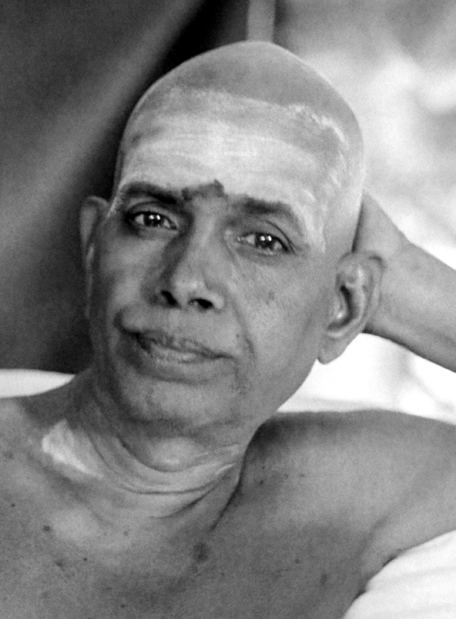
The practice of witnessing thoughts and events, which is much recommended nowadays by lecturers and writers, was never even in the least recommended by Sri Bhagavan, Indeed, whenever He was asked what should be done when thoughts rise (that is, when attention is diverted towards second or third persons) during sadhana, He always replied in the same manner as He had done to Sri Sivaprakasam Pillai in ‘Who am I?’, where He says:
“If other thoughts rise, one should, without attempting to complete them, enquire ‘To whom did they rise?’. What does it matter however many thoughts rise? At the very moment that each thought rises, if one vigilantly enquires ‘To whom did this rise ?’, it will be known ‘To me’. If one then enquires ‘Who am I?’, the mind (our power of attention) will turn back (from the thought) to its source (Self)”.
Moreover, when He says later in the same work, “Not attending to what-is-other (that is, to any second or third person) is non-attachment (vairagya) or desirelessness (nirasa)”, we should clearly understand that attending to (witnessing, watching, observing or seeing) anything other than Self is itself attachment, and when we understand thus we will realize how meaningless and impractical are such instructions as ‘Watch all thoughts and events with detachment’ or ‘Witness your thoughts, but be not attached to them’, which are taught by the so-called gurus of the present day.
————
Tom: The following excerpt is also taken from the same chapter, chapter 7, of The Path of Sri Ramana – Part 1:
Since, whether we know it or not, Self, which is now wrongly considered by us to be unknown, is verily our reality, the very nature of our (the Supreme Self’s) attention itself is Grace (anugraha). This means that whatever thing we attend to, witness*, observe or look at, that thing is nourished and will flourish, being blessed by Grace…
…Hence, when the power of attention of the mind is directed more and more towards second and third person objects, both the strength (kriya-bala) to attend to those objects and the ignorance – the five sense-knowledges in the form of thoughts about them – will grow more and more, and will never subside! Have we not already said that all our thoughts are nothing but attention paid to second and third person objects? Accordingly, the more we attend to the mind, the thoughts which are the forms (the second and third person objects) of the world, the more they will multiply and be nourished. This is indeed an obstacle. The more our attention – the glance of Grace (anugraha-drishti) – falls on it, the more the mind’s wavering nature and its ascendancy will increase. That is why it is impossible for the mind to negate anything by thinking ‘I am not this, I am not this’ (neti, neti). (Footnote to text here: This is why aspirants who, in order to destroy evil thoughts like lust, anger and so on, fight against them and thereby think about them fail in their attempts, while aspirants practising Self-enquiry, who pay their full attention to Self with an indifference towards their thoughts, bypass them easily)
On the other hand, if our (Self’s) attention is directed only towards ourself, our knowledge of our existence alone is nourished, and since the mind is not attended to, it is deprived of its strength, the support of our Grace. “Without use when left to stay, iron and mischief rust away” – in accordance with this Tamil proverb, since they are not attended to, all the ‘vasana-seeds, whose nature is to rise stealthily and mischievously, have to stay quiet, and thus they dry up like seeds deprived of water and become too weak to sprout out into thought-plants. Then, when the fire of Self-knowledge (jnana) blazes forth, these tendencies (vasanas), like well-dried firewood, become a prey to it.
This alone is how the total destruction of all tendencies (vasanakshaya) is effected.
 Tom Das