The Story of the Daoist / Taoist Farmer
As mentioned in Satsang last week:
Ashtavakra Gita – all is illusion, I am the Self
Please listen to the video below, namaste

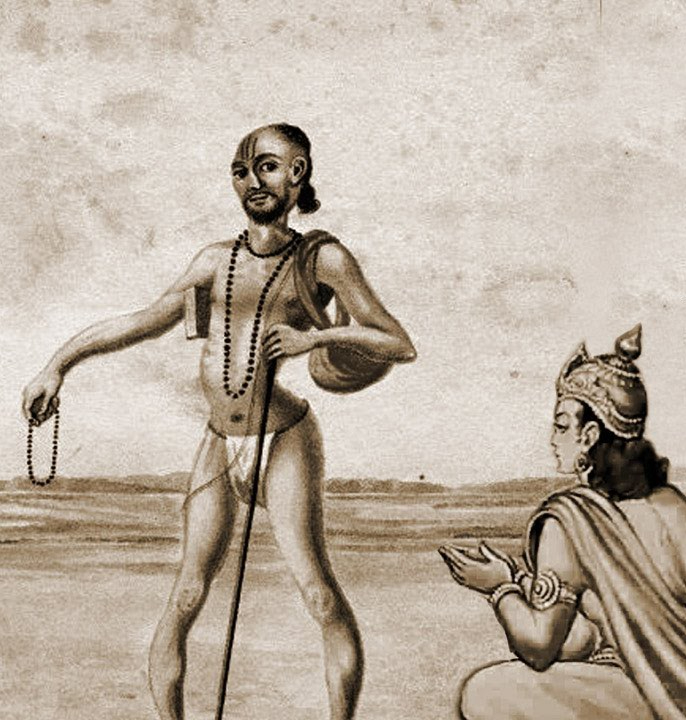
The following verses are read on this video here (a couple of the verses are in a slightly different order):
Sage Ashtavakra, the young boy with contorted limbs, teaches King Janaka, and the result is the Song of Ashtavakra, or Ashtavakra Gita. Here are some selected verses, enjoy:
2.1. Oh, I am spotless, tranquil, Pure Consciousness, and beyond Nature. All this time I have been mocked by illusion.
Tom – Now the triad of knower/knowing/known are said not to exist. Note that this triad essentially encompasses all arising or objective phenomena:
2.15. Knowledge, knower and the known –these three do not exist in reality. I am that stainless Self in which this triad appears through ignorance.
Tom – here the remedy is prescribed:
2.16. Oh, the root of misery is duality. There is no other remedy for it except the realisation of the unreality of all objects…
View original post 832 more words
Isn’t all ONE ALREADY? So why seek the SUBJECT?
Sattvic, Rajasic and Tamasic Spirituality | Sri Ramakrishna Paramhamsa
(Understanding this can be a great help on the spiritual journey, my comments are in red)
Question. What is the difference between the Sattvic, the Rajasic and the Tamasic ways of worship?
Sri Ramakrishna:
The man who worships from the very depth of his heart without the least ostentation or vanity is a Sattvic worshipper.
Tom: the sattvic (peaceful) worshiper is the highest form of worshiper, pure of heart and of intent. They do not make a great grand show of their spirituality and care not for outer forms, unlike the rajasic one:
The man who gives much attention to decorating his house, makes much fuss about music and dancing, and makes all costly and elaborate arrangements for a rich feast when celebrating the worship of the Deity, is a Rajasic worshipper.
Tom: the rajasic (passionate) worshipper tends to be concerned more about appearances, pleasure and activity. They may pay great attention to decoration, dress, ceremony, outward appearance and what others think of them. They may tend to wear spiritual-looking clothes and have spiritual-looking paraphenalia and accesories and make a show of spiritual-looking rituals. They may look and sound more spiritual than they actually are. Still lower than them is the tamasic one:
The man who immolates hundreds of innocent goats and sheep on the altar, has dishes of meat and wine for offerings, and is absorbed only in dancing and singing while conducting worship, is a Tamasic worshipper.
Tom: The tamasic (dull) one here is essentially shows to be a hedonist, one who is interested in sense-pleasures and, for this end, they are willing to abuse their own body (eg. with excessive food and wine) and engage in immoral activity (eg. the unnecessary slaughtering of animals) in order to satisfy their wants and apetites.
~ Sayings of Sri Ramakrishna no. 239
——–
Tom: whilst the above may perhaps sound judgemental, I think it is better not to think of it in this way: we can instead see them as descriptions of stages of spiritual growth that many of us often go though, and each stage often has a role to play:
eg. in the tamasic stage, we are often dealing with supressed emotional pain and trauma, in the rajasic stage we are often developing self-esteem and self-worth, and in the sattvic stage we are learning to be more peaceful and pure, perhaps having already healed ourself of many of our psychological traumas and developed a healthy sense of self-esteem.
We can also use this as a way to guage where spiritual teachers/groups/teachings themselves are – are they sharing a tamasic, rajasic or sattvic type of spirituality?
These 3 (sattva, rajas and sattva) are known as the 3 energies of Maya or the 3 gunas.
Have you found this teaching to be helpful for you? Please leave a comment to let me know…
Also see:
The three energies (three Gunas)
A True Teacher Doesn’t Foster Dependence | The Three Gunas | Shedding Negative Self-Concepts
Q. I genuinely understand the teachings but still egoic tendencies arise. What can I do?
How to meditate for spiritual enlightenment
Meditation can serve many purposes: increased happiness, improved concentration and academic performance, clarity and insight into everyday issues, improved health and sleep, etc. This article’s meditation will likely help with all or most of these, but the end goal is none of the above. The goal here is total freedom, enlightenment, nirvana or moksha (all are used as synonyms here). I have included some Sanskrit words in brackets in case you are interested.
Contemplate this
No object, gross or subtle, can lead to lasting fulfillment.
I recommend you contemplate deeply on this.
For most of us, after a little contemplation, this becomes obvious to us. However,we can go further: if we continue on this contemplation, we can start to realise that even seeking momentary pleasure or momentary fulfillment in objects is a cause of suffering. Subtlely, we still believe that our fulfillment lies in obtaining contact with the objects of…
View original post 1,712 more words
Q. How to recognise a True Spiritual Teacher?
Tom: If we are honest with ourselves and earnest in our desire for freedom, we will only find the teacher/teaching that is right for us at any one particular time. We will only be able to discern the true teacher according to the wisdom that is flowing through us, which is inversely proportional to the strength of our ego-mind. However, more important than the teacher is the seeker – as long as your heart is pure and you are discerning, open and self-honest, then you will certainly find your way 
Spend time in Reality, not in Illusion
(As much as you are able to)
Spend time in Reality,
Not in illusion.
_________________________
*Reality: Unchanging & Unmoving Silence, Stillness, Formless Objectless Consciousness-Being-Love-Bliss-Awareness devoid of body-mind-world. ie. Attending to the Subject-Self
*Illusion: Maya, the three states, name and form, identifying as a body-mind living in a world. ie. Attending to name & form & objects.
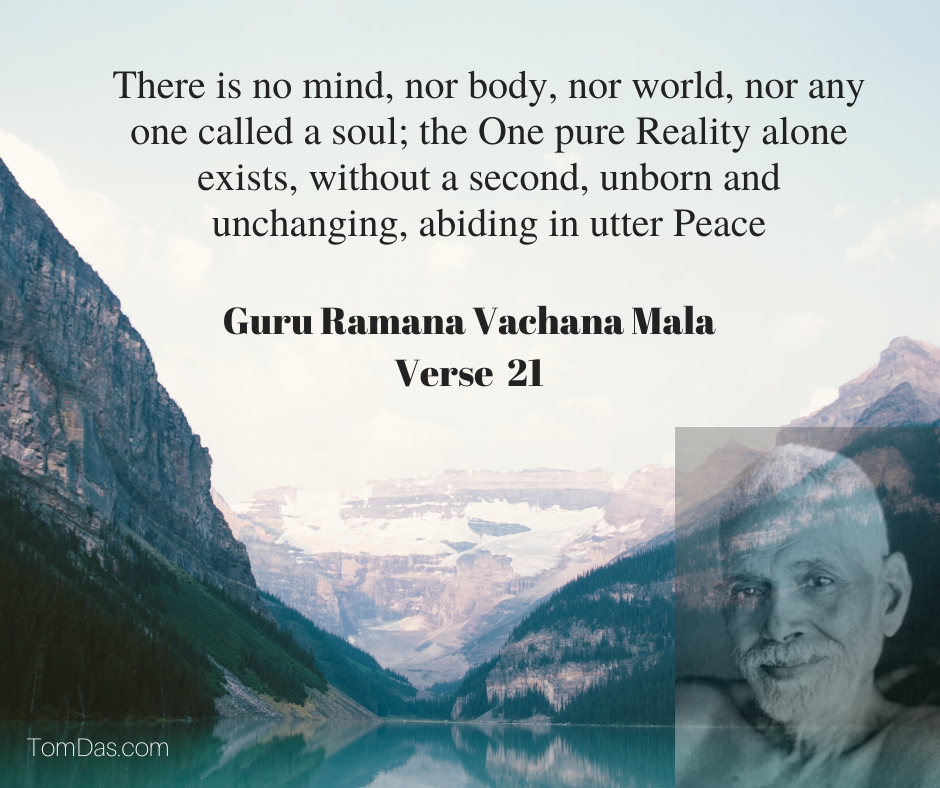
No body, no mind, no world
All that which is seen or perceived is an utter illusion. In reality there is no body, no mind and no world. There is only the One Formless Blissful Reality and You Are That. This must be discovered for oneself. The Reality, That which you ARE, which is unseen, is often overlooked, ignored.
When this is pointed out, those overly-attached to their individuality – ie. those overly attached to the notion of being a particular body-mind and their worldly life – they may cite this as being an offensive, impractical or life-denying teaching. In doing this they miss the Eternal Life of Unending Bliss!
But do not concern yourself with all of this: of course, this is all part of the illusion, the dream…Have faith in Bhagavan Sri Ramana and His Teachings and His Grace…press on with your Sadhana!
Piercing the veil of illusion
When the mind starts to become profoundly still, and starts to shake off the notion ‘I am a body-mind, I am a person’, then not only does deep Bliss-Oneness-Love start to arise and the sense of individuality wane, but the intuition-seeing occurs that all of these things we perceive – such as body, mind and world – all of these are intuited-seen-perceived to be just a mere dancing of thought, a mere projection of mind-stuff, like a dream: empty, unreal, illusory, nothing more.
As thoughts markedly and profoundly slow down, all this comes to be seen directly.
 Tom Das