Q. We are all connected, like buds on a rosebush are all connected. And when a rosebud blooms, we do not state “there is no rosebud, there is no bloom.” And yet, you seem intent on denying the flowering of your own local focal point of consciousness. You are an individual viewpoint for the Cosmic Consciousness (aka Brahma). Like a rosebud, you have bloomed.
I understand that awakening is unlike an academic or professional accomplishment. It’s not something that you have printed out on a sheepskin and get framed and hang on your wall. It’s not something to brag about. Its not something to check off on your spiritual “bucket list.” But to deny that the mind/body combination known as Tom Das has had his awakening to oneness makes as much sense as denying that a rosebud has opened and is in full bloom. Those Satsangs that you share with the world as part of your Sadhana are you sharing the fragrance of truth. What purpose does denying your awakening have?
Tom: I know it may appear that Tom Das has awakened, etc, but actually Tom Das is just an appearance, nothing. There is no-one here that knows anything, although it may appear that way within the waking dream. The ‘me’ identifies itself & believes itself to be a body-mind entity and projects that identity onto others, and so believes that Tom Das or whoever has ‘woken up’. But this is all part of the apparent dream. I agree there is no point denying the appearance (I do appear to be Tom Das), but it is empty and non-significant with respect to liberation/non-duality. The scriptures have tried to explain this in many ways, I will try to find you a few quotes…Namaste
Q. The thing here is… we (Brahma) incarnated on this planet as 7.4 billion people and countless animals and plants and the planet itself. Brahma chose to be us, in different bodies and different personalities and different life stories and ultimately, these bodies and personal identities will end, but while we are incarnated in our current forms, are we not looking for the “middle path” as we make our way through the world? We are individually and collectively Brahma and Atman simultaneously.
I understand and fully comprehend everything that Sri Ramana Maharishi is saying [in these quotes] . But I get the sense that you are inviting people to abandon their egoic sense of self (Atman) in favor of identifying as Brahma. The middle path IMHO is when one can hold both illusions (or ultimate truths depending upon your perspective) in mind simultaneously. When you are at work and a patient or coworker says “Dr. Tom Das” you don’t ignore them or say something confusing like “I am not this body, I am not this name, I am pure conscious awareness disguised in human form” you go ahead and answer to your name. You and other people who have experienced awakening and not ended up in a no-self dissociative state continue to have an ego. It’s how you and everyone else navigates this world. I don’t find it particularly useful to deny the continued existence of this ego.
You ARE Tom Das and simultaneously, you ARE everyone and everything and everywhere and everywhen. I don’t see the Atman / Brahman as an either/or decision. It’s NOT a case of mutually exclusive choices. We can and ideally are a mixture of both. Deny the existence of Tom Das all you want but you will still answer to your name and show up and fulfill your roles in life and at work. Repeated denials that you are Tom Das seem even sillier than an actor on the stage repeatedly telling the audience “I am not really Hamlet.”
Tom: I agree it is not about abandoning one view for another – that is more duality, more ego, more ‘me’. What you have written is also not the middle way, which is about not being attached to any conceptions of self, at least according to Nagarjuna.
The teachings, as I have explained before, are pointers that tend to aim at removing ignorance, not truths.
The view you are advocating is called Vashisthadvaita in the Vedic texts in which multiplicity is acknowledged to co-exist with Brahman, whereas the views coming from myself and Ramana in the above quotes are advaita (no multiplicity) at times and ajata (no creation) at other times. Traditionally the non-dual teachings proceed from dvaita (duality) to vashisthadvaita, to advaita to ajata, so you will find all 4 types of expressions in the scriptures and from the sages.
Traditionally the non-dual teachings proceed from dvaita (duality) to vashisthadvaita, to advaita to ajata, so you will find all 4 types of expressions in the scriptures and from the sages.
The first 2 of the views (Dvaita and Vashisthadvaita) can be understood by the mind and seem to make sense within the subject-object reality that is imagined to be real by the ‘me’ or ‘ego’. The fact that they are understandable and they do somewhat relieve suffering makes them valuable teachings to the seeker (ego), whereas Advaita and Ajata cannot be comprehended by the mind and makes no sense to the mind which only can think in terms of subject-object.
If everyone thinks an actor is only Hamlet, and they don’t realise he is an actor playing the role, the teaching ‘I am not Hamlet’ becomes more important, which is why these teachings tend to be emphasised. You could say I appear to be Tom Das, and there is no need to deny this, but in reality there is only the Inexpressible This.
Often people think that someone wakes up, someone becomes enlightened, that enlightenment somehow belongs to a person. Although this is how it often seems, this is not quite how it works. It may appear that Tom Das or whomever has awakened, etc, but actually Tom Das is just an appearance, nothing.
There is no-one here that knows anything, although it may appear that way within the waking dream.
The ‘me’ thinks itself to be an individual and projects that individuality onto others. The ‘me’ identifies itself and believes itself to be a body-mind entity and so believes that Tom Das or whoever has ‘woken up’. But this is all part of the apparent dream of ‘me’ (ignorance or ajnana in Sanskrit).
What happens in the appearance is in essence empty and non-significant with respect to liberation/non-duality. The sages and scriptures have tried to explain this in many ways.
Below are a few quotes, all from Ramana Maharshi, where he tries to explain how the Jnani (‘liberated sage’, so to speak) is not a person and there is only That.
In the quotes you will see the words jnani/jnana and ajnani/ajnana. The word jnani (lit. knower) refers to a liberated sage – this is only a term used as a way of expressing non-duality – there is no liberated sage in reality, only in the eyes of the ignorant (ajnani, lit. one who does not know).
The word ajnana means ignorance, and someone who is ignorant is termed an ajnani, what I have called the ‘me’ above. In reality there is no ajnana and no ajnani – that is just how it appears, but the appearance is not real.
Here are the quotes from Bhagavan Sri Ramana Maharshi:
Q: I see you doing things. How can you say that you never perform actions?
Ramana Maharshi: The radio sings and speaks, but if you open it you will find no one inside. Similarly, my existence is like the space; though this body speaks like the radio, there is no one inside as a doer.
Q: I find this hard to understand. Could you please elaborate on this?
Ramana Maharshi: Various illustrations are given in books to enable us to understand how the jnani can live and act without the mind, although living and acting require the use of the mind…. It is hard to understand how this is possible…These explanations are for the onlookers who think of the jnani as one with a body and cannot help identifying him with his body.
An ajnani sees someone as a jnani and identifies him with the body. Because he does not know the Self and mistakes his body for the Self, he extends the same mistake to the state of the jnani. The jnani is therefore considered to be the physical frame.
Again since the ajnani, though he is not the doer, imagines himself to be the doer and considers the actions of the body his own, he thinks the jnani to be similarly acting when the body is active.
The jnani sees nothing separate from the Self. The Self is all shining and only pure jnana. So there is no ajnana [ignorance] in his sight.
In the ignorant state one superimposes one’s ignorance on a jnani and mistakes him for a doer.
There is an illustration for this kind of illusion or superimposition. Two friends went to sleep side by side. One of them dreamt that both of them had gone on a long journey and that they had had strange experiences. On waking up he recapitulated them and asked his friend if it was not so. The other one simply ridiculed him saying that it was only his dream and could not affect the other. So it is with the ajnani who superimposes his illusory ideas on others.
Q: There are said to be sadeha mukta (liberated while still in the body) and videha mukta [liberated at the time of death].
Ramana Maharshi: There is no liberation, and where are muktas [the liberated]?
The Self alone is and nothing else. However it is differentiated owing to ignorance.
The existence of the ego in any form, either in the jnani or ajnani, is itself an experience. But to the ajnani who is deluded into thinking that the waking state and the world are real, the ego also appears to be real. Since he sees the jnani act like other individuals, he feels constrained to posit some notion of individuality with reference to the jnani also.
Q: As the bodies and the selves animating them are everywhere actually observed to be innumerable how can it be said that the Self is only one?
Ramana Maharshi: If the idea `I am the body’ is accepted, the selves are multiple. The state in which this idea vanishes is the Self since in that state there are no other objects.
The reality which shines fully, without misery and without a body…
Since the body itself does not exist in the natural outlook of the real Self, but only in the extroverted outlook of the mind which is deluded by the power of illusion, to call Self, the space of consciousness, dehi [the possessor of the body] is wrong.
The jnani knows he is the Self and that nothing, neither his body nor anything else, exists but the Self.
It is false to speak of realization. What is there to realize?
Q: What are the fundamental tests for discovering men of great spirituality, since some are reported to behave like insane people?
Ramana Maharshi: The jnani’s mind is known only to the jnani. One must be a jnani oneself in order to understand another jnani….His words or actions or appearance are no indication of his greatness, for they are ordinarily beyond the comprehension of common people.
Q: You are Bhagavan. So you should know when I shall get jnana. Tell me when I shall be a jnani.
Ramana Maharshi: If I am Bhagavan there is no one besides the Self – therefore no jnani or ajnani.
Coming here, some people do not ask about themselves. They ask: `Does the jivan mukta see the world ? Is he affected by karma? What is liberation after being disembodied ? Is one liberated only after being disembodied or even while alive in the body ? Should the body of the sage resolve itself in light or disappear from view in any other manner? Can he be liberated though the body is left behind as a corpse?’ Their questions are endless. Why worry oneself in so many ways? Does liberation consist in knowing these things?
Actually, the idea of the Self being the witness is only in the mind; it is not the absolute truth of the Self. Witnessing is relative to objects witnessed. Both the witness and his object are mental creations.
Q: How did the knower come?
Ramana Maharshi: On account of the error of perception. In fact the knower and his misperceptions appear simultaneously, and when the knowledge of the Self is obtained, they disappear simultaneously.
Just as in a dream a false knowledge, knower and known rise up, in the waking state the same process operates…Whatever you see happening in the waking state happens only to the knower, and since the knower is unreal, nothing in fact ever happens.
I am That,
That Awareness,
That unchanging eternal Consciousness,
That which is intrinsically different to and untouched by the myriad phenomena of body-mind-and-world,
That which does nothing, but in whose presence all is done,
That which is beyond the grasp of the fickle mind,
That which is beyond all experiences of bliss and suffering,
That which can never be known,
But always IS.
Yet all this is Me,
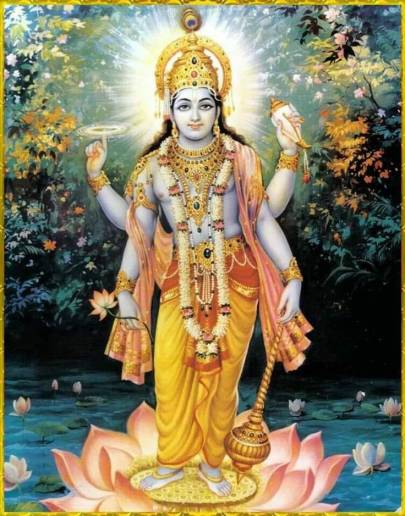
The all-pervading Vishnu,
Benevolently smiling,
Radiant with Blissful Love,
Protecting all,
Loving all and everything,
Encompassing all,
One with all phenomena,
Clear,
Pure,
The nature of Love,
Beauty itself,
Worthy of Ceaseless Devotion and Gratitude,
Self-shining,
Bright and ever-whole,
Ever-pristine and peaceful,
Always intuitively known by simply BEING,
Effortlessly present and ever-free.
The the following talks, Bhagavan Sri Ramana Maharshi outlines a very simple but powerful teaching, that of wakeful-sleep or Jagrat-Sushupti (Jagrat means the waking state, Sushupti means deep dreamless sleep). This teaching in essence is no different to the other teachings of Sri Ramana Maharshi, and is also no different to the great Vedanta teachings (this teaching is also found in the Upanishads – see the end of this post), but is just another way of expressing the same principle.
The method consists of noting that in deep dreamless sleep the mind is still and there is no suffering, but there is also no awareness of this fact at the time. In the waking state we are presently aware, but thoughts and suffering also exist.
Therefore the method is that of remaining awake but with the thoughts stilled. Ramana says this is the state of Jagrat-Sushupti, which is also the state of the Jnani (the knower of truth or the enlightened sage). Ramana states this jagrat-susupti is also called Samadhi (talks 286, 313) and that it is also Mukti (liberation, talk 311) and bliss (talks 609, 372).
I will start with an excerpt from Talk 609 as this goes into the most detail, and the opening paragraphs alone contain many gems that should be carefully contemplated on. Thereafter the talks are chronological, with bold added by myself for emphasis.
Wishing you the eternal peace that is already ever-present
Tom
From Talks with Sri Ramana Maharshi, talk 609:
The incentive to realise can arise only in the waking state and efforts can also be made only when one is awake. We learn that the thoughts in the waking state form the obstacle to gaining the stillness of sleep.
“Be still and know that I AM God”.
So stillness is the aim of the seeker. Even a single effort to still at least a single thought even for a trice goes a long way to reach the state of quiescence. Effort is required and it is possible in the waking state only. There is the effort here: there is awareness also; the thoughts are stilled; so there is the peace of sleep gained. That is the state of the Jnani. It is neither sleep nor waking but intermediate between the two. There is the awareness of the waking state and the stillness of sleep. It is called jagrat-sushupti.
Call it wakeful sleep or sleeping wakefulness or sleepless waking or wakeless sleep. It is not the same as sleep or waking separately. It is atijagrat (beyond wakefulness) or atisushupti (beyond sleep).
It is the state of perfect awareness and of perfect stillness combined. It lies between sleep and waking; it is also the interval between two successive thoughts. It is the source from which thoughts spring; we see that when we wake up from sleep. In other words thoughts have their origin in the stillness of sleep. The thoughts make all the difference between the stillness of sleep and the turmoil of waking.
Go to the root of the thoughts and you reach the stillness of sleep. But you reach it in the full vigour of search, that is, with perfect awareness. That is again jagrat-sushupti spoken of before. It is not dullness; but it is Bliss. It is not transitory but it is eternal. From that the thoughts proceed. What are all our experiences but thoughts? Pleasure and pain are mere thoughts. They are within ourselves. If you are free from thoughts and yet aware, you are That Perfect Being.
From Talks with Sri Ramana Maharshi, talk 286:
Sushupti continues in this state also. We are ever in sushupti. That should be consciously gone into and realised in this very state. There is no real going into or coming from it. Becoming aware of that is samadhi.
From Talks with Sri Ramana Maharshi, talk 290:
Bring sleep into the waking state (jagrat sushupti) and you will be all right.
From Talks with Sri Ramana Maharshi, talk 311:
The Self who was undifferentiated in sleep is differentiated in the present state, and sees the diversity. The Real Existence is the only One devoid of objective knowledge. That is absolute consciousness. That is the state of happiness, as admitted by all of us. That state must be brought about even in this waking state. It is called jagrat sushupti. That is mukti.
From Talks with Sri Ramana Maharshi, talk 313:
Take another example: A passenger in a cart has fallen asleep. The bulls move or stand still or are unyoked on the journey. He does not know these occurrences, but finds himself in a different place after he wakes up. He has been blissfully ignorant of the occurrences on the way, but his journey has been finished.
Similarly with the Self of the person. He is asleep in the body. His waking state is the movement of the bulls, his samadhi is their standing still (because samadhi = jagrat sushupti) i.e., to say, he is aware of but not attached to actions. So the bulls are in harness but do not move. His sleep is the unyoking of the bulls, for there is complete suspension of activities corresponding to the release of the bulls from the yoke.
From Talks with Sri Ramana Maharshi, talk 372:
D.: Sleep state is said to be the experience of Bliss, yet, on recollecting it the hairs do not stand on end. Why should they do so, if the samadhi state is recollected?
M.: Samadhi means sleep in waking state (jagrat sushupti). Bliss is overpowering and the experience is very clear, whereas it is different in sleep.
From Talks with Sri Ramana Maharshi, talk 601:
Someone: The limitation (upadhi) of being a man cannot be got rid of.
M.: How were you in deep sleep? There was no thought of being a man.
Another: So, the state of sleep must be brought about even when one is awake.
M.: Yes. It is jagrat-sushupti.
Tom: Ellam Ondre is a text that Bhagavan Ramana Maharshi highly recommended. It states in Chapter 4, verse 1:
What is peace? Although the world persists when a man is in deep sleep, does he have any cares concerning it? His mind is tranquil and refreshed. Should his mind be in the same degree calm and refreshed even when he is face to face with the world and is active therein, then there is peace.
The Upanishads
We see the same teaching of Jagrat-Susupti in the Upanishads too. Here is a quote from the Annapurna Upanishad 2.12 and 2.13:
2.12. The quiescent state of the attenuated mind, free from all objective reference, is said to be the deep sleep in wakefulness (Jagrat- Sushupti). 2.13. This state of slumber, O Nidagha, fully developed through practice, is styled the Fourth (Turiya) by the best knowers of Truth.
Tom: note the term Turiya, or The Fourth, means the state of being the Self, also known as Moksha or Jnana.
Ribhu Gita
We see the same teaching of Jagrat-Sushupti in the Ribhu Gita, Chapter 16 verse 7:
16.7 There is no such thing as the troublesome mind, no world of names and forms, not the least bit of ego. All these are nothing but the perfect Brahman-Self, which I am. In this conviction one should abide firmly, until one achieves the state of sleepless-sleep which is alert-peace-eternal.
You are innate divine power. You are naturally free. You are self-fulfilled: You need nothing to complete You.
Nothing can harm You. You, the essence, ever remain the same, unacting, unmoving, whole, unscathed and untouched.
You, pure consciousness, are one with everything and all-pervading, yet no individual object is You, the divine essence.
Discerning self from non-self, knowing this, realise your true nature as You. Then rest here, as the unacting, all-pervading, untouchable, self-fulfilled Self.
When this knowledge is firm, letting go of all thoughts, even thoughts of ‘I am That’, etc, simply be still and abide as the Self (ie. that which is denoted by ‘You’ above).
In the above lines, the first 3 paragraphs are when the teaching is verbally explained and listened to by the seeker (Sravana, which means listening in Sanskrit). This is the first step of the teachings in which the concepts of the teachings are delivered and explained by a teacher and thereafter retained by the seeker.
In the 4th paragraph the verbal teachings are contemplated (Manana in Sanskrit) by the seeker. This is the second step of the teaching and this eventually culminates in an experiential realisation or understanding of what the teachings are pointing towards. The conceptual understanding that occurs through Sravana of ‘Tat Tvam Asi’ (You are That) has now been transformed into a direct experiential understanding through examining ones direct experience in light of the conceptual teachings.
In the last paragraph the verbal teachings themselves are transcended once the ‘I am the body-mind’ concept is no longer present, and the instruction is simply to remain as That (Nididhyasana or meditation in Sanskrit).
It is this last stage that leads to lasting fulfilment and the end of suffering through (1) destruction of the habitual tendency (Vasana in Sanskrit) to identify as a limited entity (ie. ignorance or avidya in Sanskrit) ie.the body-mind) and (2) destruction of the egoic tendencies to seek pleasure and fulfilment through objects (Vishaya Vasanas in Sanskrit), including subtle objects such as experiences and knowledge /understanding /insights /intuitions, all of which are transient and so never lead to lasting satisfaction or lasting peace.
When suffering is no more, this is also known as ‘understanding’ or ‘knowledge’ or wisdom (Jnana), and it is also the culmination of devotional love (Bhakti) and the culmination of the path of meditation or yoga. It is also known as Self-realisation or liberation (Moksha).
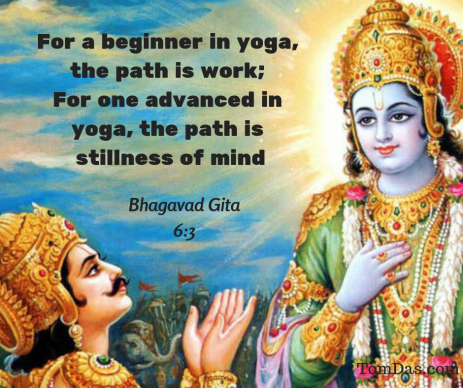
In the original Sanskrit, the word translated here as ‘work’ is ‘karma’. In the the preceding chapters Krishna has taught Arjuna about spiritual practice during activities, ie. karma yoga, in which the mind is made calm during activities by various means.
Now, in Chapter 6, Krishna teaches Arjuna that eventually the path of work leads to the path of stillness, and it is through stillness of mind that one advances in yoga. The rest of Chapter 6 explains in more details how this is to be done.
Whilst everything is nothing but the Self and nothing is ever apart from the Self, the Vedanta texts often speak of abiding as the Self.
This means to still the mind so that it is undisturbed and lose any notion of being a separate ‘I’ or ‘me’. Here we just abide as pure consciousness or pure knowingness, devoid of thoughts and phenomena, devoid of egotism.
This is pure ‘knowledge’ beyond knowledge, direct ‘experience’ beyond experiences, the ‘peace’ that passeth all understanding, Silence, beyond words and chatter.
When we engage with egoic thoughts, we suffer. All egoic thought assumes the existence of a separate ‘me’ and aims to deliver pleasure, security or fulfilment to that ‘me’.
By simply seeing that thoughts themselves are empty arisings with no intrinsic self, and that they are non-separate from ordinary awareness which in essence is ever-unchanged, we have spontaneously transcended them. In that moment, suffering is no more. This is the way of INSIGHT.
Alternatively, we can simply ignore the thoughts. Sometimes it can be useful to focus on something else such as the breath, a mantra, the sense of presence, etc, in order to distract us from the thoughts. This is the path of PRACTICE. It is a coarser path, as the notion of ‘me’ as the practitioner is still subtly present, but for most of us PRACTICE is required during much
of our spiritual journey as the habitual tendencies are too strong and deeply ingrained to be abated by pure insight practice alone. Once through PRACTICE the thoughts become less strongly ingrained, INSIGHT becomes the more predominant focus of the path, eventually becoming spontaneous.
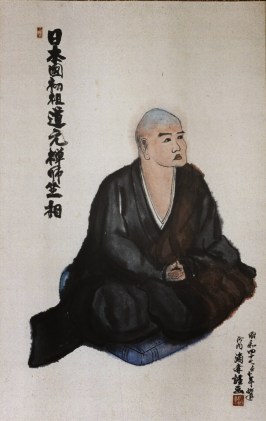
Often, PRACTICE and INSIGHT will go together, sometimes alternating, depending what is happening and what is required. Ultimately they fuse, as indicated by teachings such as ‘Be still’ or ‘Be as you are’ (Ramana Maharshi) and ‘Just sitting’ (Dogen), in which spontaneous non-egoic non-volitional INSIGHT-PRACTICE is implied.
The paradoxial thing is that throughout all of this, all there is is INSIGHT. There is no ‘me’, and there never was. Everything is LIGHT. Experientially, that is all there is!
Following lots of positive feedback from both the online and in person meetings over the last 2 weeks, I will continue to go over some essential basic teachings that focus in on directly pointing out one’s True Nature in upcoming meetings, both online and in person.
While these pointings are simple, there is something about experiencing them in person with a real-time direct interaction that makes these teachings so especially powerful. There are many teachings you can read in books or watch online, but the pointing out the true nature teachings usually have to be done in person to really hit home. This is why with this teaching I often get comments like ‘I’ve heard the same words before but this time it really made sense!’.
For those of you who already have come this far, we will take the teachings deeper still…
So, do come along to the next meeting if you are able to. If you have never been to a meeting before, I highly encourage you to attend this week’s meeting (London) or the week after (Online). We are going to meet at the Druid’s Head this Thursday at 7pm.



 When we engage with egoic thoughts, we suffer. All egoic thought assumes the existence of a separate ‘me’ and aims to deliver pleasure, security or fulfilment to that ‘me’.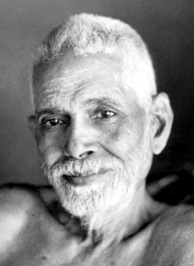
 Tom Das