Advaita Vedanta
Levels of reality

I have often seen people talk and write about various levels of reality. Typically, they talk of the level of the absolute and the level of the relative. On the level of the absolute, everything is one, so they say. Whereas on the relative level, the level of being a person different rules apply. On the relative level differentiation exists, we talk to each other, we love one another, we get annoyed and irritated, we buy fast-food from time to time, and yet ultimately, at the highest and truest level we are told this is all oneness.
Well let me start off by saying that I reject the notion of levels of reality. I think reality has various aspects, but not levels per se. Now this may seem like a minor difference, a play of semantics if you will, but let me explain the difference.
Talking about the same thing in different ways
When I say reality has various aspects, all I really mean is that there are various ways you can talk about reality – actually there are various ways you can talk about anything. That doesn’t mean there are different levels of reality.
Lets take a simple example: lets take a human body. You can talk about a human body in different ways. You can talk about it in terms of its size: you can say it is big, small, medium. You can talk about its age: is it a young or older body. You can talk about it in terms of organ systems such as the cardiovascular system or digestive system and how they function and describe the body that way, or you can talk about its anatomy and how various parts of it fit together. You can talk about the body’s name and culture – eg. maybe it is called John and it comes from the United Kingdom, you can talk about its occupation. You could talk about its fashion sense, its muscularity…
…ok ok, hopefully you get the idea: there are different ways you can talk about things. There are different conceptual frameworks from where we can view the body. And this is true for anything. We can talk about a pebble in terms of its age, size, geology or how good it would be to skim on a lake’s surface. We can talk about a lake in terms of its scenic beauty, how choppy its water are, its phosphorus content, or remark how it is all made up (mainly) of water.
Now, how many levels does a body or a pebble have? It doesn’t actually have any levels at all – there is only one body or stone (in the above examples) – it’s just that we can talk about them in various ways. In the same way there are no levels in reality, just different ways of talking about it.
No particular conceptual framework is intrinsically higher than another
Also note that no particular way of talking about the body or a pebble is intrinsically better that any other way. It just depends on what you want the conceptual framework to achieve. For example, if you want to skim a stone on the surface of a lake, then it’s less useful to talk about the geology of the stone, and more useful to look at it in terms of its shape and size with respect to achieving your goal (skimming it across the lake). You can’t legitimately claim that one way of viewing something is intrinsically higher and another way is lower, which is something you often hear when talking about ‘ultimate reality’ or the ‘highest level’. It just depends on how well the way you are conceptualising and viewing the object(s) in question fits in with your goal.
It depends on what you want to achieve
Similarly, it is not necessarily better to talk about the body in terms on physiology or organ systems compared to it’s occupation or fashion sense. As previously stated, it just depends on what you want to achieve. If the body has a disease, then understanding the physiology and how to correct any imbalance or defect in this is useful. Conversely if you are going out on a first date, then perhaps a degree of fashion sense would be useful.
No paradoxes, no contradictions
Also there in no contradiction in talking about a single object in different ways depending on the context. There is no paradox that a stone has both an age and a shape, or that a river is a single system made up of a variety of different things, all of which are in motion. There is a consistent underlying reality that underpins the various ways we talk about it. No contradiction or paradox at all.
Different ways of talking about the same experience
Remember, what we are talking about here is our experience of reality. Our reality is our experience – that’s all we know. We can talk about how everything we perceive is non-different to our consciousness, and we can also talk of how things interact within this consciousness, and the rules and consequences thereof. These are just different ways of talking about our experience and our experiences. No particular way is higher or lower, and there are no actual ‘levels’ that exist apart from our conceptualisations.
The description is not the described
We can chose how to conceptually carve up and talk about our experiential reality in order to achieve certain specific aims. To that end these conceptual maps are useful and often necessary. However we must not mistake any particular conceptual map of (our experience of) reality for reality, just as no particular way of describing the body is the body itself.
Ramana Maharshi Quote: There is no goal to be reached.
Tom’s comments:
God is already here,
wholeness is ever-present.
Call it what you want,
THIS-IS-IT
(At this level, even self-inquiry is a joke)
How yoga leads to Enlightenment

In my previous two posts (here and here) I’ve described the aims of the of yoga as being twofold:
- Knowledge: to see/know/realise that the notion of being a separate doer-entity is an illusion
- Peace: to become peaceful (sattvic) and remove compulsive desires
Each of these two aims of yoga are there to solve a basic problem. First, as long as you take yourself to be a doer, you suffer. This is corrected with Knowledge as defined above. Note that this Knowledge is not knowledge of something new (additive or positive knowledge) but it is realising something is false (negative knowledge).
And second, as long as you are a slave to compulsive desires, right action (ethical and intelligent action in accordance with natural law or dharma) will not fully manifest, and the flow of the innate natural intelligence will be impeded and distorted by these addictive and compulsive tendencies (vasanas). This is corrected by becoming sattvic (peaceful).
There are many forms of yoga and some can be very technical and detailed. However in general, some yogas work upon the body, others on the breath/voice, and some focus more on the mind. However the main purpose of yoga is to affect the mind, as this is where the core problems described above lie. Those yogas that work primarily upon the body, voice or breath do so in order to directly or indirectly effect the mind to which they are connected.
Each type of yoga strives to achieve the two points mentioned above in a slightly different way. Often there is a conceptual framework within which the yoga operates. When the aim of the yoga has been achieved (ie. by achieving the two points above), then the conceptual framework within which the yoga operated can be dismantled and left behind.
Improving your posture
Let’s give a simple example of how concepts, even when false, can aid us. If you want to improve your posture an expert may recommend you imagine a length of string attached to the crown of your head, pulling the top of your head upwards towards the sky/ceiling. When you imagine this, you naturally straighten your posture in line with the visualised imaginary piece of string.
After practicing this for sometime, your posture improved and now you no longer have to imagine a piece of string. At no point did you actually thinks there was a piece of string actually there, but you can see how this concept was useful to correct your posture.
Concepts in Yoga
Lets take a look at some of the main traditional forms of yoga to see how this works. In the sections below there are many aspects of the yoga I have not gone into, as the purpose of this text is to demonstrate how yoga can use concepts to achieve the two goals mentioned above, and then the concepts can be thrown away, to be picked up again only when this needs to be taught to someone else.
Jnana Yoga
Jnana means knowledge in Sanskrit, and Jnana Yoga is the Yoga of Knowledge.
In this yoga the concept of Brahman is introduced and is initially equated as being being-consciousness-bliss (sat-chit-ananda). Brahman is initially defined as being our basic sense of presence-awareness and the teachings show this to be (apparently) Unchanging, Ever-Present/Permanent, Eternal, Infinite and Indestructible. This is stark contrast to the subtle and gross objects that appear within it which are ever-changing, temporary, transient, limited and subject to creation and destruction.
The Jnana yogi is taught to identify him/herself as that Unchanging Absolute Brahman and not to identify as the ephemeral objects. Through this process of de-identification with the body-mind and identification with that which does not change, insight into experience occurs.
We start to realise that the body-mind entity that we formerly took ourself to be actually is not us at all. We thought that we we responsible for our thoughts and action, whereas from the point of view of Brahman or Absolute Consciousness, it is seen that there is no doer and the body-mind-entity functions by itself. At this point the doer-entity is seen to be non-existant, and Knowledge as defined above in objective (1) arises.
At this point the essential job of jnana yoga has been completed, and the concepts of Brahman as being an unchanging essence can then be dropped and life goes on, living itself. There is no attachment to concepts such as the relative and absolute or concepts of the infinite, all of which are ultimately unverifiable in our experience.
Incidentally, once the doer has seen to be non-existent, sattva tends to arise over time as the processes that fuel compulsive desires are slowly wiped away, and so objective (2) is also indirectly achieved.
We can see that in Jnana yoga the concept of an Absolute Brahman has been useful to us to serve a purpose. However ultimately we cannot know for sure from our experience alone that there is such as thing as the Absolute Unchanging Brahman. Because Knowledge, ie. seeing through the doer, has occurred, Freedom is innately realised, and concepts are not clung to, and no beliefs are required.
Karma Yoga
Karma means action in Sanskrit, and Karma Yoga is the Yoga of Action.
There are a few ways karma yoga can be performed according to the traditional scriptures, but one of them is to set up the concept of a personal God, an all-powerful entity that is responsible for everything and every action in the universe. The Karma yogi is taught to realise that it is this God that ultimately has control and not the limited body-mind that it thinks itself to be.
The karma yogi therefore practices gladly accepting everything that comes his or her way as a gift from God, working to the best of their ability, but not being attached to the results of their actions.
As the Karma yogi starts to learn to be happy regardless of what is happening, this has the direct result of eroding away compulsive desires, converting them into non-compulsive desires, and so eventually objective (2) is achieved.
Thereafter, over time, the sense of identification with the body-mind entity loosens and is seen through. It can become apparent to the Karma yogi that actions happen by themselves: thoughts happen by themselves, but there is no thinker, just a spontaneous thought occurring, one by one, in quick succession. Similarly actions happen by themselves: limbs move, lips speak in the same way that dogs bark, leaves rustle and clouds float by – all happens spontaneously, and there is no doer. Here Knowledge arises.
Now the yoga has completed its aims: Freedom has been realised and we are seen to be free from suffering – we are seen to have always been free from suffering and the world. Now we no longer have to worry about concept of an infinite all-powerful personal God that is ultimately unknowable and unverifiable.
Again, the concept of the infinite God, as with the concept of the Unchanging Indestructible Brahman for Jnana yoga, can be seen to have been a useful tool, aiding the seeker to attain Liberation, but now no longer needs to be believed in.
So here are just two examples of how concepts are utilised in yoga to achieve a greater end than perhaps could have been achieved without them.
Remember, don’t cling to concepts, beliefs and ideas. Use them by all means, but when you no longer need them, let them go. Ultimately, stay with what you know, stay with what’s true, question your beliefs, be unafraid to admit if you’re wrong, and don’t pretend to know something you don’t. Keeping to these guidelines will safeguard you from dogma, and the suffering that results from it.
Also see:
How spiritual teachings work
The essence of yoga
The paradox of yoga
Can you know something is infinite?
Non-Duality & Spirituality Meetings with Tom Das

Just a reminder that I hold meetings weekly, both in London (UK) and online. The next meeting is today (Thursday 24th November 2016). Please see one of the links below for details:
http://www.tomdas.com/events
http://www.meetup.com/Non-duality-Kingston-London
My Lord…

Feel free to substitute ‘Dear Universe’ in place of ‘My Lord’.
The essence of yoga
The other aim of yoga, in addition to seeing through the false concept of being a separate doer-entity described in my previous post, is to remove compulsive desires. When these have been removed, the result is peace of mind which in turn leads to the ending of suffering and moksha (freedom, liberation).
We could classify desires into two types, compulsive and non-compulsive. Compulsive desires are ones that you feel compelled to enact. Your happiness depends upon fulfilling these desires. Non-compulsive desires are ones which you could take or leave. While you may enjoy the consequences of acting out and fulfilling a non-compulsive desire, your sense of happiness and wellbeing does not depend on it. You could call non-compulsive desires preferences.
When a compulsive desire is not fulfilled, suffering is the result. When a non-compulsive desire is not fulfilled, it’s ok. You may have wanted it to pan out a certain way, but it’s fine that it didn’t happen the way you wanted it to.
When compulsive desires have been rooted out, our happiness no longer depends on objects, and the mind becomes peaceful (sattvic).
In the Bhagavad Gita, Krishna repeatedly advises Arjuna to practice yoga. By this Krishna means to practice not minding what happens regardless of the outcome of a situation. In his first lesson to Arjuna on the subject of yoga, Krishna defines yoga as follows, a definition that is often repeated in various ways throughout the text:
yogasthaḥ kuru karmāṇi saṅgaṃ tyaktvā dhanañjaya
siddhyasiddhyoḥ samo bhūtvā samatvaṃ yoga ucyate
Perform actions, Dhananjaya [Arjuna], giving up attachment, be steadfast in yoga, be equal in success and failure. This evenness of mind is called yoga.
Bhagavad Gita 2.48
So in summary, what is the essence of yoga? Well according to the Bhagavad Gita, yoga essentially means ‘evenness of mind’, or as I put it, not minding what happens. Practice of this leads to having a peaceful (sattvic) mind. All forms of yoga have this sattva and peace as their aim, with the exact methods and mechanisms varying depending on the type of yoga.
Also see:
How yoga works
The paradox of yoga
Ramana Maharshi: The 4 paths to freedom (the 4 yogas)
The paradox of yoga
The word yoga can be used to describe a series of specific methods which aid and direct the seeker towards the goal of the ending of suffering or of attaining realisation. So let me start by saying something quite obvious: all of the yogas* are practices to be performed or actions to be done. They are therefore meant to be performed by a person who thinks themselves to be a separate doer-entity.
The very existence of the (illusory) separate doer implies a duality – in fact the imagined doer is the essence of duality, the first conceptual step from which all other dualistic notions proceed from. The duality that it sets up is between that of the subject (the doer) and objects (the objects of the world in which actions are done).
The aim of all yogas is, through practice, to facilitate a seeing/realisation that the separate doer-entity is an illusion. And therein lies the apparent paradox. Yoga is action undertaken by the (imaginary) separate doer in order to see through this illusion of doership.
*Traditionally there are several key yogas outlined in the vedic texts, the main ones being Jnana Yoga (yoga of knowledge or understanding), Karma Yoga (yoga of action), Bhakti Yoga (yoga of devotion) and Raja Yoga (the king of yogas).
Also see:
How yoga works
The essence of yoga
Ramana Maharshi: The 4 paths to freedom (the 4 yogas)
Ramana Maharshi: remaining quiet and aware is the state of mind to aim at
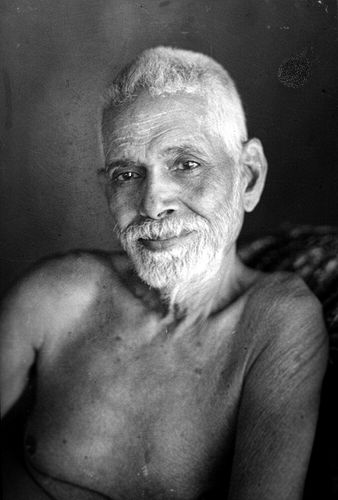
Questioner: There are times when persons and things take a vague, almost transparent form, as in a dream. One ceases to observe them as outside, but passively conscious of their existence, while not actively conscious of any kind of selfhood. There is a deep quietness in the mind.
Is it at such times that one is ready to dive into the Self? Or is this condition unhealthy, the result of self hypnotism? Should it be encouraged as yielding temporary peace?
Ramana Maharshi: There is Consciousness along with quietness in the mind. This is exactly to be aimed at. The fact that the question has formed on this point, without realizing that it is the Self, shows that the state is not steady but casual.
The word ‘diving’ is appropriate when there are outgoing tendencies, and when, therefore, the mind has to be directed and turned within, there is a dip below the surface of externalities. But when quietness prevails without obstructing the Consciousness, where is the need to dive?
Taken from Talks with Ramana Maharshi, Talk 348
Tom’s comments:
The sadhana (spiritual practice) that Bhagawan recommends above is to simply remain quiet (in mind and thought) and also to remain aware.
This is self-knowledge. This is the Self.
When thoughts can come and go without disturbing this essential quality of mind, there is no need to ‘dive’ using the tools of Self Inquiry (ie. the question ‘Who am I?’). With time it may be seen that nothing ever disturbs this ‘peace that passeth all understanding’, and that nothing ever did.
It was always here, fully manifest, right under our noses.
Here is the gateway to Self-knowledge or liberation.
Poetry: no way to talk about this

When this is seen,
It is seen there are so many ways to talk about this,
So many ways to guide others to this,
So many helpful ways,
– yet all of them false.
Ultimately,
All ways are false,
All descriptions are false.
The Truth cannot be contained in words:
The best teaching is whatever works.
No self, True self, or just Self?
Freedom, Enlightenment or Bliss?
Emptiness, Fullness, or Infinite?
Personal, impersonal, or no story at all?
Duality, non-duality? Both, neither?
All can be helpful concepts pointing the way,
None are THE SACRED TRUTH.
The proverbial finger points at the moon,
Don’t cling to the finger!
 Tom Das