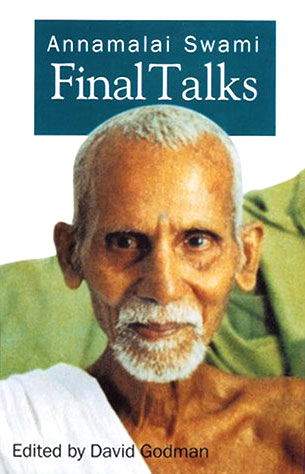
The following excerpt is from Chapter 7 of the above book:
Annamalai Swami: Enquire ‘Who am I?’ or ‘What is my real nature?’ The nature of the Self is nothing but peace. If you are not aware of that peace, it means that you are identifying with something that is not the Self. As long as you hear, taste and smell things, you identify with the body. When the perceptions and the perceiver of them vanish, you become aware of the peace that is there all the time.
If you are not aware of that peace, it means that you are identifying with something that is not the Self.
Q: I hear the sound. Then I ask myself who is hearing the sound, and the answer is ‘I’. What happens next depends on where I am. If I am in Swami’s presence or in the meditation hall at Sri Ramanasramam, I feel the presence of the Self and the bliss of peace, but when I am away from Swami, it is not easy.
AS: You need not hold on to That because you are That all the time. That is enough. You are That. How can you hold on to That, or feel separate from it, or try to get it back, or lose it? If That is your real nature, how can you pretend that you are nearer to it in two places and separate from it when you are somewhere else?
How can you hold on to That, or feel separate from it, or try to get it back, or lose it?
Q: I have the experience of That with Swami, but I don’t have the same experience when I am away from him. This is definitely my experience, so I don’t really understand what you are telling me.
AS: Your understanding or your lack of it does not affect the truth of what I am saying. You are That. See who you are and there will be nothing obstructing the experience of this fact.
Q: I still say I see who I am when I am near Swami. When I am away from him, I can remember it as a fact, but it is not my direct experience.
AS: This is because you identify with your body and your mind. Your mind is making you believe that a certain experience can only happen when you are in a particular place. Give up this identification and you will find that the Self is everywhere. You will see it, know it and be it wherever you go. Everything is Swami including you yourself.
Question: How do I give up identification with the body, particularly when I am not in front of Swami? I keep practicing, but I don’t have that experience.
AS: Meditate ‘I am the Self’. If you do this, the idea that you are the body will go. ‘I am the Self’ is still an idea, and as such, it belongs in maya, along with all other ideas. But you can begin to conquer maya by giving up utterly wrong ideas that bind you and cause you trouble. How to do this? Replace them with ideas that are a better reflection of the truth, and which are helpful in leading you towards that truth. If you want to cut iron, you use another piece of iron.
But you can begin to conquer maya by giving up utterly wrong ideas that bind you and cause you trouble. How to do this? Replace them with ideas that are a better reflection of the truth…
In battle, if someone shoots an arrow at you, you shoot one back. In maya, if the arrow of a bad idea comes speeding towards you, dodge it. Don’t let it stick to you of you will end up in pain. Then, in retaliation, fire back the arrow of ‘I am the Self’ at the place where the wrong idea came from.
Sadhana is a battlefield. You have to be vigilant. Don’t take delivery of wrong beliefs and don’t identify with the incoming thoughts that will give you pain and suffering. But if these things start happening to you, fight back by affirming, ‘I am the Self; I am the Self; I am the Self’. These affirmations will lessen the power of the ‘I am the body’ arrows and eventually they will armour-plate you so successfully, the ‘I am the body’ thoughts that come your way will no longer have the power to touch you, affect you or make you suffer.
Don’t take delivery of wrong beliefs and don’t identify with the incoming thoughts that will give you pain and suffering…fight back by affirming, ‘I am the Self; I am the Self; I am the Self’.
This fight all takes place within maya because in reality you are peace and peace alone. But while you are suffering in maya you can use these thoughts as a means of ultimately conquering it.
“Listen to the Master…
by hearing, Ignorance has come up,
and by hearing it goes off.” Shri Ranjit Maharaj
Tom’s comments:
The master speaks: because, as a child, we ‘listened’ to those around us, through absorbing their words we came to believe that we are a separate individual, a doer, a separate entity responsible for everything that this body-mind does. This is the basic ignorance.
Now, we can listen to the Master dispense his words. While his words, like ignorance, are also conceptual these concepts are there to remove ignorance.
The master’s words are like anti-matter: just as when anti-matter and matter collide they both disappear in a flash of energy leaving nothing behind, the master’s teachings nullify the suffering caused by our wrong notions of doership. Then the master’s teachings are also seen to be false.
We are left with no concepts at all, neither our original ignorant concepts, nor the concepts of the teaching. Only reality remains. It was always here.
Over the centuries, the lives of countless enlightened and self-realised sages have been studied and investigated, contrasting how they were prior to and after enlightenment, searching for clues as to what may aid other seekers in reaching total and complete liberation. Through this investigation several common qualities have been found which, if developed, aid the spiritual seeker to reach their goal.
In Vedanta, traditionally, there are four qualities (sadhana catustaya in Sanskrit) that a person should cultivate prior to engaging with the higher teachings of vedanta. These qualities, or qualifications, are deemed necessary to have, at least in some degree, before enlightenment can subsequently be achieved.
A similar notion that a certain level of attainment or qualification is required before higher teachings are taught are found throughout spiritual traditions, including many ‘no-path’ schools such as Dzogchen, Mahamudra and Zen (all types of Buddhism).
The idea is that without these qualities being present the seeker may have many insights and epiphanies, but the results will be unstable, with insights often coming and going, the results being a continued sense of lack and frustration. In a more mature seeker this may result in so-called ‘flip-flopping’, when the seeker has repeated experiences of being enlightened only to find, much to their dismay, that these experiences also end and suffering resumes.
The idea is that without these qualities being present the seeker may have many insights and epiphanies, but the results will be unstable, with insights often coming and going, the results being a continued sense of lack and frustration.
Conversely, when a seeker has developed these qualities, when exposed to the higher teachings of vedanta they make quick progress and quickly attain moksha (Freedom), which does not come and go.
Below Shankara, that great proponent of advaita vedanta (non-duality), tells us that these qualities are more important than other factors in attaining moksha. This quote is taken a text attributed to Shankara called vivekachudamani, one of his most famous texts and one of my favourites when I was a seeker:
Ultimate success in spiritual endeavours depends chiefly upon the qualifications of the seeker. Auxiliary conveniences such as time and place all have a place indeed, but they are essentially secondary.
Vivekachudamani by Adi Shankara, verse 14
The 4 Qualities (sadhana catustaya)
Here are the 4 qualities, sometimes known as the ‘4 Ds’, (with the Sankrit word in brackets):
Discrimination (viveka): being able to tell the difference between what is permanent and what is transient
Dispassion (vairagya): not desiring what is transient/impermanent; turing away from the impermanent towards what is permanent
Discipline (samadisatkasampatti): dropping trivial activities and turning towards the teaching and what is permanent.(Samadisatkasampatti more literally refers to the six treasures, each of which will be discussed in later posts).
Desire for freedom (mumuksutvam): this helps overcomes the ups and downs that life may bring and enables the seeker to overcome obstacles along the way.
There are several texts that outline these 4 qualities, perhaps the most succinct being Shankara’s Vivekachudamani which I have already mentioned above:
17. He alone is considered qualified to inquire after the supreme Reality (Brahman), who has discrimination, detachment, qualities of calmness etc., and a burning desire for liberation.
18. Great sages have spoken of four qualifications for attainment which, when present, succeed in the realization of Brahman and in the absence of which the goal is not attained.
Vivekachudamani by Adi Shankara, verses 17 & 18
Risk Factors vs qualifications
Before we look at each of the qualities in turn (in forthcoming articles), I would like to give my view. I don’t think these qualities are definite prerequisites for Freedom or self-realisation, important as they are. I think of them more as risk factors – ie. there may be an increased risk of enlightenment if these qualities are cultivated. Having the qualities does not guarantee enlightenment, and not having them does not bar one from Freedom.
It should be obvious really, but just because a particular tradition states something is necessary, doesn’t mean it is so – that’s my take on things at least. For me this Freedom is so simple, beyond simple actually, as it already is, that the whole notion of qualifications seems a bit arbitrary.
That being said, I do think they are of importance, and understanding and practising them will benefit many seekers, both in terms of increasing their day-to-day happiness, and in terms of realising Freedom.
It has been said that this knowledge of the four qualities required for enlightement has come about by looking at and studying the lives of hundreds of spiritual seekers and knowers-of-Freedom (Jnanis) and seeing if they had anything in common. When we go through each of the four qualities I hope that you will be able to see, in a commonsense way, how these qualities work together and the principles that underlie them, and how they can indeed aid the attainment of moksha (the realisation of Freedom).
At the same time I feel it is important that we bear in mind that there are also inherent problems with the notion of qualifications which must also be understood if one is to engage with them effectively, namely that the very idea of a progressive path to Freedom (implied by the need for qualifications) can itself be an obstacle to realising that-which-already-is.
I will explore each of the above 4D’s in turn in forthcoming articles.
(The following is an excerpt from the above book and comprises most of Chapter 3):
A devotee who came to Annamalai Swami had so much pain in one of his legs, he found it very difficult to sit comfortably on the floor. Observing his difficulties, Annamalai Swami (AS) made the following remarks:
AS: Though the body is needed for Sadhana, one should not identify with it. We should make good use of it and look after it well,but we should not pay too much attention to it.
There are so many thoughts in the mind. Thought after thought after thought. They never stop. But there is one thought that is continuous, though it is mostly subconscious. ‘I am the body’ – this is one string on which all other thoughts are threaded. Once we identify ourselves with the body by thinking this thought, Maya follows. It also follows that if we cease to identify ourselves with the body, Maya will not affect us anymore.
‘I am the body’ – this is one string on which all other thoughts are threaded. Once we identify ourselves with the body by thinking this thought, Maya follows.
Maya is fundamentally non existent. Bhagavan said that Maya literally means ‘that which is not.’ It is unreal because everything that Maya produces is an outgrowth of a wrong idea. It is a consequence of taking something to be true that is not really true. How can something that is not real produce something that is real? If a barren woman says that she has beaten by her son, or that she has been injured by the horns of a hare, we would rightly take her to be deluded. Something that does not exist cannot be the cause of suffering or of anything else.
Maya is fundamentally non existent.
How to get rid of this ‘I am the body’ feeling and of the Maya that is produced by it? It goes when there is ‘saman bhava’ the equanimity or equality of outlook that leaves one unaffected by the extreme opposites such has happiness and unhappiness, pleasure and pain. When ‘saman bhava’ is attained, the idea ‘I am the body’ is no longer present and Maya is transcended.
Question: Is the body to be regarded as unreal, as ‘not me’? What attitude should I have towards this body and all the sensory information it provides me with?
AS: By itself, this body is jada, inert and lifeless. Without the mind, the body cannot function. And how does the mind function? Through the five senses that the body provides.
Mind and body are like the tongue and teeth in the mouth. They have to work in harmony with each other. The teeth do not fight with tongue and bite it. Mind and body should combine in the same harmonious way.
However, if we want to go beyond the body, beyond the mind, we have to understand and fully accept that all the information the senses provide is not real. Like the mirage that produces an illusory oasis in the desert, the senses create information that there is a real world in front of us that is being perceived by the mind. The apparent reality of the world is an illusion. It is merely a misperception. When the mind perceives a snake where in reality there is only a rope, this is clearly a case of the senses projecting an imaginary image onto a real substratum. This, on a large scale, is how the unreal appearance of the world is projected by the mind and the senses onto the underlying reality of the Self….
…Self Inquiry is the process by which attention is put on the substratum instead of on names and forms that are habitually imposed on it. Self is the substratum out of which all things appear to manifest, and the Jnani is the one who is continually aware of the real substratum. He is never deluded into believing that the names and forms that are perceived by the senses have any real existence.
Self Inquiry is the process by which attention is put on the substratum instead of on names and forms that are habitually imposed on it.
Whatever we see in this room, for example, that picture of Bhagavan over there, is unreal. It has no more reality than objects we perceive in our dreams. We think we live in a real, materially substantial world, and that our minds and bodies are real entities that move around in it. When the Self is seen and known, all these ideas fade away and one is left with the knowledge: Self alone exists.
Question: If I regard all the people that I see and meet as unreal projections, what do I base my moral sense on? I can go around killing then or robbing them without feeling guilty because i would know that they are just characters in my dream.
AS: Everything that we perceive is maya, an unreal dream, but one should not then think, “Since everything is unreal, I can do what I like”. There are dream consequences for the bad acts committed in the dream, and while you still take the dream to be the reality, you will suffer the consequences of your bad behaviour. Do no evil and have no hate. Have equanimity towards everything.
The following excerpt is from the wonderful book Annamalai Swami FINAL TALKS, Chapter 1:
Annamalai Swami: Mind is just a shadow. Attempts to catch it and control it are futile. They are just shadows chasing shadows. You can’t control or eliminate a shadow by chasing it or by putting a shadow hand on it. These are just children’s games.
Ram Tirtha once told a story about a small boy who ran down the street, trying to catch up with the head of his shadow. He never managed because no matter how fast he ran, the shadow of his head was always a few feet ahead of him.
His mother, who was watching him and laughing, called out, ‘Put your hand on your head!’
When the boy followed this instruction, the shadow hand caught up with the shadow head. This was enough to satisfy the boy.
This kind of advice may be enough to keep children happy, but it won’t produce satisfactory results in the realm of sadhana and meditation. Don’t chase your shadow thoughts and your shadow mind with mind-control techniques because these techniques are also shadows. Instead, go back to the source of the shadow-mind and stay there. When you abide in that place, you will be happy, and the desire to go chasing after shadow thoughts will no longer be there.
Bhagavan often told the story of a man who tried to get rid of his shadow by burying it in a pit. This man dug a hole and then stood on the edge of it in such a way that his shadow was cast on the bottom of the hole he had just made. After lining it up in this way, he started throwing soil on the shadow in an attempt to bury it. Of course, no matter how much soil he put in the hole, the shadow still remained on top of it.
Your mind is an insubstantial shadow that will follow you around wherever you go. Attempts to eliminate or control it cannot succeed while there is still a belief that the mind is real, and that it is something that can be controlled by physical or mental activity.
Question: But this shadow mind must still be eliminated by some means.
Annamalai Swami: When self-realisation happens, mind is no longer there. However, you do not get self-realisation by getting rid of the mind. It happens when you understand and know that the mind never existed. It is the recognition of what is real and true, and the abandonment of mistaken ideas about the reality and substantiality of this ephemeral shadow you call the mind.
This is why Bhagavan and many other teachers kept bringing up the analogy of the snake and the rope. If you mistake a rope on the ground for a snake, the snake only exists as an idea in your mind. That idea might cause you a lot of worry and anxiety, and you may waste a lot of mental energy wondering how to avoid the snake or kill it, but this fact remains: there is no snake outside your imagination. When you see the rope, the substratum upon which your false idea of a snake is superimposed, the idea that there is a snake, and that it is real, instantly vanishes. It is not a real snake that has disappeared. The only thing that has disappeared is an erroneous idea.
The substratum upon which the false idea of the mind has been superimposed is the Self. When you see the mind, the Self, the underlying substratum, is not seen. It is hidden by a false but persistent idea. And conversely, when the Self is seen, there is no mind.
Question: But how to give up this false idea that the mind is real?
Annamalai Swami: The same way that you give up any wrong idea. You simply stop believing in it. If this does not happen spontaneously when you hear the truth from a teacher, keep telling yourself, “I am not the mind; I am not the mind. There is no mind; there is no mind. Consciousness alone exists.” If you have a firm conviction that this is the truth, one day this firm conviction will mature to the point where it becomes your direct experience.
Consciousness alone exists. If you generate a firm conviction that this is the truth, eventually this firm conviction will become your own direct experience. Consciousness alone exists. That is to say, whatever exists is consciousness alone. Keep this in mind and don’t allow yourself to regard anything else as being real. If you fail and give even a little reality to the mind, it will become your own false reality. Once this initial wrong identification – ‘I am the mind, the mind is real’ – has happened, problems and suffering will follow.
Don’t be afraid of the mind. It’s a false tiger, not a real one. Something that is not real cannot harm you. Fear and anxiety may come to you if you believe that there is a real tiger in your vicinity. Someone may be making tiger noises as a joke to make you afraid, but when he reveals himself, all your fears go because you suddenly understand that there never was a tiger outside your imagination.
Question: One can have a temporary experience of the Self, the underlying reality, but then it goes away. Can you offer any guidance on how to stabilise in that state?
Annamalai Swami: A lamp that is lit may blow out if the wind is strong. If you want to see it again, you have to relight it. But Self is not like this. It is not a flame that can be blown out by the passing winds of thoughts and desires. It is always bright, always shining, always there. If you are not aware of it, it means that you have put a curtain or a veil in front of it that blocks your view. Self does not hide itself behind a curtain. You are the one who puts the curtain there by believing in ideas that are not true. If the curtain parts and then closes again, it means that you are still believing in wrong ideas. If you have eradicated them completely, they will not reappear. While these ideas are covering up the Self, you still need to do constant sadhana.
So, going back to your question, the Self does not need to stabilise itself. It is full and complete in itself. The mind can be stabilised or destabilised, but not the Self.
Question: By constant sadhana, do you mean self-enquiry?
Annamalai Swami: Yes. By strength of practice, by doing this sadhana, this veil will be removed completely. There will be no further hindrances. You can go to the top of Arunachala, but if you are not alert, if you are not paying attention, you may slip and end up at Easanya Math (a Hindu institution at the base of the hill).
You have to make an enormous effort to realise the Self. It is very easy to stop on the way and fall back into ignorance. At any moment you can fall back. You have to make a strong determined effort to remain on the peak when you first reach it, but eventually a time will come when you are fully established in the Self. When that happens, you cannot fall. You have reached your destination and no further efforts are required. Until that moment comes, constant sadhana is required.
Question: Is it important to have a Guru at this stage, this period when constant effort is required?
Annamalai Swami: Yes. The Guru guides you and tells you that what you have done is not enough. If you are filling a bucket with water, you can always add more if there is still space. But when it is completely full, full to overflowing, it is pointless to add even a single drop. You may think that you have done enough, and you may believe that your bucket is full, but the Guru is in a better position to see that there is still a space, and that more water needs to be added. Don’t rely on your own judgement in this matter. The state you have reached may seem to be complete and final, but if the Guru says, “You need more sadhana,” trust him and carry on with your efforts.
Bhagavan often used to say, ‘The physical Guru is outside, telling you what to do and pushing you into the Self. The inner Guru, the Self within, simultaneously pulls you towards itself.’
Once you have become established in the inner Guru, the Self, the distinction between Guru and disciple disappears. In that state you no longer need the help of any Guru. You are That, the Self.
Until the river reaches the ocean it is obliged to keep on flowing, but when it arrives at the ocean, it becomes ocean and the flow stops. The water of the river originally came from the ocean. As it flows, it is merely making its way back to its source. When you meditate or dosadhana, you are flowing back to the source from which you came. After you have reached that source, you discover that everything that exists – world, Guru, mind – is one. No differences or distinctions arise there.
Non-duality is jnana; duality is samsara. If you can give up duality, Brahman alone remains, and you know yourself to be that Brahman, but to make this discovery continuous meditation is required. Don’t allocate periods of time for this. Don’t regard it as something that you do when you sit with your eyes closed. This meditation has to be continuous. Do it while you are eating, walking, and even talking. It has to be continued all the time.
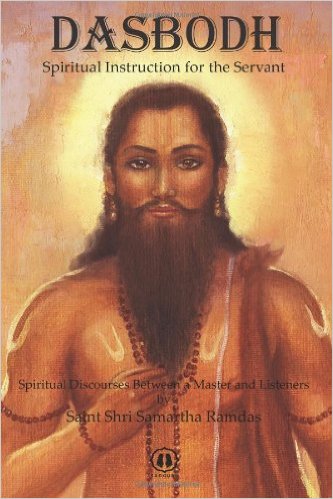
Dasbodh, written by Sri Samartha Ramdas in 1654, has been long used as a source text for seekers of enlightenment within the Advaita Vedanta tradition. Nisargadatta Maharaj’s lineage, the Inchegarei Sampradaya, were hugely inspired by this text and Nisargadatta used to regularly read from it.
Here Samartha Ramdas is pointing us to something very profound, yet very simple once realised. For more, compare this verse with that of Zen master Han-Shan here.
“The differences are the result of the sense of doership.
The fruits will be destroyed if the root is destroyed.
So relinquish the sense of doership.
The differences will vanish and the essential reality will reveal itself.
In order to give up the sense of doership one must seek to find out who the doer is.
Inquire within. The sense of doership will vanish.
Vichara (inquiry) is the method.”
Taken from Talks with Sri Ramana Maharshi, talk no. 429
Tom’s comments:
The root of suffering is the sense of doership, the sense that there is a doer-entity, the sense that you are a doer. The root is the notion ‘I am a doer’, the fruit is suffering and duality.
Let go of this sense of doership, either by simply relaxing and letting go, or, as suggested above, look and find out what the doer is. Look at your own direct experience: can you see the doer? Can you feel the doer? What does the doer look and feel like exactly? Where does the doer begin and end? How big is the doer? Where is the doer located?
When you look, as you keep on noticing, you may start to realise/see that there is no actual experience of a doer at all. All there are are sensations, feelings and thoughts. Specifically there may be the thought ‘I am the doer’ or ‘this is the doer’, but no actual doer is seen/experienced apart from the thought. The doer is seen to be an imagined entity. The doer (ie. ego) is revealed to be a fiction.
Ramana uses the word ‘reality’ above. What is reality? It’s just what’s left over when the sense of doership is seen through. It’s just what’s left over when false illusions are seen for what they are: false.

 Tom Das