Start the day with love, fill the day with love, end the day with love

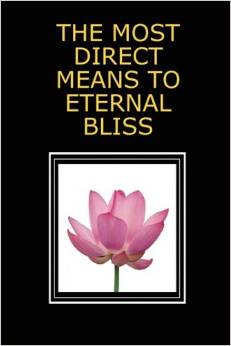
 The following is an excerpt from a book rather modestly titled ‘The Most Direct Means To Eternal Bliss’.

Despite some tendency towards grandiosity, this book is actually pretty amazing in my opinion. I think it was written as a labour of love and has been uploaded to the internet for free viewing by the author here. You can also buy a hard copy here which contains a single extra chapter (which was written later).

MDMTEB

Be warned, this book and its tone may not be for everyone. It is radical, focused, in some ways quite narrow, and not at all modest. However the advice dispensed is actually very good in the context in which it was written and the teachings are made extremely clear. The initial chapters alone are worth the purchase price in my opinion (plus it’s free online anyway)

Below is Chapter 12, blessings to you all ❤

Chapter 12 – THE LOVING-ALL METHOD

Continue reading

Ramana Maharshi: The 4 paths to freedom (the 4 yogas)

In this passage below Ramana Maharshi talks about the four traditional Hindu paths to ending suffering or moksha (liberation/freedom). The four paths are traditionally called the paths of knowledge (jnana), love or devotion (bhakti), meditation (raja yoga), and doing good works (karma).

Almost every spiritual tradition around the world will fit into one of more of these four paths Continue reading

A rant: kicking spiritual seekers in the balls

“And yet, even as I speak, Subhuti, I must take back my words as soon as they are uttered, for there are no Buddhas and there are no teachings.”

Buddha, Diamond Sutra

I’ve been reading several blogs and other writings aimed at spiritual seekers who have everything laid out so clearly. They have the map to spiritual enlightenment all put together ready for mass consumption. They say things like you are Pure Consciousness or Pure Awareness.

All the concepts are lined up ready to be taught by the bearded guru and gobbled up by the next willing namaste-wielding student greedy for the big E. Here, let the Kunjed Gyalpo metaphorically kick the spiritual-seeker-in-you in the balls (if you’ll forgive my sexism): Continue reading

Ramakant Maharaj: Meditation is the anti-virus for illusion

Selfless Self RM

The following is an excerpt from ‘Selfless Self: Talks with Shri Ramakant Maharaj‘, page 15. To find out more, click on the hyperlinks above.

YOU ARE ALMIGHTY. ALMIGHTY GOD, OMNIPRESENT.

YOUR PRESENCE IS EVERYWHERE.

YOU ARE BEYOND THE SKY

THERE IS NO INDIVIDUALITY.

Questioner: [laughing] I find it hard to believe that this ‘little me’ is all of that! If I am all of that, as you say, how is it I am not aware of this? And if I’m not, then how can I start becoming aware of my Self?

Maharaj: How can I? There is no ‘I’ at all. There is no ‘You’ and there is no ‘I’. Everything is just like the sky. You see, even when the Master tells you that you are Almightly, that you are Ultimate Truth, you are not accepting it. You are not able to accept that Truth because you’re caught up in all sorts of illusionary thoughts. You are considering yourself as ‘little me’, and that is making you blind to your Innate Power.

The remedy for this, a very simple remedy for this, as I have said, is meditation. Meditation is the anti-virus for illusion.

Isha Upanishad: That is full, this is full

full-moon

“That is full, this is full,
From that fullness comes this fullness,
If you take away this fullness from that fullness,
Only fullness remains”
Invocatory verse of Isha Upanishad

Gandhi famously declared the Isha Upanishad to be the summit of human wisdom. He said if all the scriptures in the world were lost, as long as the first verse of the Isha Upanishad remained then Hinduism would last forever.

To the rational mind devoid of spiritual experience this verse makes little sense – how can you take fullness from fullness, and for fullness to still remain? However to the one whose heart has glimpsed the Lord, the poetry reverberates and delights.

That is full, this is full…I can imagine the anonymous rishi (seer or wise person) who composed the verse pointing  away from him when saying ‘that’ and pointing near him or even perhaps towards himself when saying ‘this’. That is full, this is full…We are surrounded by the infinite. That is the infinite, I am also the infinite. The infinite is everywhere, nothing is not it. Nothing is limited, everything is free and unbound, one.

In the invocation above, the sanskrit word that has been translated as ‘full’ ispurna. Purna can also be translated as complete, whole, infinite, limitless or perfect. Taking this into account, what does it mean? It means that we are already whole and complete. You are whole and complete, I am whole and complete – already. You do not have to make yourself whole. Sadhana (spiritual practice) will not make you complete – it cannot. Sadhana can only reveal the completeness that is already here.

The problem for a spiritual seeker is not that they are un-enlightened or deficient in any way. It is that they do not realise they are already enlightened and whole.

This lack of realisation of one’s true nature is called ignorance, meaning that you do not see what is already the case, you do not know your true identity as That which is already full.

This ignorance or misunderstanding of reality has been demonstrated using many metaphors in the classic texts of vedanta, such as the woman who thinks she has lost her necklace only for a look in the mirror to reveal it is on her neck. The snake on the dimly lit ground that scares the man was actually a rope all along; when revealed by the light the rope is seen and the man’s fear is abated. Or when ten men have crossed a river the group leader becomes worried when he can only count nine men on the other side. A passer-by reassures the leader: he has merely forgotten to count himself.

In all these examples, all was well the entire time, only the protagonist made a mistake. The protagonist did not need to make things well, they only needed to see things clearly. The mirror, the light and the passerby in the analogies above represent the scripture or guru that reveals the mistake and thus ends suffering.

The solution to suffering and lack is therefore not one of self-improvement in which you build your small-shallow self up into some perfect super-duper being: you are already the perfect super-duper being. In fact we are all that One Being. We just don’t see it. All we have to do is look deeply at reality as it is now and investigate it and our assumptions about it. Then we can see for ourselves that the sense of lack is based on illusion and that we are already free.

As Jesus said, “seek and ye shall find” and “the truth shall set you free”.

Swami Vivekananda: You can know God directly

swami-vivekananda

“What right has a man to say he has a soul if he does not feel it, or that there is a God if he does not see Him? If there is a God we must see Him, if there is a soul we must perceive it; otherwise it is better not to believe.”

Swami Vivekananda

As a child I totally rejected religion. I must admit that a part of me did want to believe in God; I saw the strength and certainty it gave people. But the bigger (better?) part of me thought it all seemed so silly and nonsensical. Continue reading

Don’t take spiritual concepts too seriously

pine cone

“The Tao that can be spoken is not the eternal Tao” Tao te ching, verse 1

We don’t need to take spiritual concepts too seriously. They are there to guide us, to point us in the right direction only. The reality they point to cannot be described. When we start to take teachings too seriously we miss this point and start to become dogmatic.

Any interpretations that are set up and established as truth become meaningless phrases” Bankei

I’ve met people who follow Advaita Vedanta who say that consciousness is what we really are, and others who say what we are is beyond consciousness. Both of these are useful teachings, but don’t take them too seriously, either one of them. Both are useful and untrue. If you take a single position as being true, then that is a belief. Your attachment to a conceptual truth indicates the belief in ego/individuality that underlies it. Continue reading

The Ribhu Gita

ribhu

Ahh, the Ribhu Gita. Its words are uncompromising: they leap off the page, smack you in the mouth and leave you speechless (and thoughtless). At first glance the ideas it unfolds are preposterous. But this text is not meant for the mind. It is meant for the heart, it is speaking directly to that Truth that we already are and always have been. Continue reading