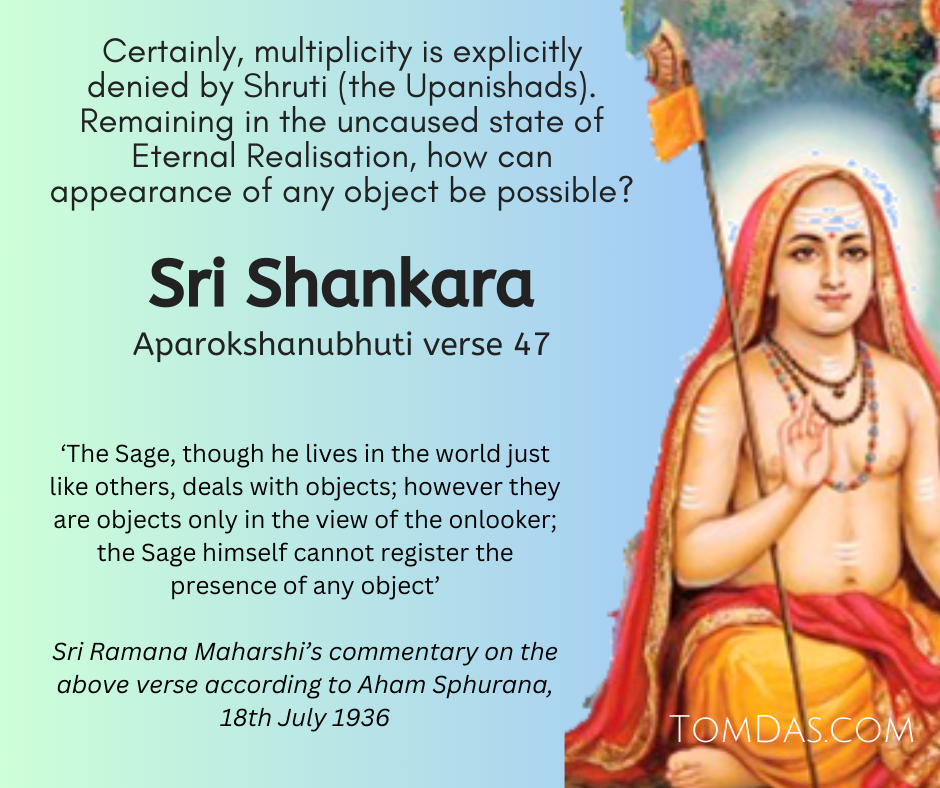
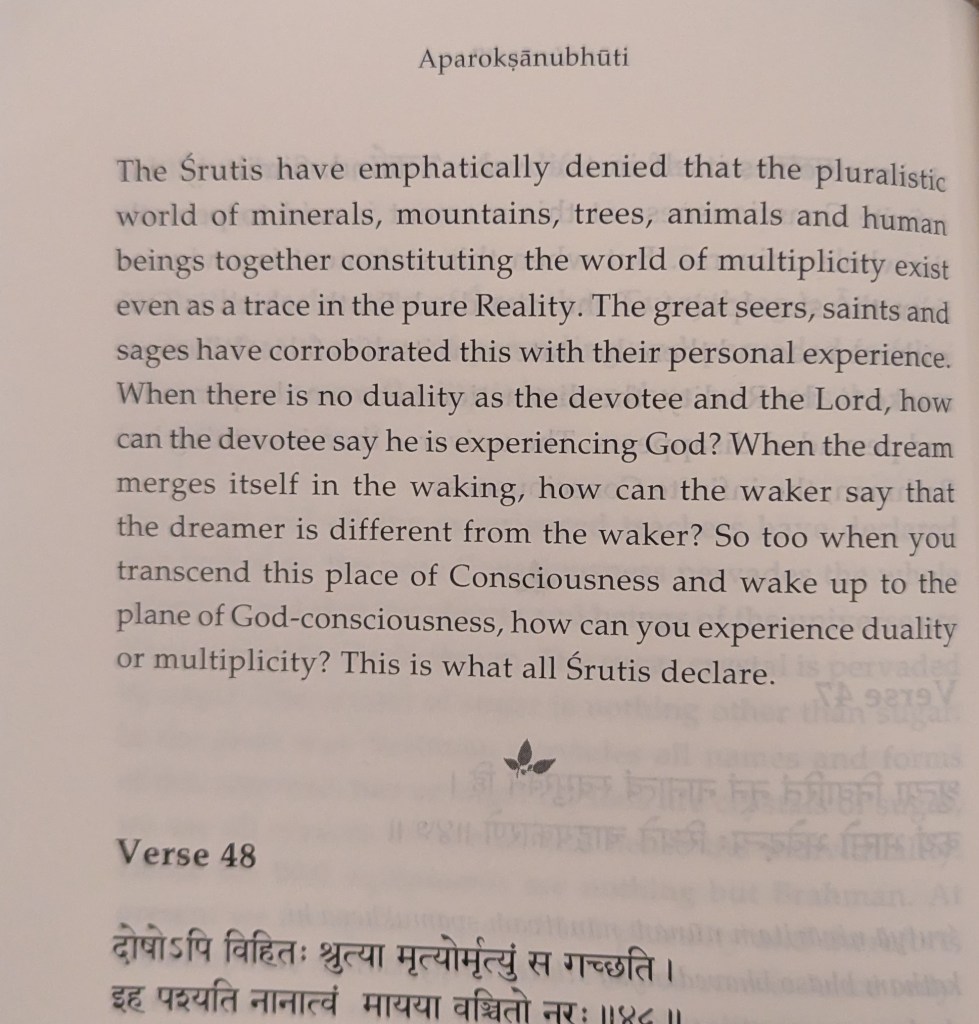
Sri Nisargadatta Maharaj: in self-realisation there is no perception of a body, mind or world | Ajata | Advaita Vedanta | Maya and illusion

The following quotes are all from Sri Nisargadatta Maharaj (NM), taken from the book ‘I Am That’ by Sri Nisargadatta Maharaj.

NM gave many different teachings, depending on the level of the seeker and the context. The ego-mind often clings to the lower teachings for safety and security – here only the higher teachings are included, so please only read the following if you have a deep and sincere interest in liberation.

If you read carefully, you will see the following themes stated and expounded by NM:

  1. The self-realised jnani has no consciousness of having a body.
  2. The self-realised jnani has no consciousness of a world or phenomena arising.
  3. The apparent consciousness of the world is only due to ignorance, also known as the ‘I thought’ or the ‘I am the body sense’. This ignorance is also known as ‘imagination’, ‘illusion’, ‘ego’ or ‘the mind’.
  4. Ignorance of what you truly are projects the (false) appearance of a world, which includes the appearance of the body-mind and world. These do not appear to a jnani.
  5. All conversation, teachings, words and thoughts are in illusion only, as are all teachers. Similarly, birth and death only (appear to) exist for the ignorant.

These are of course the Ajata teachings, and you can read about them here in this article and also in the introductory articles on the tomdas.com homepage.

Some may say that this notion of liberation is not appealing at all (for the ego-mind), but of course it is actually everything you are looking for and more. It is the treasure found within, this is the ‘kingdom of God’ within us. Anything less and the seeking, the doubts and the sense of ego will not end, and so suffering and duality will continue; hence the value of these teachings in reminding us to continue to go further with our sadhana until all objective phenomena have dissolved rather than stop prematurely.

Many of these quotes below are also found in the wonderful book The Seven Steps to Awakening, one of the best books ever written on self-realisation and liberation. This book goes much further than this article and clearly describes other aspects of the teaching including the method by which self-realisation can be attained.

Here are the quotes from Sri Nisargadatta Maharaj:


The body and mind are only symptoms of ignorance, of misapprehension.

——-

He who knows the state in which there is neither the world nor the thought of it, he is the Supreme Teacher.

——-

What do you know of me, when even my talk with you is in your world only?

——-

NM: The body appears in your mind; in my mind nothing is.
Q: Do you mean to say you are quite unconscious of having a body?
NM: On the contrary, I am conscious of not having a body.
Q: I see you smoking!
NM: Exactly so. You see me smoking. Find out for yourself how did you come to see me smoking, and you will easily realize that it is your ‘I am the body’ state of mind that is responsible for this ‘I see you smoking’ idea.

——-

Nothing dies. The body is just imagined. There is no such thing.

——-

In my world nothing happens

——-

Without imagination there is no world.

——-

If you seek real happiness, unassailable and unchangeable, you must leave the world with its pains and pleasures behind you.

——-

You are neither the body nor in the body – there is no such thing as body

——-

NM: My world is real, while yours is made of dreams
Q: Yet we are talking.
NM: The talk is in your world. In mine – there is eternal silence. My silence sings, my emptiness is full, I lack nothing. You cannot know my world until you are there.

——-

It is not at all as you imagine and I am not bound by your imaginings.

——-

Q. If all that passes has no being, then the universe has no being either
NM: Who ever denies it? Of course the universe has no being.

——-

In reality, nothing ever happens.

——-

No doubt imagination is richly creative. Universe within universe are built on it. Yet they are all in space and time, past and future, which just do not exist.

——-

In pure consciousness nothing ever happens

——-

The moment you allow your imagination to spin, it at once spins out a universe.

——-

There is no body, nor a world to contain it; there is only a mental condition, a dreamlike state, easy to dispel by questioning its reality.

——-

All experience is born of imagination; I do not imagine, so no birth or death happens to me.

——-

To take appearance for reality is a grievous sin and the cause of all calamities

——-

It is by your consent that the world exists. Withdraw your belief in its reality and it will dissolve like a dream.

——-

What is real is nameless and formless.

——-

Do understand that what you think to be the world is your own mind

——-

I take my stand where no difference exists, where things are not, nor the minds that create them. There I am at home.

——-

All thinking is in duality. In identity [Tom: ie. self realisation] no thought surives

——-

Now go within, into a state in which you may compare to a state of waking sleep, in which you are aware of yourself, but not of the world. In that state you will know, without the least trace of doubt, that at the root of your being you are free and happy.

——-

To know yourself, turn your attention away from the world and turn it within.

——-

The world appears to you so overwhelmingly real, because you think of it all the time; cease thinking of it and it will dissolve into thin mist.

——-

To see what Sri Ramana Maharshi thought of the same Ajata teachings please see this article here.

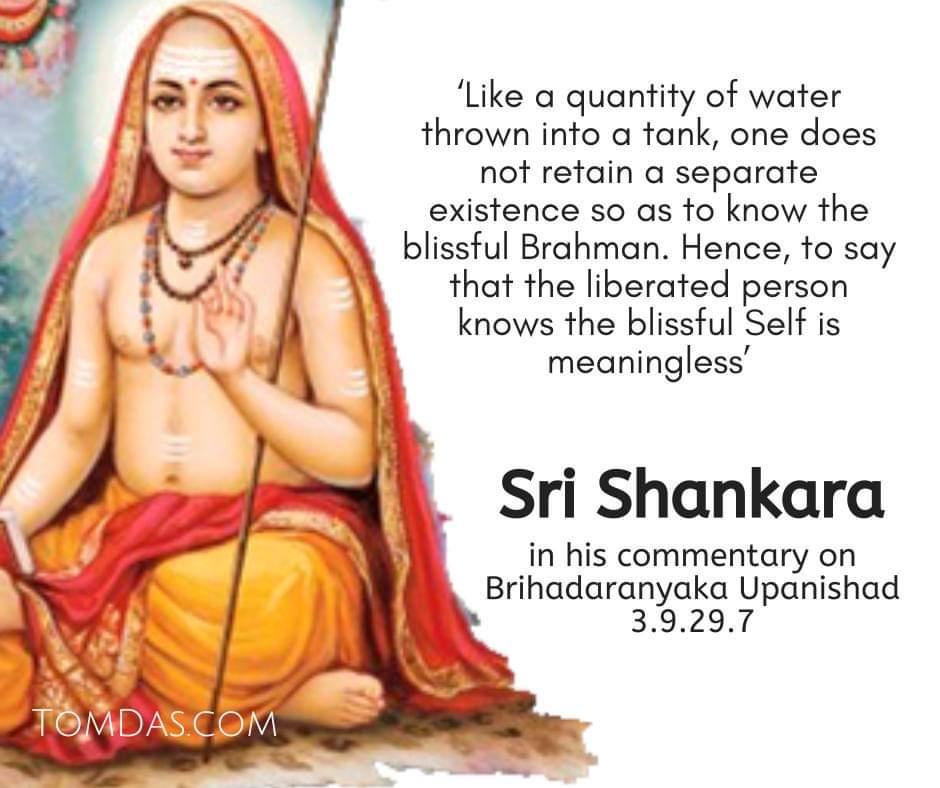
This article here also goes into what Shankara wrote on these Ajata teachings.

Tejobindu Upanishad: what is Jivanmukti?

CHAPTER – IV

The Kumara asked the great Lord: “Please explain to me the nature of Jivanmukti and Videhamukti.” To which the great Shiva replied:

1. “I am Chidatma. I am Para-Atma. I am the Nirguna, greater than the great. One who will simply stay in Atman is called a Jivanmukta.

2. He who realises: ‘I am beyond the three bodies, I am the pure consciousness and I am Brahman’, is said to be a Jivanmukta.

3. He is said to be a Jivanmukta, who realises: ‘I am of the nature of the blissful and of the supreme bliss, and I have neither body nor any other thing except the certitude ‘I am Brahman’ only.

4-6. He is said to be a Jivanmukta who has not at all got the ‘I’ in myself, but who stays in Chinmatra (absolute consciousness) alone, whose interior is consciousness alone, who is only of the nature of Chinmatra, whose Atman is of the nature of the all-full, who has Atman left over in all, who is devoted to bliss, who is undifferentiated, who is all-full of the nature of consciousness, whose Atman is of the nature of pure consciousness, who has given up all affinities (for objects), who has unconditioned bliss, whose Atman is tranquil, who has got no other thought (than Itself) and who is devoid of the thought of the existence of anything.

7-11(a). He is said to be a Jivanmukta who realises: ‘I have no Chitta [mind], no Buddhi [intellect], no Ahamkara [ego, sense of doership and enjoyership], no senses, no body at any time, no Pranas, no Maya, no passion and no anger, I am the great, I have nothing of these objects or of the world and I have no sin, no characteristics, no eye, no Manas [mind], no ear, no nose, no tongue, no hand, no waking, no dreaming, or causal state in the least or the fourth state.’

~ Tejobindu Upanishad

Tom: Tejo means radiant; Bindu means point (or drop)

Q: Why is it necessary for the mind to die? | Lakshmana Swamy | Ramana Maharshi

Q: Why is it necessary for the mind to die?

Lakshmana Swamy [a devotee of Ramana Maharshi]: The mind must die, there is no other way to realize the Self. Some people say that complete equanimity of mind is Self realization, but this is not true. This is only a stage one passes through on the way to Self-realization. Other people say that seeing the Self or God everywhere is Self-realization, but this idea is not true either. To see the Self everywhere there must be an “I” who sees, and while that “I” exists the mind will also exist. The jnani does not see anything because the seeing entity in him has died. In the Self there is no seeing, only being. When the mind still exists one can reach a stage where one can see the whole world as a manifestation of the Self, but when the mind dies, there is no one who sees the world and no world to be seen.

If you have a mind then the earth, the sky and the stars will exist and you will be able to see them. When the mind dies there will be no earth, no sky, no stars and no world. The world of objects, names and forms is only the mind, and when the mind dies, the world dies with it. Only the Self then remains.

Seeing everything as the Self gives the impression that the Self is equally distributed everywhere. This is also an idea in the mind. When the mind finally dies you realize that there is no distribution and no everywhere.

SHANKARA – WHY YOU NEED TO COMPLETELY STILL THE MIND FOR LIBERATION

[Tom: The following verses were written by Sri Shankara. First he explains that the entire universe is a projection of the mind, and then he will go on to explain that this projection veils the self and therefore needs to be removed in total silence of the mind, also known as self-knowledge or nirvikalpa samadhi:]

170. In dreams, when there is no actual contact with the external world, the mind alone creates the whole universe consisting of the experiencer etc. Similarly in the waking state also; there is no difference. Therefore all this (phenomenal universe) is the projection of the mind.

342. Even wise men cannot suddenly destroy egoism after it has once become strong, barring those who are perfectly calm through the Nirvikalpa Samadhi. Desires are verily the effect of innumerable births.

344. …But the victory is undoubtedly (complete and) free from obstacles when there is no oscillation of the mind due to the unreal sense-objects.

[Tom: The term Samadhi refers to a state of mind that is completely stilled but also aware and not asleep, it is attained only through self-enquiry and is synonymous with self-knowledge (Jnana):]

353. When the Atman, the One without a second, is realised by means of the Nirvikalpa Samadhi, then the heart’s knot of ignorance is totally destroyed.

354. Such imaginations as “thou”, “I” or “this” take place through the defects of the Buddhi. But when the Paramatman, the Absolute, the One without a second, manifests Itself in Samadhi, all such imaginations are dissolved for the aspirant, through the realisation of the truth of Brahman.

355. The Sannyasin, calm, self-controlled, perfectly retiring from the sense-world, forbearing, and devoting himself to the practice of Samadhi, always reflects on his own self being the Self of the whole universe. Destroying completely by this means the imaginations which are due to the gloom of ignorance, he lives blissfully as Brahman, free from action and the oscillations of the mind.

[Tom: Shankara again stresses the importance of Samadhi, stating those alone are free or liberated.]

356.Those alone are free from the bondage of transmigration who, attaining Samadhi, have merged the objective world, the sense-organs, the mind, nay, the very ego, in the Atman, the Knowledge Absolute – and none else, who but dabble in second-hand talks.

[Tom: The above verse is a rendering of a verse from the Amritabindu Upanishad]

357. Through the diversity of the supervening conditions (Upadhis), a man is apt to think of himself as also full of diversity; but with the removal of these he is again his own Self, the immutable. Therefore the wise man should ever devote himself to the practice of Nirvikalpa Samadhi, for the dissolution of the Upadhis.

[Tom: Again, Shankara uses the word ‘only’ to drive home the importance of Samadhi:]

360. The truth of the Paramatman is extremely subtle, and cannot be reached by the gross outgoing tendency of the mind. It is only accessible to noble souls with perfectly pure minds, by means of Samadhi brought on by an extraordinary fineness of the mental state.

361. As gold purified by thorough heating on the fire gives up its impurities and attains to its own lustre, so the mind, through meditation, gives up its impurities of Sattva, Rajas and Tamas, and attains to the reality of Brahman.

[Tom: Nirvikalpa Samadhi refers to the complete absence of ‘mind waves’ or modifications of consciousness, in which there is only pure awareness or consciousness present devoid of thoughts and perceptions. Again and again Shankara states that it is Samadhi of the Nirvikalpa variety (ie. no thoughts and no objects) that leads directly to self-realisation:]

362. When the mind, thus purified by constant practice, is merged in Brahman, then Samadhi passes on from the Savikalpa to the Nirvikalpa stage, and leads directly to the realisation of the Bliss of Brahman, the One without a second.

363. By this Samadhi are destroyed all desires which are like knots, all work is at an end, and inside and out there takes place everywhere and always the spontaneous manifestation of one’s real nature.

[Tom: How much clearer can Shankara make the case for the essential practice of Nirvikalpa Samadhi?]

364. Reflection should be considered a hundred times superior to hearing, and meditation a hundred thousand times superior even to reflection, but the Nirvikalpa Samadhi is infinite in its results.

[Tom: Shankara continues to stress the importance of the thoughtless aware state of samadhi, or, to put it more simply, being still of mind:]

365. By the Nirvikalpa Samadhi the truth of Brahman is clearly and definitely realised, but not otherwise, for then the mind, being unstable by nature, is apt to be mixed up with other perceptions.

398. When the mind-functions are merged in the Paramatman, the Brahman, the Absolute, none of this phenomenal world is seen.

[Tom: the Jnani does not see the phenomenal world]

407. This apparent universe has its root in the mind, and never persists after the mind is annihilated. Therefore dissolve the mind by concentrating it on the Supreme Self, which is thy inmost Essence.

408. The wise man realises in his heart, through Samadhi, the Infinite Brahman, which is something of the nature of eternal Knowledge and absolute Bliss, which has no exemplar, which transcends all limitations, is ever free and without activity, and which is like the limitless sky, indivisible and absolute.

409. The wise man realises in his heart, through Samadhi, the Infinite Brahman, which is devoid of the ideas of cause and effect, which is the Reality beyond all imaginations, homogeneous, matchless, beyond the range of proofs, established by the pronouncements of the Vedas, and ever familiar to us as the sense of the ego.

410. The wise man realises in his heart, through Samadhi, the Infinite Brahman, which is undecaying and immortal, the positive Entity which precludes all negations, which resembles the placid ocean and is without a name, in which there are neither merits nor demerits, and which is eternal, pacified and One.

411. With the mind restrained in Samadhi, behold in thy self the Atman, of infinite glory, cut off thy bondage strengthened by the impressions of previous births, and carefully attain the consummation of thy birth as a human being.

[Tom: Shankara again makes it clear that when he speaks of Samadhi, he is speaking of that aware state in which there are no objects or ‘limiting adjuncts’ present:]

412. Meditate on the Atman, which resides in thee, which is devoid of all limiting adjuncts [Tom: ie. objects], the Existence-Knowledge-Bliss Absolute, the One without a second, and thou shalt no more come under the round of births and deaths.

[Tom: Manonasa (destruction of the mind), a synonym for moksha, is declared by this scripture. As Shankara has already explained that the mind projects the entire world as well as thoughts, this means, and you will see this if you read the verses carefully, that no thoughts or phenomenal objects appear in the self in truth:]

481. My mind has vanished, and all its activities have melted, by realising the identity of the Self and Brahman; I do not know either this or not-this; nor what or how much the boundless Bliss (of Samadhi) is

502. How can there be merits and demerits for me, who am without organs, without mind, changeless, and formless – who am the realisation of Bliss Absolute? The Shruti also mentions this in the passage “Not touched”, etc.!

~ All the above verses were written by Sri Shankara, taken from his masterpiece ‘Vivekachudamani’

THE ENTIRE NON-DUAL ‘PATH’ EXPLAINED

The entire path to liberation is explained here in this text called The Path of Sri Ramana, which you can download for free here:

If you read it carefully, all the teachings are there for you. Nothing else is needed. However many, for some reason, do not read it clearly and do not understand the teachings. Their mind skips over key sentences and paragraphs. Their ego or minds will not allow them to see what is clearly written on the page! I have come across many seekers like this!

So, even more detail is given and the teachings are further explained here, in this very slim text called Sadhanai Saram, which means ‘the essence of the spiritual practice’, also available for free download:

Even though everything is clearly spelt out, some people for some reason still don’t understand the teachings! Their minds will not let them read the words plainly and interpret them correctly! Their egos reinterpret the words according to their own views – in that case you should read this text too, The Most Direct Means to Eternal Bliss’:

Of course the true teaching can never be fully given in a book or in words, but these are great pointers nonetheless – they are some of the best texts on liberation ever written imho.

🙏🙏🙏

Why is man born, only to die? Why does God create, only to destroy? | Sri Ramana Maharshi | Aham Sphurana

Q.: Why is man born, only to die? Why does God create, only to destroy? Is it not absurd? If one is going to die one day, why is he born? If everything is going to be destroyed one day, why create anything?

B.: All creation is mental hallucination or delusion. In Reality there is no creator and no creation.

Q.: I desire to know the reason for the existence of the world I see around me.

B.: The apparent perceiver is the reason for the apparent perceptions.

Q.: I do not understand.

B.: Perceiver perceived and perception are all completely fictitious.

Q.: For Bhagavan it might be so. I see a solid world around me. I desire an explanation for it.

B.: What of your own apparent existence in the form of this perishable body?

Do you desire no explanation for that?

Q.: Yes, that too.

B.: Any number of theoritical explanations may be given to satisfy the craving of the intellect for the time being; but there will be no permanency in your satisfaction. Soon new doubts will arise and your old intellectual standpoint or belief will collapse. Then you will set about searching for a new explanation.

This goes on happening until the mind becomes disgusted with temporal life as a whole; then, it plunges into the Heart and loses itself there – that is the final dawn of wisdom.

Q.: So, the world is something that appears to exist only because I am engaged or involved in perceiving?

B.: Quite so.

Q.: So, now, if I close my eyes for two minutes, during those two minutes do Bhagavan, the sofa he is sitting on, this Hall and Tiruvannamalai, all totally disappear or vanish into thin air? [closes his eyes seriously for sometime] There, now, was Bhagavan not there in this Hall, were the other people in this Hall not present, even whilst my eyes remained closed? If I ask anyone, ‘Excuse me, did you exist whilst my eyes were closed, or not?’ will they not think I have gone mad?

What is the explanation?

B.: You are confusing implicit existence with implied existence. No doubt corroboration is available from the ‘others’ seated in this Hall including Bhagavan, but naturally in a dream everything is in spontaneous synchronisation. It is [your] one mind that has become all this. So, naturally confirmation is available. What is the surprise in it? You think you are taking corroboration from others, and therefore asking this question. The one whom you are asking is [also] your own mind only. Of course he would corroborate.

The idea that things exist, and then you perceive them, is implied exixstence.

It derives its strength from the principle of intellection, which in turn from the buddhi [faculty of reasoning], which in turn from the mind. Implicit existence is swayam-pratyaksham. It shines by its own light, not by any borrowed light.

Therefore it is the one thing Real.

Q.: Will sriramanamasmaranam [Tom: repetition of the Holy Lord’s name ‘Sri Rama’] help me Realise?

B.: If and only if it be accompanied by intense devotion. The devotion must be so intense that even the thought ‘I am engaging in sriramanamasmaranam’ must not find it possible to arise

The above excerpt is taken from Aham Sphurana, 20th July 1936, see here for more information on this text.

Guru’s Grace means inward-vision or introverted mind | Sri Ramana Maharshi | Aham Sphurana

Questioner: I want Bhagavan to bestow his compassionate glance of Grace on me, so that I should undergo Emancipation in this very lifetime.

Bhagavan Sri Ramana Maharshi: Listen to the following joke:

Once upon a time man was fully aware of his Realised nature, and all humans enjoyed Transcendental consciousness while yet in a body; but on one fine morning, Brahma found he had become jealous of them, since all humans were then equal to him in rank, all being Realised gods. So, Brahma decided to take Self-knowledge away from man and hide it where it could never be found by him. Where to hide It was the question. So Brahma called a council of the gods of Heaven, headed by Indra, to help him resolve the matter.

“Let us bury it deep in the earth,” said the gods. But Brahma answered, “No, that will not do, because men will dig into the earth and find it.”

Then the gods said, “Let us sink it in the deepest ocean.” But Brahma said, “No, not there, for they will eventually learn to dive into the ocean, and so will surely find it one day.”

Then the gods said, “Let us take it to the top of the highest mountain and hide it there.” But again Brahma replied, “No, that will not do either, because they will sooner or later climb every mountain and once again find their Immortal Self.

We must hide It so thoroughly from man that he will never succeed in finding It again.” Then the gods gave up and said, “We do not know where to hide it, because it seems that there is no place on earth or under the sea that man will not eventually reach.”

Brahma thought for a long, long, long time. Finally he said, “Here is what we shall do. We will hide It deep in the center of their own being, for men will never think to look for It there.” All the gods agreed that this, in fact, was the perfect hiding place, and the deed was done. Ever since that day, men have been going up and down the earth, digging, diving, climbing, and excavating- searching for something which is already within themselves.

Q.: How cruel of Brahma to do such a thing…!

B.: That was only a joke. The point is, turn inwards and SEE. That is Guru’s Grace. Guru’s Grace means inward-vision or introverted mind. Guru’s Grace and Jnana-dhrishti [Tom: literally knowledge-vision, ie. vision of self-knowledge or experience of self-knowledge] are thus one and the same.

The above excerpt is taken from Aham Sphurana, 30th August 1936, see here for more information on this text.

If told ‘Everything is an illusion’ people may find it disturbing | The analogy of ‘toxic gas’ | Sri Ramana Maharshi | Aham Sphurana

Gajapathi Aiyyer: If told, ‘Everything is an illusion’, people may find it disturbing…

Bhagavan Sri Ramana Maharshi: Thus they are told, ‘Find your Self’ or ‘Gnothi seauton’ [Tom: Greek for ‘Know thyself’], leaving them to make the discovery themselves that there is no world to see, but only the Self. Actually saying ‘Everything is an illusion’ or ‘There is no anything’ is more meaningful.

Strictly speaking, ‘Know thyself’ is absurd. The Self has nothing to know. It cannot be known by anything. People may say, ‘Bhagavan teaches that the Self is Self-aware, or that the Self knows Itself.’ It is not correct. Knowledge implies vritti [Tom: thoughts]. There are no vrittis in the Self. It is Purity Itself. The Self does not need to know Itself, because it is Knowledge Itself.

It cannot know Itself or anything else, because it is in Motionless Timeless Realisation of Actionless Reality, which is Itself; therefore it is Nescience Itself [Tom: here Bhagavan is saying the Self is actually Nescience or Ignorance, as it knows nothing, which is the literal meaning of nescience or ignorance].

Yet the Self transcends Knowledge and Nescience. Nothing can know the Self, because there is nothing besides it; therefore there is no such thing as not-Self. That day on which man awakens into Living Realisation of the fact that knowledge of the not-Self or nescience of the Self is impossible is the day on which he awakens into his true imperishable nature of Immortality. This teaching alone is verily the nectarous ambrosia which rouses man from the sleep of his illusory mortality.

Chadwick was swimming in tears by the time Bhagavan had finished enunciating these words.

G.: While the teaching sounds simple, practising the state of effortless-and-volitionless-thoughtlessness does not seem to be so easy…

B.: The biggest tragedy is that people, instead of giving up everything, think that by doing some practise they are going to go somewhere or attain something. If everything is thrown away, only Jnana remains. Supposing you want to make space inside a room – how do you go about it? Hurl away the useless objects taking up space in the room – as simple as that. There is no question of importing space from elsewhere. If all ideas or vrittis [mental modifications or conceptualisations] are thrown away or given up, only the Self remains.

If you are able to realise the truth that what you are giving up is indubitably more obnoxious than the egesta in your intestines and what you gain is indubitably worthier than your life in this ephemeral body, you will be able to give up everything in your mind one, neat, simple stroke; to such a one Jnana comes in a trice; then what awaits is only the Kingdom of Heaven from which there is no return possible.

Chadwick: We are unable to develop the conviction that the world is worthless or mirage-like – that is the problem.

B.: There is no need for any [new] convictions to be cultivated. Give up even your existing convictions.

C.: The conviction that the world is unreal can be used to combat the conviction that the world is real.

B.: [laughing] Oh! Is that so? Have you heard the story of the monkey that kept chasing its own tail?

C.: No.

B.: You would not have, and you cannot. Why? Because the story is yet to conclude. The monkey started at the beginning of Krita-yugam. Still he is going on.

C.: He must be a very energetic monkey. Bhagavan must have fed him peanuts with his own hands… [All 3 of us laugh.]

G.: What is the analogy?

B.: That will be the perverse fate of one who endeavours to counteract concepts with concepts. The fetid odour of concept-gas can be eliminated only by diverting the gas away from the mind-room. Instead, some want to release into their own originally odour-free, pristine and blemishless mental environment more and more poisonous, odious concept-gases, thinking, ‘Aa haa! This concept-gas will fight [all] the previous one[s]!’. If this should keep on happening, as it does indeed in the case of many unfortunate beings on this Earth, what will the result be? [laughs] Will not everyone suffocate unto death? What has caused the absurd mentality which prompts man to go on releasing one mephitic concept-gas after another? HE HAS FORGOTTEN THE BLISS OF HIS ORIGINAL ODOUR-FREE ENVIRONMENT.

He thinks being surrounded with the miasmic fumes of his own concept-gas is his natural state. When it has all become patently and obviously unmanageable, he goes to a charlatan, who says unto him:

[Tom: in all the following examples Bhagavan is referring to thoughts and concepts as being like toxic gas, and various false teachers as handing out these toxic-gas concepts]

‘Sir! Be certain that your anxities end with today. What I have with me is the most precious concept-gas in the world, released by the Self-Realised Sages of the Himalayas. Here I have captured it in this areca nut-coloured bottle. You are indeed fortunate that you have met with me today, sir, have not the least doubt about it. Forthwith take this invaluable gas into your room and release the same. Then you will come back and thank me till your mouth aches.’

Delighted, the man rushes back into his noisome room and with tremendous eagerness does as told. What is the result? He ends up burning his nostrils. He thinks his delicate nostrils are to blame and thus harbours no ambition to pick any quarrel with the charlatan.

What does he do next? Go to another charlatan. This time the gas has been released by the Sages of the Vidhya Hills. And then another – perhaps this time the Podhigai Hills. And so on and so forth. Finally he decides these foreign gases are only making his room more olid, and, abjectly resigning himself to his miserable fate of having to put up with his putrid mental environment, gives up hunting after newer and newer exotic nocuous concept-gases to release.

Then a friend of him chances to meet him and asks why he should look so despondent, whereupon the man confesses unto him his malodorous problem. ‘Oh! Is this all?’, says the other, ‘Don’t worry. I know just the thing to set you aright. In the Arunachala Hill there is one koupeenadhâri-swami; he-‘.

[Tom: koupeenadhâri means one who wears a kaupina or loin cloth]

The next moment the vexed man catches hold of his friend by the scruff of the neck and shouts wrathfully into the alarmed man’s face, ‘I shall have no more of it, I tell you. It is all a grand fraud; I realised the fact just some time prior. ALL GAS STINKS’.

‘Pray, do not enrage yourself, my good man.’, says the calm friend, shaking himself free from the first man’s irate grip, ‘This swami will neither demand any money from you nor will he give you any gas to release.’

‘Then what is he a swami for?’ ‘He never announced himself as a swami. People understand him to be this or that depending upon their individual tempraments of mind. I am sure you will benefit by visiting him…’ The man reluctantly makes the trip, telling himself, ‘At any rate I don’t have anything to fear from possibility of disappointment, since this time I have no expectations. What is probably going to happen is this: he will try to sell me a bottle of his gas, and I shall refuse to buy it and come away peacefully, after telling him, “Thank you very much for the kind offer, sir, but you see, my nostrils have been assaulted with enough gas for this one lifetime.”. If he tries to persuade me [into making a purchase] I shall slap him and run away from the place.’.

When he puts his difficulty before the koupeenadhâri-swami, he expects to as usual be handed with a bottle of concept-gas and demanded money, but the swami, being no gas-releaser, merely decorously says, ‘Open the windows’. The man is stunned. Can it really be that simple?, he wonders. For a time the man is reluctant to give up the rancid odours to which he has been for a long time now acclimatised. Then he begins to yearn for the odour-free state. Finally he abandons altogether his penchant for concept-gases and throws the windows open as per the advice of the koupeenadhâri-swami of Arunachala Hill. Then sweet, fresh air, which he has not experienced in [his] living memory, bursts into the room and he dances for ecstatic joy. He remembers all his various exploits with the different charlatans he had encountered and enjoys a hearty laugh at his own expense…

Chadwick is unable to contain himself. He has already collapsed against the wall of the Hall in laughter at hearing Bhagavan’s ‘gas-analogy’. His paroxysmic convulsions, which are yet to abate, are now observed with a curious eye by early inmates and visitors trickling into the Hall. ‘Shoo! Shoo!’ says Bhagavan, smiling and putting a finger to his lips. Chadwick – with difficulty – manages to straighten himself up. He wipes away the tears trickling down his cheeks and tries to look serious.

G.: Concept-gas stands for vrittis, the bottles stand for instructions on sadhana, releasing them in one’s room means trying to practise any mental activity as sadhana, and opening the windows is summa iruththal [Tom: ‘Be still’ or ‘just be’]. Am I correct?

C.: Hey, boy! Isn’t it obvious?

G.: I still want to make sure. So I am corroborating my understanding with Bhagawan. What does Bhagavan say?

B.: Yes. Also, the reluctance to abandon one’s age-old mental predilections is exclusively the handiwork of – But at that moment the brahmins enter the Hall. It is time for the chanting of the vedas. For now the conversation is at an end.

The above excerpt is taken from Aham Sphurana, 14th August 1936, see here for more information on this text.

One who would try to teach something can never be the Sadhguru | Sri Ramana Maharshi | Aham Sphurana

B.: One who would try to teach something can never be the Sadhguru [Tom: the true or genuine or real guru]. He who gives unto the earnest sadhaka suggestion to do this or that can never be the Sadhguru. The sadhaka wants rest from activity – that is why he has come in search of spiritual awakening. He has already become exasperated with ‘doing’, although he might be unable to understand, express or articulate that such is the case with himself. The peace he is searching for so longingly is permanent termination of possibility of activity. In other words he wants everlasting cessation of the madness called ‘doing’.

Instead of being told how to achieve the same, the conned sadhaka finds that the charlatan asks him to do something in addition to, or in place of, his incumbent activities. Could more ‘doing’ possibly be a help to the sadhaka? It will make him lose what little peace of mind he yet had.

Activity stands for creation; creation stands for the destruction of one’s inherent happiness – i.e., the natutal state of poorna.

Reality is perfect happiness only because there is no creation possible in that state. Creation is seen owing to avidya maya. If activity be advocated, the adviser is not a Guru but a heartless tormentor. In such cases we can say that Lord Yama has come in the guise of a Guru, to torture the unsuspecting, gullible sadhaka.

The [evil-minded] charlatan cannot Emancipate; but the one thing he invariably does is this – he strengthens the fetters of those who care to pay any attention to him. You talk of appointing an uttharadikari [Tom: heir or successor] for Ramana Maharshi. Ramana Maharshi has nothing to say; he makes no assertions; he has no message for the world; he has got nothing to convey; he is no teacher; he has no teachings. He IS. That is all. That being the case, where is the question of any successor? The charlatan, therefore, first collects a hefty fee as ‘dhakshina’ and then persuades the unwitting man on the Clapham omnibus to do this and that, saying, ‘If you sincerely do as I tell you, you will obtain peace of mind…’. It is like paying a fortune to purchase poison, thinking it to be amrutham, and drinking it gleefully, congratulating yourself on your ‘rare luck’ at having chanced upon the same. So, the charlatan abets your attempt to kill yourself; obscuring the self-luminous Aathman, which is fathomless Bliss Itself, with upadhis that obnubilate it, and reaffirming for yourself thereby the poisonous, false conviction that your self-identity lies with the perishable body, is certainly an act of attempting suicide. As for Sec. 306, no amount of concealment can permanently veil the Self.

No matter how dense one’s nescience [Tom: ignorance] might be, one casual, merciful glance of Grace from the compassionate Sadhguru, lasting not even for a complete nimisha, will suffice to destroy countless aeons of accumulated ignorance. A mountainsized heap of gunpowder is burnt up by a single spark of fire.

A room might have been in darkness for thousands of years, but when the door is thrown open and sunlight floods in, how long does it take for the room to become totally illumined? Thus, since ignorance is totally vulnerable to being eviscerated by the Sadhguru’s Grace at any time, it cannot be said to have any permanence; so, it is unreal or non-existent…

The point is, turn inwards and SEE. That is Guru’s Grace. Guru’s Grace means inward-vision or introverted mind. Guru’s Grace and Jnana-dhrishti [Tom: literally, knowledge-vision, ie. seeing the self or self-knowledge] are thus one and the same.

The above excerpt is taken from Aham Sphurana, 30th August 1936, see here for more information on this text.

Tom: compare the above text to Guru Vachaka Kovai verse 271:

271.
The guru who tells his disciple
“Do this or that,” becomes for him
Yama, lord of death, or Brahma,
Lord of birth. He who declares
“You have done enough,” is the true guru
Bringing grace divine.

[The true guru prescribes no discipline, but the enquiry “Who am I?”]