Ramana Maharshi: Be still

buddha silver

All the texts say that in order to gain release one should render the mind quiescent; therefore their conclusive teaching is that the mind should be rendered quiescent; once this has been understood there is no need for endless reading.

Ramana Maharshi (from Who Am I)

One of the problems of Ramana’s teachings is that they are so simple. Most people do not want to be still and keep the mind quiet. They want to avoid themselves by discussing and understanding the concepts.

Now conceptual discussion has its place, but once one has understood the import of the teachings, namely silence, then it is time to sit down and shut up. Muruganar, who is regarded as Ramana’s closest and most influential devotee, says the same about Ramana’s teachings in his masterpiece Guru Vachaka Kovai:

What our Master clearly teaches by way of great, good, powerful tapas (spiritual effort) is only this and nothing more
BE STILL
Apart from this the mind has no task to do or thought to think

Guru Vachaka Kovai
(verse 773)

And in case you still haven’t got the message, here’s another quote from Who Am I, which is the publication that Ramana had issued at his Ashram as an introduction to his teachings. Note that the Sanskrit word ‘Jnana’ below literally means ‘knowledge’ and in a spiritual context refers to Self-Knowledge/Realisation or Liberation itself:

Questioner: What is wisdom-insight (jnana-drsti)?
Ramana Maharshi: Remaining quiet is what is called wisdom-insight.

Ramana Maharshi (from Who Am I)

Krishnamurti: Meditation is natural

evening sky

I recall walking in the gardens of a local convent in Autumn last year. After meandering around for a while I found my self standing by a tree. I looked up to see a dark angular leaf-less branch silhouetted against a luminous evening blue sky. There was complete stillness and a sense of vastness. The universe was functioning, but “I” was not there. Everything was happening by itself, seemingly magical and uncaused. The silence was deafening, as they say. The universe was, as ever, mysterious, strange and peaceful. It was both familiar and unfamiliar at the same time. Continue reading

Jesus and Krishnamurti: The importance of being alone

I was reading a passage from J. Krishnamurti’s slim book called meditations which reminded me of a passage from The Gospel According to Matthew. The language they use is strikingly similar. I’ll start with the biblical passage as it’s shorter:

But when you pray, go into your room, close the door and pray to your Father, who is unseen. Then your Father, who sees what is done in secret, will reward you.
Matthew 6:6

Continue reading

Maturing in our spiritual search: from experience to knowledge

abstract blue

Most of the great spiritual traditions claim that there is something eternal and supremely infinite, something that is all-knowing, all-powerful and present everywhere (omniscient, omnipotent and omnipresent).

If that is the case, then this Infinite must already be here, right now. If it isn’t already present right now, then it is not omnipresent. This is a vital point to grasp – if there is such a thing as the Infinite, then it must already be fully here, right now, otherwise it is limited and therefore not infinite.

It is not that certain mystical or transcendental experiences are experiences of the Infinite but our normal everyday experiences are not. No, all our experiences must be of Him. We must always be experiencing the Infinite.

This has several ramifications for the spiritual seeker. This means that the problem we face is not that we are apart from God and need to find Him or experience Him. No, the issue is that we are already always experiencing God but do not know it.

The issue is not one of acquiring a special experience or state of mind. It is that we do not correctly understand our current experience as it is right now. Even traditions that do not admit a God such Buddhism acknowledge that understanding, or insight, is what is key:

“If you do not have insight into the way you yourself and all things actually are, you cannot recognize and get rid of the obstacles to liberation from cyclic existence, and, even more important, the obstructions to helping others.”
Dalai Lama (from How to See Yourself as You Really Are)

Armed with this knowledge, we can mature in our spiritual seeking. So-called materialistic or worldly life is characterised by chasing experiences such as pleasure, power, fearlessness, pride and security. Many spiritual seekers just transfer this same pattern of yearning for worldly experiences into their quest for spiritual experiences. However as we mature in our spiritual search we can stop chasing states of mind and experiences – all of which are temporary – and instead start to try and understand our direct experience as it is right now.

This understanding or insight, whilst based upon our direct experience, is not a search for a particular experience, but an understanding of experience itself.

“That is why the insight that can liberate you from these afflictions is the key to happiness…Insight brings love, and love is not possible without insight, understanding. If you do not understand, you cannot love. This insight is direct understanding, and not just a few notions and ideas.”
Thich Nhat Hanh

Ramana Maharshi: Self-realisation is non-verbal

Ramana smiling

‘I did not yet know that there was an essence or impersonal Real underlying everything, and that Ishwara (God) and I were both identical with It.

Later at Tiruvannamalai, as I listened to the Ribhu Gita and other sacred books, I learned all this and found that the books were analysing and naming what I had felt intuitively without analysis or name.’

Ramana Maharshi and the Path of Self-knowledge, p. 16

Ramana Maharshi, that great 20th century sage, explains in the above quote that his experience of Self-realisation was non-verbal. Though already self-realised at the time, he did not describe his experience in terms of that which changes (the transient) and that which never changes (the eternal), as is often traditionally done. It was only later, when listening to others read the scriptures, did he realise that his state had also been experienced and analysed by others before him, and that their traditional exposition described his own experience. Continue reading

YOU ARE THAT WHICH KNOWS THE BODY, MIND, WORLD, AND CONSCIOUSNESS

What most people take themselves to be, the body-mind entity, is in fact a series of perceptions, images and sensations within consciousness, bound together by the (false) concept “I”.

The world too, as we experience it, is nothing but a play of consciousness, images and sensations rising and falling, creating the impression of a world. Continue reading

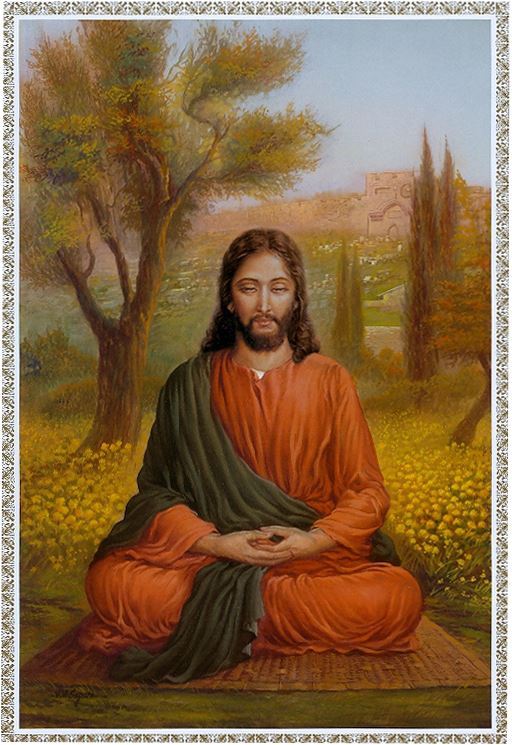
Did Jesus meditate?

Did Jesus meditate?
Did Jesus meditate?

For me, the answer is he probably did. Let me preface this by stating the obvious: I don’t actually know for sure what Jesus did. I don’t even want to get into the ‘did Jesus exist’ debate in this post. But if we take the New Testament at face-value (I don’t want to get into this debate either) it seems to me that he did meditate, or at least engage in contemplative-meditative practices. Continue reading

Ramen with Ramana

image
Mushroom Ramen from Bone Daddies, London

Wandering through Soho (London), I decided to treat myself to something a bit different for lunch. I soon stumbled across Bone Daddies. Not being au fait with these things I had no idea what this place actually was (restaurant? clothes shop?), but it looked pretty cool. My ears quickly picked up on a few guitar riffs emanating from inside and peeking through the windows I could see a plethora of men with beards, women clad in skin-tight pre-distressed jeans and thick rimmed black spectacles to boot. Oh, and they were eating – it seems that Bone Daddies is a restaurant after all. Continue reading

A rant: kicking spiritual seekers in the balls

“And yet, even as I speak, Subhuti, I must take back my words as soon as they are uttered, for there are no Buddhas and there are no teachings.”

Buddha, Diamond Sutra

I’ve been reading several blogs and other writings aimed at spiritual seekers who have everything laid out so clearly. They have the map to spiritual enlightenment all put together ready for mass consumption. They say things like you are Pure Consciousness or Pure Awareness.

All the concepts are lined up ready to be taught by the bearded guru and gobbled up by the next willing namaste-wielding student greedy for the big E. Here, let the Kunjed Gyalpo metaphorically kick the spiritual-seeker-in-you in the balls (if you’ll forgive my sexism): Continue reading