Q. Isn’t it the ego that wants to turn within or end the ego? | Why we need to turn within | Advaita Paradox

Q. Isn’t it the ego that wants to turn within or end the ego?

Tom: yes, it is only the ego, also known as thought or mind, that requires a teaching or needs to turn within.

Because the ego-I is an unreal illusion and doesn’t really exist, when it turns within towards the Subject or I AM, the ego and all multiplicity/duality disappear and the (true) Self is revealed as Self by the Self.

Through (the ego) turning within, the Reality that is Eternal Timeless Thoughtless Bliss-Love is revealed. This Reality is what you are, what you have always been, and is beyond words, but the above words (…thoughtless bliss…) are just used as indicators.

Without turning within, it is merely the ego proclaiming ‘there is no ego’ or ‘all is already perfect’ or something similar, and the teaching remains on the superficial levels of concepts and words only, and the illusion of suffering and duality continue.

As long as ego-mind-thoughts persist, there is need for effort or spiritual practice (sadhana), for ego-mind-thought is duality, ego-mind-thought is suffering.

As long as separation or multiplicity is perceived in any way shape or form, there is need for effort or sadhana.

As long as identification with body-mind continues (and therefore desire, fear and suffering continue), there is need for effort or sadhana.

However the Self itself is beyond any such efforts!

Oh, the paradox! However, turn within towards your Self, towards I AM, towards the Subject, and all these paradoxes will be resolved and dissolved in the Reality-That-Is.

❤️

Also see:

Q. Why turn within? Nonduality as I have experienced it is the actual disappearance of what is considered within and without, one seamless blending

Q. Doesn’t the notion of ‘turning within’ to find yourself create an artificial duality? All is already one! | Self-Enquiry | Atma Vichara

HOW TO END EGO-SUFFERING (and why other spiritual paths tend not to ultimately work)

Emptiness vs Fullness

Sometimes non-duality is described as nothing or emptiness. But this is only from the point of view of the mind. In truth, non-duality is total and utter fullness, it is not empty in the least.

It is the total cessation of suffering, it is the total extinction of multiplicity, duality and individuality.

It is beyond words but we can call it unchanging incomparable fullness-beingness-bliss or love absolute.

You intuitively already know this in your heart | Self-Knowledge | Advaita Vedanta | Non-duality

This knowledge is already fully within you

All the Spiritual Knowledge you ever need is already within you (it actually is you). What is this Spiritual Knowledge? It is knowledge of what you truly are, namely Pure Ever-Blissful Ever-Full Eternal Formless Spirit.

You already fully know this

You already know this. You have always eternally known this. This knowledge has always been within you, intuitively, meaning non-verbally ie. NOT knowledge in the mind and NOT knowledge known by a person. It is innate inborn knowledge that cannot be lost, ever, and does not need to be gained ever.

If you look within, take the time to really feel, then perhaps you will intuit that you have always known that you are infinite, formless and divine, beyond time and space.

Intuitively you have always known that you are not merely flesh and bone, you are not this mere body and mind.

You do not need any new knowledge or understanding in the mind for this path.

So, what’s the problem?

Well, in truth there is no problem, and there never has been, and never will be (no problems are real, and time such as past and future are also not actually real)…and you already intuitively and deeply know that there is no problem…but…

…But so long as you believe the limiting ideas thrown out by the mind – and all the mind’s ideas are limiting – then you will consider yourself to be limited. You will consider yourself to have name and form, you will consider yourself to be flesh and blood, and to be subject to birth, disease, suffering and death. You will consider the world to be real and you will consider problems to be real.

In Truth you are Spirit Divine, Eternal, Lumonious, Blissfull, devoid of time, space, individuality, devoid of one iota of suffering, devoid of one iota of multiplicity or duality, ever whole, pure, pristine Beauty and Love.

This ‘knowledge’ is not in the mind – no body or mind is required for this ‘knowledge

As I said, you know this already – ‘in your heart’ – meaning intuitively this is known, ie. this is not known and can never be known with the mind or with concepts/thoughts, but it is always known in your Heart or Being.

Your True Nature always knows itself to be Divine, fully. This knowledge does not require and body or mind, both of which, together with the world, are non-existent and unreal.

In truth there is no you and me. There is only ONE, THAT. And ‘we’ are THAT ONE.

The only ‘issue’ (not that there really is any issue) is that we take on wrong concepts, believing ourselves to be a body-mind entity living in a world when actually these are all false and non-existent In Truth.

‘Ignorance’

All ‘we have to do’ to realise this is lose the wrong concepts, lose the wrong beliefs, which means to stop attending to them, to stop paying attention to the body + mind + world, especially our thoughts and concepts. All we have to do is have faith in our own innate unborn non-mental non-conceptual knowledge of what we are, and attend to and nurture that intuitive-faith-knowingness-self.

Then, as ignorance slips away, all will eventually be seen to be One and Yourself, Shining as Pure Consciousness, initially with Objects Present (Savikalpa, with forms or with objects) and then in its pure Divine Form devoid of objective phenomena (Nirvikalpa, without form or without objects).

‘Self-Knowledge’

This is Self-Knowledge devoid of a shred ignorance, this is what already IS, this is what you already are, this is what is already and eternally intuitively known ‘in the heart’, meaning never with the mind.

The Self always fully knows itself to be Divine and Full, without words, without a body and without a mind – ignorance never really ever was.

If anything is needed, all we have to do is to nurture and attend to this intuitive self-knowledge. It is the guru, it will teach us, it will reveal itself to us.

‘The Teaching’

Therefore the teaching is simply: KNOW THYSELF or BE THYSELF or ATTEND TO THYSELF or HAVE FAITH IN AND NURTURE YOUR OWN INNATE INTUITIVE KNOWING/KNOWLEDGE

Ignore body/mind/world and see/intuit only consciousness-beingness-love-bliss. Attend to your beingness-knowingness, which is Self-Knowledge. Nurture, stoke and tend to this intuitive knowing – it will grow and consume everything. This is what you truly are.

And of course, you know all of this already

Namaste

❤️🕉

Knower, knowing and known are all ego | Self-Knowledge | Jnana

True Knowledge is Being devoid of knowledge as well as ignorance of objects. Knowledge of objects is not true knowledge.

~ Forty Verses on Reality, Verse 12, written by Sri Ramana Maharishi

—–

In Self-Knowledge, neither the knower, the knowing, or the known remain. If any of these three remain, that is ego, that is duality, that is suffering.

So how can this even be called ‘knowledge’? Know that the word ‘knowledge’ is just used to signify that thoughtless non-dual intuition of Reality that is Self.

It, the Self, is indescribable, so various words and phrases, all insufficient, are used, such as ‘knowledge’, ‘know thyself’, ‘be thyself’, etc, etc. None of these are quite right, but these words and phrases can convey something nonetheless, for you ‘know’ this already. You already fully know yourself, so these words can seemingly awaken you to that which you already know.

—–

To know the Self is just to, having severed the identity with body-mind-name-form-ego, it is just to BE the Self, that which you ARE.

—–

Self-knowledge is an inherent quality of the Self. Self and Self-Knowledge are one and the same. The Self always fully knows itself. You always fully know what you are. Not that the ego or mind knows – that is maya – but the Self, that which you are, always knows itself non-conceptually, without words, without any mediation by the body or mind.

—–

This can never be known by the mind-ego. That is why even brain-damage will not remove self-realisation – because self-realisation is not related to the body-mind! Realisation ‘takes’ one ‘beyond body-mind-world! If it didn’t, it would itself be temporary, and liberation is neither temporary nor is it affected by time!

—–

The Self is Self-Knowledge. But because there is no other that the Self, it cannot be said to be knowledge really, for there is no knower/knowing/known!

❤️🙏❤️

Q. Tom, what do you think of neo-advaita?

Questioner: Tom, what is your view on some of the Neo-Advaitists who do not seem to agree that there is a Self? All I hear from them is ‘there is only what is; there is no self’?

Tom: If you find these types of teaching helpful, meaning if they provide you with some kind of ease/happiness/peace/fulfilment/a sense of freedom, then that is good, and in that case I encourage you to engage with them as there is likely to be something of value there for you.

However my sense is that for the most part they are not truly liberating teachings but are predominantly spoken of from the mental/intellectual level. But what do I know! It is for you to decide what is right for you. What do you think?

Questioner: I’ll be totally honest with you. I can find some peace of mind with many ‘spiritual’ teachings. For instance I sometimes envy my Christian friends who seem so sure they will be spending eternity in heaven, but I left Catholicism and I can never believe that again. With Buddhism and nonduality I see different views within each, some saying there is a self, others denying self.

For me I can navigate life somewhat with some peace and happiness, but there always seems to be the ultimate fear of death no matter what. The neo-Advaitists say they have conquered death because they’ve died already, so to speak. But isn’t that throwing the baby out with the bathwater? So many contradictions.

In Buddhism some say the ‘self’ reincarnates, some, like Zen say there is no such thing. For Ramana is the Self immortal? What Self is there after death? Is it just silent and empty? You say it is found in deep sleep. But deep sleep is still ‘on this side’, in life. It is not the same as death. How can one know death while alive? How is one certain I AM is not also impermanent? Isn’t Ramana’s Self also an objectification? Like I doubt the truth of my Christian friends’ heaven, I always doubt that Self.

Tom: Yes, I had all these same doubts as you. My idea was to keep on searching until I found something that gave me all the answers I was looking for. The problem is that you will not find such a thing! There are always unanswered questions and problems with all spiritual systems and teachings on the conceptual level if you are intellectually probing/questioning enough.

However for me what then happened is that I unexpectedly fell in love with Sri Ramana Maharshi, and started to develop faith in his teachings (even though I perceived many ‘flaws’ and problems with his teachings). However, it was following his teachings with faith and love and devotion, despite the apparent problems with the teachings, that allowed all my doubts and questions to be answered and resolved so that now none remain. So this is what I share now.

Namaste

Spiritual, emotional and non-dual guidance & counselling with Tom Das

For the last seven years I have been actively guiding people in their spiritual, emotional and human journeys. From non-duality and spiritual experiences, to helping people through relationship and practical issues, I have met with hundreds of people and have pretty much seen it all!

It’s a deep honour and privilege for me to assist people in this way.

If you feel moved to, you can now book a 1 to 1 session with me directly using this link.

To find out more about what I offer, pricing, etc, please see this link here.

Namaste & best wishes

Tom

Sattvic, Rajasic and Tamasic Spirituality | Sri Ramakrishna Paramhamsa

(Understanding this can be a great help on the spiritual journey, my comments are in red)

Question. What is the difference between the Sattvic, the Rajasic and the Tamasic ways of worship?

Sri Ramakrishna:

The man who worships from the very depth of his heart without the least ostentation or vanity is a Sattvic worshipper.

Tom: the sattvic (peaceful) worshiper is the highest form of worshiper, pure of heart and of intent. They do not make a great grand show of their spirituality and care not for outer forms, unlike the rajasic one:

The man who gives much attention to decorating his house, makes much fuss about music and dancing, and makes all costly and elaborate arrangements for a rich feast when celebrating the worship of the Deity, is a Rajasic worshipper.

Tom: the rajasic (passionate) worshipper tends to be concerned more about appearances, pleasure and activity. They may pay great attention to decoration, dress, ceremony, outward appearance and what others think of them. They may tend to wear spiritual-looking clothes and have spiritual-looking paraphenalia and accesories and make a show of spiritual-looking rituals. They may look and sound more spiritual than they actually are. Still lower than them is the tamasic one:

The man who immolates hundreds of innocent goats and sheep on the altar, has dishes of meat and wine for offerings, and is absorbed only in dancing and singing while conducting worship, is a Tamasic worshipper.

Tom: The tamasic (dull) one here is essentially shows to be a hedonist, one who is interested in sense-pleasures and, for this end, they are willing to abuse their own body (eg. with excessive food and wine) and engage in immoral activity (eg. the unnecessary slaughtering of animals) in order to satisfy their wants and apetites.

~ Sayings of Sri Ramakrishna no. 239

——–

Tom: whilst the above may perhaps sound judgemental, I think it is better not to think of it in this way: we can instead see them as descriptions of stages of spiritual growth that many of us often go though, and each stage often has a role to play:

eg. in the tamasic stage, we are often dealing with supressed emotional pain and trauma, in the rajasic stage we are often developing self-esteem and self-worth, and in the sattvic stage we are learning to be more peaceful and pure, perhaps having already healed ourself of many of our psychological traumas and developed a healthy sense of self-esteem.

We can also use this as a way to guage where spiritual teachers/groups/teachings themselves are – are they sharing a tamasic, rajasic or sattvic type of spirituality?

These 3 (sattva, rajas and sattva) are known as the 3 energies of Maya or the 3 gunas.

Have you found this teaching to be helpful for you? Please leave a comment to let me know…

Also see:

The three energies (three Gunas)

A True Teacher Doesn’t Foster Dependence | The Three Gunas | Shedding Negative Self-Concepts

Q. I genuinely understand the teachings but still egoic tendencies arise. What can I do?

Ramana Maharshi: The path to Self Realisation (includes teachings on the Self, the mind, rajas and tamas, vasanas and Samadhi)

Pure sattva is the Self | Ramana Maharshi

Q. How to recognise a True Spiritual Teacher?

Tom: If we are honest with ourselves and earnest in our desire for freedom, we will only find the teacher/teaching that is right for us at any one particular time. We will only be able to discern the true teacher according to the wisdom that is flowing through us, which is inversely proportional to the strength of our ego-mind. However, more important than the teacher is the seeker – as long as your heart is pure and you are discerning, open and self-honest, then you will certainly find your way 🙏

Spend time in Reality, not in Illusion

(As much as you are able to)

Spend time in Reality,

Not in illusion.

_________________________

*Reality: Unchanging & Unmoving Silence, Stillness, Formless Objectless Consciousness-Being-Love-Bliss-Awareness devoid of body-mind-world. ie. Attending to the Subject-Self

*Illusion: Maya, the three states, name and form, identifying as a body-mind living in a world. ie. Attending to name & form & objects.

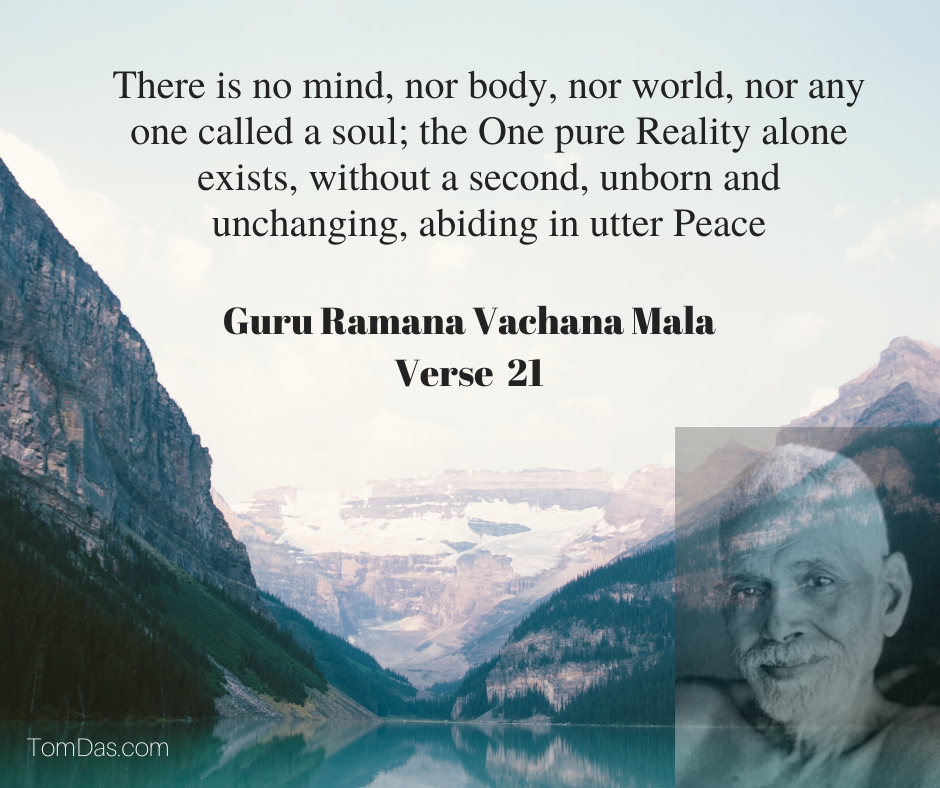
No body, no mind, no world

All that which is seen or perceived is an utter illusion. In reality there is no body, no mind and no world. There is only the One Formless Blissful Reality and You Are That. This must be discovered for oneself. The Reality, That which you ARE, which is unseen, is often overlooked, ignored.

When this is pointed out, those overly-attached to their individuality – ie. those overly attached to the notion of being a particular body-mind and their worldly life – they may cite this as being an offensive, impractical or life-denying teaching. In doing this they miss the Eternal Life of Unending Bliss!

But do not concern yourself with all of this: of course, this is all part of the illusion, the dream…Have faith in Bhagavan Sri Ramana and His Teachings and His Grace…press on with your Sadhana!