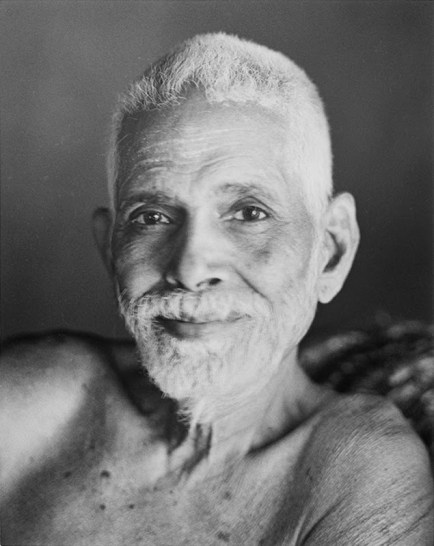
Ramana Maharshi: seeing a Lion in a Dream

ramana-maharshi face
Sri Ramana Maharshi

That questioner said, “The ancients say that for a person who wants to know that real state sadhana, sravana, manana, and nididhyasana are absolutely necessary till the very end.”

Tom: traditionally the means to liberation is said by vedantins to consist of sravana (listening to the teachings), manana (contemplating upon the teachings) and nididhyasana (meditation).

Bhagavan replied, “They are necessary only to get rid of the various things that come from outside and that too for purposes of sadhana only, but not for realising the Self. One’s own self is there at all times and in all places.

Sravana, etc., are to be resorted to only to get rid of external influences, but if they are regarded as the most important things they will be the cause of the development of the feelings of ahankara [egotism or doership], such as ‘I am a pandit’ (learned man), ‘I am a great man’ and the like. That is a big samsara [cause of suffering]. It is difficult to get rid of it later on. It is bigger than a wild elephant. It will not yield ordinarily.

Tom: Ramana states here that the Self is ever-present and ever-realised. There is no need for sravana, manana or nididhyasana for realisation, only to remove ignorance. Sravana, manana or nididhyasana do not lead to Self-Knowledge or Realisation! Realisation is always present! Conversely, if this is not understood and it is thought that sravana, etc will lead to realisation, this will cause immense suffering as the sense of ‘me’ is perpetuated.

“For that wild elephant, it is said that Guru Kataksham (the Grace of the Guru) is like seeing a lion in its dream,” said the questioner.

“That is true. If an elephant sees a lion in its dream, it wakes up startled and will not sleep again that day for fear that the lion might appear again in a dream. In the same way in a man’s life which is also akin to a dream, it is not Guru Kataksham alone, but also sravana, manana, nididhyasana, etc., that are akin to the sight of a lion in a dream.

Tom: Ramana here agrees that the guru’s grace is like a dream lion which wakes up the elephant who is dreaming of it.

…With some surprise, that questioner said, “Are sravana etc. and Guru Kataksha akin to dreams?”

“Yes, that is so. For those who realise the truth, everything is akin to a dream…

… When you are able to understand your state which had been existent all the time, you will then understand that all the rest is like a dream. When that is known, the feeling that the Guru is different from you will disappear.

Tom: Ramana states that both the guru’s grace and the teaching are both like dreams. You are That!

The above were excerpts taken from Letters from Sri Ramanasramam, 18th May 1947.

The Ten most important verses of Shankara’s Vivekachudamani according to Sri Ramana Maharshi

ramana-maharshi face
Sri Ramana Maharshi

Ramana Maharshi stated that Shankara’s text Vivekachudamani contains in detail all the points required for a seeker of liberation ‘thereby directing them to the true and direct path‘.

Vivekachudamani contains 580 verses. Ramana Maharshi evidently placed this text in high regard, so much so that he translated the entire text into Tamil for those who could not read or understand the original Sanskrit. He also selected what he felt were the ten most important verses, which are as follows:

The ten most Significant Verses From Sri Sankara’s Vivekachudamani

As selected by Sri Ramana Maharshi

1. Among things conducive to Liberation, devotion (Bhakti) holds the supreme place. The seeking after one’s real nature is designated as devotion. (Verse 31)

2. The Supreme Self, the eternal, indivisible, non-dual Consciousness, the Witness of buddhi and the rest, is other than the real (Sat) and the unreal (asat), and is the ultimate significance of the notion conveyed by the term ‘I’. It is the immediate Reality, the embodiment of Bliss. (Verse 351)

3. Different from matter (prakriti) and its modifications is the Supreme Self, of the nature of pure Knowledge. It is Absolute and directly manifests the entire gross and subtle universe, in waking and other states, as the substratum of the steady sense of egotism. It manifests Itself as the Witness of the intellect (buddhi). (Verse 135)

4. That which clearly manifests itself in the waking, dream and deep sleep states; that which shines inside uniformly and continuously as I-I; witnesses the ego, the intellect etc, which are of different forms and modifications; which shines as Eternal bliss (nitya ananda) and consciousness (chit), know this, within your heart, as your own Self. (Verse 217)

5. With a regulated mind and a purified intellect, directly know yourself as the essential Self, in the form ‘This I Am’. Cross the shoreless ocean of worldy existence (samsara) with its waves of births and deaths. Firmly established as Brahman, which is your own true essence, be blessed (Verse 136)

6. The self-shining witness (sakshi) of everything, this Atman shines eternally, in the sheath of the intellect (vijnanakosha). Making this Atman, which is distinct from the unreal, the aim of contemplation, meditate upon It as your own Self, eliminating all other thoughts (Verse 380)

7. Extremely subtle is the Truth of the Self Supreme, and it is not discernible to the gross vision (of the mind). It is knowable to the noble-minded of very pure intellect, through samadhi, brought about by an extraordinarily subtle mind. (Verse 360)

8. Thus purified by constant practice when the mind merges with Brahman, then Samadhi passes from the Savikalpa stage [where objects still arise] to the Nirvikalpa stage [where no objects arise], leading directly to the experience of the Bliss of Brahman, the Non-dual. (Verse 362)

9. By this [Nirvikalpa] Samadhi are destroyed all the knots of vasanas and all karma is destroyed. One‘s Real Nature (swarupa) manifests spontaneously and effortlessly, forever, everywhere and always, within and without. (Verse 363)

10. In the cave of the intellect, there is the Brahman, the Supreme non-dual Reality, distinct from [relative] truth (sat) and untruth (asat). One who dwells in this cave as Brahman has no rebirth*. (Verse 266)

*Tom: The literal rendering of this last line of verse 266 is a play on the word ‘cave’ and states ‘One who dwells in this cave as Brahman does not enter into the cave of the body’. The ‘word ‘cave’ is used in the Upanishads to describe the location of Brahman, whilst ‘cave of the body’ refers to the mother’s womb, which in turn refers to rebirth in samsara and continued suffering.


Sri Ramana Maharshi also said that the entirety of Advaita Vedanta can be found in in verse 170 of Vivekacudamani:

170. In dreams, when there is no actual contact with the external world, the mind alone creates the whole universe consisting of the experiencer, etc. Similarly in the waking state also, there is no difference. Therefore all this [phenomenal universe] is the projection of the mind.

New Sunday Online Satsang!

Tom Das online satsang

I am very happy to announce that I will now be holding ONLINE Satsang every Sunday at 3pm UK time (cost £5) in addition to the usual Thursday Satsang at 8pm UK time (cost £10). Further details can be found here.

All are welcome to attend and it’s easy to join if you have not done so before:

To join simply make a payment of £5 beforehand here: www.tomdas.com/donate

Then click here at the meeting time to join: https://zoom.us/j/9409264979

(If you have never used Zoom before it will prompt you to download the program onto your computer/phone/tablet)

I look forward to seeing you soon!

Tom

Note: nobody will be turned away due to inability to pay. In this situation please contact me if you would like to attend.

Disclaimer:
Meetings and sessions are not intended as a substitute for professional therapy, medical care, or legal advice. Please consult a licensed professional in these matters. Group meetings are usually recorded and may be shared publicly at a future date. Please read the full disclaimer at www.tomdas.com/disclaimer

Ramana Maharshi quoting Shankara on Bhakti (The path of love and devotion)

In talk number 428 from the book Talks with Sri Ramana Maharshi, Ramana Maharshi selects 10 verses from Sivananda Lahari, a devotional work of 100 verses written by Sri Sankara. In it, Bhakti is described, and Ramana has provided his own free translations of the meaning of the verses. So, here in the following text we have in effect a combined statement on Bhakti from both Shakara and Ramana!

!Praise and blessings to Sri Ramana and Sri Shankara!

ramana-maharshi face
Sri Ramana Maharshi


(1) What is bhakti?

Just as the ankola fruit falling from the tree rejoins it or a piece of iron is drawn to magnet, so also thoughts, after rising up, lose themselves in their original source. This is bhakti. The original source of thoughts is the feet of the Lord, Isvara. Love of His Feet forms bhakti. (Verse 61)

(2) Fruit of bhakti:

The thick cloud of bhakti, formed in the transcendental sky of the Lord’s Feet, pours down a rain of Bliss (ananda) and fills the lake of mind to overflowing. Only then the jiva, always transmigrating to no useful end, has his real purpose fulfilled. (Verse 76)

(3) Where to place bhakti?

Devotion to gods, who have themselves their origin and end, can result in fruits similarly with origin and end. In order to be in Bliss everlasting our devotion must be directed to its source, namely the Feet of the ever blissful Lord. (Verse 83)

(4) Bhakti is a matter only for experience and not for words:

How can Logic or other polemics be of real use? Can the ghatapatas (favourite examples of the logicians, meaning the pot and the cloth) save you in a crisis? Why then waste yourself thinking of them and on discussion? Stop exercising the vocal organs and giving them pain. Think of the Feet of the Lord and drink the nectar! (Verse 6)

(5) Immortality is the fruit of Devotion:

At the sight of him who in his heart has fixed the Lord’s Feet, Death is reminded of his bygone disastrous encounter with Markandeya and flees away. All other gods worship only Siva, placing their crowned heads at His feet. Such involuntary worship is only natural to Siva. Goddess Liberation, His consort, always remains part of Him. (Verse 65)

(6) If only Devotion be there – the conditions of the jiva cannot affect him.

However different the bodies, the mind alone is lost in the Lord’s Feet. Bliss overflows! (Verse 10)

(7) Devotion always unimpaired:

Wherever or however it be, only let the mind lose itself in the Supreme. It is Yoga! It is Bliss! Or the Yogi or the Bliss incarnate! (Verse 12)

(8) Karma Yoga also is Bhakti:

To worship God with flowers and other external objects is troublesome. Only lay the single flower, the heart, at the feet of Siva and remain at Peace. Not to know this simple thing and to wander about! How foolish! What misery! (Verse 9)

(9) This Karma Yoga puts an end to one’s samsara:

Whatever the order of life (asrama) of the devotee, only once thought of, Siva relieves the devotee of his load of samsara and takes it on Himself. (Verse 11)

(10) Devotion is Jnana:

The mind losing itself in Siva’s Feet is Devotion. Ignorance lost! Knowledge! Liberation! (Verse 91)