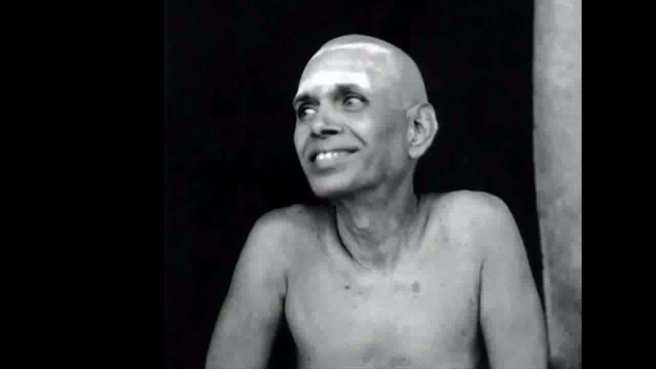
The following is taken from Talks with Sri Ramana Maharshi, talk 371. My comments are interspersed in red italics, any bold text has been added by me for emphasis:
The first part of this talk is about the path of yoga:
There was a group of three middle-aged Andhras on a visit to Sri Bhagavan. One of them kneeled and asked: I am performing hatha yoga, namely basti, dhauti, neti, etc. I find a blood vessel hardened in the ankle. Is it a result of Yoga?
Ramana Maharshi: The blood-vessel would have hardened under any circumstances. It does not trouble you as much now as it would otherwise. Hatha yoga is a cleaning process. It also helps peace of mind, after leading you to pranayama.
First Bhagavan Ramana states that Hatha yoga has likely been beneficial to the questioner. Ramana has also hinted that it is a purification or ‘cleaning’ process which helps the mind to become peaceful, and is but one of several steps towards liberation. The questioner continues, asking about pranayama or the yogic practice of controlling the breath:
Questioner: May I do pranayama? Is it useful?
Ramana Maharshi: Pranayama is an aid for the control of mind. Only you should not stop with pranayama. You must proceed further to pratyahara, dharana, dhyana and samadhi. Full results are reaped finally.
Make no mistake, Ramana is stating that pranayama, or formal control of the breath, is a useful practice. He states it is helpful for controlling the mind, but one must not stop there but should proceed to pratyahara (withdrawal of the senses), dharana (concentration), dhyana (meditation) and samadhi (the presence of vivid awareness without thoughts or other mental impressions arising). Practitioners of yoga will recognise that this sequence represents the final four stages of yoga as prescribed by Patanjali the Yoga Sutras in which eight stages are outlined and prescribed. Ramana is essentially stating that he is in agreement here with Patanjali, emphasising this with the final part of his statement ‘full results are reaped finally’.
Now Ramana is asked about how to overcome negative mental tendencies:
Another of the group asked: How are lust, anger, acquisitiveness, confusion, pride and jealousy overcome?
Ramana Maharshi: By dhyana.
Questioner: What is dhyana?
Ramana Maharshi: Dhyana is holding on to a single thought and putting off all other thoughts.
Dhyana is a sanskrit word that is usually translated as ‘meditation’. Ramana, at least here in this passage, is clear: dhyana, or meditation, is the way. Traditionally the last three of Patanjali’s eight limbs or stages of yoga are grouped together: dharana (concentration) is when the mind is trained to become one-pointed and an object of choice is concentrated on. Dhyana (meditation) is when this concentration intensifies and remains unbroken. Lastly Samadhi is when this concentration intensifies and the object of concentration is dropped, so that all that remains is a vivid-free-spacious-awareness in which the notion of ‘I’ and ‘other’ or the subject-object duality is no longer present.
Now Ramana is asked about the technique of meditation:
Questioner: What is to be meditated upon?
Ramana Maharshi: Anything that you prefer.
Questioner: Siva, Vishnu, and Gayatri are said to be equally efficacious. Which should I meditate upon?
Ramana Maharshi: Any one you like best. They are all equal in their effect. But you should stick to one.
The key point here is that one should meditate. Specifically, this means one should, according to Sri Bhagavan Ramana, concentrate on an object of choice. What the object is matters not, just choose something that you like the most, and then stick to it (Siva, Vishnu and Gayatri are traditional objects of meditation). Ramana has already told us above that pranayama and pratyahara are useful aids to this meditation, but that we should then proceed to the real heart of yoga: meditation.
How exactly should this be done, and why/how does this work?
Questioner: How to meditate?
Ramana Maharshi: Concentrate on that one whom you like best. If a single thought prevails, all other thoughts are put off and finally eradicated. So long as diversity prevails there are bad thoughts. When the object of love prevails only good thoughts hold the field. Therefore hold on to one thought only. Dhyana is the chief practice.
Ramana is emphasising one-pointedness of mind.
A little later Sri Bhagavan continued: Dhyana means fight. As soon as you begin meditation other thoughts will crowd together, gather force and try to sink the single thought to which you try to hold. The good thought must gradually gain strength by repeated practice. After it has grown strong the other thoughts will be put to flight.
This is the battle royal always taking place in meditation. One wants to rid oneself of misery. It requires peace of mind, which means absence of perturbation owing to all kinds of thoughts. Peace of mind is brought about by dhyana alone.
Questioner: What is the need then for pranayama?
Ramana Maharshi: Pranayama is meant for one who cannot directly control the thoughts. It serves as a brake to a car. But one should not stop with it, as I said before, but must proceed to pratyahara, dharana and dhyana. After the fruition of dhyana, the mind will come under control even in the absence of pranayama. The asanas (postures) help pranayama, which helps dhyana in its turn, and peace of mind results. Here is the purpose of hatha yoga.
Here above, Bhagavan Ramana has in brief outlined both the technique of yoga and its mechanism of action. If one wants to end suffering, one needs peace of mind (bolded text above). How to achieve peace of mind? Ramana states that the only way is through dhyana, or sustained concentration (also bolded text above).
The earlier of the eight steps of yoga, such as those dealing with yogic physical exercises and postures (asana) and breath control (pranayama) are important and helpful aids to attain the higher goal of meditation. Initially these earlier stages are required, but later on they are no longer required.
So, what happens as our dhyana strengthens?
Later Sri Bhagavan continued:
When dhyana is well established it cannot be given up. It will go on automatically even when you are engaged in work, play or enjoyment. It will persist in sleep too. Dhyana must become so deep-rooted that it will be natural to one.
Many people ask how can one combine spiritual practice with daily life. Bhagavan Ramana has indirectly answered this question above: through regular formal practice of dhyana, the beneficial effects spill over into both active daily life and also even during sleep. The Dhyana must become deeply rooted in our hearts and minds.
Now the questioner, having heard both the essential method of yoga, namely dhyana, and also heard about the aids to attaining dhyana, namely asana, pranayama and pratyahara – the questioner still seems to have some doubts which are posed in the next three questions:
Questioner: What rite or action is necessary for the development of dhyana?
Ramana Maharshi: Dhyana is itself the action, the rite and the effort. It is the most intense and potent of all. No other effort is necessary.
This question is about rituals – what rituals and efforts are required. Ramana says the ritual and effort required is that of dhyana. Just get on and start. Another doubt:
Questioner: Is not japa necessary?
Ramana Maharshi: Is dhyana not vak (speech)? Why is japa necessary for it? If dhyana is gained there is no need for anything else.
Japa refers to the verbal repetition of a sound or phrase, like mantra repetition. Again, Ramana directs the questioner to just stick to dhyana.
Questioner: Is not a vow of silence helpful?
Ramana Maharshi: A vow is only a vow. It may help dhyana to some extent. But what is the good of keeping the mouth closed and letting the mind run riot. If the mind be engaged in dhyana, where is the need for speech? Nothing is as good as dhyana. Should one take to action with a vow of silence, where is the good of the vow?
Seemingly infinite in his patience, Ramana continues to direct the questioner away from potential superficialities and towards the key message: ie. the need to get on and practice dhyana. He emphatially states ‘nothing is as good as dhyana’. May a vow of silence be helpul? Certainly. Better still is to practice meditation, dhyana.
Now the questioner turns to the path of knowledge, or jnana-marga (jnana means knowledge, marga means path). There is a mistaken view amongst some that jnana-marga does not require meditation, which is why I suspect the questioner has asked this question, even though the scriptures in jnana-marga clearly indicate the need for meditation:
Questioner: What is jnana-marga?
Ramana Maharshi: I have been saying it for so long. What is jnana? Jnana means realisation of the Truth. It is done by dhyana. Dhyana helps you to hold on to Truth to the exclusion of all thoughts.
For such a long time now Ramana, together with the vedic scriptures, has stated that dhyana is the means to jnana, or realisation of truth. If this is true, then what about all the Gods?
Questioner: Why are there so many Gods mentioned?
Ramana Maharshi: The body is only one. Still, how many functions are performed by it? The source of all the functions is only one. It is in the same way with the Gods also.
Just as a single body performs a variety of functions, so the One Being appears to expresses itself as many things and processes, including all the many gods.
Now, why does one suffer?
Questioner: Why does a man suffer misery?
Ramana Maharshi: Misery is due to multifarious thoughts. If the thoughts are unified and centred on a single item there is no misery, but happiness is the result. Then, even the thought, “I do something” is absent; nor will there be an eye on the fruit of action.
Continuing on the same theme of dhyana, ie. making the mind one-pointed and remaining there, Ramana states this is the way to end suffering. Suffering is caused by the multitude of thoughts, but a one-pointed mind leads to happiness and peace. When the mind is one-pointed to the exclusion of all other thoughts, the notion of personal doership, itself a thought/concept, is abandoned, as is the attachment to outcomes of actions (‘fruit of action’).
Om Namo Bhagavate Sri Ramanaya Om



 Tom Das