Q. Dear Tom, I hope you are well. How can one control the mind? Simple English please!
Tom: There are basically two ways of doing this. First of all by various practices to calm the mind and generate peace, of which there are different types (see the link below). Secondly by insight, which means seeing that there is no mind, or no thinker/doer entity, only a spontaneous succession of thoughts.
These two methods usually work together in tandem, like a virtuous circle, one helping the other which in turn helps the other, and so on.
Insight alone is usually not stable and leads to an ‘enlightenment’ that comes and goes, and calm/peace alone is not ultimately liberating, as peace also comes and goes. Both of these alone are not ultimately satisfactory. However the two together usually work wonderfully well.
I’ve written some blog posts here that goes into a bit more detail about some of this, so please take your time to read through these if you want to:
The following is a translation of a poem attributed to Seng-ts’an, the Third Ch’an (zen) Patriarch. I could write more about it, but all I will say is that it is truly sublime and one of my favourites.
This version of the text has been translated by Richard B. Clarke
Enjoy
❤
Hsin Hsin Ming or Trust in Mind Sutra
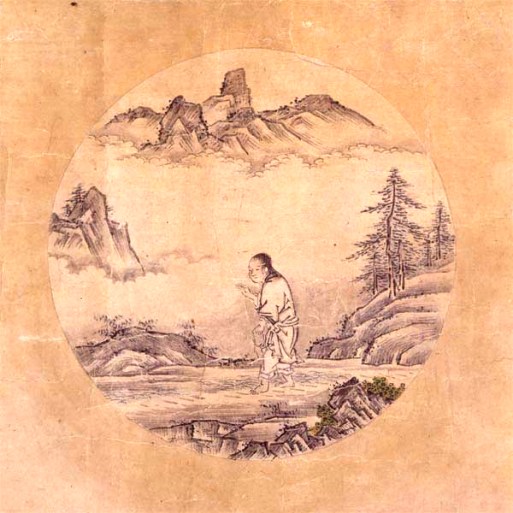
Oxherding picture number 2: noticing the footprints
The Great Way is not difficult
for those who have no preferences.
When love and hate are both absent
everything becomes clear and undisguised.
Make the smallest distinction, however,
and heaven and earth are set infinitely apart.
If you wish to see the truth
then hold no opinions for or against anything.
To set up what you like against what you dislike
is the disease of the mind.
When the deep meaning of things is not understood
the mind’s essential peace is disturbed to no avail.
The Way is perfect like vast space
where nothing is lacking and nothing is in excess.
Indeed, it is due to our choosing to accept or reject
that we do not see the true nature of things.
Be serene in the oneness of things
and such erroneous views will disappear by themselves.
When you try to stop activity to achieve passivity
your very effort fills you with activity.
As long as you remain in one extreme or the other,
you will never know Oneness.
Those who do not live in the single Way
fail in both activity and passivity, assertion and denial.
To deny the reality of things is to miss their reality;
to assert the emptiness of things is to miss their reality.
The more you talk and think about it,
the further astray you wander from the truth.
Stop talking and thinking
and there is nothing you will not be able to know.
To return to the root is to find the meaning,
but to pursue appearances is to miss the source.
At the moment of inner enlightenment,
there is a going beyond appearance and emptiness.
The changes that appear to occur in the empty world
we call real only because of our ignorance.
Do not search for the truth; only cease to cherish opinions.
Do not remain in the dualistic state; avoid such pursuits carefully.
If there is even a trace of this and that, of right and wrong,
the Mind-essence will be lost in confusion.
Although all dualities come from the One,
do not be attached even to this One.
When the mind exists undisturbed in the Way,
nothing in the world can offend,
and when a thing can no longer offend,
it ceases to exist in the old way.
When no discriminating thoughts arise,
the old mind ceases to exist.
When thought objects vanish, the thinking-subject vanishes,
and when the mind vanishes, objects vanish.
Things are objects because there is a subject or mind;
and the mind is a subject because there are objects.
Understand the relativity of these two
and the basic reality: the unity of emptiness.
In this Emptiness the two are indistinguishable
and each contains in itself the whole world.
If you do not discriminate between coarse and fine
you will not be tempted to prejudice and opinion.
To live in the Great Way
is neither easy nor difficult.
But those with limited views
are fearful and irresolute;
the faster they hurry, the slower they go.
Clinging cannot be limited;
even to be attached to the idea of enlightenment is to go astray.
Just let things be in their own way
and there will be neither coming nor going.
Obey the nature of things
and you will walk freely and undisturbed.
When thought is in bondage the truth is hidden,
for everything is murky and unclear.
The burdensome practice of judging
brings annoyance and weariness.
What benefit can be derived
from distinctions and separations?
If you wish to move in the One Way
do not dislike even the world of senses and ideas.
Indeed, to accept them fully
is identical with true Enlightenment.
The wise man strives to no goals
but the foolish man fetters himself.
There is one Dharma, not many;
distinctions arise from the clinging needs of the ignorant.
To seek Mind with discriminating mind
is the greatest of all mistakes.
Rest and unrest derive from illusion;
with enlightenment there is no liking and disliking.
All dualities come from ignorant inference.
They are like dreams of flowers in air: foolish to try to grasp them.
Gain and loss, right and wrong;
such thoughts must finally be abolished at once.
If the eye never sleeps,
all dreams will naturally cease.
If the mind makes no discriminations,
the ten thousand things are as they are, of single essence.
To understand the mystery of this One-essence
is to be released from all entanglements.
When all things are seen equally
the timeless Self-essence is reached.
No comparisons or analogies are possible
in this causeless, relationless state.
Consider motion in stillness
and stillness in motion;
both movement and stillness disappear.
When such dualities cease to exist
Oneness itself cannot exist.
To this ultimate finality
no law or description applies.
For the unified mind in accord with the Way
all self-centered striving ceases.
Doubts and irresolutions vanish
and life in true faith is possible.
With a single stroke we are freed from bondage;
nothing clings to us and we hold to nothing.
All is empty, clear, self-illuminating,
with no exertion of the mind’s power.
Here thought, feeling, knowledge, and imagination are of no value.
In this world of Suchness
there is neither self nor other-than-self.
To come directly into harmony with this reality
just simply say when doubt arises, “Not two.”
In this “not two” nothing is separate,
nothing is excluded.
No matter when or where,
enlightenment means entering this truth.
And this truth is beyond extension or diminution in time or space;
in it a single thought is ten thousand years.
Emptiness here, Emptiness there,
but the infinite universe stands always before your eyes.
Infinitely large and infinitely small;
no difference, for definitions have vanished
and no boundaries are seen.
So too with Being and non-Being.
Waste no time in doubts and arguments
that have nothing to do with this.
One thing, all things;
move among and intermingle,
without distinction.
To live in this realization
is to be without anxiety about nonperfection.
To live in this faith is the road to nonduality,
because the nondual is one with the trusting mind.
Words!
The Way is beyond language,
for in it there is no yesterday, no tomorrow, no today.
What is the ego?
Will you accept my definition or find out for yourself?
Stop, be aware of what is happening:
Notice the content of your thoughts.
Notice the feelings that accompany the thoughts:
Is there tension and stress in a particular thought?
Or is there a freedom,
A space where thought is free to move,
Free to come and go as it pleases?
And what is the ego?
What does it feels like?
What kind of energy does it bring into the physical organism?
Be open to feel this ego:
Get a sense of what it feels like in its many guises.
Relax and let it in.
Notice a cascade of thoughts and feelings:
When they are believed in and invested in,
The egoic thoughts weave an apparently believable story line,
But when seen for what it is,
Inherently empty of any self,
Just empty thoughts coming and going,
With some associated sensations,
And perhaps an interpretive thought accompanying and interpreting what the ‘feelings mean’.
Notice there may be an urge to get out of the ego,
A movement of thought that attempts to end the ego may occur,
And notice that this is simply more of the ego,
More of this activity based on this false sense of self,
Based on this false notion of separation.
When things are seen for what they are,
And allowed to unfold as they are,
And illusion born of thought is no longer believed in,
What remains?
Q. Hi Tom, often you talk about spiritual teachings as something you have to do, like a spiritual practice such as devotion or enquiry, but in my experience the most effective spiritual teachings are not really teachings or prescriptions but the best teachings are descriptions. Does that make sense? What are your thoughts?
Tom: Hi _____, yes that’s a really good point, especially as you near the end of your spiritual search or spiritual journey, descriptions become more important than prescriptions. Essentially the higher teachings are descriptions and the lower teachings are prescriptions. Let me explain:
Descriptions
The higher teachings simply describe your normal everyday experience, pointing out the Freedom that already is. This is why some higher teachings are called pointers. They are pointing out what already is the case.
They are not saying you need to do anything or become anything, they are not saying you have to improve in some way, but are pointing out the illusion of separation that when believed in causes suffering. Examples include statements like ‘there is no separate self’, ‘there is no doer’, ‘there is only god’, ‘all is one’, ‘awareness always is’.
These teachings are descriptions. These descriptions can trigger an insight, or in-seeing, into something about life as it already is, but has thus far not been recognised/realised.
Prescriptions
Now the prescriptions, the lower teachings: these teachings tell you that you have to do something, they prescribe you something do to, such as meditation, chanting, physical exercises, be near the guru or some other kind of action to do. Prescriptions are instructions to be carried out by the body mind. They are often teachings for the ego, and are something for the ego to do, and so may serve to perpetuate the ego and can often actually reinforce the sense of self/ego/separation.
Prescriptions are instructions to be carried out by the body mind. They are often teachings for the ego, and are something for the ego to do, and so may serve to perpetuate the ego and can often actually reinforce the sense of self/ego/separation.
Perhaps implicit in this type of teachings is that you are not quite good enough as you are and that you have to improve or change in some way. There is also, perhaps, the idea of spiritual progress here, the idea of a path that can be travelled and a destination to be reached. All this is implied in prescriptive practices.
Notice that I write ‘perhaps’ and ‘often’ because practices are not necessarily bad, as I explain below.
Prescriptions as descriptions
There is also a third way of looking at this, which is that teachings that prescribe certain activities or practices can also be seen to be descriptions when looked at in another way, and so what appears to be a lower teaching can then be seen to be a higher teaching.
For example, the practice of mindfulness in which the seeker is instructed to ‘be mindful’ or ‘be aware of the present moment’ can be instead seen as a description of the way things already are, ie. awareness is already aware of whatever is being experienced, regardless of whether or not the mind is caught up in thoughts or not. The instruction of ‘be aware’ has been trumped by the pointer or description that ‘you are already aware’ or ‘awareness is already here.’
Similarly with ‘be unattached’, or ‘be loving’, or ‘be at peace’ – these prescriptions can be seen as descriptions of life as it already is, without having to lift a finger: ‘be unattached’ becomes a description of awareness that is already unattached and ever-free, ‘be loving’ becomes a description of awareness that already fully embraces, ‘loves’ and is one with the totality of every experience, and ‘be at peace’ points out that awareness is a synonym for peace in that it is a constant in a world of impermanent transitory objects. All things come and go, awareness just is. We could continue: the prescription ‘let go’ becomes a pointer at the fact that awareness has already ‘let go’ as it is and always has been unattached.
Descriptions are not necessarily better
As I said at the start of this answer, descriptions become more important towards the end of your seeking journey and they are essentially the higher teachings. Descriptions act as pointers that can trigger insight into the illusion of separation. Does this mean they are better? Many would say yes, but I disagree, at least partially. Both prescriptions (practices) and descriptions (pointers) are useful to different people depending where they are.
Practices are useful to purify the mind, reduce neurotic and addictive habitual tendencies, which results in a calm and peaceful mind that is able to better understand the pointers. As the mind becomes calmer, more psychologically integrated and mature, and happier, the pointers work much better and can trigger a ‘shift’ as intended.
Practices are useful to purify the mind, reduce neurotic and addictive habitual tendencies, which results in a calm and peaceful mind that is able to better understand the pointers.
Here, where the mind is already relatively pure, happy and calm, pointers/descriptions become increasingly important. What is interesting is that most spiritual teachings in the public domain tend to be action orientated, ie. practices/prescriptions. Most people when they encounter spirituality never even hear of direct pointers or so-called radical non-duality, so in this context of lack, the pointing teachings/descriptions become even more important.
That said, many seekers do not possess calm, contended happy minds, and so a practice/prescription becomes much more important, at least initially. I often come across seekers who are addicted to the radical non-dual teachings but their minds are still gripped strongly by illusion and as a result the chaotic and addictive habitual tendencies of body and mind doesn’t allow the pointers to truly hit home apart from on the intellectual conceptual level. The pointers do not penetrate the heart as the heart is barricaded in by a barbed-wire fence of intellect and concepts, often non-dual concepts.
These seekers are often lured in by the possibility of a quick, easy and instantaneous enlightenment in which one single ‘ah-ha’ moment will result in the total annihilation and vapourisation of all their pain, suffering and negative habits into a giant puff of smoke, and they will emerge An Enlightened Master from the Instantaneous School of Awakening. And while that may apparently happen for some, for most a process of purification is required, both before and after awakening.
Non-dual prescriptions
Yes, purification is also often required after awakening, and this is why I said ‘perhaps’ above when talking about the prescriptive teachings. Even when the illusion of separation has been seen through, spiritual practices may still be useful. Here, after awakening, practices no longer perpetuate the ego or false sense of self/separation that may happen during seeking.
Just as an enlightened sage can take driving lessons to learn to drive or buy an electric toothbrush to better clean their teeth, they can also utilise spiritual, physical and psychological practices to make their lives more comfortable on the social, physical and psychological levels.
Now practices fulfil a practical function. Just as an enlightened sage can take driving lessons to learn to drive or buy an electric toothbrush to better clean their teeth, they can also utilise spiritual, physical and psychological practices to make their lives more comfortable on the social, physical and psychological levels. They refine the body and mind and remove negative habitual tendencies which in turn results in less suffering on the relative level (of things or objects) and eases the flow of energy in the body. This improves alignment with life and also improves social and physical functioning as a result. As the mind is purified, psychic and intuitive channels are also allowed to more fully open and wisdom can pour in this way too. Lastly, it is this purifying aspect of the teaching that leads to a more ethical way of living and is the link between love, ethics and spirituality.
Lastly, it is this purifying aspect of the teaching that leads to a more ethical way of living and is the link between love, ethics and spirituality.
I often describe this as a process of heart opening in which the conceptual understanding sinks down into the energetic and emotional heart and eventually the knot of the ego is cut when the egoic tendencies have been removed, either by life or with the additional help of a more formal spiritual practice. Here the sense of individuality is lost at an energetic level as well as the intellectual knowing, but the perspective of the body-mind continues as long as the body-mind lives.
Descriptions can also purify
Pointers and descriptions, whilst their primary purpose is to trigger insight or recognition into an aspect of ordinary life that was previously overlooked, they can also have a purifying function, that is they can also have a role in removing negative habitual tendencies which is the usual role of spiritual practices.
This works by being exposed to pointers repeatedly over a length of time. Over time, the pointers seep into the mind of a seeker, infiltrating the mind’s hidden depths, slowly rooting out false thoughts and notions based in ignorance, slowly rooting out ignorance. Then one day a critical mass is reached and the penny drops, the bottom of the bucket of water falls out and the illusion of separation is seen through. If the seeker-finder now continues to expose themselves to the pointers, even though the essential insight/realisation has occurred, these same pointers can have a purifying function in removing residual and vestigial habitual tendencies that may still cause discomfort and suffering on the phenomenal level (ie. the everyday world of objects in which the person/we live)
Gradual vs sudden path
Basically what we have been talking of here have historically been called the gradual and sudden paths to enlightenment. The gradual path is sometimes called the progressive path, and the sudden path can be called the instantaneous path or no-path school. Pointers may form part of the sudden school, whereas practices predominate in the gradual paths. There have been arguments between these ways of looking at enlightenment teachings and technologies/practices for many centuries across various traditions, most notably Buddhist schools.
Hopefully in this answer I have outlined how these two approaches can be utilised together to maximise success in achieving both insight into the Freedom that is already here, as well as remove the negative addictive habitual tendencies that perpetuate relative suffering and egoic decision-making.
Purification and insight
Purification takes time and energy – it occurs at the level of the body and mind and results in a maturation in the psychological and energetic domains. I liken it to weeding a garden. Insight is quick, takes little energy, and most readily occurs in a relaxed but awake and aware state of mind relatively free of thoughts. I liken it to looking up and noticing for the first time the sky that was always there.
Purification involves change and improvement of the body-mind; insight is noticing that which was always there, but was overlooked.
Don’t all practices just perpetuate the false-self? (Seeking vs teaching)
Now I’m sure many will disagree with what I am saying. Particularly the staunch non-dualists, those who say no practice is required and say that all practices just strengthen and reinforce the false-notion of separation/self.
However I have always been interested in what actually works and am not really one to cling to dogma. It was when I started sharing or ‘teaching’ this that I really came to realise how important practices are. Of course, there is such a lack of pointing/descriptive type teachings in the common public domain, this form of direct pointing inevitably becomes very valuable, especially to those seasoned seekers who have not encountered it before.
However I have always been interested in what actually works and am not really one to cling to dogma. It was when I started sharing or ‘teaching’ this that I really came to realise how important practices are.
However I have seen many seekers who need to learn to relax, learn to be more positive and deal with their psychological issues first, as these are the overriding issues that are causing suffering and preventing insight from occurring. Whilst dealing with these psychological issues first is not always necessary, it does make the awakening process much easier for most, as when the false sense of self is seen through, what can initially happen is that the ego/mind reacts with fear and anxiety. However if these fears and anxieties have largely already been dealt with, then the awakening to no-self becomes much smoother and easier.
Often what happens is that as a seeker becomes more advanced and purified, the direct pointings become more important and it is these that are ultimately liberating. When the seeker becomes a finder, often they stress the importance of the teachings that directly led to their own realisation – ie. the direct pointings.
However to ignore the indirect teachings, or practices and gradual path, we do a disservice to those who need them, and we may also prevent further purification post-insight from occurring.
However to ignore the indirect teachings, or practices and gradual path, we do a disservice to those who need them, and we may also prevent further purification post-insight from occurring.
Some final words
Whilst I try to map some of this out in order to aid seekers, especially those who are unable to find the answers they are looking for in a teacher or teaching, I acknowledge that the path is different for everyone. These are some general trends and I am sharing what I know. I hope you find these words useful. Don’t cling to them too much either and remember this is difficult, if not impossible to put into words.
Best wishes to you and please contact me or join me in one of my online meetings if you think I can be of service.
Q. Hi Tom, thank you so much for sharing your experiences through your blog. It’s very helpful. In my journey I have learned a lot from the folks you have read Ramana Maharshi, Kirshnamurti, etc. I have experienced the sense of oneness almost like a peaceful black hole, and this feeling is now always accessible to me, although the strength of it varies. This access has changed how I experience life and a lot of suffering has diminished.
However I have a pretty intense, stressful leadership job and I find that my reactions to some people that I think are not being effective in my jobs is just as intense as it used to be before I found this state. I find myself suffering in navigating these situations, but I have to address these types of problems as a natural part of my job responsibilities.
Is there some guidance you can share that might nudge me to navigate this differently? I really suffer every time I confront this situation, and I have found myself making good decisions but causing pain to both myself and the people who are impacted by this decision. I know you are busy, but anything you can nudge me on would be helpful. I want to stay in the world and be effective in whatever role I am playing at the time, but want to not cause suffering to me or others in my path.
Tom: Thank you for your kind words and sorry it has taken me some time to respond. It’s great that your suffering has reduced and that you have instant access to that state of peace whenever you need to take shelter there.
I think I understand what you mean by the situation you face at work. As you know, I also have a job and family life and am in some ways very much in the world.
With these kinds of issues, there is no one fixed solution that works for everyone. I can give you some suggestions, but it is for you to experiment and find what works for you.
My recommendation is to start the day with a sense of gratitude, perhaps even a formal ‘giving thanks’ meditation session/puja in the morning to start the day.
The following is the last few verses of Advaita Bodha Deepika, a classical vedanta text that summarises the theories and methods of vedanta. It was also a favourite text of Ramana Maharshi’s. Here is the culmination of the teaching, as stated in the last verses of Chapter 8.
(Note, if you are unsure about why this chapter starts in this way and why we are even discussing ‘extinguishing the mind’, have a look at this post here Advaita Bodha Deepika: Vital Teachings for Self-Realisation which explains the rationale behind this first question):
Disciple: How can the mind be extinguished?
Master: To forget everything is the ultimate means. But for thought, the world does not arise. Do not think and it will not arise. When nothing arises in the mind, the mind itself is lost. Therefore do not think of anything, forget all. This is the best way to kill the mind.
To forget everything is the ultimate means
D.: Has anyone else said so before?
M.: Vasishta said so to Rama thus: ‘Efface thoughts of all kinds, of things enjoyed, not enjoyed, or otherwise. Like wood or stone, remain free from thoughts.
Rama: Should I altogether forget everything?
Vasishta: Exactly; altogether forget everything and remain like wood or stone.
Rama: The result will be dullness like that of stones or wood.
Vasishta: Not so. All this is only illusion. Forgetting the illusion, you are freed from it. Though seeming dull, you will be the Bliss Itself. Your intellect will be altogether clear and sharp. Without getting entangled in worldly life, but appearing active to others remain as the very Bliss of Brahman and be happy.
Unlike the blue colour of the sky, let not the illusion of the world revive in the pure Ether of Consciousness-Self. To forget this illusion is the sole means to kill the mind and remain as Bliss.
Though Shiva, Vishnu, or Brahman Himself should instruct you, realisation is not possible without this one means. Without forgetting everything, fixity as the Self is impossible. Therefore altogether forget everything.’
…altogether forget everything and remain like wood or stone….Though seeming dull, you will be the Bliss Itself. Your intellect will be altogether clear and sharp.
D.: Is it not very difficult to do so?
M.: Though for the ignorant it is difficult, for the discerning few it is very easy. Never think of anything but the unbroken unique Brahman. By a long practice of this, you will easily forget the non-self. It cannot be difficult to remain still without thinking anything. Let not thoughts arise in the mind; always think of Brahman.
In this way all worldly thoughts will vanish and thought of Brahman alone will remain. When this becomes steady, forget even this, and without thinking ‘I am Brahman’, be the very Brahman. This cannot be difficult to practise.
Now my wise son, follow this advice; cease thinking of anything but Brahman. By this practice your mind will be extinct; you will forget all and remain as pure Brahman.
Never think of anything but the unbroken unique Brahman…When this becomes steady, forget even this, and without thinking ‘I am Brahman’, be the very Brahman. This cannot be difficult to practise.
Tom’s commentary:
It is not only Sage Vasistha who tells us we need to ‘forget all’. In the Ashtavakra Gita, sage Ashtavakra says in chapter 16, verse 1:
‘My son! You may recite or listen to countless scriptures, but you will not be established in the Self unless you forget all.’
Similarly Ramana Maharshi says in his text ‘Who am I?’:
‘Eventually all that one has learnt will have to be forgotten’
In the traditional path of Knowledge or Jnana, first we are to know our True Self (Atman) and know this to be the same as the Absolute (Brahman). Then we are to be still and renounce all desires.
This spiritual knowledge (Jnana) of ‘I am Brahman’ (Aham Brahmasmi) allows the mind to become still and desireless. Note this does not mean that the body becomes totally inert – no – rather it continues to function naturally according to its destiny (Prarabdha Karma) until the body dies.
Shankara states this multiple times, eg, in Vivekachudamani, and also in his many commentaries, eg. in his commentary upon the Kena Upanishad – in his introduction to the Kena Upanishad Shankara writes:
And [the Self] being eternal, it is not to be secured by any means other than the cessation of ignorance. Hence the only duty is to renounce all desires after the realisation of the unity of the indwelling Self and Brahman.
This is akin to Self-Surrender, as spoken by Sri Ramana Maharshi:
There is no destiny. Surrender, and all will be well. Throw all the responsibility on God. Do not bear the burden yourself. What can destiny do to you then?”
(Talks 244)
and again here:
Question: Surrender is said to be Bhakti [the path of devotional love]. But Sri Bhagavan [Ramana Maharshi] is known to favour enquiry [ie. the path of Knowledge or Jnana] for the Self. There is thus confusion in the hearer.
Ramana Maharshi: Surrender can take effect only when done with full knowledge. Such knowledge comes after enquiry. It ends in surrender.
Question: Jiddu Krishnamurti used to say that ‘Truth is a pathless land’. What are your thoughts on this?
Tom: Thanks for your question and sorry it’s taken me a while to respond. I’ve just re-read J Krishnamurti’s original ‘truth is a pathless land’ speech (see www.jkrishnamurti.org/about-krishnamurti/dissolution-speech.php) and it seems to me that the thrust of what he was saying was that truth is not to be approached by following an authority. The key word is following.
In the later part of the speech he says ‘But those who really desire to understand, who are looking to find that which is eternal, without beginning and without an end, will walk together with a greater intensity, will be a danger to everything that is unessential, to unrealities, to shadows. And they will concentrate, they will become the flame, because they understand. Such a body we must create…‘
So it seems to me Krishnamurti was saying that you cannot find freedom through following another, but by looking for yourself, which ultimately means to free yourself from beliefs and dogma.
I read Krishnamurti for many many years, and he did have a teaching that he kept on coming back to. In a way this was his teaching, or one of them. Here’s a post from 2015 which I ironically titled ‘Krishnamurti’s Method’, to drive the point home to people who are familiar with Krishnamurti’s writings: