Watch my Livestream with Conscious 2 here, originally filmed on 18th February 2016:
Non-duality
Love, happiness and non-duality
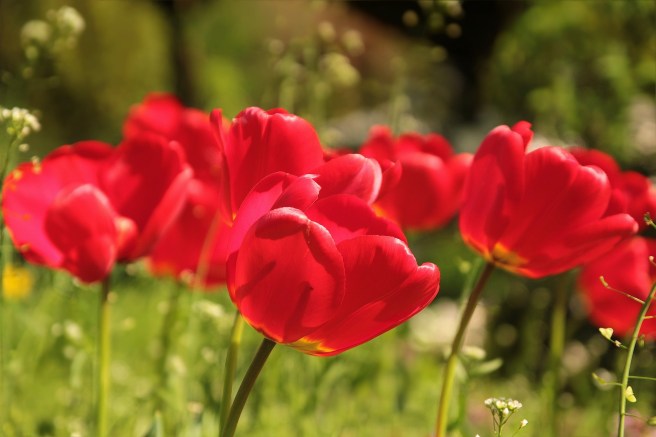
When the ego is seen through, all there is is what is. This is actually love, this is the real love.
Q. What is the relationship between love and non-duality?
A. Non-duality, as you call it, when it is fully seen, has nothing to do with trying to become more loving. But when the intrinsic-Freedom-that-already-exists is recognised, there is a tendency to become more loving, more open. Not that that actually matters. Openness and love are just what tend to happen when the illusion of a separate doer-entity is seen to be illusory. They are side effects.
Q. If in seeing this Freedom one tends to become more loving, then why do you say non-duality has nothing to do with being more loving?
A. This is about what is true, not what you want to be true. You may want to be more loving, more ethical or more whatever, but so-called ‘non-duality’ is about seeing what already is, right now. It is the ego or person that wants to become more loving, more ethical, more radiant, more popular, and so on. So the desire to be more loving is actually a subtle form of ego. ‘Non-duality’, or whatever you want to call it, is not about a continuation of the ego, but seeing that this ego is a fiction, that the sense of doership is an imagined belief without any evidence to underpin it.
It is the ego or person that wants to become more loving, more ethical, more radiant, more popular, and so on.
Who cares about love? Who cares about being ethical? It’s the ego of course. The ego cares, the doer-entity cares and it is the ego that wants to improve itself and therefore perpetuate itself. Ask yourself, ‘what is this entity that cares about being loving, being ethical?’. If you really are interested and you look, then it can become obvious that there is no ego there, it was all just a belief all along, a false belief. The story of doership is false.
Then all there is is what’s happening. Nobody doing anything, just what’s happening. I call this Freedom, but it doesn’t really have a name. It is simply what’s happening. It is simply the way things actually are, not they way you want things to be based on your projection which is in turn based on beliefs and concepts. It is the simplicity of life stripped clean of false notions and narratives, in which false notions are seen through as they arise.
I call this Freedom, but it doesn’t really have a name. It is simply what’s happening.
In Freedom, you don’t care about love, or any other projected ideal. You don’t try to be more ethical. Maybe you are more loving, maybe you are not. That’s why this automatically tends towards love – because there is no motive, because the ego is not at play. It may go against intuition but love does not care about love. Love just is when things are seen for what they are. To put it more poetically, in seeing truth (of no-self), love is.
In seeing truth, love is
Q. What about happiness?
A. Again, who cares about happiness? It’s the ego! The ego cares, and the ego is a fiction. Relax your mind and look for the ego – where is it? It is just empty thoughts, there is no entity there! But you have to really want to know the truth to see this: by that I mean that you have to be willing to drop all your ideas and concepts about yourself and your life. Then you really have to actually look – at least most people do. Some people just see this spontaneously, but all you have to do is notice what is already true.
When this is seen, that there is no ‘self-entity’, the neurotic drive for happiness naturally dissipates, and then Joy naturally arises. Why? Because the (neurotic) drive for happiness is actually a form of suffering. When there is no concern for happiness, then Joy naturally tends to manifest. A feeling of wellbeing may not always be there, but who cares? That’s just the way things are. No feeling-state or mind-state is permanent. Everything changes. Nothing lasts forever. Who cares? That’s the freedom.
Investigate the present reality instead of chasing a future projection.
When you are trying to get somewhere, you are chasing a projected ideal, something conceptual, not something actual. Instead of chasing the conceptual, why not remain with the actual, with what is actually happening now? Investigate the present reality instead of chasing a future projection. When the ego is seen through, all there is is what is. This is actually love, this is the real love. The lack of a centre, the lack of a doer, that’s what love really is. It’s not an emotion at all. It’s not necessarily even feeling loving, although that may happen when it’s appropriate.
When the ego is seen through, all there is is what is. This is actually love, this is the real love.
Without the ego at play, all there is is natural functioning. Emotions then act accordingly when they are required. It’s not healthy to be happy all the time, nor is it likely to be physiologically possible. Our varied emotions, fears and mental states are there to guide us as we navigate the world.
So, when the ego is seen through, this is what we could call love, although love is just a label for this as it actually is. This ‘love’ is not what most people mean by ‘love’. It is not an emotion, it includes everything that is happening, and it is not dependent on what is happening. It is un-conditional you could say. It is always here because it is none other that what is here. It is universal motion seeing through illusion. It is what is recognising what actually is.
Not mine
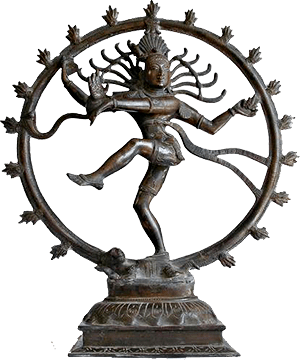
Nothing is mine.
I did not create
This world,
This body,
Or this mind,
With its thoughts.
They were all given to me.
Yes – even my thoughts were given to me.
None of it has anything to do with me.
Then I look at the ‘me’:
There is no me.
Only this,
None of it mine,
All of it moving.
When you do not cling

When you do not cling
There is no you.
Actually,
There never was a you.
You are just:*
Water in mirage,
The son of a barren woman,
The snake in a rope,
The moon in a pail of water.
*these are all traditional Indian metaphors used to describe our basic mistake (original sin)
You cannot become free

You cannot attain Freedom
-Freedom is here already.
You cannot become Free
– there is only Freedom.
Ramana Maharshi: Self-Realisation is simply being one’s self
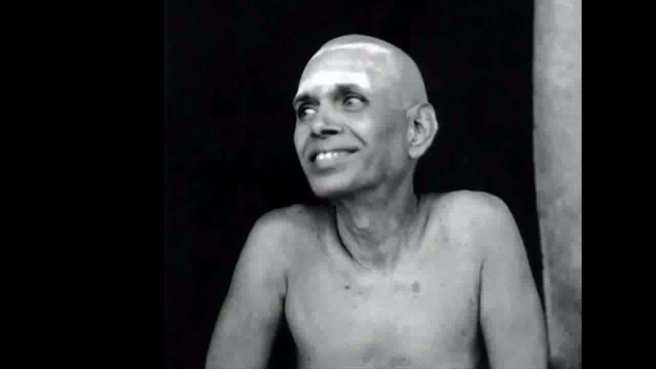
The state we call Realisation is simply being one’s self, not knowing anything or becoming anything.
If one has realised, one is that which alone is and which alone has always been. One cannot describe that state, but only be That.
Of course, we talk loosely of Self-Realisation for want of a better term.
Ramana Maharshi
(taken from the book Day by Day with Bhagavan, p. 296)
Tom’s comments:
Notice that the search for ‘understanding’ and the search for becoming ‘enlightened’ or ‘self-realised’ are both pursuits of the ego. The ego is looking for security and pleasure and has projected/created these fantasies which it tries to attain.
Instead of trying to attain a projected fantasy, why not instead look at what is actually happening? Look at yourself, look at the ego, the ‘I’. Ask yourself ‘what is this ego? Who am I?’ Investigate for yourself repeatedly and you will see that the ego, the ‘you’ is illusory – it’s just a bundle of thoughts that occur by themselves, spontaneously. ‘Your thoughts’ are not yours at all: note how you cannot chose to stop thinking, stop worrying, stop your addictions. You cannot chose to believe something you don’t. You cannot chose to not believe something you do believe. You cannot stop your ‘bad thoughts’. In fact you probably do not even know what exactly you will be thinking in 5 minutes time let alone tomorrow or 5 days from now.
Another point: if you happen to think you are a dinosaur, it doesn’t necessarily make you one. Similarly if you think that you are an ego (a doer, a thinker, an agent who has authorship over his/her actions), it doesn’t make it true. Yes, the idea of being a doer is just that: it is an idea, a belief that has been tacitly repeated to us and drummed into us since childhood. An oft-repeated lie is then (mistakenly) taken to be true.
In seeing this first-hand, there is no specific intellectual understanding or state of mind gained. It’s just that an illusion has been seen through, like seeing that a frightening snake is in fact just a harmless rope in poor light (or like realising that you are not in fact a dinosaur after all!).
No dogmas, no metaphysics, no complex body-twisting acrobatics, no beliefs and no rituals are necessary (although they may be a part of the apparent journey).
Then all there is is ‘what’s happening’, and what you thought was you is actually just a part of that happening. Or as Bhagavan puts it, all there is is ‘simply being one’s self’.
Free webstream talk: ‘Freedom from Suffering’
Do you want to watch me talk about this stuff? This Thursday I’ll be doing a live (and free) webstream with Conscious 2, find out more below:
http://www.conscious2.com/freedom-from-suffering/
http://www.conscious2.com/teachers/tom-das/
Only this spontaneous happening

This is too obvious for the mind.
We know nothing but this.
There is no process of knowing though:
Only this
Spontaneous happening.
Tibetan Buddhism: The Mind Instructions of Khenpo Gangshar
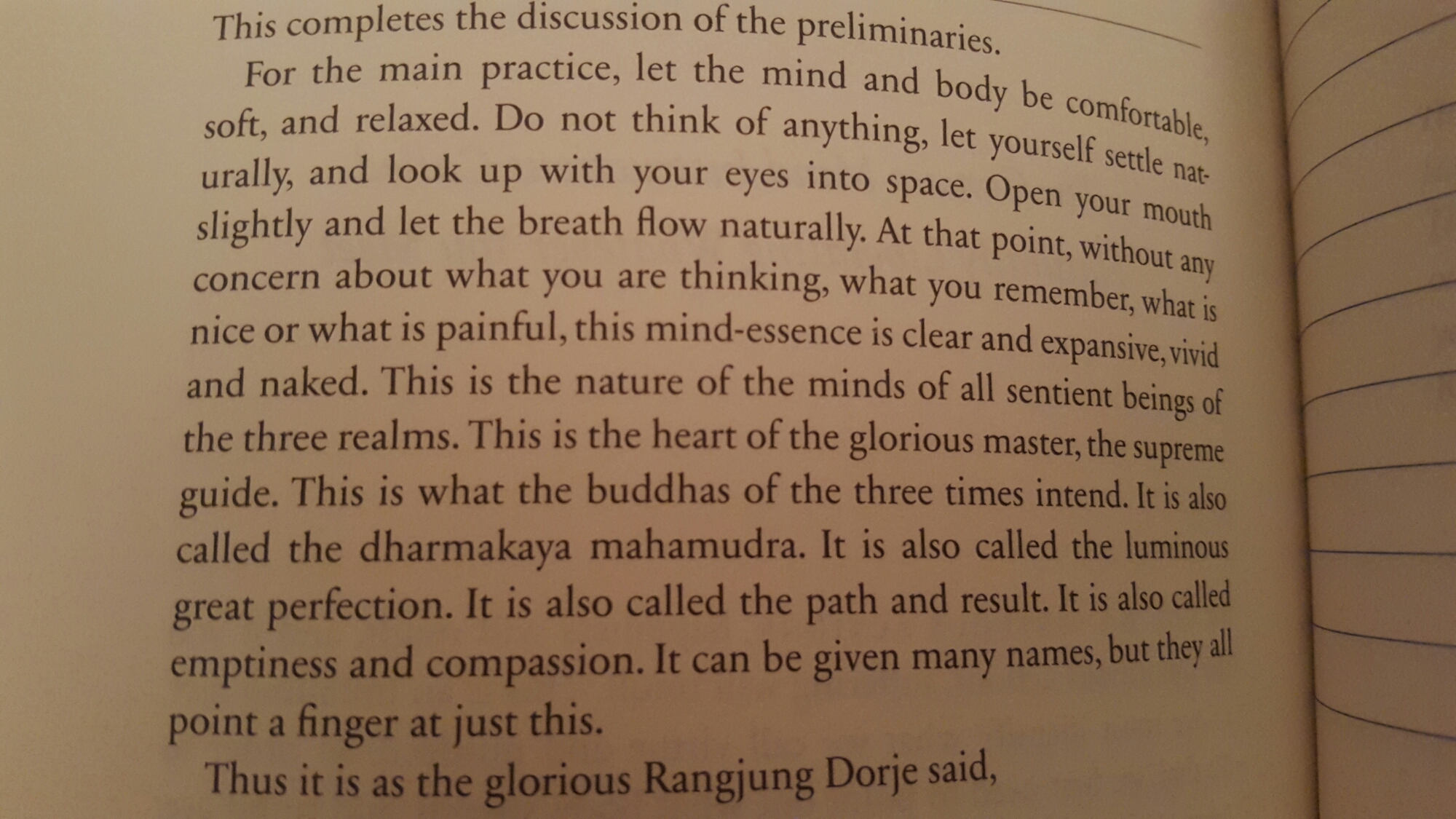
Above is an excerpt from a text called ‘The Concise Mind Instructions Called Naturally Liberating Whatever You Meet’ by Khenpo Gangshar, as found in the book Vivid Awareness by Khenchen Thrangu.
In this short text Khenpo Gangshar goes on to say:
Directly, whatever arises, do not change it – rest naturally. This fulfils the essence of all creation stages, completion stages, mantra recitations, and meditations.
This is the heart of the highest Tibetan Buddhist teachings: to rest naturally and be vividly aware. Just be. I would add that in this no sense of self is being created, and this is the practice. To simply be, and not to take yourself as being a ‘self’ or ‘doer’. To use a commonly used phrase in vedanta: do not take yourself to be ‘this or that’.
Khenpo Gangshar goes on to give advice on how to deal with difficulties along the way:
You must take sickness as the path, afflictions as the path, the bardo as the path, and delusion as the path. The heart of all these applications is to rest naturally in the essence.
This advice is very much in line with most of traditional Tibetan Buddhist teachings, but here it is stated in very concise form. When difficulties come along, just rest in your natural being. Don’t identify as being ‘this or that’, don’t start to create or believe in the concept of being a doer. This is the false concept that is rooted out and seen through in this practice.
When life throws us a challenge, don’t simply fall back into your old habits of self-identification. It is from this creation of an imaginary doer/self that all other afflictions and suffering follows. Instead, just rest, just be. Let your awareness shine, let it shine brightly. If the thought ‘I’ arises, let it, notice it, notice that it is empty and does not describe or pertain to any reality. There is no ‘I’, there is no self. Only the bright expanse of phenomena.
One final thought from me, a question:
Does any of this have anything to do with Freedom? Does Freedom depend on any practice? Does Freedom depend on any of this?
How spiritual teachings work

This is one of a series of introductory articles – please see the homepage of tomdas.com for more introductory articles.
Buddha’s raft
The Buddha likened his teachings to a raft that takes you from the shore of suffering (samsara) across the river to the shore of enlightenment (nirvana). When you get to the land on the other side, you do not carry the raft around with you – the raft would actually be an impediment on land.
The teachings are therefore provisional constructs and concepts and are not true in themselves. Ultimately we can let go of attachment both to the teaching and teacher once it has done its work.
If we fall in love with the teaching or teacher, this is not necessarily a bad thing. It can serve as a useful and positive motivation force, keeping our search and inquiry strong through both good and bad times, and may well continue after a genuine enlightenment. However I have often seen how the attachment to (and belief in) a teaching or teacher can impede a genuine realisation, as it can restrict our ability to freely inquire and see things as they really are.
‘Use a thorn to remove a thorn, then throw them both away’
In this Hindu saying, a thorn represents a concept that gives rise to suffering when it pierces our skin. The teachings are another concept/thorn that you can use to remove the first thorn from your body. However you must throw the teaching away too when it’s work is done, otherwise it simply becomes a thorn in your side that binds you.
Ramana Maharshi used to speak of his teachings as being like a wooden stick used to prod the burning carcass in the funeral pyre. Once the teaching has done its job of ‘burning the ego (sense of being a separate doer)’, the stick is also pushed into the fire and it too burns away.
‘Eventually, all that one has learnt will have to be forgotten’
Sri Ramana Maharshi
Kill the Buddha
There is a famous Zen teaching: “If you see Buddha on the path, kill him”. Don’t even let Buddhism and Buddha’s teachings get in the way. Let go of all concepts and liberation is there as it always has been.
This idea is similarly indicated in Hindu teachings such as in the Yoga Vasistha:
‘When you realise that which is indicated by the words, then naturally you will abandon the jugglery of words’
Yoga Vasistha
Expedient Means
In Mahayana Buddhism the term ‘expedient means’ (Sanskrit: upaya) is used to signify that the best teaching is the one that produces the result – ie. enlightenment. What is good for one aspirant may not be good for another, depending on where they each are. This is also why various teachings can appear contradictory and may not be true in themselves. The point is that the teachings are not necessarily true, but as long as they work that’s what matters.
Some of my analogies and thoughts on how teachings work
- The teachings are not themselves ultimately true. They are just words. But like a finger pointing to the moon, they point to something greater than themselves.
- Teachings use words and concepts to point to or indicate that which is beyond all words and concepts.
- The teachings are like a virus. Once you have heard them, they get to work within you, chipping away at false beliefs and in doing so the Truth is revealed.
- Like when matter and anti-matter collide, the teachings destroy false notions and then when its work is done, the teaching also self-destructs.
- We think we chose to read or hear the teachings and apply them. When we understand the teachings more fully, we realised that the teachings came to us, they were a gift to us, that they chose us, and they work their magic on us.
- If you cling to words of the teachings, it is a sure indicator you have not understood what they are pointing to. Eventually you have to go beyond the teachings. Excessive clinging to notions such as Absolute Consciousness or ‘You are the Witness’ or overly complicated metaphysics is a sure sign of not seeing the essence of what is being pointed to.
- The teachings are like a recipe – you follow the instructions and get the results. Until the food is made, you treasure the recipe for it is the gateway to your meal. Note that the cooked meal looks nothing like the recipe and you can throw away the recipe once you have mastered the cooking and are eating the meal. However, please don’t worship the recipe, please don’t (just) discuss recipes endlessly with your friends, and please don’t forget to do what it says!
 Tom Das