Questioner: When I look into myself, I find my strongest desire is to create a monument, to build something which will outlast me. Even when I think of a home, wife and child, it is because it is a lasting, solid, testimony to myself. Continue reading →
Most of the great spiritual traditions claim that there is something eternal and supremely infinite, something that is all-knowing, all-powerful and present everywhere (omniscient, omnipotent and omnipresent).
If that is the case, then this Infinite must already be here, right now. If it isn’t already present right now, then it is not omnipresent. This is a vital point to grasp – if there is such a thing as the Infinite, then it must already be fully here, right now, otherwise it is limited and therefore not infinite.
It is not that certain mystical or transcendental experiences are experiences of the Infinite but our normal everyday experiences are not. No, all our experiences must be of Him. We must always be experiencing the Infinite.
This has several ramifications for the spiritual seeker. This means that the problem we face is not that we are apart from God and need to find Him or experience Him. No, the issue is that we are already always experiencing God but do not know it.
The issue is not one of acquiring a special experience or state of mind. It is that we do not correctly understand our current experience as it is right now. Even traditions that do not admit a God such Buddhism acknowledge that understanding, or insight, is what is key:
“If you do not have insight into the way you yourself and all things actually are, you cannot recognize and get rid of the obstacles to liberation from cyclic existence, and, even more important, the obstructions to helping others.”
Dalai Lama (from How to See Yourself as You Really Are)
Armed with this knowledge, we can mature in our spiritual seeking. So-called materialistic or worldly life is characterised by chasing experiences such as pleasure, power, fearlessness, pride and security. Many spiritual seekers just transfer this same pattern of yearning for worldly experiences into their quest for spiritual experiences. However as we mature in our spiritual search we can stop chasing states of mind and experiences – all of which are temporary – and instead start to try and understand our direct experience as it is right now.
This understanding or insight, whilst based upon our direct experience, is not a search for a particular experience, but an understanding of experience itself.
“That is why the insight that can liberate you from these afflictions is the key to happiness…Insight brings love, and love is not possible without insight, understanding. If you do not understand, you cannot love. This insight is direct understanding, and not just a few notions and ideas.”
Questioner: As a child fairly often I experienced states of complete happiness, verging on ecstasy: later, they ceased, but since I came to India they reappeared, particularly after I met you. Yet these states, however wonderful, are not lasting. They come and go and there is no knowing when they will come back.
Nisargadatta Maharaj: How can anything be steady in a mind which itself is not steady?
Q: How can I make my mind steady?
M: How can an unsteady mind make itself steady? Of course it cannot. It is the nature of the mind to roam about. All you can do is to shift the focus of consciousness beyond the mind.
Q: How is it done?
M: Refuse all thoughts except one: the thought ‘I am’. The mind will rebel in the beginning, but with patience and perseverance it will yield and keep quiet. Once you are quiet, things will begin to happen spontaneously and quite naturally without any interference on your part.
Q: Can I avoid this protracted battle with my mind?
M: Yes, you can. Just live your life as it comes, but alertly, watchfully, allowing everything to happen as it happens, doing the natural things the natural way, suffering, rejoicing — as life brings. This also is a way.
Q: Well, then I can as well marry, have children, run a business… be happy.
M: Sure. You may or may not be happy, take it in your stride.
Q: Yet I want happiness.
M: True happiness cannot be found in things that change and pass away. Pleasure and pain alternate inexorably. Happiness comes from the self and can be found in the self only. Find your real self (swarupa) and all else will come with it.
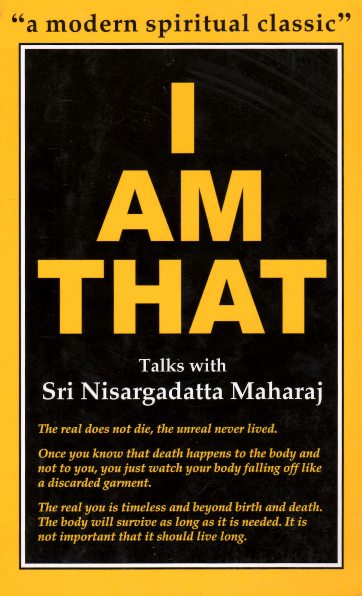
The above excerpt is from I Am That by Nisargadatta Maharaj
Tom’s comments:
There are so many gems in just this short passage! First Maharaj points out the mind need not be directly controlled and that the very nature of the mind is to roam, ruminate and be unsteady. Instead focus on something else: the sense ‘I AM’. Then the goal of a quiet mind will naturally arise.
Maharaj then gives us more: if we are not drawn to this sadhana (spiritual practice), then we can try an alternative. Instead we can surrender to whatever happens, keeping a watchfulness about ourselves whilst we do so. This, rather like the ‘I AM’ sadhana, also has the effect of quietening the mind and prevents the ego having room to manoevure. The ‘I’ which is always trying to meddle in things is cut off, restricted. There is much more to how these methods work and how they can be practised – I have written an article hereexplaining more on this.
Lastly Maharaj gives us a final nugget: ‘True happiness cannot be found in things that change and pass away.’
Experience, knowledge, insight and consciousness all come and go – so where does this leave us? Where can we seek if we do not seek in this world of impermanent things? Here we pass from the domain of the mind to that which is beyond words. Call it ‘true self’ (swarupa) or ‘no-self’, words do not apply.
What most people take themselves to be, the body-mind entity, is in fact a series of perceptions, images and sensations within consciousness, bound together by the (false) concept “I”.
The world too, as we experience it, is nothing but a play of consciousness, images and sensations rising and falling, creating the impression of a world. Continue reading →
The following is an excerpt from a book rather modestly titled ‘The Most Direct Means To Eternal Bliss’.
Despite some tendency towards grandiosity, this book is actually pretty amazing in my opinion. I think it was written as a labour of love and has been uploaded to the internet for free viewing by the author here. You can also buy a hard copy here which contains a single extra chapter (which was written later).
Be warned, this book and its tone may not be for everyone. It is radical, focused, in some ways quite narrow, and not at all modest. However the advice dispensed is actually very good in the context in which it was written and the teachings are made extremely clear. The initial chapters alone are worth the purchase price in my opinion (plus it’s free online anyway)
In this passage below Ramana Maharshi talks about the four traditional Hindu paths to ending suffering or moksha (liberation/freedom). The four paths are traditionally called the paths of knowledge (jnana), love or devotion (bhakti), meditation (raja yoga), and doing good works (karma).
Almost every spiritual tradition around the world will fit into one of more of these four paths Continue reading →
“And yet, even as I speak, Subhuti, I must take back my words as soon as they are uttered, for there are no Buddhas and there are no teachings.”
Buddha, Diamond Sutra
I’ve been reading several blogs and other writings aimed at spiritual seekers who have everything laid out so clearly. They have the map to spiritual enlightenment all put together ready for mass consumption. They say things like you are Pure Consciousness or Pure Awareness.
All the concepts are lined up ready to be taught by the bearded guru and gobbled up by the next willing namaste-wielding student greedy for the big E. Here, let the Kunjed Gyalpo metaphorically kick the spiritual-seeker-in-you in the balls (if you’ll forgive my sexism): Continue reading →
The following is an excerpt from ‘Selfless Self: Talks with Shri Ramakant Maharaj‘, page 15. To find out more, click on the hyperlinks above.
YOU ARE ALMIGHTY. ALMIGHTY GOD, OMNIPRESENT.
YOUR PRESENCE IS EVERYWHERE.
YOU ARE BEYOND THE SKY
THERE IS NO INDIVIDUALITY.
Questioner: [laughing] I find it hard to believe that this ‘little me’ is all of that! If I am all of that, as you say, how is it I am not aware of this? And if I’m not, then how can I start becoming aware of my Self?
Maharaj: How can I? There is no ‘I’ at all. There is no ‘You’ and there is no ‘I’. Everything is just like the sky. You see, even when the Master tells you that you are Almightly, that you are Ultimate Truth, you are not accepting it. You are not able to accept that Truth because you’re caught up in all sorts of illusionary thoughts. You are considering yourself as ‘little me’, and that is making you blind to your Innate Power.
The remedy for this, a very simple remedy for this, as I have said, is meditation. Meditation is the anti-virus for illusion.
How can we eloquently speak about life’s most precious and deepest aspects? Can we really say life is like this or like that? Can we fully describe what a sunset feels like, or can we fully convey our (my) mixed-up emotions when we hear about a devastating earthquake in Nepal? Even more basically, can we even begin to describe what it feels like to exist as a human being? It is easy to describe the parts of a car – we have a whole vocabulary for this – but the sense of existing that we all know and take for granted is more iffy.
It is almost as if the more basic and essential something is, the less easy it is to articulate, with complex and superficial matters being much easier to pin down.



 Tom Das