No sadhanas are required
No sadhana (spiritual practice) can lead to self realisation. No map can take you to where you already are, and no practice can transform you into that which you always have been.
All sadhanas such as meditation, mindfulness, mantra, puja, selfless service and devotion – all sadhanas are for the illusory individual. They are an extension of greed/egotism. It is this web of illusion, all hinged upon the idea of being a person with a body and mind, that prevents the obvious from being ‘seen’. Continue reading →
Ramana Maharshi: As I said already, that which is, is peace. All that we need do is to keep quiet.
Peace is our real nature. We spoil it. What is required is that we cease to spoil it. We are not going to create peace anew. There is space in a hall, for instance. We fill up the place with various articles. If we want space, all that we need do is to remove all those articles, and we get space.
Similarly if we remove all the rubbish, all the thoughts, from our minds, the peace will become manifest. That which is obstructing the peace has to be removed. Peace is the only reality.
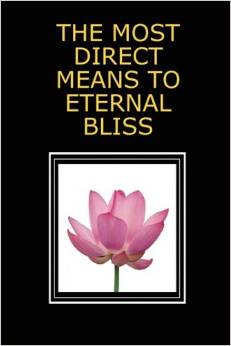
Here is another chapter from the book ‘The Most Direct Means to Eternal Bliss’. For my initial (and brief) opinion on this controversial but useful book click here. This chapter focuses on thought and how thought gets in the way of direct communion with that which lies beyond thought. Continue reading →
I recall walking in the gardens of a local convent in Autumn last year. After meandering around for a while I found my self standing by a tree. I looked up to see a dark angular leaf-less branch silhouetted against a luminous evening blue sky. There was complete stillness and a sense of vastness. The universe was functioning, but “I” was not there. Everything was happening by itself, seemingly magical and uncaused. The silence was deafening, as they say. The universe was, as ever, mysterious, strange and peaceful. It was both familiar and unfamiliar at the same time. Continue reading →
I was reading a passage from J. Krishnamurti’s slim book called meditations which reminded me of a passage from The Gospel According to Matthew. The language they use is strikingly similar. I’ll start with the biblical passage as it’s shorter:
But when you pray, go into your room, close the door and pray to your Father, who is unseen. Then your Father, who sees what is done in secret, will reward you.
Matthew 6:6
Questioner: When I look into myself, I find my strongest desire is to create a monument, to build something which will outlast me. Even when I think of a home, wife and child, it is because it is a lasting, solid, testimony to myself. Continue reading →
Most of the great spiritual traditions claim that there is something eternal and supremely infinite, something that is all-knowing, all-powerful and present everywhere (omniscient, omnipotent and omnipresent).
If that is the case, then this Infinite must already be here, right now. If it isn’t already present right now, then it is not omnipresent. This is a vital point to grasp – if there is such a thing as the Infinite, then it must already be fully here, right now, otherwise it is limited and therefore not infinite.
It is not that certain mystical or transcendental experiences are experiences of the Infinite but our normal everyday experiences are not. No, all our experiences must be of Him. We must always be experiencing the Infinite.
This has several ramifications for the spiritual seeker. This means that the problem we face is not that we are apart from God and need to find Him or experience Him. No, the issue is that we are already always experiencing God but do not know it.
The issue is not one of acquiring a special experience or state of mind. It is that we do not correctly understand our current experience as it is right now. Even traditions that do not admit a God such Buddhism acknowledge that understanding, or insight, is what is key:
“If you do not have insight into the way you yourself and all things actually are, you cannot recognize and get rid of the obstacles to liberation from cyclic existence, and, even more important, the obstructions to helping others.”
Dalai Lama (from How to See Yourself as You Really Are)
Armed with this knowledge, we can mature in our spiritual seeking. So-called materialistic or worldly life is characterised by chasing experiences such as pleasure, power, fearlessness, pride and security. Many spiritual seekers just transfer this same pattern of yearning for worldly experiences into their quest for spiritual experiences. However as we mature in our spiritual search we can stop chasing states of mind and experiences – all of which are temporary – and instead start to try and understand our direct experience as it is right now.
This understanding or insight, whilst based upon our direct experience, is not a search for a particular experience, but an understanding of experience itself.
“That is why the insight that can liberate you from these afflictions is the key to happiness…Insight brings love, and love is not possible without insight, understanding. If you do not understand, you cannot love. This insight is direct understanding, and not just a few notions and ideas.”
Questioner: As a child fairly often I experienced states of complete happiness, verging on ecstasy: later, they ceased, but since I came to India they reappeared, particularly after I met you. Yet these states, however wonderful, are not lasting. They come and go and there is no knowing when they will come back.
Nisargadatta Maharaj: How can anything be steady in a mind which itself is not steady?
Q: How can I make my mind steady?
M: How can an unsteady mind make itself steady? Of course it cannot. It is the nature of the mind to roam about. All you can do is to shift the focus of consciousness beyond the mind.
Q: How is it done?
M: Refuse all thoughts except one: the thought ‘I am’. The mind will rebel in the beginning, but with patience and perseverance it will yield and keep quiet. Once you are quiet, things will begin to happen spontaneously and quite naturally without any interference on your part.
Q: Can I avoid this protracted battle with my mind?
M: Yes, you can. Just live your life as it comes, but alertly, watchfully, allowing everything to happen as it happens, doing the natural things the natural way, suffering, rejoicing — as life brings. This also is a way.
Q: Well, then I can as well marry, have children, run a business… be happy.
M: Sure. You may or may not be happy, take it in your stride.
Q: Yet I want happiness.
M: True happiness cannot be found in things that change and pass away. Pleasure and pain alternate inexorably. Happiness comes from the self and can be found in the self only. Find your real self (swarupa) and all else will come with it.
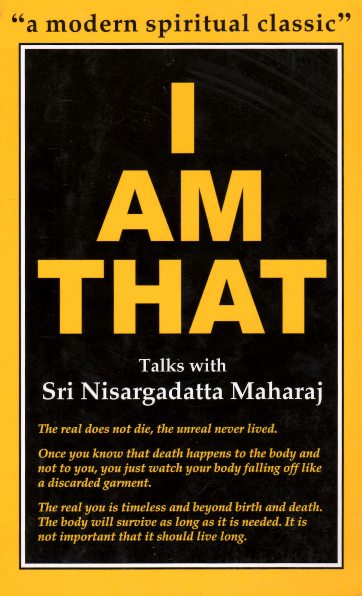
The above excerpt is from I Am That by Nisargadatta Maharaj
Tom’s comments:
There are so many gems in just this short passage! First Maharaj points out the mind need not be directly controlled and that the very nature of the mind is to roam, ruminate and be unsteady. Instead focus on something else: the sense ‘I AM’. Then the goal of a quiet mind will naturally arise.
Maharaj then gives us more: if we are not drawn to this sadhana (spiritual practice), then we can try an alternative. Instead we can surrender to whatever happens, keeping a watchfulness about ourselves whilst we do so. This, rather like the ‘I AM’ sadhana, also has the effect of quietening the mind and prevents the ego having room to manoevure. The ‘I’ which is always trying to meddle in things is cut off, restricted. There is much more to how these methods work and how they can be practised – I have written an article hereexplaining more on this.
Lastly Maharaj gives us a final nugget: ‘True happiness cannot be found in things that change and pass away.’
Experience, knowledge, insight and consciousness all come and go – so where does this leave us? Where can we seek if we do not seek in this world of impermanent things? Here we pass from the domain of the mind to that which is beyond words. Call it ‘true self’ (swarupa) or ‘no-self’, words do not apply.
What most people take themselves to be, the body-mind entity, is in fact a series of perceptions, images and sensations within consciousness, bound together by the (false) concept “I”.
The world too, as we experience it, is nothing but a play of consciousness, images and sensations rising and falling, creating the impression of a world. Continue reading →



 Tom Das