
Do not consider yourself to be limited

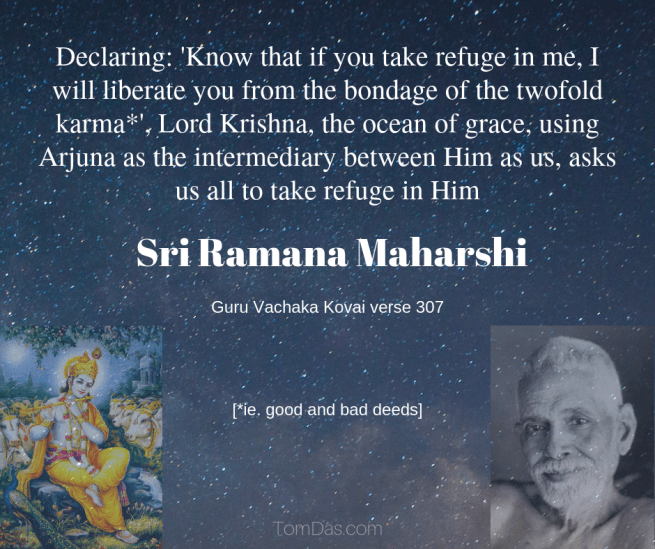
Sri Ramana Maharshi is better known for his teachings on Self-Inquiry. As a general rule he did not encourage guru worship and usually directed seekers towards Silence and Self-inquiry. However, he did speak about Bhakti (the path of devotion and love) on many occasions, and here are a few quotes:


One learns more and more that no number of objects we experience (this includes worldly objects, people, thoughts, feelings, experiences, praise, adoration, etc) will ever bring lasting satisfaction. These objects (which includes all experiences), each being temporary and limited, will bring only temporary and limited pleasures at best. This pleasure will inevitably end which results in stress and suffering as we try to prevent the ending of our association with the desired objects. So seeking fulfillment in objects results in the perpetuation of suffering, and this is learnt over and over again ever more deeply over the course of time.
Simultaneously, we realise that lasting fulfillment only comes from not-seeking, ie. when we are resting as our-Self in the Natural Condition. Again, this insight-realisation deepens and our conviction that this is true grows stronger over time, as we psychologically and spiritually mature.
How quickly we learn this depends on our ability to observe, listen, discern and learn the lessons life is teaching us (this is called Viveka in Sanskrit, often translated as discrimination or discernment, but also can be translated as wisdom).
This natural turning away from gross and subtle objects and dropping away of desire for them is known as dispassion or vairagya in Sanskrit, and this vairagya naturally occurs to spiritual seekers (ie. the ego) as they spiritually mature and internalise these above lessons.
When vairagya becomes fully mature there is just constant abiding as Self. Self is satisfied as Self, not needing pleasure or good feelings from ‘outside’ limited objects. The seeking mind (which is the egoic mind or the functioning of the separate ‘I’ concept), then never emerges and is eventually destroyed through sustained inactivity.
This total Vairagya is where the separate ‘I concept’ never rises and is essentially dead. This is known as destruction of the Mind (Manonasa) or extinction of the vasanas (the habitual egoic tendencies, the extinction of which is called Vasana Kshaya). It is also known as Self-Realisation (Atma Sakshatkara) or Self-Knowledge (Atma Jnana). It is not realisation or knowledge in the traditional sense, as there is not necessarily any knowledge in the mind. Rather it is the non-emergence of egotism (egotism is also known as ignorance or separation, so knowledge is simple the lack of ignorance or the lack of separation). It is also known as Silence (Mauna) or the Absolute (Brahman).
Bhagavan Sri Ramana Maharshi gives us a practical definition of Silence here when he states:
‘The Self is that where there is absolutely no “I”-thought. That is called silence [mauna]’ and again he states ‘That state in which the “I”-thought does not rise even in the least is silence [mauna].’
In the same vein Advaita Bodha Deepika states:
‘What is variously described as Knowledge [Jnana], Liberation [Moksha], etc., in the scriptures, is but stillness of mind.’
In the Amritabindu Upanishad it is written:
‘When the mind, with its attachment for sense-objects annihilated, is fully controlled within the heart and thus realises its own essence, then that is the Supreme State (Brahman is gained)’
The Advaitic giant, Sri Gaudapada, (Shankara’s guru’s guru) writes in his Mandukya Karika:
‘The controlled mind is verily the fearless Brahman’ (Chapter 3, verse 35)
Regarding Vairagya and Jnana, in the text ‘Who am I?’, Bhagavan Ramana Maharshi writes:
‘Not to desire anything extraneous to oneself constitutes vairagya (dispassion) or nirasa (desirelessness). Not to give up one’s hold on the Self constitutes jnana (knowledge). But really vairagya and jnana are one and the same.’
Later in the same text, ‘Who am I?’, he writes:
‘It is pleasant under the shade of a tree, and scorching in the heat of the sun outside. A person toiling in the sun seeks the cool shade of the tree and is happy under it. After staying there for a while, he moves out again but, unable to bear the merciless heat of the sun, he again seeks the shade. In this way he keeps on moving from shade to sun and sun to shade.
It is an unwise person who acts thus, whereas the wise man never leaves the shade: in the same way the mind of the Enlightened Sage (Jnani) never exists apart from Brahman, the Absolute. The mind of the ignorant, on the other hand, entering into the phenomenal world, suffers pain and anguish; and then, turning for a short while towards Brahman, it experiences happiness. Such is the mind of the ignorant.’
May these teachings, through repeated hearing and contemplation, grow in your hearts and mind and give rise to stillness of mind and eventually Mauna, that is Self-Realisation itself.
May vairagya and viveka grow and blossom into timeless Jnana!
Tat Tvam Asi!
🕉
Om Shanti Shanti Shanti
🕉
🙏🙏🙏
❤️❤️❤️
Also see: What is the relationship between Desire and Realisation?
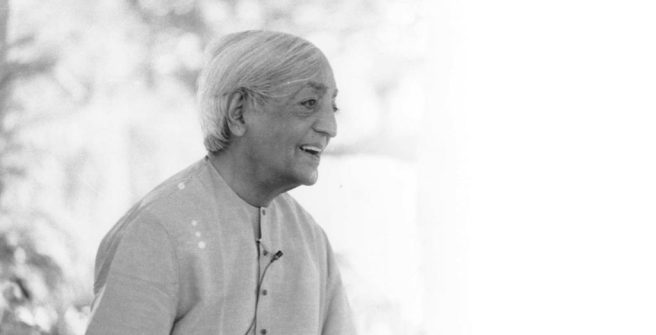
I’ve put together some quotes from The First And Last Freedom written by J. Krishnamurti. My first introduction to the teachings of J. Krishnamurti were through a book called The First Krishnamurti Reader which I read as a teenager, and the first few chapters of this book were lifted straight from The First and Last Freedom. Reading this book subsequently propelled me to zealously consume almost all the writings of ‘K’ I could find! (Perhaps I had not read it carefully enough!)
Here I have chosen quotes that I felt summarised much of what he was trying to get across. Of course, the quotes are very concise, so take your time with them – do not speed read this if you want to ‘get’ what they are pointing at – ie. the very absence of ‘you’.
Best wishes
Tom
——
It is only if you are aware of inward insufficiency and live with it without escape, accepting it wholly, that you will discover an extraordinary tranquillity, a tranquillity which is not put together, made up, but a tranquillity which comes with understanding of what is. Only in that state of tranquillity is there creative being.
~ Jiddu Krishnamurti, The First and Last Freedom
——
Truth is not something to be gained. Love cannot come to those who have a desire to hold on to it, or who like to become identified with it. Surely such things come when the mind does not seek, when the mind is completely quiet, no longer creating movements and beliefs upon which it can depend, or from which it derives a certain strength, which is an indication of self-deception. It is only when the mind understands this whole process of desire that it can be still. Only then is the mind not in movement to be or not to be; then only is there the possibility of a state in which there is no deception of any kind.
~ Jiddu Krishnamurti, The First and Last Freedom
——
Thus regeneration is only possible in the present, not in the future, not tomorrow. A man who relies on time as a means through which he can gain happiness or realise truth or God is merely deceiving himself; he is living in ignorance and therefore in conflict. A man who sees that time is not the way out of our difficulty and who is therefore free from the false, such a man naturally has the intention to understand; therefore his mind is quiet spontaneously, without compulsion, without practice. When the mind is still, tranquil, not seeking any answer or any solution, neither resisting nor avoiding – it is only then that there can be a regeneration, because then the mind is capable of perceiving what is true; and it is truth that liberates, not your effort to be free.
~ Jiddu Krishnamurti, The First and Last Freedom
——
A mind that would be in a state in which the new can take place – whether it be the truth, whether it be God, or what you will – must surely cease to acquire, to gather; it must put aside all knowledge. A mind burdened with knowledge cannot possibly understand, surely, that which is real, which is not measurable.
~ Jiddu Krishnamurti, The First and Last Freedom
——
We do not have to seek truth. Truth is not something far away. It is the truth about the mind, truth about its activities from moment to moment. If we are aware of this moment-to-moment truth, of this whole process of time, that awareness releases consciousness or the energy which is intelligence, love. So long as the mind uses consciousness as self-activity, time comes into being with all its miseries, with all its conflicts, with all its mischief, its purposive deceptions; and it is only when the mind, understanding this total process, ceases, that love can be.
~ Jiddu Krishnamurti, The First and Last Freedom
——
Love is not of the self. Self cannot recognise love. You say ”I love; but then, in the very saying of it, in the very experiencing of it, love is not. But, when you know love, self is not. When there is love, self is not.
~ Jiddu Krishnamurti, The First and Last Freedom
——
Truth, God or what you will, is not something to be experienced, for the experiencer is the result of time, the result of memory, of the past, and so long as there is the experiencer there cannot be reality. There is reality only when the mind is completely free from the analyser, from the experiencer and the experienced. Then you will find the answer, then you will see that the change comes without your asking, that the state of creative emptiness is not a thing to be cultivated – it is there, it comes darkly, without any invitation; only in that state is there a possibility of renewal, newness, revolution.
~ Jiddu Krishnamurti, The First and Last Freedom
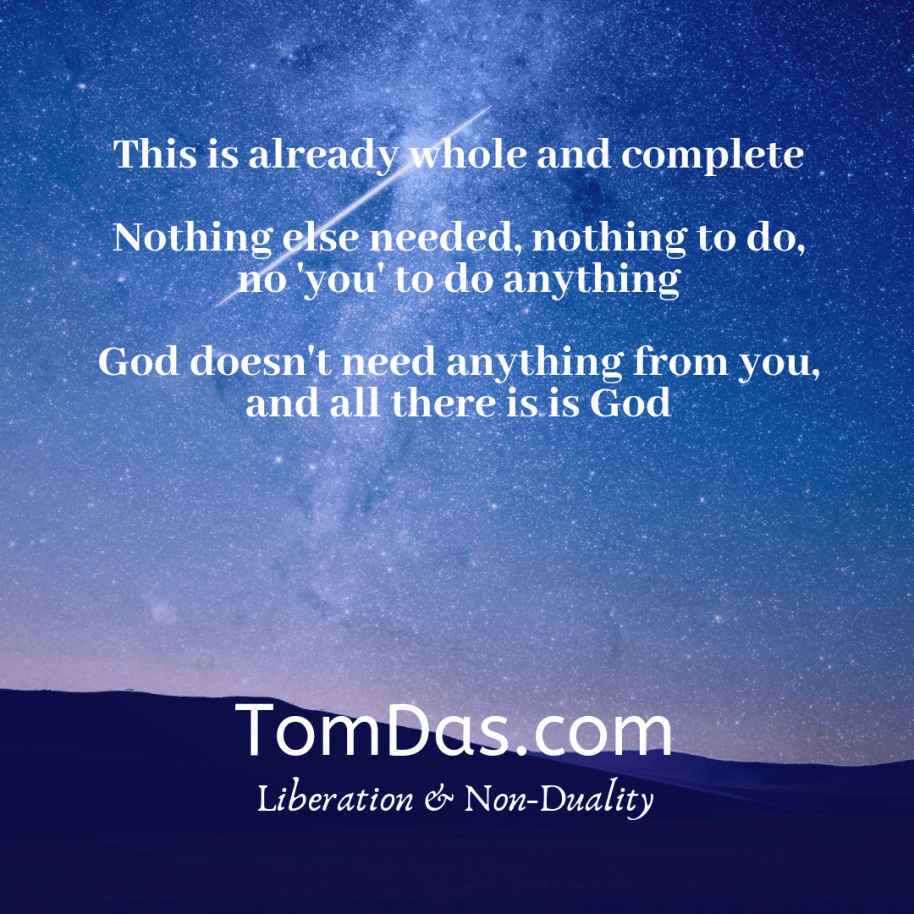

Everyone gives value to the world. The realised being, who has gone beyond the world, beyond knowledge, only gives value to zero. When you understand that the world is untrue and that everything is zero, then all that remains is Reality.
You reduce yourself to being a body and then you constantly worry for it. Why? By thinking “I am the body”, you have reduced yourself to such a small creature. The body is nothing. It comes from zero and will soon return to zero.
When you lose all love for the illusion, He automatically is there. You get absorbed into Reality because He and you are the same, nothing else. There is no “you” or “self” in Reality. Forget about self. The real understanding is, “I don’t exist.“
The world is nothing but a long dream, take it for granted.
There’s nothing there, so what is there to say? As long as the body is there, he acts, no doubt. He calls his mother “mother”, and his wife “wife”, but still he knows. If somebody asks him, “What is your name?”, he gives his name, but he knows, “I am not this.”
The master is the greatest illusion because all that he says with full hear and frankness is false. But the false words that the master tells you can make you reach Reality.
The master takes you to that place where there is no one to understand anything. There is no knowledge nor ignorance and so understanding has no meaning. Let everything appear within That, but say that it is not true. There is no need to change anything because it doesn’t exist. When you forget the sense of the world, which is nonsense, then you will know the real sense and Reality opens up to you.
An enlightened person says at once, “One plus two is three! I know!” He says it so strongly. Understanding should come. Master awakens your understanding.
Nobody comes, nobody goes. All is a dream. In a dream you can become a great master, but when you wake up, you come back to your ordinary state. Who has gone there and who has come back? Nothing has happened.
The concept of a “great master” has come upon you, and you have become the “great master”, but when you wake up you feel, “All this is nonsense. How can I be a great master? I know nothing!” Still, in the dream, you were giving lectures and were talking easily about all these things, but when awakening comes, all this knowledge vanishes. It was only a dream.
The so-called sage who says, “I am the reincarnation of God”, doesn’t know Him, doesn’t know Reality. On the contrary, he is the slave of his ego, of illusion. When knowledge itself has no entity, there is no question of all these things.
Understanding should come, and finally one should see that knowledge is also not true. Forget everything. Knowledge, ignorance . . . all is zero.
[Tom – see the same written in a traditional Advaita Vedanta text here.]
Understand this way: that you should be free from ignorance and finally from knowledge, also. Knowledge is the greatest ignorance. Understand this way and forget everything. In that moment, you are He.
First mental understanding is required and after that comes a practical understanding. Intellectual talent is the greatest thing. Without the intellect, one cannot understand. So, you have to understand with the full intellect and then, that knowledge, or that understanding will submerge, because knowledge is a thought. A good thought or a bad thought, both are thoughts. So, knowledge is a golden thorn, and ignorance is an ordinary thorn and both are bondage. Suppose your hands have been put in handcuffs. Maybe they’re iron cuffs or maybe they’re golden, but it’s still bondage. So, both are thorns. One should understand and throw them away. It is very difficult to throw out the knowledge, because ego remains up till knowledge. Knowledge is the ego, nothing else. To erase that knowledge, one should say, “I know nothing.”
Ignorance came by hearing and is dispelled by hearing. By words you have become bound and by words you can be free. Words are false, but their meaning is true. The illusion is needed in order to go beyond it.
There is only one way to know Reality – forget everything and instantly you are He. Short and sweet. There are no words for Reality. Forget the illusion and He is there. Do everything, but say that it is not true. That is the main point.
When you feel that something can touch you, or harm you, it means that you are in the illusion. How can nothing touch you? Everything in the illusion is nothing.
Why to fear? Nothing is there. Everything is illusion. Keep your mind in that fearless state only. Just as the poisonous tooth is taken out, in the same way, play with the world, play with the illusion, there is no harm. It won’t affect your mind. Live fearlessly; no death, no fear, knowing that “I am that real power.” There is nothing! What will harm you?
The world is full of Him. Nothing is there except Him. What you see is Him.
No matter if you are poor, sitting on a throne or lying in the gutter, still you are always Reality. The outside appearance has nothing to do with who you are. Everyone is He, no matter what state you may be in.
 Tom Das