How to know God. How to see God.

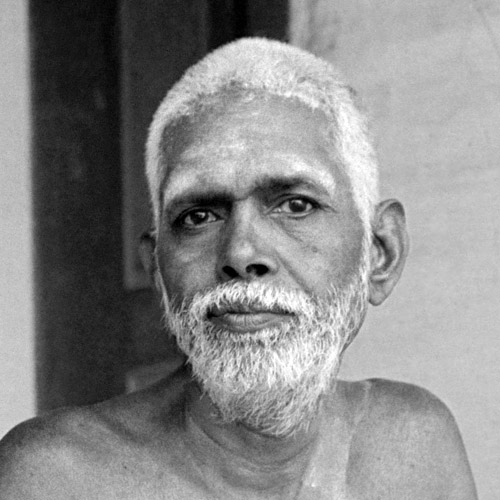
ramana-maharshi.asr_12.crop

See also: IN BRIEF: HOW TO ATTAIN LIBERATION (MOKSHA)

Here a seeker asks Sri Ramana Maharshi how to find or ‘see’ God. When Ramana gives his usual answer, the seeker objects with a very common objection, let us see. The following dialogue has been recorded in the book Conscious Immortality, page 125:

Questioner: How is God to be seen?
Ramana Maharshi: Within. If the mind is turned inwards, God manifests as the inner consciousness.
Questioner: But isn’t God in all the objects we see around us?
Ramana Maharshi: God is in everything and in the seer. Where can God be seen? He cannot be found outside. He should be felt within. To see the objects, mind is necessary, and to conceive God in them is only a mental operation. But that is not real. The consciousness within, purged of the mind, is felt as God.

We can see that Ramana states that to find God, or see God, one must turn within, away from objects and abide as the Consciousness within, the pure Subject, devoid of objects. The seeker responds with a philosophical argument that seems to make sense to the mind. The seeker’s reasoning is as follows: but if God is everywhere and everything, why must I turn within to find Him?

The problem is that while this seem philosophically correct and so makes sense (to the ego-mind!), it doesn’t work. Ramana Maharshi’s teaching is a practical guide. It actually works! Ramana does not simply say to us ‘All is God…All is Self…All is One’ or something similar and leave it at that. Ramana states that yes, God is All, but he cannot be found outside, only within.

What we see around us is also God, yes, but it is God as Maya, and is therefore unreal and gives rise only to suffering and confusion. Maya/the world may make us feel we are making progress by giving us superficial temporary realisations and insights together with philosophical platitudes and positive feelings, but this is simply ‘Maya’s way of ensnaring us’ and perpetuating the ego and suffering.

It is only when we turn within and attend to what is Real, namely our own very Self, that we then Abide as the Self and the above is seen for oneself. Only when we turn within, away from objects, do the Vedanta teachings  come alive. They are transformed from mere concepts to first-hand Reality, and suffering finally comes to an end. Only then is the body-mind identification destroyed. Only then is the infinite divine nature of the Self truly seen. Only then do we truly experience the Ananda or Blissful aspect of the Self.

We see the same teaching given in Ramana’s text ‘Who Am I?’, and knowing the above teaching, namely that we need to turn within, explains what could be seen as a rather strange answer to a question by Ramana:

Question: Is not everything the work of God?
Ramana Maharshi: Without desire, resolve, or effort, the sun rises; and in its mere presence, the sun-stone emits fire, the lotus blooms, water evaporates; people perform their various functions and then rest. Just as in the presence of the magnet the needle moves, it is by virtue of the mere presence of God that the souls governed by the three (cosmic) functions or the fivefold divine activity perform their actions and then rest, in accordance with their respective karmas. God has no resolve; no karma attaches itself to Him. That is like worldly actions not affecting the sun, or like the merits and demerits of the other four elements not affecting all pervading space.

Again, we can see here that Ramana does not simply write ‘yes, all is God, God does all, all is One’, or something similar, but puts forward a different conception of the Self which will orientate our practice as above. He is stating God or the Self is Still, Whole, Unmoving, Unaffected, Self-Shining and Actionless (ie. God or Self does nothing). It is Pure Consciousness, the Subject, the Source of all, and we are to attend to That only. This is how we are to conceive of or think of the Self in order to orientate our practice. This is all beautifully explained in The Path of Sri Ramana.

So, how can we know this is the only way? Try other teachings if you want! You will eventually see they don’t work – despite all the concepts, practices and words your suffering will continue! All other teachings are based upon objects, Maya (ie. they are based upon thoughts, feelings, sensations, body, mind, world, etc): they are therefore based upon that which is transient and temporary and so do not serve to be a good foundation for firm Happiness.

Until you turn within, suffering will continue! Whenever you attend to (ie. attach to) objects, you tacitly strengthen the ego-notion, so turn within, abide as the Self! It is what you truly are, it is the only constant!

See also:

IN BRIEF: HOW TO ATTAIN LIBERATION (MOKSHA)

and

The Path of Sri Ramana

The entire path explained: the Path of Sri Ramana (Parts 1 and 2; PDF downloads)

This is one of a series of introductory articles – please see the homepage of tomdas.com for more introductory articles.

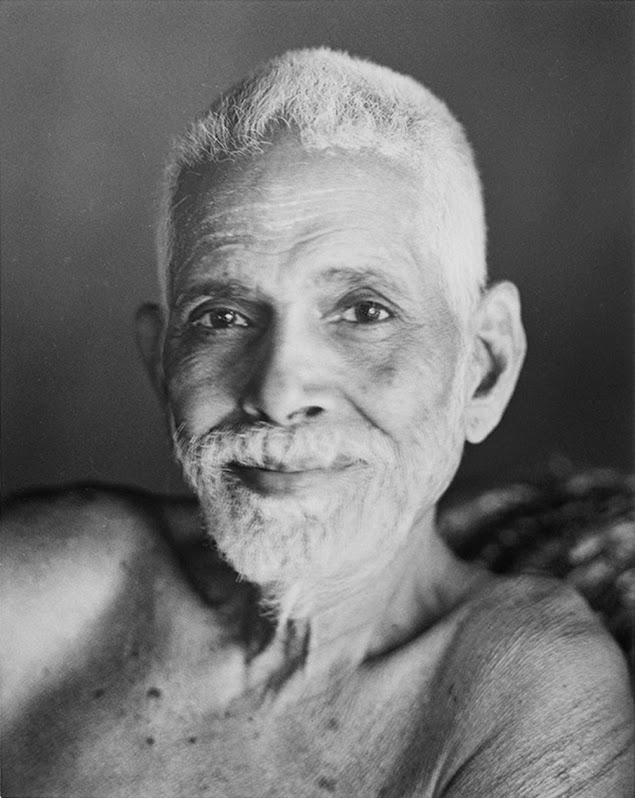
Ramana younger face
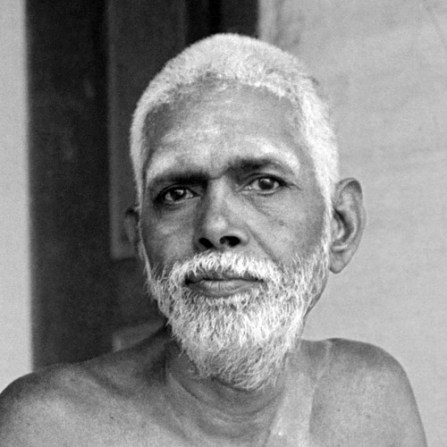
Sri Ramana Maharshi
See also:
IN BRIEF: HOW TO ATTAIN LIBERATION (MOKSHA)

Recommended Reading: books for Liberation & Self-Realisation

‘The path of Sri Ramana is meant for anyone who craves for happiness…’

These texts, written by Sri Sadhu Om, himself a direct devotee of Sri Ramana Maharshi, clearly, unambiguously and thoroughly explain the path to Self-Realisation, which is the extinguishment of suffering, as taught by Sri Ramana Maharshi.

  • Part one focuses on Self-Enquiry (the path of knowledge or Jnana), which is the principal path for liberation/Moksha.
  • Part two focuses on Self-Surrender (the path of Bhakti or love/ devotion).

Together these texts summarise the entire Vedanta path, and are consistent with the Vedanta scriptures, but the teachings are arranged practically for those with a genuine yearning for liberation and not just philosophical study.

There is also a text which is considered to be ‘Part three’ called Sadhanai Saram, which means ‘The Essence of Spiritual Practice’, and this text further explains what is given in parts one and two, and goes into more detail about the nature of liberation itself as well as various other topics. Click on the link above to download this as a PDF file.

Sri Sadhu Om (1922-1985), sometimes known as Sri Sadhu Om Swamigal, spent 4 years with Sri Ramana Maharshi from 1946 until Ramana’s death in 1950. He was regarded by many other direct devotees as both Self-Realised and an authority on Ramana Maharshi’s teachings. Sri Muruganar, one of the few devotees of Sri Ramana Maharshi who Sri Ramana openly conceded to be Self-Realised, considered Sri Sadhu Om to be one of the few people who truly understood Sri Ramana Maharshi’s teachings.

We are indeed fortunate to have these clear and precise teachings to hand!
All we have to do is understand them and put them into practice!

Click on the links below to download these precious texts, and then put them into practice:

The Path of Sri Ramana Part One (PDF file)

The Path of Sri Ramana Part Two (PDF file)

UPDATE 2023: a new revised translation in a single volume is now available to purchase, eg. on Amazon, called ‘The Path of Sri Ramana’. There are 60 pages of new additional previously untranslated material, part 2 is now called the supplement, and the biographical section has been removed. Personally I find the older version, available as a PDF on this website, easier to read, however several people who attend satsang meetings with me have informed me they prefer the newer translation which they feel is more precise and more accurate.

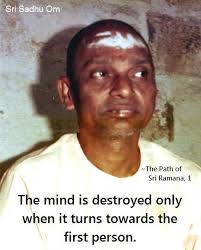
Sri Sadhu Om Mind turn towards first person
Sri Sadhu Om

“We should not run after the world; we should not look outwards at the world, we should look inwards at Self. Those sannyasis who run after the world achieve neither the world nor Self (God). If we try to chase after our shadow, we will never catch it; but if we go towards the sun, our shadow will automatically come running behind us.

Those sannyasis who are always attending to the world with the aim of teaching the world became spoilt in the end. . . No Sage (jnani) who ever came on earth was the product of an ashramam, math or any such institution. Each one of them stood alone and realized the Truth by himself.

There is no rule that a man can attain true knowledge (jnana) only by becoming an inmate of a religious institution. Therefore, in the name of service to the world, let no one cheat himself and retard his spiritual progress by forming foundations and associations and by preaching, shouting slogans and running magazines”

~ Sri Sadhu Om

The entire path is also explained in more concise form in Ramana Maharshi’s text ‘Who Am I?’ (Nar Yar?). However I have found that many people actually miss the key teachings in ‘Who Am I?’ even though they are plainly written due to the ego’s distortion in interpreting what it hears/reads. After reading ‘The Path of Sri Ramana’, the teachings in ‘Who Am I?’ become crystal clear.

ramana-maharshi face

Ramana Maharshi: True Wisdom

ramana-maharshi.asr_12.crop

The following are sayings of Sri Ramana Maharshi, taken from the text Guru Vachaka Kovai which is widely accepted as the most precise, systematic and authoritative exposition of Sri Ramana Maharshi’s teachings:

Download Guru Vachaka Kovai as a PDF file here

536.
O worldly folk who long for and run after
An endless series of unenduring things
’Tis wisdom true to seek and know
That one thing, on knowing which
All other things will cease to be.

537.
For those who see with insight keen
The subtle Truth, what is there to gain
From knowledge of gross material things?
What the imperishable inner sense
Perceives surpasses far the sight
Seen by the corporeal eye.

538.
Knowing aright the nature of the Self
And abandoning the non-self as void,
Unreal, is wisdom true.
All other knowledge is ignorance,
And not wisdom.

Ramana Maharshi: ‘…unless you give up the idea that the world is real…’

ramana maharshi eyes of grace

Question: I cannot say it is all clear to me. Is the world that is seen, felt and sensed by us in so many ways something like a dream, an illusion?

Sri Ramana Maharshi: There is no alternative for you but to accept the world as unreal, if you are seeking the Truth and the Truth alone.

Question: Why so?

Sri Ramana Maharshi: For the simple reason that unless you give up the idea that the world is real, your mind will always be after it. If you take the appearance to be real you will never know the Real itself, although it is the Real alone that exists. This point is illustrated by the analogy of the ‘snake in the rope’. As long as you see the snake you cannot see the rope as such. The non-existent snake becomes real to you, while the real rope seems wholly non-existent as such.

Question: It is easy to accept tentatively that the world is not ultimately real, but it is hard to have the conviction that it is really unreal.

Sri Ramana Maharshi: Even so is your dream world real while you are dreaming. So long as the dream lasts, everything you see, feel, etc., therein is real.

Question: Is then the world nothing better than a dream?

Sri Ramana Maharshi: What is wrong with the sense of reality you have while you are dreaming? You may be dreaming of something quite impossible, for instance, of having a happy chat with a dead person. Just for a moment you may doubt in the dream saying to yourself, ‘Was he not dead?’, but somehow your mind reconciles itself to the dream vision, and the person is as good as alive for the purposes of the dream.

In other words, the dream as a dream does not permit you to doubt its reality. Even so, you are unable to doubt the reality of the world of your wakeful experience. How can the mind which has itself created the world accept it as unreal? That is the significance of the comparison made between the world of wakeful experience and the dream world. Both are but creations of the mind and so long as the mind is engrossed in either, it finds itself unable to deny the reality of the dream world while dreaming and of the waking world while awake.

If, on the contrary, you withdraw your mind completely from the world and turn it within and abide thus, that is, if you keep awake always to the Self, which is the substratum of all experience, you will find the world, of which alone you are now aware, just as unreal as the world in which you lived in your dream.

The above excerpt was taken from Maharshi’s Gospel

Ramana Maharshi: Encouragement for Self-Enquiry

ramana maharshi

The following are teachings of Sri Ramana Maharshi taken from the text Guru Vachaka Kovai, a text which is widely considered to be the most precise, systematic and authoritative collection of Sri Ramana’s spoken teachings.

I have arranged them in an order with the aim of encouraging Self-Enquiry.

I hope these verses are of help to you,

best wishes

Tom

755.

If without wasting time one starts
And keeps up steady self-enquiry,
One’s life becomes at once ennobled,
One is no more this wretched body,
And there wells up within one’s heart
A sea of bliss supreme.

644.

Those who do not keenly seek
And recognise the Being Awareness
Shining incessant in the heart
Sink deep into delusive maya,
Thanks to the denotative knowledge
Piled up by the mounting ego.

393.

One who has wisely chosen the straight path
Of self-enquiry can never go astray;
For like the bright, clear Sun, the Self
Reveals itself direct to whoso
Turns towards it.

77.

What does one gain, you well may ask,
By giving up the wealth immense
Of worldly pleasure and seeking only
Mere Awareness?
The benefit of true Awareness
Is the unbroken prevalence
Of peace within the heart, the bliss
Of one’s own natural being.

71.

How piteous is the spectacle
Of people wandering in the world’s ways
Aimless, frisky like a goat’s beard
And chafing at the discipline
That leads to permanent freedom.

756.

Barring fruitful self-enquiry
There is, for real mind-control,
No other sadhana whatsoever.
The mind may seem to be controlled
By other methods. But after a while
It will spring up again.

692.

Since it was one’s own past effort
That now has ripened into Fate,
One can with greater present effort
Change one’s Fate.

1186.

Uninterrupted and whole-minded
Concentration on the Self,
Our true, non-dual Being, this
Is mouna, pure, supreme, the goal;
Not at all the lazy mind’s
Inertia which is but a state
Of dark illusion.

186.

Poor seer, who suffers endlessly
Because you still perceive the object,
Not the subject, please look inward,
Not without, and taste the bliss
Of non-duality

878.

The Self alone is the true Eye.
Only of the Self one has
Direct immediate knowledge.
But minds averted from the Self
Look through the senses at a world
Other than the Self and think it can
Be known directly.

190.

You pilgrims, who without discovering
What is within, proceed from place
To place, ever hovering bird-like,
Know Siva supreme is but Awareness,
Absolutely still, abiding
Centred in the Heart.

529.

The jiva’s thirst will vanish only
When the vasanas of the frenzied mind
Die and direct experience comes
Of Pure Awareness.
If mirage water could quench thirst
Then only would knowledge indirect
Satisfy the jiva’s longing.

921.

None can confront and overcome
The mind. Ignore it, then, as something
False, unreal. Know the Self
As the real ground and stand firm-rooted
In it. Then the mind’s movements will
Gradually subside.

694.

Even in this worldly life one’s labours bear
No fruit without abundant faith.
Hence till one merges in the bliss
Supreme and boundless, one’s strong zeal
In sadhana should never slacken.

695.

However great one’s former sins, if one
Repines not, sighing “A sinner am I”
But plunges straight into one’s own Being,
One reaches quick the ocean of bliss
And sports in it.

192.

For the man of dharma seeking
Experience of the state supreme,
The heroic action needed is
To draw in the outward-darting mind
And fix it firmly in the Heart.

193.

If the mind, turned outward and distracted,
Starts observing its own being,
Alienation ends, the vestige ego
Merges in the light of true
Awareness shining in the Heart.

697.

They say that Fate can never bind
Those heaven-bound. What does this mean?
Not an iota of the past can touch
Those who dwell unceasingly
In the firmament of Self-Awareness,
Vast, boundless, frontierless and full.

1059.

The Self, the home of blissful Awareness,
Is an ocean vast of peace serene.
And he whose mind turns inward and dives
Deep within it, gains the infinite treasure
Of its grace.

1062.

The ever-present Self, the radiant
Gem, this is the rarest, richest
Treasure. Look within and find
And hold it fast. Your penury,
The grand illusion, source of every
Trouble on earth, will vanish forthwith.

343.

Those who, diving deep within,
Have found the Self have nothing else
To know. And why? Because they have gone
Themselves beyond all forms and are
Awareness without form.

763.

Only a mind one-pointed, inward turned,
Succeeds in self-enquiry. Weak,
Faltering minds, like green banana trees,
Are not fit fuel to feed this fire.

531.

From questing inward in the heart
Comes knowledge which destroys
All false illusions. Searching books
For pure, clear wisdom is like trying
To cook and eat the picture of a gourd.

532.

Can hunger be appeased by eating
Food cooked over a painted flame?
The end of pain, the bliss of peace,
Results from egoless awareness,
And not at all from verbal wisdom.

533.

Never through argument, but only
By abiding in the heart as pure
Awareness, which lights up and shines
Within the mind, can one enjoy
The thrill, the throb, the bliss supreme
Of being the Self.

612.

Undeluded by whatever else
May come and go, unwinking watch
The Self, because the little fault
Of forgetting for one moment one’s true Being
As Pure Awareness brings tremendous loss.

750.

What we incessantly think of,
That we become. Hence, if we
Keenly seek the Self and think
Of nothing else, the malady
Of birth will cease and all thoughts end.

1029.

Bliss is the very nature of the Self.
Self is the infinitude of Bliss.
All Being is but Bliss.
Knowing this firmly, in the Self
Abide enjoying Bliss forever.

Why do we find so many troubles in the world? The five types of Maya and how to remove them| Ramana Maharshi

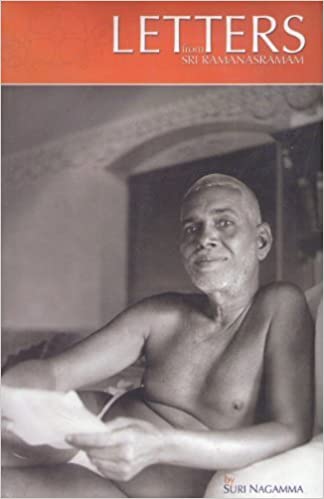
Ramana letters.jpg

Tom: the following text is from Letters from Sri Ramanasramam, 21st May 1947. In the first part Ramana will tell us the basic theory. In the second part he will tell us how to realise this truth for ourselves:

Yesterday morning at 8 o’clock, Dr. Syed who is a worker for Arya Vignana Sangha and one of the disciples of Bhagavan, came here for Bhagavan’s darshan and asked “Bhagavan says the whole world is the swarupa of Atma. If so, why do we find so many troubles in this world?”

Tom: Swarupa, literally meaning form of the self (Swa = self; rupa = form), usually is translated as ‘essential nature’ or ‘true nature’. Atma or Atman means Self. The questioner above is therefore asking about the true nature of the Self – “if all is Atma Swarupa, then why all this trouble in the world?”

With a face indicating pleasure, Bhagavan replied “That is called Maya. In Vedanta Chintamani, that Maya has been described in five ways. One by name Nijaguna Yogi wrote that book in Canarese. Vedanta has been so well dealt with in it, it can be said to be an authority on the Vedanta language.

There is a Tamil translation. The five names of Maya are, Tamas, Maya, Moham, Avidya and Anitya.

Tamas is that which hides the knowledge of life.

Maya is that which is responsible for making one who is the form of the world appear different from it.

Moha is that which makes a different one look real: sukti rajata bhranthi — creating an illusion that mother-of-pearl is made of silver.

Avidya is that which spoils Vidya (learning).

Anitya is transient, that which is different from what is permanent and real.

On account of these five Mayas troubles appear in the Atma like the cinema pictures on the screen. Only to remove this Maya it is said that the whole world is mithya (unreal).

Atman is like the screen. Just as you come to know that the pictures that are shown are dependent on the screen and do not exist otherwise, so also, until one is able to know by Self-enquiry that the world that is visible is not different from Atma, it has to be said that this is all mithya.

But once the reality is known, the whole universe will appear as Atma only. Hence the very people who said the world is unreal, have subsequently said that it is only Atma swarupa. After all, it is the outlook that is important. If the outlook changes, the troubles of the world will not worry us. Are the waves different from the ocean?

Why do the waves occur at all? If asked, what reply can we give? The troubles in the world also are like that. Waves come and go. If it is found out that they are not different from Atma this worry will not exist.”

Tom: How many times have we heard the above metaphor about the movie and the screen? But do we truly understand? Are we truly free? The questioner therefore asks the following:

That devotee said in a plaintive tone, “However often Bhagavan teaches us, we are not able to understand.”

“People say that they are not able to know the Atma that is all-pervading. What can I do? Even the smallest child says, ‘I exist. I do; and this is mine’. So, everyone understands that the thing ‘I’ is always existent. It is only when that ‘I’ is there, the feeling is there that you are the body, he is Venkanna, this is Ramanna and the like. To know that the one that is always visible is one’s own self, is it necessary to search with a candle? To say that we do not know the Atma swarupa which is not different but which is in one’s own self is like saying ‘I do not know myself ’,” said Bhagavan.

Tom: Ramana above is stating that the Self is always realised – it is the knowledge ‘I am’. Everyone knows they exist! This is self-knowledge or self-realisation! However the problem is when you identify as being the body the trouble starts. Now the questioner has figured out the path laid out before him, and Ramana confirms the way forwards in order to secure removal of this wrong identification with the body. There is no need to gain self-knowledge, just to remove wrong identification (ignorance):

That means that those who by sravana (hearing) and manana (repeating within oneself) become enlightened and look upon the whole visible world as full of Maya, will ultimately find the real swarupa by nididhyasana [meditation],” said the devotee.

“Yes, that is it. Nidi means swarupa; nididhyasana is the act of intensely concentrating on the swarupa with the help of sravana and manana of the words of the Guru. That means to meditate on that with undeflected zeal. After meditating for a long time, he merges in it. Then it shines as itself. That is always there. There will be no troubles of this sort if one can see the thing as it is. Why so many questions to see one’s own self that is always there?” said Bhagavan.

Ribhu Gita – Chapter 26 (as recommended by Sri Ramana Maharshi)

Also see the wonderful text The Essence of the Ribhu Gita

Sri Ramana Maharshi often mentioned the Ribhu Gita in his teachings. It is reportedly said that he especially recommended the recitation of chapter 26, and that reciting it could lead one directly to the natural state or sahaja samadhi.

I have subdivided the chapter into four sections: the introduction, ‘without a trace of sankalpa’, ‘I am that, that am I’ and the concluding portion of the chapter.

Recite and be free!

You can download the PDF version of Ribhu Gita Chapter 26 here:

PDF: Ribhu Gita Chapter 26
ramana maharshi eyes of grace

!Om Namo Bhagavate Sri Ramayana!


RIBHU GITA

Chapter 26
‘Undifferentiated Abidance in the Non-Dual Nature’

Translated from the Tamil version of the Ribhu Gita

Introductory verses

1.

Nidagha! in this explanation,
I shall tell you about being established in the Undivided,
Which has nothing apart from itself, which is full of itself.
May you be in the Bliss of being That itself, as being proclaimed to you.
This teaching is highly secret and rare to come by
In the Vedas and the scriptures.
Moreover, this is rare to come by for even the gods and yogis
And is dear to their hearts.

2.

Son ! it has been said by those who know fully
That being at one with the perfectly full non dual Brahman,
The mass of Existence Consciousness Bliss, the immutable
The Self of all, the serene,
With the vikalpas (imaginations, notions) of the fickle mind ended
And thought dissolved wholly and indistinguishably herein,
Like a solute such as cumin seed dissolved in water,
Is the abidance in That itself.

3.

When inquired into deeply, all the multitude of differences
Will be seen to be never existent.
All is the undivided Supreme Brahman, which is not different from the Self,
And That am I.
Be always correctly practicing
In this exalted certitude
And relinquishing all else,
Be in the Bliss of being ever That itself.

4.

That in which all these apparent differences of duality
Cease to exist when inquired into,
In which all cause and effect –
Even a trace thereof – cease to exist,
And in which not a trace of this fear of duality exists
When the mind is merged therein –
Being that itself,
Ever abide in unwavering Bliss.

5.

That in which there is neither a sankalpa (intention) nor vikalpa (notion)
In which there is neither peace nor perturbance,
In which there is neither mind nor intellect,
In which there is no confusion or conviction,
In which there is no bhava (conviction or feeling) or absence of bhava,
And in which there is no cognition of duality at all –
Being as That itself, without the least fear of duality
Ever abide in unwavering Bliss.

‘Without a Trace of Sankalpa (intention, volition, will)’

6.

That in which there is nothing bad or good,
In which there is neither sorrow nor pleasure,
In which there is neither silence nor speech.
In which there are no pairs of opposites.
In which there is no distinction of ‘I’ or ‘body’ (or I am the body)
And in which there is not the least thing to perceive –
Ever abide in Bliss, without a trace of sankalpa (intention).
In That itself as That itself.

7.

That in which there is no activity of body,
In which there is no activity of speech,
In which there is no activity of any other kind,
In which there is nothing sinful or meritorious,
And in which there is no trace of desire or its consequences –
Ever abide in Bliss, without a trace of sankalpa,
In That itself as That itself.

8.

That in which there is never any imagination,
In which there is no one who imagines,
In which he universe has not arisen,
In which the universe does not exist,
In which the universe does not get dissolved,
And in which nothing exists at any time –
Ever abide in Bliss, without a trace of sankalpa,
In That itself as That itself.

9.

That in which there is no appearance of maya (illusion),
In which there are no effects of maya (delusion),
In which there is neither knowledge nor ignorance,
In which there is neither Lord (Isvara) nor individual (jiva),
In which there is neither reality, nor unreality,
And in which there is not the least appearance of the world –
Ever abide in Bliss, without a trace of sankalpa,
In That itself as That itself.

10.

That in which there are no manifold gods,
In which there is no worship or service to these,
In which there is no differentiation as the triad of forms (Brahma, Vishnu, Siva),
In which there is no meditation on the triad of forms,
In which there is no form of the Supreme Siva,
And in which there is no meditation on the Supreme Siva –
Ever abide in Bliss, without a trace of sankalpa,
In That itself as That itself.

11.

That in which there is no action suggesting differentiation,
In which there is neither devotion nor knowledge,
In which there is no result to be obtained,
Bereft of which there is no supreme abode
In which there is nothing of means for attainment,
In which there is nothing to be attained –
Ever abide in Bliss, without a trace of sankalpa
In That itself as That itself.

12.

That in which there is nothing of the body or senses or life.
In which there is nothing of mind or intellect or thought,
In which there is nothing of ego or ignorance,
In which there is no experiencer of these,
In which there is no macrocosm or microcosm,
And in which there is not a trace of samsara (cycle of birth and death) –
Ever abide in Bliss, without a trace of a sankalpa –
In that itself as That itself.

13.

That in which there is no desire and no anger,
In which there is no covetousness and deluded infatuation,
In which there is no arrogance and envious malice,
In which there are no other impurities of the mind,
And in which there is no delusive notion of bondage,
And in which there is no delusive notion of liberation –
Ever abide in Bliss, without a trace of sankalpa
In That itself as That itself.

14.

That in which there is neither beginning nor end,
In which there is no bottom or middle or top,
In which there is neither shrine nor deity,
In which there is neither charity nor righteous conduct,
In which there is neither time nor space,
And in which there is no object to be perceived –
Ever abide in Bliss, without a trace of sankalpa,
In That itself as That itself.

15.

That in which the fourfold means for realisation of Brahman (sadhana chatushtaya) do not exist,
In which there is no Sadguru (true guru) nor diligent disciple,
In which there is no illustrious jnani (the Knower or sage).
In which there is neither of the two kinds of liberation (jivanmukti and videha mukti)
Ever abide in Bliss, without a trace of a sankalpa.
In That itself, as That itself.

16.

That in which there are no scriptures like Vedas and such,
In which there is no inquiring individual,
In which there is no confusion and clarification,
In which there is no position to be established,
In which there is no position to be rejected,
In which there is nothing at all except oneself –
Ever abide in Bliss, without a trace of sankalpa,
In That itself as That itself.

17.

That in which there is no disputation,
In which here are no victories or defeats,
In which there is no text or its meaning,
In which there are no words with which to give expression,
In which there is no differentiation of individual (jiva) and the Supreme,
and in which there are no conditionings –
Ever abide in Bliss, without a trace of a sankalpa
In That itself, as That itself.

18.

That in which there is no listening (sravana) or connected practices (manana, nididhyasana),
In which here is no exalted samadhi,
In which there is no differentiation between objects of the same particular group,
In which there is no differentiation as affording pleasure or otherwise,
And in which there are no words or their meanings –
Ever abide in Bliss, without a trace of sankalpa
In That itself, as That itself.

19.

That in which there is no trace of the fear of hell,
In which there is no pleasure of heaven, either,
In which there are no worlds of the Creator or others,
In which there are no fruits to be enjoyed there,
In which there are no other worlds,
And in which there exists no universe –
Ever abide in Bliss, without a trace of sankalpa,
In That itself as That itself.

20.

That in which there are no elements,
In which there is not even a trace of any derivatives of the elements,
In which there is no egoism or sense of possession,
In which there is no trace of the kingdom of the mind,
In which there is no defect of attachment,
And in which there is not the slightest trace of vikalpa
Ever abide in Bliss, without a trace of sankalpa
In That itself as That itself.

21.

That in which there is no triad of bodies (gross, subtle, causal),
In which there is no triad of states of existence (waking, dream and deep sleep),
In which there is no triad of souls (ever free, having attained freedom, bound),
In which there is no triad of afflictions, (caused by bodily and mental factors, caused by external factors, caused by supernatural and cosmic factors),
In which there is no pentad of sheaths, (physical, vital energy, mental, intellectual, blissful),
And in which there is no experiencer of any of these –
Ever abide in Bliss, without a trace of sankapa,
In That itself as That itself.

22.

That in which there is no sentient being,
In which there is no power of veiling,
In which there is no array of differences,
In which there is no power of false projection,
In which there is no delusion of a manifest world –
Ever abide in Bliss, without a trace of sankalpa,
In That itself as That itself.

23.

That in which there is nothing of action,
In which there is no performer of action,
In which arises unsurpassed Bliss,
Which is, indeed, the changeless state,
Knowing and realizing which none returns (to mortality or illusion)
And becoming which one is freed from bondage of worldly existence –
Ever abide in Bliss, without a trace of a sankalpa
In That itself as That itself.

24.

That by realizing which and in Bliss of which
All other joys appear to be the joys of That,
That after realizing which with very firm certitude as oneself
Nothing else will be something apart,
That by realizing which with very firm certitude as oneself
All kinds of jivas will attain Liberation –
Ever abide in Bliss, without a trace of a sankalpa
In That itself as That itself.

25.

That which by knowing firmly as oneself
One has no need to know anything else in the least,
By knowing which with full conviction as oneself
All is know for ever,
And by knowing which as oneself in complete certitude
All actions are accomplished in their entirety –
Ever abide in Bliss, without a trace of sankalpa,
In That itself as That itself.

26.

That which can be easily attained in an unimpeded manner
By the certitude that I am Brahman,
In which, by quiescence after such certitude,
One completely full, ineffable Bliss will reveal itself,
And by merger of the mind in which
One will be joined with unsurpassed, incomparable contentment –
Ever abide in Bliss, without a trace of sankalpa,
In That itself as That itself.

27.

That by merger of the mind in which
All sorrows will cease to exist in the least,
By merger of mind in which
Neither you nor I nor anything else will exist,
And by merger of the mind in which
All these differences will disappear –
Ever abide in Bliss, without a trace of sankalpa,
In That itself as That itself.

28.

That by merger of the mind in which
One abides as oneself with no sense of duality,
By merger of the mind in which
Not a trace of anything separate will remain,
and by merger of the mind in which
Incomparable Bliss alone will reveal itself –
Ever abide in Bliss, without a trace of sankalpa,
In That itself as That itself.

‘I Am That, That Am I’

29.

That which is, indeed, of the nature of undifferentiated Existence,
Which is, indeed, of the nature of undifferentiated Consciousness,
Which, is, indeed, of the nature of undifferentiated Bliss,
Which is, indeed, of the nature of non duality,
Which, is indeed, not different from the Self,
And which, indeed, is of the undivided Supreme Brahman –
In the firm certitude that ‘I am That’,
Abide in the Bliss of ever being That itself.

30.

That which, indeed, is ‘I’ and ‘you’,
Which, indeed, is everyone else,
Which, indeed, is the substratum of all,
Which, indeed, is One without a trace of anything else,
Which, indeed, is utmost purity,
And which, indeed, is the undivided, complete, perfect fullness –
By the conviction that ‘I am That’,
Be in the Bliss of ever being That itself.

31.

That in which there are no varying modes,
In which there is not the least thing different,
In which all egoism is extinguished,
In which all desires or imaginings get destroyed,
In which mind and such perish,
And in which all delusion is destroyed –
By the firm conviction that ‘I am That’,
Be in the Bliss of ever being That itself.

32.

That in which the body and others cannot be discerned,
In which there is no perception of manifestation whatsoever,
In which the thought itself is destroyed,
In which merges the jiva,
In which all the imaginings get dissolved,
And in which even certitude disappears –
By the deep conviction that ‘I am That’,
Be in the Bliss of every being That itself.

33.

That in which all meditation is merged,
In which all yoga is obliterated,
In which all ignorance is dead,
In which all knowledge is nullified,
In which there are no interactions involved,
And which is the state of Absolute Truth –
By the very firm conviction that ‘I am That’,
Be in the Bliss of ever being That itself.

34.

Merging in which one attains happiness always,
Merging in which one never experiences sorrow,
Merging in which one perceives nothing,
Merging in which one never takes birth at all,
Merging in which one never experiences a sense of being separate,
Merging in which one abides as the Supreme (Para) itself –
By this deep conviction of ‘I am That’
Be in the Bliss of ever being That itself.

35.

That which is verily the nature of the Supreme Brahman,
Which is verily is of the nature of Supreme Siva,
What verily is of the nature of the Supreme State,
Which is verily of the nature of the Knowledge of Reality,
And which verily is of the nature of the Supreme Truth –
That, indeed, am I.
By such conviction, be in the Bliss of ever being That itself.

36.

That which is verily of the nature of the Pure Absolute,
Which verily is of the nature of a mass of Bliss,
Which verily is of the nature of the subtle Supreme,
Which verily is of the nature of the non dual,
Which verily is of the nature of self luminous,
And which verily is of the nature of the meaning of the undifferentiated –
That, indeed, am I.
By such conviction, be in the Bliss of ever being That itself.

37.

That which is verily of the nature of Truth,
Which is verily of the nature of the peaceful Absolute,
Which verily is of the nature of the eternal,
Which verily is of the nature of the attribute-less,
Which verily is of the nature of the Self,
Which verily is of the nature of the undivided Absolute –
That, indeed, am I.
By such conviction, be in the Bliss of ever being That itself.

38.

That, indeed, which constitute the entirety of interactions,
That even the least of which, cannot indeed, be conveyed by the ‘highest truth’,
Which, indeed, is the Existence Consciousness Bliss,
Which, indeed, is ever peaceful,
From which, indeed, there is nothing apart,
And which, indeed, abides self existent, all by itself,
That, indeed, am I.
By such conviction, be in the Bliss of ever being That itself.

Concluding Verses

39.

Thus, have I explained to you, Nidagha!
The state of being established as That itself, without any duality.
You shall enjoy perpetual Bliss
By attaining this state by constant
Continuous, changeless certitude
Of the undifferentiated Absolute
There are no more miseries of mundane existence at all at any time in the future
For you are Brahman alone.

40.

Casting aside all impure Vasanas
By the pristine tendency left by the practice of
‘The Absolute Existence Consciousness Bliss, is all,
And That I ever am’,
And subsequently effacing even that tendency,
Son! You will be established in the perfect, full absorption
In and as the non dual Supreme Brahman itself
And attain the Liberation of being the undifferentiated, undivided One.

41.

All impure vasanas are of a state of the mind.
The tendencies (vasanas) about the Pure Absolute are also of a state of the mind.
The Supreme has no such tendencies (vasanas).
Hence, be established in this state,
Without any tendencies (vasanas) of the mind,
Whether considered pure or considered impure,
Like a motionless piece of stone or wood
And without any strain, be in Bliss.

42.

Having disassociated from the imaginings of all other thoughts,
By the conviction (bhava) of being the undivided Absolute,
And forgetting even the said conviction (bhava) of being the Absolute,
You yourself abide as the perfectly full Supreme Brahman.
Even if a great sinner in this world
Hears this explanation now proclaimed
And understands it, he shall, rid of all the great sins of his ego,
Abide as the nature of the undivided, undifferentiated Absolute

43.

The endless Vedas
In revealing here and there,
The means of meditation for mental purification,
Have indicated only rock-like, motionless merger with and absorption in
The unafflicted mass of Bliss,
The undivided, completely, perfectly full Siva,
As the means for the happy Liberation
Of those who are mentally purified.

44.

Therefore, one can here attain
The undifferentiated Liberation by abiding as just That itself
And with a purified mind arising out of the practice of the meditation
That whatever is known is Siva
And that Siva am I.
Whatever stated here is the Truth
Thus, the Sage Ribhu explained in full to Nidagha
The abidance in the True State.

45.

It is the undivided form of our Supreme Lord in a state of sublime, joyous dance that says:
By the conviction that I am ever the Reality, which is Existence Consciousness Bliss,
And by the state of abiding at one with That being That itself,
The empty bondage of the world can be cut asunder and pure Liberation attained.