Ramana Maharshi on people ‘Mutilating’ the Truth | The 2 levels of non-dual teachings | Advaita Vedanta

(SEE PENULTIMATE PARAGRAPH FOR THE ‘MUTILATING TRUTH’ PART)

One devotee of Sri Ramana Maharshi’s, a certain Lakshmana Sarma (LS), was unhappy about how Sri Ramana’s teachings had been misrepresented – even by other devotees – so after consulting with Sri Ramana Maharshi he wrote several texts aimed at correcting these distorting teachings.

Lakshmana Sarma, who was with Sri Ramana for over 20 years, was uniquely qualified to comment on Sri Ramana’s teachings as he was one of only 2 people who received personal 1 to 1 tuition from Sri Ramana on the deeper meaning of Sri Ramana’s teachings which went on for several years. He was also a Vedic and Sanskrit scholar, having studied the Upanishads and Shankara’s vast works as well as many other works too. Many of his books were published during Sri Ramana’s lifetime and were recommended by Sri Ramana himself. Ramana Maharshi said that LS’s commentary on Ramana’s work ’40 verses on reality’ was the best one availabile. Being fluent in English, LS translated his books himself into English so we can be sure the English translations are accurate.

In LS’s book entitled ‘Maha Yoga‘, he explains Sri Ramana Maharshi’s teachings in the context of the Upanishads and Advaita Vedanta; and he also gives Sri Ramana’s view on how the Sage sees the world.

In Maha Yoga LS explains there are 2 levels of the teaching, the higher (true) teachings for those who can accept there the world is not real and lower (ultimately untrue) teachings for those who cannot. Note that LS uses the English word ‘revelation’ to refer to Shruti (the revealed scriptures consisting primarily of the Vedas and Upanishads). Here is Maha yoga pages 59-60:

The ancient lore is twofold. One part of it is addressed to those who are not conscious of being in ignorance, and therefore have no use for a teaching intended to dispel that ignorance. The other part of the ancient lore is addressed to those that are conscious of the ignorance and are in earnest to escape from it. These two parts are quite distinct. But this feature of the ancient Revelation is not known to these believers. Besides they are offended by the inevitable corollary that theirs is a lower position; they also feel it a grievance that the world, which they believe to be real, should be dismissed as unreal, and often want to quarrel with us who are followers of the Sages; we however have no quarrel with them, as the Sages have pointed out, because we realise that for them it is all right to believe as they do, and, so believing, to make the best of the world while it lasts. They are like dreamers who are persuaded that their dreams are real, and do not want to awake.’

LS testifies about how he often saw Bhagavan Sri Ramana ‘water down’ the teachings to suit those who were unwilling or unable to hear the true teachings. Even many devotees of Sri Ramana were often not able to accept the higher teachings. See here in Maha Yoga pages 160-161:

‘Even among the Sage’s disciples, there are some who cannot understand the answer [that the world is not real and has never even actually appeared]; but that is so because they are believers in a fascinating, but complicated creed, in which the chief tenet is that the world is real as such; it is therefore quite natural that they should refuse to understand the Sage’s teachings, of which the essential part is that the world is not real as such. They are dualists in fact, and as such violent haters of Advaitic teaching.

‘In this connection we may take note of the tenderness the Sage shows for the weaknesses of believers. The Sage observes the rule enunciated in the Gita (3.26) that no one’s faith should be disturbed. Therefore when ardent dualists are present, the Sage is very careful in what he says. He does not, while they are present, give out clear Advaitic teaching. But as soon as the dualists go out, he turns round to the Advaitis that remain, and apologetically explains to them that he had to water down the teaching to suit the dualists.’

This is important to note, as Sri Ramana’s closest devotees were all in agreement about this point, that Sri Ramana’s highest teaching to those who knew him best was Ajata Vada (see here for more on this) and that the body-mind-world does not even appear to a Jnani, not even as an appearance. Lower teachings stating that the world still remained were often given out to those who were not willing or able to receive these higher teachings.

In the Bhagavad Gita verse 3.26, referred to above by LS, Lord Krishna recommends that we do not disturb the minds of the ignorant who are attached to a life of doing and action (karma) and who are not yet ready to hear the higher teaching:

3.26 Let not the wise disrupt the minds of the ignorant who are attached to action, they should not be encouraged to refrain from work, but to engage in work in the spirit of devotion

LS continues:

‘He thus treats the latter as immature ones, and the Advaitis as adults who can understand that allowances have to be made to the immature. But he leaves us in no doubt at all, that the Advaitic teaching is the highest there can be.

‘On many occasions the Sage has clearly testified to this. One such occasion was this. Somebody had written in a book, that the Truth would be whole only if the world be real as such – with all its variety – not else. When this writer was reading this, the Sage [Sri Ramana Maharshi] exclaimed: ‘As if the Truth would be mutilated otherwise.’’

How many times have we heard the (false) teaching that true non-duality would and must include the world! Here above Sri Ramana is clearly refuting this.

🙏🙏🙏

Sri Ramana Maharshi on great public workers trying to reduce misery and suffering in the world

Excerpt from Talks with Sri Ramana Maharshi, Talk 272

Devotee: There are widespread disasters spreading havoc in the world e.g., famine and pestilence. What is the cause of this state of affairs?

Sri Ramana Maharshi: To whom does all this appear?

D: That won’t do. I see misery around.

M: You were not aware of the world and its sufferings in your sleep; you are conscious of them in your wakeful state. Continue in that state in which you were not afflicted by these. That is to say, when you are not aware of the world, its sufferings do not affect you. When you remain as the Self, as in sleep, the world and its sufferings will not affect you. Therefore look within. See the Self! There will be an end of the world and its miseries.

D: But that is selfishness.

M: The world is not external. Because you identify yourself wrongly with the body you see the world outside, and its pain becomes apparent to you. But they are not real. Seek the reality and get rid of this unreal feeling.

D: There are great men, public workers, who cannot solve the problem of the misery of the world.

M: They are ego-centred and therefore their inability. If they remained in the Self they would be different…

Look – there’s no one here! (And other false teachings) The essentials of Self-Enquiry | Genuine non-dual realisation | Non-duality

This post was originally posted on Facebook here.

Looking at your own direct immediate experience and not being able to find a separate self – this exercise or practice or so-called ‘investigation’ has nothing to do with genuine self-inquiry.

Looking at your own direct immediate experience and not being able to find a separate self – this exercise or practice or so-called ‘investigation’ has nothing to do with genuine self-inquiry.

Many times I have seen how this teaching leads to confusion and dullness of mind, and actually ensnares you in a belief system called ‘non-duality’ or ‘there is no self’ or ‘there is no person, there is no one here’. These stock phrases are said by a body-mind entity and can create a belief system in the mind that leads you away from the genuine non-dual realisation.

AN EXPLANATION

It is just like saying ‘can you in your direct and immediate experience find air?’, and when you (in this example) cannot find air or see it or touch it or feel it, then you can triumphantly exclaim ‘there is no air!’.

If this was believed, then this would mean you have now entered into a conceptual belief system, and one that is not in line with reality, and therefore needs constant reinforcement and leads to confusion about how to live and act in the world.

Or it is like saying can you find loyalty in your direct experience? No? That means there is no such thing as loyalty! Or can you find a proton or electron in your own direct experience? No? This means you have now discovered there are no protons or electrons! Of course, this kind of exploration and investigation is superficial, non-scientific, irrational and ultimately absurd.

Like loyalty, a separate self cannot always be found in one’s own direct experience, but it emerges in relationship, in daily life and through actions. Merely saying ‘I cannot find my/a separate self’ and repeatedly coming back to this practice/inquiry, will not lead to genuine liberation at all. Whilst it does involve observation and seeing, it is a mental practice as its conclusion is in the mind; ironically it is egoic, as it is for the mind.

SEPARATE SELF KEEPS ON COMING BACK! (WITH THE FLAWED TEACHINGS)

Because the sense of separate self emerges during relationship and actions, it keeps on popping up again, leading the seeker to frustration – why at one point could they (allegedly*) see there was no self, but at another point self keeps on coming back to them again, causing them suffering?

(*If no ego-self was truly ‘seen’, it never comes back again. If ego comes back again, that means it never really went away, and that it was the ego claiming there was no ego all along)

OTHER SIMILARLY FLAWED TEACHINGS

This flawed teaching is similar to other forms of so-called ‘enquiry’ that conclude ‘all is consciousness’ after simply noticing that all they can be conscious of is consciousness, or all objects (that you are conscious of) appear within consciousness. This cannot be a proof that all there is is consciousness – it is merely proof that all you are aware of is within your own awareness, or all that you are conscious of is within your own consciousness, which is self-evident but which tells us nothing about reality per se. Again, this is superficial, irrational and flawed logic.

All is consciousness, but this is only known through a genuine self-enquiry.

More than this, this kind of so-called ‘enquiry’ will also take you away from a genuinely liberating teaching that leads one to genuine discovery of the actual non-dual truth (that is far deeper and also far simpler, more natural and more intuitive than these kinds of superficial, and ultimately conceptual/intellectual, teachings).

SRI RAMANA MAHARSHI SETS US ON THE CLEAR PATH

This is why genuine teachers such as Sri Ramana never gave these kinds of teachings at all. Instead, he always advised we turn our attention inwards, away from phenomenal and objective appearances, towards the sense of self or ‘I am’, the subject, and thereby discover the non-dual truth that we actually, already always are.

See in the text he wrote called ‘The essence of instruction‘ (Upadesa Saram), in verse 16 he writes:

’16. It is true wisdom for the mind to turn away from outer objects and behold its own effulgent form.’

See how he makes the teaching simple and clear!

WHAT ABOUT VERSE 17?

Now in verse 17, the next verse, there is a teaching which is often misunderstood. People do not usually realise that he explains what the actual meaning of verse 17 is in verse 18 and 19. He writes in verse 17:

’17. When unceasingly the mind scans its own form there is nothing of the kind. For everyone this path direct is open’

Whilst this verse seems to be an endorsement of the very teaching I’m saying here is not a genuine teaching, we can see in the next two verses he explains what verse 17 really means. In the next two verses, in verses 18 and 19, Ramana Maharshi explains the meaning of verse 17, namely that one must find the source of the ego and not simply say ‘I cannot find any separate self here’.

What is the source of the ego? It is the self, the subject, as he is already explained in verse 16 and in other verses in the same text.

(For brevity I will not quote all the verses here in this post, as you can easily look at them up yourselves here. The entire text of Upadesa Saram is only 30 verses long.)

THE TRUE TEACHING

The teaching is always to turn within, to turn away from objects, and sink and merge the mind into the Self, the pure subject, thereby attain liberation/self-knowledge. The point of a question such as the question ‘who am I?’, is only to drive one’s attention inwards towards the subject, as he is explained in his writings and verbal teachings.

Sri Ramana Maharshi assures us that this is the essential teaching when he says in The Garland of Guru’s Sayings (Guru Vachaka Kovai) verse 291:

  1. For those who seek eternal life the assurance stands: the senses five retracted tortoise-like, the mind turned homeward to the self and there abiding is pure bliss.

He also chides those who teach these intellectual teachings, who have never turned within and discovered their true nature:

  1. The innocent girl-bride thinking that betrothal is full conjugal union is filled with joy. Even so the learned who have yet to turn within and taste true bliss claim that the verbal wisdom which they prattle is Advaita Jnana (non-dual knowledge)

For an easy to read but comprehensive overview of the true teaching I recommend this book which you can download for free here, or alternatively check out my recommended reading list and/or introductory articles on the homepage of the same website:

Here are some more quotes from Sri Ramana Maharshi, also taken from Guru Vachaka Kovai (click here to download the entire text for free):

391. Those who do not dive into the Heart
And there confront the Self in the five sheaths hid

Are only students answering out of books
Clever questions raised by books,
And not true seekers of the Self.

835. Renouncing this phenomenal world
Which seems to, but does not, exist
We gain (the great ones say) the Self,
The Awareness shining all unseen.

See here for more verses like the ones above together with a guided meditation.

May we listen to Bhagavan’s teachings and thereby become one with him, discovering our own self, our own glorious true nature, which is found within, shining in the heart as I Am, I Am.

🙏🙏🙏

♥️ Om Namo Bhagavate Sri Arunachala Ramanaya Om ♥️

🙏🙏🙏

Effort, effortlessness and choiceless awareness | Sri Ramana Maharshi

Sri Ramana Maharshi:

Effortless and choice-less awareness is our real nature. If we can attain that state and abide, that is all right. But one cannot reach it without effort, the effort of deliberation or meditation, whether it be upon Self inquiry, surrender or both. All the age-old vasanas (inherent tendencies) turn the mind outward to external objects. All such thoughts must be given up, the mind turned inwards. That, for most people, requires effort. Every teacher and every scripture tells the aspirant to keep quiet, but it is not so easy to do.

That is why all this effort is necessary. Even if we find somebody who has achieved this supreme state of stillness without seeming effort, you may take it that the necessary effort had already been made in a previous life. So effortless and choice-less awareness is attained only after deliberate meditation. That meditation can take whatever form that most appeals to you. See what helps you to be free of thought and adopt that for your meditation.

Bliss will ensue if you keep still, but however much you tell your mind this truth, it will not keep still. It is the ego-mind that tells itself to be still in order for it to attain bliss, but it will not do it. Though all the scriptures have said it and though we hear it daily from the great ones and even from our Guru, we are never quiet, always straying into the world of Maya (illusion) and sense objects. That is why conscious, deliberate effort is needed to attain that effortless state of stillness.

Indeed, until the supreme, effortless state is attained, it is impossible for a man not to make effort. His own nature compels him to, just as Sri Krishna in the Bhagavad Gita told Arjuna that his own nature would compel him to fight.

If you can keep still without engaging in any other pursuits, well and good. But for so long as you are obliged to be active, do not give up the attempt to realize the Self. Often glimpses of Realization are attained before it becomes permanent, and in all such cases effort remains necessary.

Yet, the belief that you have to make an effort to get rid of this dream of a waking state and attain Realization or real awakening is also a part of the dream. When you attain Realization you will see that there was neither the dream during sleep nor the dream during the waking state, but only yourself and your real nature.

~ Sri Ramana Maharshi.

🙏🙏🙏

Ramana Maharshi on Devotion or Bhakti | Guru Vachaka Kovai


Here are some verses from Guru Vachaka Kovai (Garland of Guru’s Sayings, a collection of Sri Ramana Maharshi’s teachings) on Bhakti:

314. Treading the path, one finds the world
Composed of ‘I’ and ‘this’
Transformed into the Guru Himself.
This steadiness of vision, this
Awareness of his presence bright
Everywhere is the true pupil’s
Worship of the Master
.

512. Rare indeed is the non-dual jnana.
Yet fixing firmly one’s true love
On Siva’s Feet will easily lead
One to the Grace divine
, the light
Which destroys illusion dark
And reveals the Real.

513. Through love firm fixing the Lord’s Feet
Ever in the heart, one can destroy
All false desires
. And then the heart,
Now blossoming wide, beholds the true
Light of supreme awareness.

649. Do not wander endlessly
Searching in vain for certitude
Through strenuous study, listening, learning
.
In love surrender to the Love
Supreme, the Lord, and reach
And hold the state supreme of Real
Being.

651. Those poor fools who have not savoured
The taste ineffable of Love
May go on talking
of seven savours.
But we who have enjoyed Love’s sweetness,
We assert that this alone,
Love, is the sole true savour.

652. To disentangle life’s hard knots
One needs must understand the Self
As Love itself. Only when one knows
This Love supreme is moksha gained
.
Of every creed this is the heart,
The real teaching.

720. Those with mind matured by bhakti,
Relishing, drinking in, its sweetness,
Deem bhakti supreme, the ever fresh
Nectar, as its own reward
And yearn for more and more of it.

792. If all you wish for is fulfilled,
Think not that it is due to your
Tapas. Know it is but God’s
Good grace, and cling with more and more
Love to His Feet
.

(Tom: note, this is how the Law of Attraction can lead one to liberation – it eventually encourages love of God more than love of Things, and this in turn takes one eventually to Self as described above)

965. If towards the Lord you take
One single step
, then with much more
Than a mother’s love He takes
Nine steps towards you to accept you.
Such is the Guru’s Grace.

974. Unbroken Self-awareness is
The true, bright path of devotion or love
.
Knowledge of our inherent nature
As indivisible Bliss supreme
Wells up as Love.

1205. The mark of bhakti true, total
Self-surrender at Siva’s Feet,
Is perfect peace without a thought
Or word of prayer or plaint.

1206. In the heart which grace divine
Has filled with radiant bliss, can there
Be room for any trivial care
,
The symptom of the ignorance which
Is knowledge for the body-bound ego?

1209. When, the dense darkness of ignorance gone,
The heart’s wide open firmament
Is filled with peace serene, clear, bright,
An inner fount of love up springs
Which is devotion true
, the pure
Auspiciousness of Siva Himself.

1210. The fortunate ones who in the Self
Abide forever, they alone,
Have realised the Truth
. From others
Far indeed is that eternal
Home of grace supreme.

1211. True devotees are they who are
Forever to the Self alone
Devoted
. Only they enjoy
Eternally the bliss supreme
Of all-transcendent, highest heaven.

Does the liberated Jnani or Sage see the body, the mind, the world or the 3 states of deep sleep, waking and dream according to Sri Ramana Maharshi and Sri Adi Shankara? | Advaita Vedanta Essential teachings| Picture quotes

You are welcome to download and share any of the following picture quotes – many more can be found on my Facebook page here in the photo albums.

Sri Ramana often said that the Jnani (self-realised or liberate Sage) is totally unaware of the body, the mind and the world, and that the liberated sage also has no awareness of the 3 states of dream, deep sleep or waking, all of which are a projection of ignorance (aka the mind). We will see below that Sri Shankara says the same.

Also see: Does the Sage (Jnani) see the world? Does the world appearance exist after liberation?

In the text Guru Vachaka Kovai (Garland of Guru’s Sayings) – a highly authoritative collection of Sri Ramana’s teachings recorded by Sri Muruganar, there are several verses that were written by Sri Ramana Maharshi himself, often highlighting key or especially important teachings. These verses were called ‘Sri Bhagavan’ – here is the 24th such verse from that text, which Sri Ramana himself wrote:

The Self-Realised Sage knows not whether the transient body comes and stays, or dies and leaves, even as a senseless drunkard knows not what happens to his clothes.

Guru Vachaka Kovai, Sri Bhagavan 24

We can see that Sri Ramana is saying that in truth the Jnani is not aware of the body at all.

This next quote is from Maharshi’s Gospel:

To him who is one with that Reality, there is neither the mind nor its three states, and therefore, neither introversion nor extroversion.

Maharshi’s Gospel (Chapter 6)

We can see here Sri Ramana is implying that it is the mind that gives rise to the 3 states (waking, dreaming, deep sleep) and for the Jnani there is no mind, nor the 3 states, therefore the Jnani’s (non-existent) mind cannot be said to be introverted nor extroverted (both of which are in relation to the body and the world of objects, of which the Jnani is unaware).

Taking about a different triad, the triad of jiva, jagat and iswara (individual person, the world, and the power that animates these – the prior verse specifies that this is the triad he is speaking of), Sri Ramana states that none of these remain in Self Realisation in the text Guru Ramana Vachana Mala:

Though these* (three) are unreal, they are not different from the Supreme Reality (Brahman); but the Supreme Reality is different (from these), because It exists without these* in the State of Self -Realisation

*the triad of jiva, jagat and Isvara; ie. the individual person, the world, and the personal God; these 3 do not exist in Self-Realisation

Guru Ramana Vachana Mala, verse 290

But doesn’t Sri Ramana teach us that for the Jnani they see the names and forms and body and mind AS THE SELF and not apart from the SELF? Yes, he does teach this, but this is a lower teaching, as he has also explained. See Sri Ramana’s own writing in Ulladu Narpadu verse 18:

18. To those who do not know and to those who do, the world is real. But to those who do not know, Reality is bounded by the world; while to those who know, Reality shines formless as the ground of the world. Such is the difference between them.

Careful readers will realised that Bhagavan Sri Ramana is saying that for the Jnani, only the substratum is real, and that the ‘world’ of the Jnani is the Pure consciousness only devoid of name and form, as he has already explained above.

Lakshmana Sarma (LS) was a close devotee of Sri Ramana Maharshi’s for over 20 years, and he was one of only 2 people to have private tuition with Sri Ramana Maharshi on the true meaning of Sri Ramana’s teachings. LS was unhappy about how Sri Ramana’s teachings had been misrepresented even by other devotees, so after consulting with Sri Ramana Maharshi he wrote several texts aimed at correcting these distorting teachings. In this post I have included some of what he said about this aspect of Sri Ramana Maharshi’s teachings, and also given LS’s comments and explanation on verse 18 above, which Sri Ramana Maharshi allegedly said was the correct interpretation.

Here are some more teachings of Sri Ramana’s in a similar vein. When read separately they are clear. When read together they surely give a definitive teaching (please also scroll past the pictures for teachings from Shankara on this same topic further below):

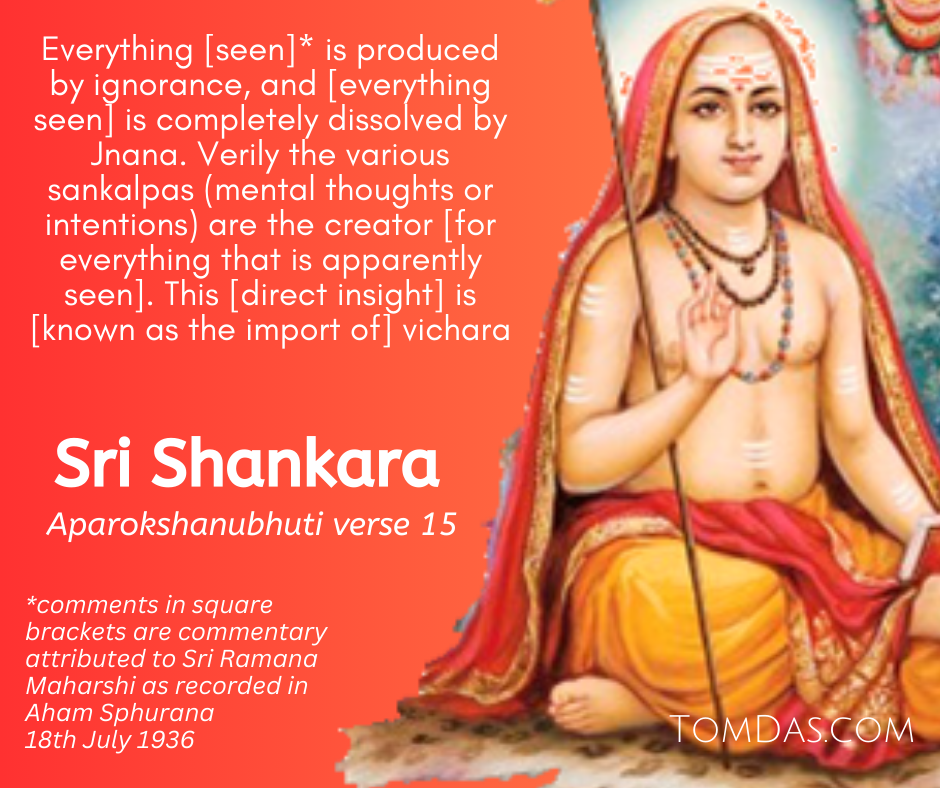
So Bhagavan Sri Ramana has give these types of teachings to us many times – see the introductory articles on the homepage of this website which explore many of these teachings even further – but so has Sri Shankara given us these same teachings in various places. Here are some quotes from Upadesa Sahasri (‘A Thousand Teachings’), the only non-commentarial work attributed to Adi Shankara that is universally agreed as being a genuine work of his:

All this world is unreal and proceeds from ignorance, because it is seen only by one afflicted by ignorance

Sri Shankara, Upadesa Sahasri 17.20

Having thus effaced the triad consisting of dreamless sleep, dream and waking experience, one crosses over the great sea of ignorance. For he is then established in his own Self, void of all attributes of the empirical world, pure, enlightened, and by his very nature liberated.

Sri Shankara, Upadesa Sahasri 17.58

Because I am without an eye*, I have no sight. As I have no ear either*, how could I have hearing? As I have no voice I can have no speech. As I have no mind, how could I have thought?

There cannot be action on the part of that which does not have life force (prana). There cannot be knowership on the part of that which has no mind. Neither can there be knowledge or ignorance on the part of me who am the Light of Pure Consciousness

*Shankara is quoting from Brihadaranyaka Upanishad 3.8.8

Sri Shankara, Upadesa Sahasri 13.1, 13.2

Just as a dream is [apparently] real and valid until one awakens from it, so are the experiences of the waking state, such as identity with the body and the authoritativeness of perception and the other means of knowledge, real and valid until knowledge of the Self

Sri Shankara, Upadesa Sahasri 11.5

Of me who am ever-liberated, pure, rock-firm and changeless, not subject to modification, immortal, indestructible and so without a body, there is no hunger or thirst or grief or delusion or old age or death. For I am bodiless

Sri Shankara, Upadesa Sahasri 13.3-13.4

There are many other places Shankara has given this same teaching, such as in his introduction to his commentary on the Mandukya Upanishad which you can view here and if you explore this website you will find many such similar teachings.

Below I have put together some picture quotes of Shankara’s teachings which I previously shared on Facebook (there are dozens more on Facebook!)- you are also welcome to share any picture quotes I have created:

And here are some verses of Sri Shankara’s that Sri Ramana Maharshi himself has translated (into Tamil – these are the English translations of his translations):

Q. How can the terrible fear of death be overcome? | Sri Ramana Maharshi

A visitor asks Sri Ramana Maharshi:

Visitor: How can the terrible fear of death be overcome?

Bhagavan: When does that fear seize you? Does it come when you do not see your body, say, in dreamless sleep, or when you are under chloroform?

It haunts you only when you are fully “awake” and perceive the world, including your body. If you do not see these and remain your pure self, as in dreamless sleep, no fear can touch you.

If you trace this fear to the object, the loss of which gives rise to it, you will find that that object is not the body, but the mind which functions in it and through which the environment and the attractive world is known as sights, sounds, smells, etc.

Many a man would be too glad to be rid of his diseased body and all the problems and inconvenience it creates for him if continued awareness were vouchsafed to him.

It is the awareness, the consciousness, and not the body, he fears to lose.

Men love existence because it is eternal awareness, which is their own Self.

Why not then hold on to the pure awareness right now, while in the body and be free from all fear?

– Sri Ramana Maharshi, GURU RAMANA, Part 2, Talks

‘It is wrong to call Self the Witness’ – Sri Ramana Maharshi

The following is an excerpt from this post: Is the Self a witness? Or is it everything? Or both?

Sri Ramana Maharshi has taught us in Guru Vachaka Kovai verse 98 (Guru Vachaka Kovai is the most authoritative record of Sri Ramana Maharshi’s verbal teachings according to Sri Ramana Ashram):

98. Unless the body is taken to be ‘I’, otherness – the world of moving and unmoving objects – cannot be seen. Hence, because otherness – the creatures and their Creator – does not exist, it is wrong to call Self the Witness.

Sri Sadhu Om, a direct devotee of Sri Ramana Maharshi, writes in his commentary on this verse:

Descriptions of self as the ‘witness of the individual soul’ (jiva sakshi) or the ‘witness of everything’ (sarva sakshi), which can be found in some sacred texts, are not true but are only figurative (upacara), because only when other things are known would the one who knows them be a ‘witness’ of them. Since self does not know anything in the state of absolute oneness, which is devoid of any other thing, to what can it be a witness? Therefore describing self as a ‘witness’ is incorrect.

What both Sri Ramana Maharshi and Sri Sadhu Om are saying is that objects only appear when the ego/ignorance is present. In Self-realisation, there are no objects, only the Self, so in truth the Self cannot be said to be a witness.

In verse 869 of Guru Vachaka Kovai Sri Ramana teaches us:

869. ’Tis a foolish fancy to ascribe the role of ‘witness’ to the Self, the luminous Sun, the mighty sky of Pure Awareness. In the Self Immutable there is no room for maya’s darkness void. The Self is one sole whole without a second.

Here is an alternative translation of the same verse, with Sri Sadhu Om’s commentary, which essentially states in truth, ie. in realisation, there is no Maya in the Self. It is only for ajnani’s, ie. the ignorant, that consider the Self to be a witness of phenomena/maya:

869. The role [dharma] of seeing is ascribed to Self – the space of consciousness, the sun – only in the imagination of ajnanis, [because] maya, the empty ignorance [of seeing otherness], never exists in Self, the support [sthanu], [and also because] Self is without a second.

Sri Sadhu Om’s comments: Since Self is in truth that which transcends all roles and all qualities, and since It exists as one without a second, to glorify It as the ‘witness of all’ [sarva-sakshi] or as the ‘knower of all’ [sarvajna] is merely the folly of ignorant people.

Also see: The practice of witnessing thoughts and events was never even in the least recommended by Sri Ramana Maharshi