You can purchase the full unedited recording of this satsang from the ‘shop’ tab above. You will be provided with both the audio and video
Ramana Maharshi
‘All that is necessary is to be rid of the thought: “I have not realised”’ – the teaching explained | Sri Ramana Maharshi
‘All that is necessary is to be rid of the thought: “I have not realised.”’
~ Sri Ramana Maharshi, Talks with Sri Ramana Maharshi, talk no. 245
This teaching sounds so simple, but let us see what this teaching actually means. To do this, we have to take a look at the context in which this teaching was given, and not merely cling to a single quote taken out of context. The quote was taken from talk 245 from the book ‘Talks with Sri Ramana Maharshi’. Let us look at the talk in its entirely. We will see there are many wonderful and revealing teachings packed into this short talk. As usual my comments will be in italicised red and the text itself will be in black:
Devotee (D):“I understand that the Self is beyond the ego. My knowledge is theoretical and not practical. How shall I gain practical realisation of the Self?”
Sri Ramana Maharshi (M).: Realisation is nothing to be got afresh. It is already there. All that is necessary is to be rid of the thought: “I have not realised.”
Tom’s comments: we can see that the questioner is asking a very relevant question, namely how to covert their intellectual knowledge into genuine realisation. Bhagavan Sri Ramana is essentially pointing out that you are the Self already and that you simply have to remove any ideas of non-realisation. We will see below, based on the text itself, that this actually means removing the entirely of non-self, for any residue of non-self is synonymous with the idea ‘I have not realised’ or ‘the feeling of non-realisation’ (this term is used next below).
D.: Then one need not attempt it.
M.: No. Stillness of mind or peace is realisation. There is no moment when the Self is not.
So long as there is doubt or the feeling of non-realisation, attempt must be made to rid oneself of these thoughts.
Tom: As Sri Ramana has said that you are already the Self, the questioner naturally follows up by asking – if that is the case, then there is no need to seek, no need to search, and by extension, no need to practice, correct? Bhagavan replies by stating ‘No’, this is not the case. As long as there is ‘the feeling of non-realisation’, one must attempt to remove or ‘rid oneself’ of these thought. He goes on to define realisation as ‘stillness of mind’. We will see later that this means cessation of mind, or pure mind, which is Self. But what is this ‘feeling of non-realisation’? What thoughts do we have to remove, and how? Do we have to remove some thoughts or all thoughts? Sri Ramana continues:
The thoughts are due to identification of the Self with the non-self. When the non-self disappears the Self alone remains. To make room anywhere it is enough that things are removed from there. Room is not brought in afresh. Nay, more – room is there even in cramping.
Absence of thoughts does not mean a blank. There must be one to know the blank. Knowledge and ignorance are of the mind. They are born of duality. But the Self is beyond knowledge and ignorance.
It is light itself. There is no necessity to see the Self with another Self. There are no two selves. What is not Self is non-self. The non-self cannot see the Self. The Self has no sight or hearing. It lies beyond these – all alone, as pure consciousness.
Tom: there are a large number of points Sri Bhagavan makes in the above paragraph. Let us briefly go through them -each of the following can be derived from the above 2 paragraphs:
-Thoughts appears due to identification with the non-self (ie. the body, the mind, the world)
-Self alone remains when non-self disappears – Bhagavan gives the metaphor of clearing the rubbish from a room to make space. The idea is that we do not need to find the self or bring the self in from elsewhere, we just need to clear space and the self or room will remain over, self-shining. The junk we need to clear out is the non-self
-The absence of thoughts is not a mere blank, but instead we are to know the One who knows the ‘blank, that is we must know the Self.
-Knowledge and ignorance are both of the mind, whereas the Self is beyond the mind, Self is the Light that lights up knowledge and ignorance.
-Knowledge and ignorance are born of duality, ie. they are false, non-self, born of primal ignorance or ego. They too must disappear, like all non-self, is the implication, for liberation to ensue.
-The non-self (ie. body or mind in this case), cannot see the Self. It is the Self that ‘sees’ the Self by simply being the Self
-The self has no sight and no hearing (because it has no body or mind, both of which are non-self, both of which must disappear for realisation to occur).
-The Self is beyond all phenomena, it is Pure Consciousness. If we read carefully we will see that the word ‘Pure’ means without any objects or thoughts appearing in it. Bhagavan continues:
A woman, with her necklace round her neck, imagines that it has been lost and goes about searching for it, until she is reminded of it by a friend; she has created her own sense of loss, her own anxiety of search and then her own pleasure of recovery. Similarly the Self is all along there, whether you search for it or not. Again just as the woman feels as if the lost necklace has been regained, so also the removal of ignorance and the cessation of false identification reveal the Self which is always present – here and now. This is called realisation. It is not new. It amounts to elimination of ignorance and nothing more.
Tom: Here Bhagavan makes it very clear, using the traditional story of the woman and her necklace, that the Self is ever present. All we need to do is remove ignorance. This is the same as removal of the cessation of the false identification with non-self. Earlier Bhagavan said all we have to do is ‘be rid of the thought ‘I have not realised” and that we have to be rid of the ‘feelings of non-realisation’. It therefore follows that ignorance, identification with non-self, feelings or non-realisation and the thought ‘I have not realised’ are all the same thing. In each case, Bhagavan is simply saying ignorance must be removed. What does this actually mean? Bhagavan will explain further:
Blankness is the evil result of searching the mind. The mind must be cut off, root and branch. See who the thinker is, who the seeker is. Abide as the thinker, the seeker. All thoughts will disappear.
Tom: Bhagavan makes it clear: ‘The mind must be cut off, root and branch’. This is what Bhagavan means by removing the thought ‘I have not realised’. This is what it means to remove ignorance. This is what it means to remove identification with non-self and rid one of ‘feelings of non-realisation’. This is what he means when he says ‘realisation is stillness of mind’. He is speaking of manonasa. It is not just the peripheral thoughts (branches) that must go, but the root thought too, the thought ‘I am the body-mind’ – ‘The mind must be cut off, root and branch‘.
How to do this? Bhagavan says ‘See who the thinker is, who the seeker is’, meaning find out the Subject, the Self, know your Self, ie. Self-enquiry is the way. Bhagavan says then ‘All thoughts will disappear’. Not some thoughts will disappear, but all thoughts will disappear.
D.: Then there will be the ego – the thinker.
M.: That ego is pure Ego purged of thoughts. It is the same as the Self. So long as false identification persists doubts will persist, questions will arise, there will be no end of them. Doubts will cease only when the non-self is put an end to. That will result in realisation of the Self. There will remain no other there to doubt or ask. All these doubts should be solved within oneself. No amount of words will satisfy. Hold the thinker. Only when the thinker is not held do objects appear outside or doubts arise in the mind.
Tom: Does Bhagavan want us to hold onto thoughts or the thinker? Does he want us to hold onto the mind or the Self? Clearly when Bhagavan says ‘only when the thinker is held’, he is not speaking of the mind, but of the Self. Especially as he has already said ‘The mind must be cut off, root and branch’ and ‘all thoughts will disappear’ a few moments earlier. Self knowledge is the way. Self Enquiry is the way.
The questioner asks this very question – are we to hold onto the ego then? The thinker? Bhagavan gives us another wonderful and revealing answer: the ego purified or ‘purged of thoughts’ – that purified ‘ego’ or ‘I’ is Self. The Jiva (purified, purged of thoughts) is Siva.
In the Skanda Upanishad it is stated:
‘Jiva is Siva. Siva is Jiva. That Jiva is Siva alone. Bound by husk [non-self], it is paddy [jiva]. Freed from husk, it is rice [Self]‘
Shankara also wrote in verse 20 of Brahma Jnanavali Mala ‘Brahma satyam, jagat mithya, jivo brahmaiva naparah’ which means ‘Brahman is Truth/Reality, the world is illusion, the Jiva [when enquired into] is nothing but Brahman’
Concluding points
We have seen that Bhagavan has said ‘When the non-self disappears self alone remains‘ and ‘the mind must be cut off, root and branch‘ and ‘it amounts to elimination of ignorance, nothing more‘ and ‘the self has no sight or hearing‘.
We can therefore deduce that ‘the mind’, ‘non-self’ and ‘ignorance’ are essentially synonyms, as in each case Bhagavan has said only these have to be removed. Sure, these words may be used in different ways in different contexts, but essentially they are one, one ignorance, one maya (illusion).
How to do this? How to remove ignorance? How to end Maya? How to still the mind? How to remove non-self and clear ‘space in the room’? And to come back to our original question, How to be rid of the thought ‘I am not realised’? By going back to the Subject, all thoughts and objects disappear and only Self remains. This is known as Self-Enquiry and it results in liberation.
Om Namo Bhagavate Sri Ramanaya Om
Awareness continues even in Deep Sleep | Sri Ramana Maharshi | Maharhi’s Gospel PDF download
The following is from the book Maharshi’s Gospel (Click on the link for a PDF download), Book 2, Chapter 6:
Sri Ramana Maharshi: Do you remember, I told you once previously that existence and awareness are not two different things but one and the same? Well, if for any reason you feel constrained to admit the fact that you existed in sleep be sure you were also aware of that existence.
What you were really unaware of in sleep is your bodily existence. You are confounding this bodily awareness with the true Awareness of the Self which is eternal. Prajnana [Pure Consciousness], which is the source of ‘I-am’-ness, ever subsists unaffected by the three transitory states of the mind, thus enabling you to retain your identity unimpaired.
Prajnana is also beyond the three states because it can subsist without them and in spite of them.
It is that Reality that you should seek during your so-called waking state by tracing the aham-vritti to its Source. Intense practice in this inquiry will reveal that the mind and its three states are unreal and that you are the eternal, infinite consciousness of Pure Being, the Self or the Heart.
For those attached to the world, the world is considered to be a divine manifestation. For the advanced seeker, the world is considered to be an illusion | Advaita Vedanta | Sri Ramana Maharshi | Ajata Vada
For those seekers who are attached to the world, the world is considered to be a divine manifestation. For the more advanced seeker, the world is considered to be an illusion. Many teachers teach this the wrong way around – this, of course, is itself due to their attachment to the world, ie. this wrong teaching is due to ignorance.
This is why Sri Ramana says, right at the start in the beginning few verses of The Garland of Gurus Sayings (Guru Vachaka Kovai), in verse 21:
21. For those who take the world appearance as real and enjoy it, it is the Lord’s creation. But for those who, free from fear, have known the Truth, the undeluded Self, it is no more than a mere mental image projected by desire.
For those who are fearful of the world, Sri Ramana gives the following even more radical advice in the same text, verse 28:
28. Ye who in fear shrink from the world, know that the place has no existence. Fear of this phenomenal world is like being frightened by a rope mistaken by you for a snake.
In verse 35 he uses the same analogy as Gaudapada (in his commentary on Mandukya Upanishad, Mandukya Karika), of a glowing flame whirled in a circle:
35. The empirical world of jostling names and forms is false and has no real existence in bright, full Awareness. Like a ring of fire formed in the dark when one whirls fast a glowing joss-stick, ’tis an illusion, mind-created.
The idea here is that in the dark (ie. in ignorance), a whirling flame appears as a world (that is a body, a mind and a world), but in the light (ie. in self-knowledge or self-realisation, also known as liberation), it is not seen at all.
Sri Ramana explains this in page 193 of Day by Day with Bhagavan when he states:
‘In reality, saying ‘We must see Brahman in everything and everywhere’ is also not quite correct. Only that state is final, where there is no seeing, where there is no time or space. There will be no seer, seeing and an object to see. What exists then is only the infinite eye.’

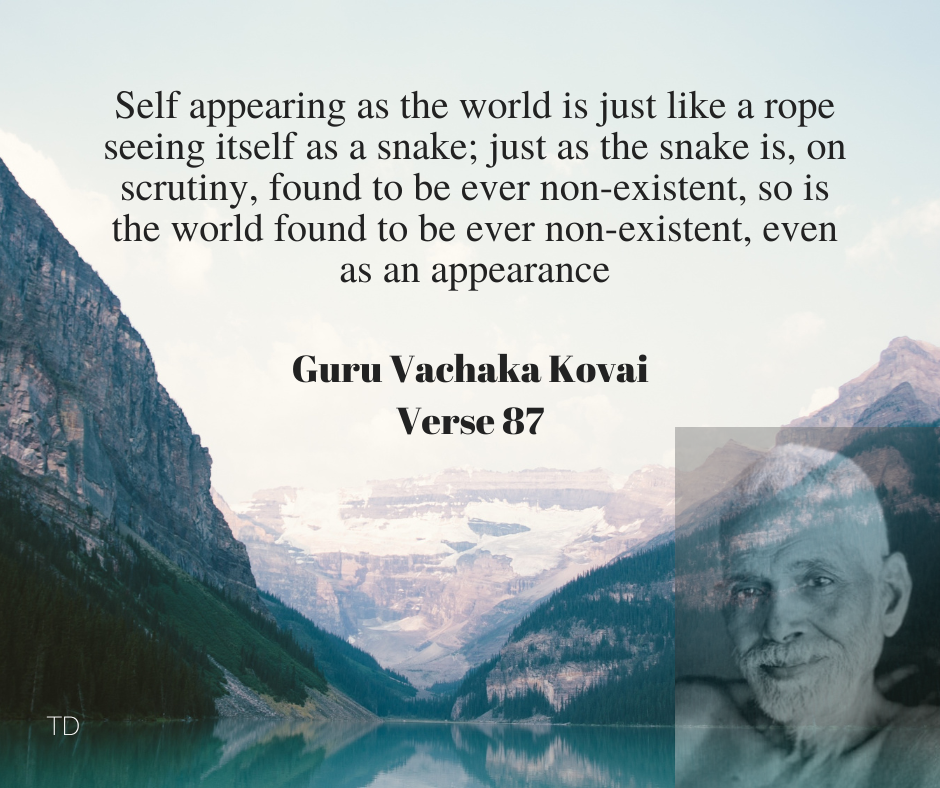
Similarly, Sri Ramana says in Guru Vachaka Kovai, verse 87:
‘…just as the snake is, on scrutiny, found to be ever non-existent, so is the world found to be ever non-existent, even as an appearance‘
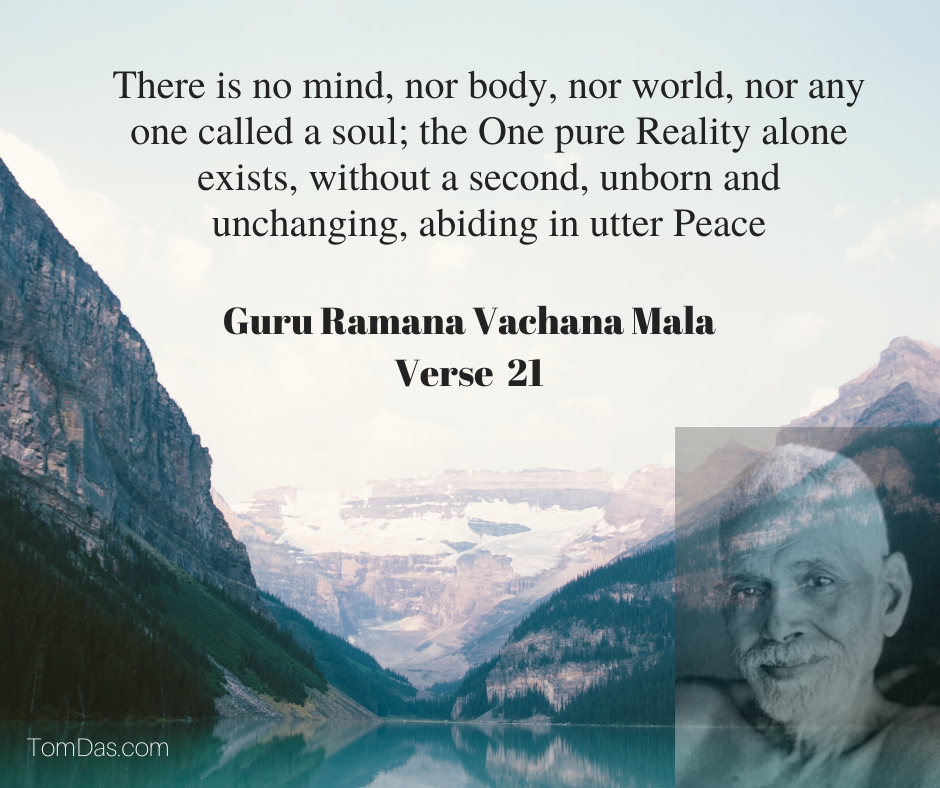
And in Guru Ramana Vachana Mala, verse 21, Sri Ramana gives us the Ajata teaching, that no-thing ever really came into existence at all:
‘There is no mind, nor body, nor world, nor anyone called a soul; the One pure Reality alone exists, without a second, unborn and unchanging, abiding in utter Peace’
For more on this teaching see here and here
Namaste
Everyone must eventually come to the path of Self-Enquiry | Sri Ramana Maharshi | Sri Sadhu Om
When I first came to Bhagavan and heard him repeating constantly that everyone must eventually come to the path of self-enquiry, I wondered whether he was being partial to his own teaching, but I soon understood why he insisted that this is so. The final goal is only oneness, and to experience oneness our mind must subside, which will happen entirely only when we attend to nothing other than ourself.
So long as we attend to anything other than ourself, our mind cannot subside, because attention to other things sustains it, since that which experiences otherness is only this mind. When the mind subsides completely, only self-attention remains, and self-attention alone is the state of absolute oneness. Bhagavan used to repeat this teaching every day, maybe ten or twenty times, but still we didn’t change. He didn’t change his teaching either, because to him this truth was so clear.
The above is an excerpt from ‘The Paramount Importance of Self Attention’ by Sri Sadhu Om, entry dated 29th December 1977. The book is highly recommended. You can download the entire text here. Also see the full recommended reading list here.
Self-Enquiry is not a ‘doing’, it is a ‘being’ | Sri Ramana Maharshi | Sri Sadhu Om
Traditionally in Vedanta teachings it is said that no actions (karma) can lead to liberation (moksha). But doesn’t Bhagavan Ramana Maharshi say that self-enquiry is the sure way to liberation? And doesn’t he even say that self-inquiry is the only way to liberation? And is not self-inquiry a karma (action)?
Here in this post the answer to this question is explained, and the nature of self-inquiry is further explained too.
The following is an excerpt from ‘The Path of Sri Ramana’ Chapter 7. You can find out more about and download the entire text for free here.
Also see: What does it really mean to ‘be still’? Summa Irru | Sri Ramana Maharshi
Therefore, while practising Self-enquiry, instead of taking anyone of the five sheaths as the object of our attention, we should fix our attention only on the ‘I’-consciousness, which exists and shines as oneself, as the singular, and as a witness to and aloof from these sheaths.
Instead of being directed towards any second or third person, is not our power of attention, which was hitherto called mind or intellect, thus now directed only towards the first person? Although we formally refer to it as ‘directed’, in truth it is not of the nature of a ‘doing’ (kriya-rupam) in the form of directing or being directed; it is of the nature of ‘being’ or ‘existing’ (sat-rupam). Because the second and third persons (including thoughts) are alien or external to us, our attention paid to them was of the nature of a ‘doing’ (krlya). But this very attention, when fixed on the non-alien first person feeling, ‘I’, loses the nature of ‘paying’ and remains in the form of ‘being’, and therefore it is of the nature of non-doing (akriya) or inaction (nishkriya). So long as our power of attention was dwelling upon second and third persons, it was called ‘the mind’ or ‘the intellect’, and its attending was called a doing (kriya) or an action (karma). Only that which is done by the mind is an action. But on the other hand, as soon as the attention is fixed on the first person (or Self), it loses its mean names such as mind, intellect or ego sense. Moreover, that attention is no longer even an action, but inaction (akarma) or the state of ‘being still’ (summa iruttal).
Therefore, the mind which attends to Self is no more the mind; it is the consciousness aspect of Self (atma-chit-rupam)! Likewise, so long as it attends to the second and third persons (the world), it is not the consciousness aspect of Self; It is the mind, the reflected form of consciousness (chit-abhasa-rupam)! Hence, since Self-attention is not a doing (kriya), it is not an action (karma).
That is, Self alone realizes Self; the ego does not ! The mind which has obtained a burning desire for Self-attention, which is Self-enquiry, is said to be the fully mature one (pakva manas). Since it is not at all now inclined to attend to any second or third parson, it can be said that it has reached the pinnacle of desirelessness (vairagya). For, do not all sorts of desires and attachments pertain only to second and third persons? Since this mind, which has very well understood that (as already seen in earlier chapters) the consciousness which shines as ‘I’ alone is the source of full and real happiness, now seeks Self because of its natural craving for happiness, this intense desire to attend to Self is indeed the highest form of devotion (bhakti).
It is exactly this Self-attention of the mind which is thus fully mature through such devotion and desirelessness (bhakti-vairagya) that is to be called the enquiry ‘Who am I ?’ taught by Bhagavan Sri Ramana! Well, will not at least such a mature mind which has come to the path of Sri Ramana, willingly agreeing to engage in Self-attention, realize Self ? No, no, it has started for its doom ! Agreeing to commit suicide, it places its neck (through Self-attention) on the scaffold where it is to be sacrificed !! How ? Only so long as it was attending to second and third persons did it have the name ‘mind’, but as soon as Self-attention is begun, its name and form (its name as mind and its form as thoughts) are lost. So we can no longer say that Self-attention or Self-enquiry is performed by the mind, Neither is it the mind that attends to Self, nor is the natural spontaneous Self-attention of the consciousness aspect of Self (atma-chit-rupam), which is not the mind, an activity!
“A naked lie then it would be
If any man were to say that he
Realized the Self, diving within
Through proper enquiry set in,
Not for knowing but for death
The good-for-nothing ego’s worth!
’This Arunachala alone,
The Self, by which the Self is known!”
‘Sri Arunachala Venba’ verse 39
‘The practice of witnessing thoughts and events…was never even in the least recommended’ by Sri Ramana Maharshi | Sri Sadhu Om | The Path of Sri Ramana
The following is written by Sri Sadhu Om, a direct devotee of Sri Ramana Maharshi’s, and is taken from the text ‘The Path of Sri Ramana – Part 1’, from one of the footnotes in Chapter 7. You can download the entire text for free here – it is a wonderful and rare text that explains the entire path to liberation. Please also see recommended reading for liberation here as well as the introductory articles on the homepage for more.
The practice of witnessing thoughts and events, which is much recommended nowadays by lecturers and writers, was never even in the least recommended by Sri Bhagavan, Indeed, whenever He was asked what should be done when thoughts rise (that is, when attention is diverted towards second or third persons) during sadhana, He always replied in the same manner as He had done to Sri Sivaprakasam Pillai in ‘Who am I?’, where He says:
“If other thoughts rise, one should, without attempting to complete them, enquire ‘To whom did they rise?’. What does it matter however many thoughts rise? At the very moment that each thought rises, if one vigilantly enquires ‘To whom did this rise ?’, it will be known ‘To me’. If one then enquires ‘Who am I?’, the mind (our power of attention) will turn back (from the thought) to its source (Self)”.
Moreover, when He says later in the same work, “Not attending to what-is-other (that is, to any second or third person) is non-attachment (vairagya) or desirelessness (nirasa)”, we should clearly understand that attending to (witnessing, watching, observing or seeing) anything other than Self is itself attachment, and when we understand thus we will realize how meaningless and impractical are such instructions as ‘Watch all thoughts and events with detachment’ or ‘Witness your thoughts, but be not attached to them’, which are taught by the so-called gurus of the present day.
————
Tom: The following excerpt is also taken from the same chapter, chapter 7, of The Path of Sri Ramana – Part 1:
Since, whether we know it or not, Self, which is now wrongly considered by us to be unknown, is verily our reality, the very nature of our (the Supreme Self’s) attention itself is Grace (anugraha). This means that whatever thing we attend to, witness*, observe or look at, that thing is nourished and will flourish, being blessed by Grace…
…Hence, when the power of attention of the mind is directed more and more towards second and third person objects, both the strength (kriya-bala) to attend to those objects and the ignorance – the five sense-knowledges in the form of thoughts about them – will grow more and more, and will never subside! Have we not already said that all our thoughts are nothing but attention paid to second and third person objects? Accordingly, the more we attend to the mind, the thoughts which are the forms (the second and third person objects) of the world, the more they will multiply and be nourished. This is indeed an obstacle. The more our attention – the glance of Grace (anugraha-drishti) – falls on it, the more the mind’s wavering nature and its ascendancy will increase. That is why it is impossible for the mind to negate anything by thinking ‘I am not this, I am not this’ (neti, neti). (Footnote to text here: This is why aspirants who, in order to destroy evil thoughts like lust, anger and so on, fight against them and thereby think about them fail in their attempts, while aspirants practising Self-enquiry, who pay their full attention to Self with an indifference towards their thoughts, bypass them easily)
On the other hand, if our (Self’s) attention is directed only towards ourself, our knowledge of our existence alone is nourished, and since the mind is not attended to, it is deprived of its strength, the support of our Grace. “Without use when left to stay, iron and mischief rust away” – in accordance with this Tamil proverb, since they are not attended to, all the ‘vasana-seeds, whose nature is to rise stealthily and mischievously, have to stay quiet, and thus they dry up like seeds deprived of water and become too weak to sprout out into thought-plants. Then, when the fire of Self-knowledge (jnana) blazes forth, these tendencies (vasanas), like well-dried firewood, become a prey to it.
This alone is how the total destruction of all tendencies (vasanakshaya) is effected.
Q. Is it really true that I am not this body? Physical pain & liberation, How to elminate wordly attachment? Sri Ramana Maharshi | Aham Sphurana book excerpt | Advaita Vedanta
The following is a teaching excerpt from a large unedited manuscript, well over 1000 pages long, called ‘Aham Sphurana’.
Aham Sphurana [‘I Shining’ or ‘I vibration’ or ‘I Am shining’ or ‘Shining of the I AM’] claims to contain a collection of previously unpublished talks with Sri Ramana Maharshi as apparently recorded by a visitor to Sri Ramana Ashrama, Sri Gajapathi Aiyyer, in 1936.
The authenticity of the teachings as being genuinely from Sri Ramana Maharshi cannot be confirmed, a fact acknowledged in the manuscript preamble itself, but I share these teachings here in case they are of interest to you.

17th July 1936
Questioner: Is it really true that I am not this body?
Sri Ramana Maharshi: Yes.
Questioner: If so, when some damage is suffered by the body, why do I feel pain? If, say, a piece of burning coal falls on somebody near me, I do not feel anything, but that person alone feels the pain. Likewise if a thorn pricks my foot I alone feel the pain, but not the one walking by my side.
Sri Ramana Maharshi: Does the body cry out, saying, ‘I am feeling pain!’? You associate yourself with your body and speak of it as your “I”. The body is only in the mind. All pain apparently suffered by the body is as imaginary as the body itself. The body cannot know anything. It is insentient flesh and bone. Notions of pain spring from our own imagination only. Thus, in deep slumber, the mind being inactive, there is no pain.
Questioner: Suppose I have a piece of metal wire in my hand. If I cut it into pieces, the metal cannot be aware that it is being cut, because it is insentient. Whereas, if a living body were to so much as be scratched, it explodes with agony. In what sense, therefore, does Bhagavan mean that the body is insentient?
Sri Ramana Maharshi: True, the body experiences the physical stimulus of pain if it is injured, but why should that fact create a thought in the mind, “I am feeling pain.”?
Physical pain creates mental agony because of the following reason – the mind assumes itself to be the body and appropriates to itself the bodily identity, because in the absence of such false self-objectification it cannot survive or thrive. If the idea “I am the body” is abandoned, everything, including pain suffered by the body, is only Bliss.
Questioner: But I am aware of the pain if the body is injured!
Sri Ramana Maharshi: When the body is injured, in the case of the unenlightened one, the following happens – his body feels the physical stimulus of pain, and his mind spontaneously manifests the thought, “I am injured”, causing him to become mentally agitated; the reason for the manifestation of such thought is the underlying erroneous idea “I am the body”. In one who is free from the mistaken idea of accepting the body for the Self, injury of the body causes no disturbance to his peace. Each one is indeed the Self, but absurdly confounds himself with the not-Self and so needlessly suffers on account of such dehatma-buddhi.
Questioner: The question still remains – if, as postulated by Sri Bhagawan, the body is insentient, how can it and why does it feel pain at all?
Sri Ramana Maharshi: The word “pain” is employed because there is a prejudice in the mind against such stimuli. When the mind is dissolved in Pure Consciousness, its prejudices also disappear. For the enlightened one, therefore, pain and pleasure are physical stimuli that stand on an equal footing. He does not covet the one and abhor the other; nor does he abhor the one and covet the other. Mind gone, there remains no yardstick by means of which one sensation is to be regarded as pain and another as pleasure.
Questioner: Sri Bhagavan seriously means to say he is unable to tell the difference between the sensation that ensues when an insect bites his leg and the one that ensues when someone is massaging it?
Sri Ramana Maharshi: That they are different sensations is self-evident; that the one is abhorrent and the other agreeable is mere mental judgement from which the Jnani is quite free. He himself seeks out neither pain nor pleasure, but accepts what comes his way without resisting; in Jnana only automatic acceptance remains.
Questioner: For Jnanis it is different; what of the common man?
Sri Ramana Maharshi: You also are a Jnani; only, you think otherwise!
Questioner: How could that be?
Sri Ramana Maharshi: The option of turning inwards and quietly allowing the mind to plunge and dissolve in the Self is equally available for all. It is not the fiefdom of a select few. All are verily only the Self.
Questioner: That does not satisfy me. I am unable to Realise it for myself.
Sri Ramana Maharshi: So long as worldly attachments are present the mind cannot be succesfully turned inwards.
Questioner: How to eliminate worldly attchment?
Sri Ramana Maharshi: By turning the mind inwards.
Questioner: Really!
Sri Ramana Maharshi: The more you hold on to the Self or retain the mind in its native state of subjective-awareness-sustained-effortlessly-and-volitionlessly, the more the mental tendancies and worldly attachments wither off; the lesser the mental tendancies and worldly attachments, the easier does become retention of the mind in its native state of subjective-awareness-sustained-effortlessly-andvolitionlessly.
Questioner: Which comes first?
Sri Ramana Maharshi: The sadhaka recognises and reflects upon the ephemeral nature of the objective world and the transient nature of his own body. He gets fed up with material pleasures, because they eventually lead only to sorrow, when their enjoyment becomes, for any reason, impossible. He asks himself if a more permanent experience of life might not be possible. Then he discovers the Ajata-advaita doctrine. Initially he is not convinced, and argues that if it were a dream there would be no possibility of corroboration, but that here his relatives and friends are able to confirm the evidence provided by his senses; he also asks why the same dream should be repeated everyday, were it all only a dream – according to him, here he sees the same sun, moon and earth everyday, whereas in his dreams he finds himself in new worlds moment to moment. Eventually it dawns upon him that everything he thinks he knows, including an understanding of the apparent permanency of the world he believes himself to live in, is only thought or imagination.
Then at the intellectual level he understands the truth – that the names and forms constituting the world are fictitious. This sparks a search for the substratum said to be underlying them, which alone is said to be Real by the wise.
He hears the teaching that the source of the mind, Beingness, is the gateway to the Real Self. Then he begins the practice of quietening the mind by vichara or any other method, tackling various distractions as and when they arise, by withdrawing attention from them and fixing it on Beingness or the Self. The beginning is only becoming fed-up with the evanescent nature of the world and the fugacious attractions it has to offer.
Questioner: The boubts Bhagavan mentioned – they are my doubts also. Why is everyone witnessing the same dream? The sun moon etc. are seen by all.
Sri Ramana Maharshi: In turn those “all” are seen by you only. In deep slumber when there is no mind, nothing is available to be seen, but your existence is a constant.
Questioner: Why do I dream the same dream everyday? For instance yesterday I came to the ashram and had darshan of Bhagawan; he was sitting on the same sofa in exactly the same manner. Today I am seeing Bhagawan and tomorrow also it is going to be the same Bhagawan.
Sri Ramana Maharshi: The future is a mere mental projection. The past is a mere memory. Have you not had dreams where the places you visit look extremely familiar?
Questioner: At least is the present real?
Sri Ramana Maharshi: Anything seen cannot be Real. What is seen is not Pratyaksha. It is not self-evident, because there is a subject-object relationship involved. It is merely sensory information that is fed into the mind by the strength of its own evil faculty of avidya maya. That alone is Real which shines by its own light.
You are asking about the objects of the world. Can such objects exist without a YOU, a perceiver? When there is no perceiver, as in swoon or deep slumber, is there anything to be perceived? No. What is the inference? The objects owe the appearance of their apparent existence to you only. They are merely mental creations. The appearance of this enormous cosmos around you is merely a mental information. The mind is fiction. Therefore the ‘objects’ manufactured by it are also fictitious. Have not the least doubt about it.
Questioner: If everything is unreal, can we conclude that bondage and liberation are also unreal?
Sri Ramana Maharshi: Yes.
Questioner: Then why should I try to obtain Liberation? Let me remain as I am.
Sri Ramana Maharshi: Exactly!
Questioner: I do not understand.
Sri Ramana Maharshi: Remaining as you are is the loftiest Sadhana.
Questioner: How can remaining in ignorance be sadhana?
Sri Ramana Maharshi: You think that you are in ignorance. When you do not think at all, what remains is only wisdom. Removal of the screen of thought is all that is required for Reality to be revealed. Since you want a sadhana by means of which you may reach this thought-free state, vichara is suggested. Actually there is no need for any sadhana for one who has mastered the art of remaining as he is – the art of Being. That is the import of the advice Summa Iru [Tom: ‘Be Still’]. People generally misunderstand it. It does not mean keeping the body idle. It means keeping the mind still or free from thought. Remain perpetually absorbed in the thought-free I-Current. This will automatically lead you to the Sahaja-stithi [Tom: the natural state, ie. liberation or self-realisation] without requirement for further effort.
Questioner: Is even desire for Liberation an obstacle to Liberation?
Sri Ramana Maharshi: Yes
Aham Sphurana – Scintillations of Jnana from Sri Ramana Maharshi – PDF download of the complete unedited text
Aham Sphurana [‘I Shining’ or ‘I vibration’ or ‘I Am shining’ or ‘Shining of the I AM’], an unedited text of over 1000 pages, claims to contain a collection of previously unpublished talks with Sri Ramana Maharshi as apparently recorded by a visitor to Sri Ramana Ashrama, Sri Gajapathi Aiyyer, in 1936.
This is a controversial text and the authenticity of the teachings as being genuinely from Sri Ramana Maharshi cannot be confirmed, a fact acknowledged in the manuscript preamble itself, but I share these teachings here in case they are of interest to you. Note that the essential teachings presented here are no different to the teachings from Sri Ramana Maharshi you will find elsewhere, but the way they are presented may be helpful to many.
At the time of writing this post, there is also a 280 page version of this text which is available from Open Sky Press – this is a beautifully arranged set of teachings collated from Aham Sphurana – but the teachings have been edited and therefore subtly changed. Sometimes this makes the teachings easier to access, but sometimes the meaning of the text may inadvertently be altered.
For example, this post, which I have presented in unedited form, is also present in the Open Sky Press version but the word ‘solipsism’ was removed from the edited version of the text on page 57 and for some reason replaced with the word ‘egoism’; the reference to Berkeley was also removed and the Latin phrase was (slightly) wrongly translated. For some this may make it easier to access, as the word solipsism is a philosophical term that some may not be familiar with, but for others reading Sri Ramana’s alleged view on solipsism may be fascinating and useful, and the removal of this term could take away from the depth of the teaching; similarly with the reference to the philosopher Berkeley.
Having read many spiritual texts, my personal preference is to read as near to the source material as possible (and where possible to go to primary sources themselves), as this gives the most accurate presentation of the teachings. I have read many texts that try to be helpful through editing but many end up inadvertently distorting the teachings. This is also why when I make comments on texts, I try to make it very clear what is added by me as opposed to what is present in the original, so the reader has an opportunity to assess my comments in light of the actual source material. To this end I am sharing the unedited PDF here for those who find it useful.
Best wishes & Namaste
Tom
Aham Sphurana book excerpt – Solipsism and the shock of hearing the Ajata teachings | Sri Ramana Maharshi | Advaita Vedanta
The following is a teaching excerpt from a large unedited manuscript, well over 1000 pages long, called ‘Aham Sphurana’. You can find out more and download the entire text here.
Aham Sphurana [‘I Shining’ or ‘I vibration’ or ‘I Am shining’ or ‘Shining of the I AM’] claims to contain a collection of previously unpublished talks with Sri Ramana Maharshi as apparently recorded by a visitor to Sri Ramana Ashrama, Sri Gajapathi Aiyyer, in 1936.
The authenticity of the teachings as being genuinely from Sri Ramana Maharshi cannot be confirmed, a fact acknowledged in the manuscript preamble itself, but I share these teachings here in case they are of interest to you. Note that the essential teachings presented here are no different to the teachings from Sri Ramana Maharshi you will find elsewhere, but the way they are presented may be helpful to many.
11th July 1936
Sri Ramana Maharshi: When a man is told he is neither the body nor the mind, he is initially puzzled, because all along his life his experience of self has been confined to these two only. When he hears the words of the Jnana-guru for the first time, he learns to his shock that these two [Tom: ie. body and mind] are suddenly to be regarded as unreal, insignificant and immaterial, and Consciousness of Being alone is to be treated as Real and material.
To one whose understanding of the world is sustained by conceptual knowledge and whose life is ruled by subject-object relationships, this can be too much of a shock to bear. He either laughs off the Ajata-advaita doctrine as sheer nonsense developed by mischievous minds that have nothing better to do, or takes it seriously and is shocked by the implications – everything he has ever known and cherished in his life is now suddenly revealed to be meaningless, fungible, evanescent and mutable, and thus unreal and unworthy of consideration, whereas what he had never before paid attention to is revealed as the only permanent, abiding Reality.
To one who has up till that point in time been regarding himself as a subject, finite across time and space, occupying an objective world, this revelation comes as a great emotional and mental upheaval, because he is attached to the things of the world.
One whose past sadhanas [Tom: spiritual practices] have weakened all attachment takes naturally to the idea that the world is a dream – either way it is not going to matter to him because he is not interested in it. The idea that the world does not exist as a collection of independent objects, but rather depends upon perception for its apparent existence, shocks some people. The evidence of the 5 sensory organs is merely random ‘information’. It does not denote that any such object is actually ‘out there’; there is no ‘out there’.
The inlet of consciousness is only one; therefore, all perceived depends upon the perceiver only; this consciousness, turned outside, is the world and its perceiver; turned inside it finds that it is the Self. Jagrat-prama [Tom: Knowledge of the waking state; Jagrat means the waking state, prama means knowledge] is the prama of jagrat-pramata [Tom: knower of the world; pramata means knower] [Tom: This entire sentence means that the [knowledge] of the waking state is knowledge for the knower of the waking state, ie. It is the ego that knows the waking state]. Apart from the perceiver there is no such thing as the perceived. The pramata [Tom:knower] believes he knows so many things about the world; he is merely accessing the contents of his own mind. All thoughts and perceptions are intra-mental modifications. The light of the Self falls on the aham-vritti and its children, the other vrittis, and a jiva [Tom: the (apparent) individual person] is born. It is for the aspirant to destroy all the other vrittis. The Self takes care of the nude ahamvritti – that is, destroys it. Then it will remain without reflection.
Questioner: This is pure solipsism – Berkeley’s Esse est percipi aut percipere [Tom: ‘to be is to be perceived or to perceive’ as expressed by George Berkeley].
Sri Ramana Maharshi: The solipsist says the mind is real, that everything, including the world and thoughts, that proceed from it is a phantom or shadow. He does not question the reality of the mind itself. I am asking you to go even further. I say that the mind itself is a shadow or phantom proceeding from the Self.
You will discover this as a matter of direct experience – if only you will probe into the source of the mind.
You ask why some do not Realize. You wonder whether prarabdha [Tom: fate or destiny] might be the reason. No. Prarabdha has no power to pull back into the world a jiva that is adamantly determined to disappear in its source forever. Then what is the reason, you ask. This is the reason – clinging fast to objective knowledge [Tom: this is the reason why some do not realise the Self – because they cling to objects].
There are learned pandits who have written rich commentaries volume after volume – upon various Advaitic texts which directly propound the Ajata-advaita doctrine- Ashtavakra Gita, Ribhu Gita, Panchadasi, Kaivalya Navaneetam, Ozhivil Odukkam, etc, etc. Go to their houses when a loved one has died, and ask how they feel. You may be met with a hostile stare. If you sit down then and there and explain all this, you may count yourself lucky if permitted thereafter to leave with your life. Where does the problem lie? All the learning has been in vain, because it has stopped at the level of the intellect.
It is unable to crush the Ego, because there was no practice. The only effort made was to read more books, go on writing commentaries, and go on receiving accolades for being ‘an Expert in the field of Advaita’, thus making the ego grow bigger and bigger. Never was effort made to still the ceaseless waves of thought. Even some effort in that direction might have brought a reciprocal flow of Grace from the Self. But no. Read, write, receive shawls at book-launch festivals, imagine oneself to be acting in a highly intelligent manner in saying the words, “No, no, it is all God’s work… I am an instrument in his hands, that is all…” there, receive applause, and inflate the ego further and further.
The Sun and the Earth may one day decide to interchange their positions out of boredom, but such people, who are infatuated with the poisonous wine of love for book-learning, cannot obtain True Knowledge. Objective knowledge and book-learning are the most deadly enemies on the path to Self-Realistion, because they are expertly disguised as sweet friends, and the disguise runs deep indeed.
 Tom Das