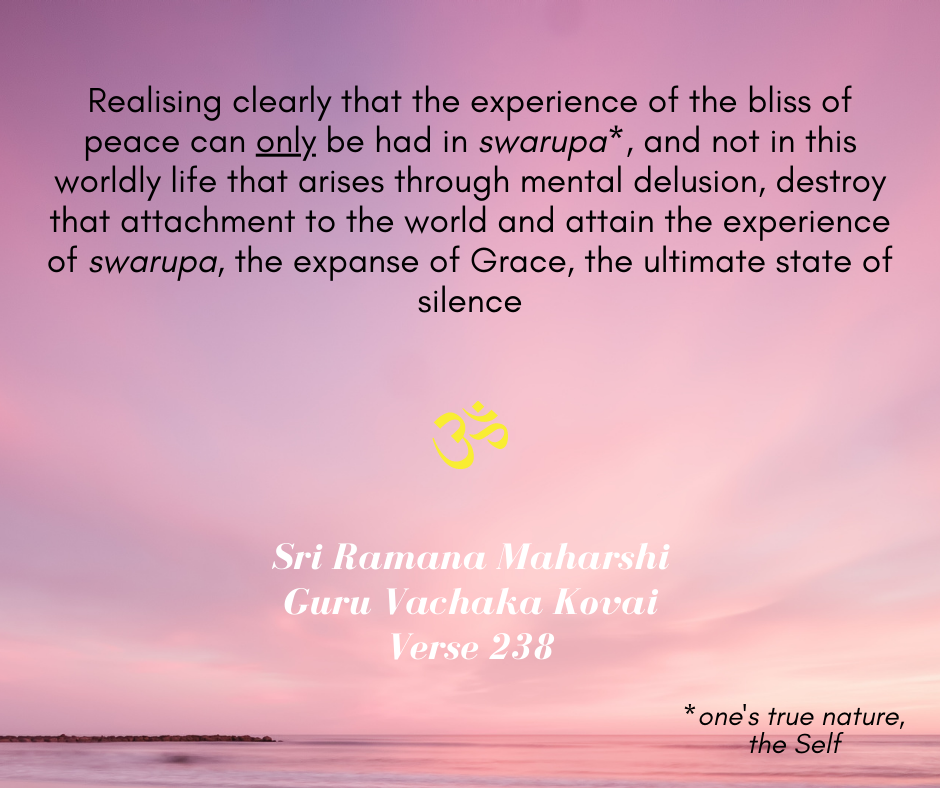
Experience the Bliss of Peace | Sri Ramana Maharshi | Guru Vachaka Kovai
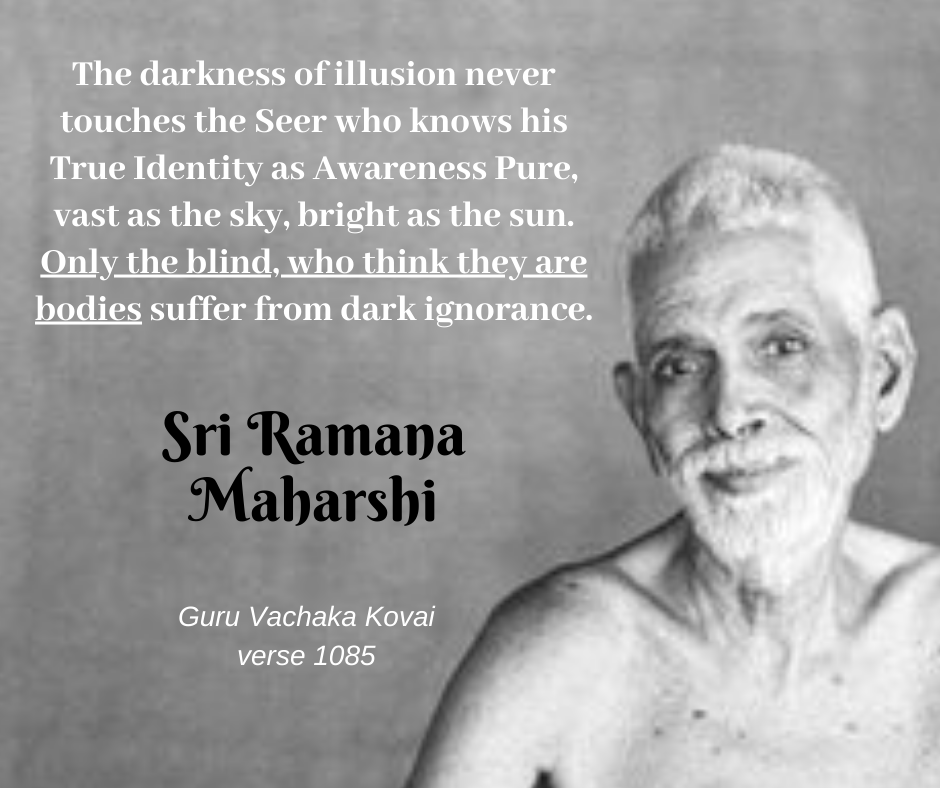

Questioner: Hi Tom, can you please explain verse 32 of Ulladu Narpadu (40 verses on Reality, a text written by Sri Ramana Maharshi)?
When the Vedas have declared, ‘Thou art That’ – not to seek and find the nature of the Self and abide in It, but to think ‘I am That, not This’ is want of strength. Because, That abides forever as the Self.
Sri Ramana Maharshi, Ulladu Narpadu, Verse 32
Tom: The idea is that we should turn within and discover what we truly are by inwardly and intuitively going towards the sense of ‘I’. When we go within in this way (this is also called self-enquiry) our mind becomes increasingly withdrawn and we start to discover, and eventually do discover, what we actually are: the formless, eternal, birthless, deathless Spirit that is devoid of objectivity, multiplicity, ego and suffering.
If instead of discovering what we truly are, we remain extroverted, sensing and perceiving objects and multiplicity, and merely repeat or think to ourselves ‘I am that’ or ‘all is already one’ or something like this, then we are fooling and deceiving ourselves, and we are weak and uncourageous, for we are not applying ourselves and developing true bravery or strength, which is turning within, away from the world, to discover our actual nature.

Sravana means hearing the teachings. Manana means contemplating upon the teachings. Nididhyasana means meditating upon the Self or placing one’s attention onto the Self in order to discover its true nature. Together these three traditionally sum up the method or process of self-realisation according to Vedanta teachings.
However…
1) There are some that say that Sravana alone leads to self-realisation, and that Manana and Nididhyasana are ancilary practices to just remove the blocks and purify/ripen the mind and ready it for Sravana, and that Sravana is the liberating factor.
2) There are some that say Sravana is just an initial teaching to allow Nididhyasana to finally occur and it is Nididhyasana that is the primary sadhana (spiritual practice) that allows liberation to arise.
This is further confounded as there are scriptural verses in support of both of the above visions of the teachings.
eg.
‘Thus only is It realised-when these means, viz. hearing, reflection and meditation, have been gone through. When these three are combined, then only true realisation of the unity of Brahman is accomplished, not otherwise – by hearing alone.’
~ Shankara’s commentary on Brihadaranyaka Upanishad 2.4.5
and seemingly contradicting this is the following:
‘for highly qualified aspirants, [self-] knowledge can arise even from mere listening to the teachings.’
~ Shankara’s commentary of Brahma Sutra 4.1.2
Swami Satchitanandendra Saraswati (SSS) in his many books on the teachings of Vedanta and on Shankara’s commentaries makes the following observation, namely that either Sravana, Manana or Nididhyasana can be the direct causes of liberation (ie. direct cause of removing ignorance), depending on the level of maturity of the (apparent) mind of the seeker. For those interested, Sri Ramana Maharshi says the same here, and also goes further to explain how this can be the case and also how both of the above scriptural passages do not actually contradict each other.
Here is SSS writing in the Appendix of his book ‘The Salient Features of Sankara’s Vedanta‘ on page 82:
6. Sravana (study of sacred revelation), Manana (reflective thinking) and Nididhyasana (concentrated contemplation), are all means for realizing Atman. Highly developed souls, however, who can immediately grasp the true meaning of the Vedic teaching, do not stand in need of any additional effort.
Not taking this principle into account is responsible for the divergence of opinion among commentators of Sankara Bhashya [Tom: Shankara’s commentaries] about the relation of Sravana and Nididhyasana. Of these, some aver that Sravana is the principal means and the other two are only ancillary to it; while others insist that nididhyasana is the one means to direct realization and without it mere Sravana would be of no avail.
7. Sravana and the other means [Tom: ie. manana and nididhyasana] are enjoined only in so far as they turn the seeker inwards and direct him to stay his mind on Atman, but the resultant knowledge is no object of any injunction. [Tom: ie. Sravana, manana and nididhyasana all have their intended effect of self-realisation by turning the seeker’s attention towards the Self, but that the Self that is subsequently realised as truth cannot itself be caused or created by any spitirual practice or effort or action, ie. the Self is uncaused and uncreated]
Those who cannot distinguish between the’ effort required for Sravana, etc, and the resultant knowledge in each case, have made it a matter for controversy whether or not ‘srotavyah’ [Tom: lit ‘that which is (to be) heard’, ie. scripture] and similar texts constitute true injunctions. Some of them maintain that these are all injunctions while others insist that they are seemingly injunctions in form but are really statements of fact. Some even think that they are merely eulogistic statements. [Tom: ie. because Shankara says actions or karma cannot lead to liberation or Jnana, there is argument about the ontological status of whether or not the 3 sadhanas of sravana, manana and nididyasana are karmas or not. In truth we should know that the Self is not a product of any action, but that the sadhana is an action that occurs in the phenomenal world of maya, and so if we discern properly between these 2 there is no real conflict.]
8. Manana refers to the type of reasoning suggested by the Sruti itself conducive to experience. Hence the term ‘experience’ here should be understood to mean the supersensuous intuition [Tom: ie. Self knowledge] which results from our enquiry which takes in one sweep the whole field possible of whatever is knowable.
From this the reader has to understand that use might be made of ordinary reasoning also in so far as it is conformable to the reasoning suggested by the Sruti. Advaitins do try to disclose the hollowness of other systems according to the course of reasoning accepted by themselves. But Advaita itself cannot be established by means of pure logical ratiocination. People who are not aware of this fact, often try to apply speculation or inferences based upon partial experiences to Vedanta also. Others condemn all reasoning and affirm that reasoning is of no use in matters taught by the Sruti. So they interpret Sruti according to their own predilection and place their own convictions before seekers as the final Vedantic truth.
9. Nididhyasana is that kind of spiritual discipline by means of which one concentrates one’s mind on the subtle principle, Atman. At the end of this discipline, one becomes conscious of the fact that the mind itself is a superimposition on Atman. Then the mind becomes no mind, that is to say, it is realized essentially as Atman himself.
Also see: Was Ramana Maharshi’s self-realisation final and complete when he was a teenager?
Tom: as usual my explanatory comments are inserted in italiscised red
Questioner: How long did it take Maharshi to realise the Self?
Bhagavan Sri Ramana Maharshi: This question is asked because the name and form are perceived. These are the perceptions consequent on the identification of the ego with the gross body.
Tom’s comments: Bhagavan Sri Ramana is stating that perception of name and form only occur after ignorance, ignorance being the notion that I am the body (or body-mind). This is consistent with his writing in ‘Who Am I?‘:
When the mind comes out (rises) from Self, the world appears. Therefore, when the world appears, Self will not appear; and when Self appears (shines), the world will not appear
Therefore, Sri Ramana is stating this question only is asked due to ignorance of taking Sri Ramana to be a person (ie. a body-mind entity) who at one time attained realisation, when in fact Sri Ramana is just the ever-realised Self, which is the only existent reality. That said, the fact that Sri Ramana gave out this teaching to this devotee in itself meant that the devotee was spiritually developed enough to receive this higher teaching.
If the ego identifies itself with the subtle mind, as in dream, the perceptions are subtle also. But in sleep there are no perceptions. Was there not the ego still? Unless it was, there cannot be the memory of having slept. Who was it that slept? You did not say in your sleep that you slept. You say it now in your wakeful state. The ego therefore is the same in wakefulness, dream and sleep.
Tom’s comments: Sri Ramana is stating that objects are seen in dream but not seen in deep sleep. In this instance he states that the ego is present in all 3 states of waking/dream/deep sleep and next he will say we are to find the reality that underlies these 3 states. When that is found, the 3 states are no longer present, he will say:
Find out the underlying Reality behind these states. That is the Reality underlying these.
In that state there is Being alone.
There is no you, nor I, nor he; no present, nor past, nor future. It is beyond time and space, beyond expression.
It is ever there.
Just as a plantain tree produces shoots at its roots, before yielding fruits and perishing, and these shoots, being transplanted, do the same again, so also the original primeval Master of antiquity (Dakshinamurti), who cleared the doubts of his rishi disciples in silence, has left shoots which are ever multiplying. The Guru is a shoot of that Dakshinamurti.
The question does not arise when the Self is realised.
~ Talks with Sri Ramana Maharshi, Talk no. 17
Unless the correct meaning of the scriptures is understood, it will not lead to liberation, and the mind will remain forever floundering in scriptural concepts.
Neti neti is the way, removing attention from non-self is the way, but how to do it?
If this is not understood, then liberation will not ensue.
See here, where Sri Ramana Maharshi once again shines a clarifying light upon the true meaning of the scriptures and how to put them into effect:
This is one of a series of introductory articles – please see the homepage of tomdas.com for more introductory articles.
The following are the first 5 verses of a composition by Sri Ramana Maharshi, all on the topic of ‘the company of sages’:
1. In the company of sages, attachment vanishes; and with attachment, illusion. Freed from illusion, one attains stability, and thence liberation while yet alive. Seek therefore the company of sages. (from Bhajagovindam, the “Mohamudagaram Hymn,” by Shankaracharya)
2. Not by listening to preachers, nor by study of books, not by meritorious deeds nor by any other means can one attain that Supreme State, which is attainable only through association with the sages and the clear quest of the Self. (a verse from the Yoga Vasishta, 5 – 12 – v.17)
3. When one has learned to love the company of sages, wherefore all these rules of discipline? When a pleasant, cool southern breeze is blowing, what need is there for a fan? (a verse from the Yoga Vasishta)
4. Fever is overcome by the cool light of the moon; want, by the good wish-yielding tree; and sin by the Holy Ganges. Those three – fever and want and sin – all flee at the august sight of the peerless sage. (Subhashita Ratna Bhandargara, chapt. 3, v. 6)
5. Holy rivers, which are only water, and idols, which are made of stone and clay, are not as mighty as the sages. For while they make one pure in course of countless days, the sage’s eyes by a mere glance purify at once. (from Srimad Bhagavatam, chapt. 48, v. 31, tenth canto)
~ above verses are taken from the Supplement to the 40 verses on Reality by Sri Ramana Maharshi. In these specific verses, rather than writing new verses himself, he incorporated verses from traditional scriptures (source given in brackets). You can read the original text in full here.
Questioner: I want to ask a question. May I do so?
Sri Ramana Maharshi: Yes, what question? You said you had read Paul Brunton’s book ‘The Secret Path’. Read it a thousand times — Paul Brunton has expressed me correctly; then why do you not practice it? Turn to page 73 and see if you don’t find an answer to your question in paragraph 2 [see later in the post for this text].
Silence is never-ending speech. Vocal speech obstructs silent speech. More things are achieved by silence and more thoughts are conveyed by silence to a wider world. Oral questions and answers may appear to benefit the questioner and a few listeners in this hall, but actually they obstruct, delay and interrupt the silent communication of thought-waves to thousands of spiritual aspirants all over the world.
So many sadhaks who come to me for inquiry and elucidation would amply benefit themselves and others by sitting before me silently — absolutely speechless. The greatest and most effective forces are those which are invisible, such as the ether or electricity. Any query you desire to make, ask your own mind or thought — you will, readily find the answer there. The most effective help is with silence.
– above dialogue taken from the book ‘Conscious Immortality’
In the above dialogue Sri Ramana Maharshi referred to page 73 paragraph 2 of Paul Brunton’s book ‘The Secret Path’, which you can read here:
Only in deep silence may we hear the voice of the soul; argument but beclouds it and too much speech stops its appearance. When you have caught your fish you may share it, but while you are angling for it, talk breaks the spell and frightens the fish away. If we could occupy ourselves less with the activities of the larynx and more with the activities of the deeper mind, we might arrive at something worth saying. Speech is an ajunct, no an obligation. To be is the prime duty of man.
Life teaches us silently while men utter their instruction in loud voices.
The treasure-trove of the real self is within us, but it can be lifted only when the mind is still.
– excerpt from ‘The Secret Path’ by Paul Brunton, pages 73-74
Question 4. If it be true that the Guru is one’s own Self (atman), what is the principle underlying the doctrine which says that, however learned a disciple may be or whatever occult powers he may possess, he cannot attain self-realisation (atma-siddhi) without the grace of the Guru?
Sri Ramana Maharshi: Although in absolute truth the state of the Guru is that of oneself it is very hard for the Self which has become the individual soul (jiva) through ignorance to realise its true state or nature without the grace of the Guru.
All mental concepts are controlled by the mere presence of the real Guru. If he were to say to one who arrogantly claims that he has seen the further shore of the ocean of learning or one who claims arrogantly that he can perform deeds which are well-nigh impossible, “Yes, you learnt all that is to be learnt, but have you learnt (to know) yourself? And you who are capable of performing deeds which are almost impossible, have you seen yourself?”, they will bow their heads (in shame) and remain silent. Thus it is evident that only by the grace of the Guru and by no other accomplishment is it possible to know oneself.
~ Sri Ramana Maharshi, Spiritual Instruction (Upadesa Manjari)
We have started playing this at the beginning of our satsang meetings for people to chant along to if they wish to.
Let this take you to your Source, with heart-melting love and devotion for Bhagavan Sri Arunachala Ramana, also known as Sri Ramana Maharshi, the True Guru, your own very Self 🙏🙏🙏
🙏 Om Namo Bhagavate Sri Arunachala Ramanaya Om 🙏
Created by volunteers/ devotees of Sri Ramana Maharshi
Vocals by Tom Das
Video by Demetrius Fuller
Produced by Gordon Sinclair
Some people say that eternal bliss is a fanciful myth, but eternal bliss is actually our true nature, and realisation of this, which DOES actually result in eternal bliss, is the entire point of the non-dual teachings.
If someone says this eternal bliss is not possible, it just means they have not found it themselves, not that it is not possible.
All the great sages testified that eternal bliss is our true nature and is the fruit of liberation, and to discover it, and thus also end all suffering, we must turn within.
Anything less than this eternal bliss will not satisfy us, and seeking (and suffering) will necessarily continue.
Anything less than eternal bliss means we have not truly discovered what the term ‘non-duality’ points to, and that we are still engaging, however subtly, on the mental/intellectual realm, where ego and suffering continue to (apparently) exist.
See what Ramana says here, in Guru Vachaka Kovai:
1062. The ever-present Self, the radiant
Gem, this is the rarest, richest
Treasure. Look within and find
And hold it fast. Your penury,
The grand illusion, source of every
Trouble on earth, will vanish forthwith.
1063. Not knowing the value of this treasure,
Their own by birthright, people perish
Through mere sloth. The great ones who
Have found the clue and traced and gained it,
They enjoy eternal bliss.
~ Sri Ramana Maharshi, Guru Vachaka Kovai, verses 1062 and 1063
🙏🙏🙏
 Tom Das