The paradox of yoga

The word yoga can be used to describe a series of specific methods which aid and direct the seeker towards the goal of the ending of suffering or of attaining realisation. So let me start by saying something quite obvious: all of the yogas* are practices to be performed or actions to be done. They are therefore meant to be performed by a person who thinks themselves to be a separate doer-entity.

The very existence of the (illusory) separate doer implies a duality – in fact the imagined doer is the essence of duality, the first conceptual step from which all other dualistic notions proceed from. The duality that it sets up is between that of the subject (the doer) and objects (the objects of the world in which actions are done).

The aim of all yogas is, through practice, to facilitate a seeing/realisation that the separate doer-entity is an illusion. And therein lies the apparent paradox. Yoga is action undertaken by the (imaginary) separate doer in order to see through this illusion of doership.

*Traditionally there are several key yogas outlined in the vedic texts, the main ones being Jnana Yoga (yoga of knowledge or understanding), Karma Yoga (yoga of action), Bhakti Yoga (yoga of devotion) and Raja Yoga (the king of yogas).

Also see:
How yoga works
The essence of yoga
Ramana Maharshi: The 4 paths to freedom (the 4 yogas)
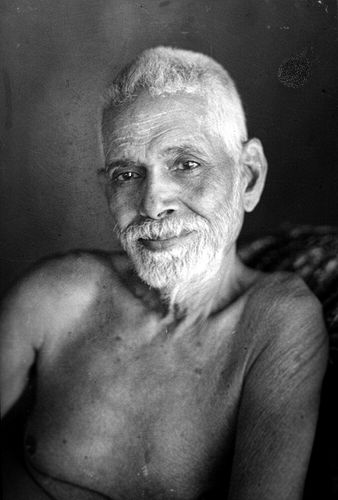
Ramana Maharshi: remaining quiet and aware is the state of mind to aim at

Ramana Maharshi sitting

Questioner:  There are times when persons and things take a vague, almost transparent form, as in a dream. One ceases to observe them as outside, but passively conscious of their existence, while not actively conscious of any kind of selfhood.  There is a deep quietness in the mind.

Is it at such times that one is ready to dive into the Self? Or is this condition unhealthy, the result of self hypnotism? Should it be encouraged as yielding temporary peace?

Ramana Maharshi:  There is Consciousness along with quietness in the mind.  This is exactly to be aimed at.  The fact that the question has formed on this point, without realizing that it is the Self, shows that the state is not steady but casual.

The word ‘diving’ is appropriate when there are outgoing tendencies, and when, therefore, the mind has to be directed and turned within, there is a dip below the surface of externalities.  But when quietness prevails without obstructing the Consciousness, where is the need to dive?

Taken from Talks with Ramana Maharshi, Talk 348


Tom’s comments:

The sadhana (spiritual practice) that Bhagawan recommends above is to simply remain quiet (in mind and thought) and also to remain aware.

This is self-knowledge. This is the Self.

When thoughts can come and go without disturbing this essential quality of mind, there is no need to ‘dive’ using the tools of Self Inquiry (ie. the question ‘Who am I?’). With time it may be seen that nothing ever disturbs this ‘peace that passeth all understanding’, and that nothing ever did.

It was always here, fully manifest, right under our noses.

Here is the gateway to Self-knowledge or liberation.

Poetry: the Presence that always is

sitting sunset.jpg

Ask a thousand questions,
Receive a thousand answers,
The real answer is not in words:
It’s the Presence that always is.

Thoughts want to know what real,
Want to have it all figured out,
One day it’s all seen through,
What’s left is the Presence that always is.

When you can, stop. Allow silence to gently fill you up,
Feel it bloom and grow within your heart,
That warm glow, that inner light, infiltrating everything,
The Presence that always is.

Feelings come and go,
Sometimes flowing, sometimes sticky,
‘Embrace them with’, ‘allow them to merge into’,
The Presence that always is.

Deep within your heart,
Presence emanates and embraces,
The sacred heart within and without, embracing all,
The Presence that always is.

The totality of experience,
‘Body’, ‘mind’ and ‘world’,
Everything that is happening or has ever happened,
Is just this Presence that always is.

Who am I…? Presence is here
Silence…Presence is here
Preoccupied with thought and deed…Presence is here
Hurt and afraid…The Presence that always is.

Life and laughter…Presence is here
Tears and pain…Presence is here
Not sure what going on? Presence is here
Now what do I do? ……………………

See also I AM


Ramana Maharshi: Once you realise the Self, it becomes your direct and immediate experience. It is never lost.

Ramana Maharshi sitting
‘Once you realise the Self, it becomes your direct and immediate experience. It is never lost.’
Ramana Maharshi

Time and time again I hear from spiritual seekers that they glimpsed the Self, they experienced that ecstasy, but it slipped through their fingers and fell away. Their question to me is how to get it back again. This is the wrong question, this is the wrong way, as it is based on a fundamental misunderstanding of the path.

Everything that comes can also go. Everything that comes, all experiences that have been attained, are not the Self.

The Self is no particular experience. It is always here, fully manifest, fully evident. Everything that is perceived is It. It is not different from whatever is being perceived to be happening.

Realising that ‘this is It’ is Self-realisation. It is simply seeing what already is the case. When it is seen, there is no desire to reach a new experience, and a seeing that everything happens spontaneously without the presence of a separate doer-entity. Here suffering falls away as the simple truth of no-doer is seen.

Actions, thoughts and desires continue to manifest themselves, spontaneously, but there is nobody doing it, just like the wind blowing or digestion happening. Things happen, no doer.

As long are you are alive, you always are, you always exist. No matter what happens, you are. This knowledge of (your) being is Self-knowledge. It is not something to attain, just something to be ‘acknowledged’. It is not separate from whatever is perceived to be happening. How can this ‘knowledge’ be lost?

Spiritual knowledge cannot be learnt

green sloping hills.jpg
“There will come a time when one will have to forget all that one has learned.” 
from ‘Who am I’ by Ramana Maharshi

Ultimate truth is simply that which never changes. It is here, now, everywhere and always already in its full glory. It is not separate from whatever is happening or from what is currently being experienced. Ultimate truth does not require you to believe in it or even do anything for it. Just drop all wrong thoughts and whatever remains is It. It cannot be caught in concepts.

The main role of the spiritual path is not to learn about ultimate truth, as it cannot be accumulated, but to discard falsehood. Seeing through false assumptions is what is called ‘spiritual knowledge’. It is not knowledge in the conventional sense at all really.

Conventionally speaking, learning is about accumulation of knowledge, but spiritual learning is more like pruning a hedge or chipping away at a block of stone to reveal a beautiful sculpture beneath. Put simply, spiritual learning is unlearning. Spiritual knowledge is seeing through false ideas.

“The state of Self-realisation, as we call it, is not attaining something new or reaching some goal which is far away, but simply being that which you always are and which you always have been. All that is needed is that you give up your realisation of the not-true as true.”
Ramana Maharshi

Anything that is learnt as being true is in the realm of relative knowledge. Anything that is learnt can also be forgotten whereas the Ultimate neither comes nor goes. Any statement posited as being true can be questioned and doubted leaving with it the bitter taste of uncertainty.

The Ultimate cannot be conceptualised. Conceptualisation itself relies on the Ultimate for its existence. All statements of truth rely on supporting structures and logic, eg. underpinning scientific or philosophical reasoning. The Ultimate truth stands by itself without needing outside support. It is none other than what you truly are. Look and you shall see.

Ramana Maharshi: To remain as you are, without question or doubt, is your natural state

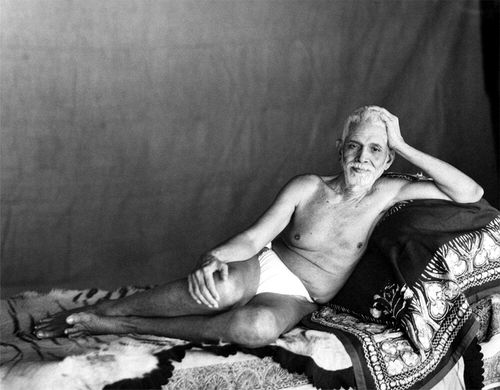
Ramana reclining

To remain as you are, without question or doubt, is your natural state
Ramana Maharshi

This is still an instruction for the spiritual seeker: ‘to remain as you are’.

With liberation, questions and doubts are irrelevant, as the natural state is simply whatever is. Nothing can obstruct it. It is always here and manifests as whatever is arising. It can never be obstructed and is always in plain sight.

However for the seeker, ie. the person that takes themselves to be the author of their thoughts and actions, the instruction to remain as you are and not worry about or get entangled with thoughts, questions and doubts, is one of the highest and most refined spiritual teachings available.

Be still, forget all concept of who you are, notice things as they happen. Regardless of what is happening, you know that you are, never what you are, only that you are.

When the mind and its concepts are no longer being believed, what use is there to talk of separation or no separation, self or no-self?

Poetry: the all knowing ego

Punch and judy.JPG

The ego thinks it has all the ‘answers’,
Thinks it knows exactly how the enlightenment game works,
Thinks it knows which practice is best,
All its concepts lined up.

Of course it has no clue.

Pride means it pretends to know what it doesn’t,
Clinging to what it hopes will work,
According to its limited understanding.

Who can blame it?

My advice: realise first, talk later.