Sri Ramana Maharshi: perceiving and creation are one and the same

147. Creation is not other than seeing; seeing and creating are one and the same process. Annihilation is only the cessation of seeing and nothing else, for the world comes to an end by the right awareness of oneself.

330. There is no creation apart from seeing; seeing and creation are one and the same. And because that seeing is due to ignorance, to cease seeing is the truth of the dissolution (of the world).

~Sri Ramana Maharshi, verses taken from Sri Ramana Paravidyopanishad

To understand these verses more deeply see these posts here and here

The Three states (Waking, Dream and Deep Sleep) and Turiya fully explained | Ajata | Self-realisation | Advaita Vedanta

The following is taken from the wonderful text Sadhanai Saram (The Essence of Spiritual Practice) written by Sri Sadhu Om, a direct devotee of Sri Ramana’s. This text not only gives us the essence of Sri Ramana Maharshi’s teaching, but also directs us to the true Vedanta teachings. The notes are written by Sri Sadhu Om himself. The sub-headings have been added by myself to aid readability. You can download the full text as a PDF using the above link.

Introduction

  1. If we did not have the good fortune of having attained a human body, which enables us to experience daily the three states of waking, dream and sleep, how could we have the fitness to do Selfinquiry? Therefore, this human birth is indeed superior to all other births.
  2. Except in this human body, all these three states are not experienced in one lifetime by any soul, whether deva (divine), animal or plant. Therefore, a very great boon indeed is the boon God has bestowed upon us in the form of this human birth, which is such a good opportunity enabling us to inquire and know the Self.

Note: Celestial beings (devas) experience only the waking state; animals experience only sleep and a dream-like waking state; plants experience only sleep**; and insentient objects like stones are always in a state like swoon. Only in the human birth, does one experience all the three states of waking, dream and sleep. Hence, even devas must take birth as human beings if they wish to attain Selfknowledge, the state of liberation.

**Note: Compare Talks, no. 617, p. 580.

  1. The three states of waking, dream and dreamless deep sleep are experienced daily by all human beings, are they not? If we keenly scrutinize the nature of these three states, knowledge of the state of liberation, which is the reality of these three states, will be attained by us as a direct experience.

The I AM

  1. In the waking state we exist as “I am”; but in this state, beside us, so many second and third person objects of various kinds are also known by the mind. How have all these come here?
  2. In dream also we exist as “I am”, having become the one who sees everything there; but in that state also so many second and third person objects of various kinds are again known by the mind. How did all those come there?
  3. In sleep also we exist as “I am”; however, in that state we do not see anything appearing as other than us. Therefore, our state of existing as “I am” alone shines always without ever slackening or being obstructed, whereas our state of knowing objects other than us undergoes change. Hence, our state of existing as “I am” is alone the one unchanging state.
  4. The state of our existing as “I am”, which shines in all the three states continuously and without ever coming to an end, is our exalted state of real knowledge; it is the state of purna (the Whole). Objects other than “I” do not exist in all the three states. Hence our own nature, the Self-existence “I am,” alone is the reality which ever exists.

Objects

  1. Since objects other than “I,” such as the body and world, do not exist unceasingly in all the three states, but rise and appear to exist only in between in the waking and dream states, they cannot be the reality, which exists always and without being obstructed. This conclusion arrived at by scrutinizing our experience in these three states, is the foundation for the practice of Self-inquiry.
  2. These objects other than “I,” which exist at one time and do not exist at another time, are truly non-existent even at the time when they appear to exist. When scrutinized, waking and dream are both found to be only one in nature, because the objects, which appear to exist in each of these states, unfailingly cease to exist in any other state.

Duality

  1. That state, in which any object seen is not experienced as other than the one who sees, is alone the state of reality. If the seer, who is an unreal ego, rises, then only will all the unreal objects other than “I” rise, and seem to exist.

The waking dream

  1. The dream-world – and the one who, living there identifying a dream-body as “I,” and sees that dream-world – both together constitute the dream. The waking state is also like that; that is, not only this seemingly vast world that is perceived in front of us, as if existing as other than us, and also we, the jiva who sees this waking world, both together constitute the appearance of this dream, which is called the waking state.
  2. In practice, waking and dream are only one and the same. Just as in waking the mind thinks, “I am this body,” so in dream also the mind projects a body by its creative power of imagination and functions there, feeling “I am this body.”

Ending the dream

  1. Until the root-tendency (mula-vasana) to identify a body as “I” ceases to exist, the appearances of the waking and dream states that arise due to delusion (maya) will not come to an end. If you, with a one-pointed mind keenly and incessantly attend to the consciousness of your existence, which shines as pure “I am,” the root-tendency “I am the body,” and all its products and other tendencies, will cease to exist.

Ignorance and deep sleep

  1. To remain inactive forgetting the feeling “I am the body,” is sleep. In the dense ignorance of this sleep, arises a creative imagination of the mind (mana-kalpana), and this alone is the cause for the appearance of dream. Therefore, it is the mind alone that projects a dream.
  2. Similarly, in the long sleep of ignorance (ajnana), which has engulfed us due to our forgetfulness of our true state of pure Self-consciousness, an imagination in mind (mana-kalpana) rises identifying a contemptible fleshy body as “I”, and this alone is the cause for the rising and appearance of this despicable waking state, which we are now experiencing.

Samsara (the cycle of birth and death)

  1. Just as sleep alone is the cause for the appearance of dream, so the sleep of forgetfulness of our true Self-Knowledge is alone the cause for the appearance of this waking state. In this long sleep of Self-forgetfulness, many dreams in the form of countless births come and go.
  2. Know that just like a person who without coming to the waking state, merges in deep sleep after the dream he was seeing has come to an end, if the dream of the present birth that this person has taken is brought to an end by death, before he attains the true waking state of Self-knowledge, he will merge again into the underlying ancient sleep of Self-forgetfulness.
  3. Just like a person who was seeing a dream and who then leaves that dream and falls into deep sleep without coming to the waking state, if the waking-body dies before we attain the state of Selfknowledge, we will fall into a state like deep sleep. Just as a dream appears as soon as the mind of a person immersed in sleep rises and begins to wander, so after the death of this waking-body, as soon as the mind rises and begins to wander on account of its former tendencies, a waking state will again arise in which a body will seemingly exist as if “I”.
  4. Taking birth again, having come out of the delusion-enfolded state of death, and living a life of whirling about in this waking state, and finally dying without attaining Self-knowledge, is just like a person rising as “I” from deep sleep, seeing a dream again, and finally once again merging in sleep. You will not take birth again only if you awaken into the true state of Self-knowledge. Awaken thus.

Awakening: Waking up from the dream & Turiya

  1. If a person who has fallen asleep and is seeing a dream suddenly wakes up, by his awakening he will attain a state in which sleep and dream have both been dispelled. Similarly, if a person awakens from the present so-called waking state by attaining the exalted state of Self-knowledge, the dream of birth and death and the underlying sleep of Self-forgetfulness will both be dispelled, and he will thereafter never again undergo either birth or death. The state of real awakening (turiya), which he thus attains, and which transcends the three ordinary states of waking, dream and sleep, is the state of liberation.

The method of Sadhana (spiritual practice) – Self-enquiry

  1. If the power of attention, which sees the second and third person objects existing in dream, turns to attend to itself, both the first person (who sees the dream) and the dream will disappear; the sleep that is the cause for the rising of that first person will be dispersed, and the worthy state of true awaking will be experienced.
  2. Similarly, if the power of attention, which knows the second person objects existing in the waking state, turns to attend to itself (the “I” who sees this waking state), the waking state will disappear; the long sleep of Self-forgetfulness which is the cause for the rising of the individual sense of “I” will be dispersed and the true waking state of Self-knowledge will be attained. Therefore, attend only to yourself, the first person consciousness “I.”

Karma and Self-Realisation

  1. Even before the experience of the current destiny (prarabdha karma) which caused the appearance of a dream has come to an end, if the mind is struck by intense fear, joy or suffering, its power of attention will be driven Selfwards and return to the heart, whereupon waking will result.

Note: Prarabdha is that part of one’s destiny (or karma) that has to be worked out in this life. Sanchita is one’s karma accumulated in former lives that has not yet taken effect.

  1. Similarly, even before all the accumulated sanchita karmas have been exhausted by being experienced in the form of prarabdha, if in this present life, which was started by prarabdha, the mind either gains firm dispassion (vairagya), being unable to bear the severe sufferings of life, or experiences intense fear of death, it will turn Selfwards and merge in the heart; whereupon the true awakening of Selfknowledge will result.

Fear, suffering and self-realisation

  1. When such intense fear or suffering are experienced, if the mind with mature discrimination (viveka) at once earnestly scrutinizes, “To whom does this fear or suffering arise?” then the extroverted power of attention, which was till then being dragged out towards objects other than itself, will turn inwards to face itself, whereupon the truly awakened life of Self-abidance will immediately be attained.

Self-knowledge: ending the dream

  1. Just as all that happens in dream is experienced as real so long as one is seeing that dream, so all that is now happening in this waking state is experienced as real. If the dream comes to an end, all that was seen there will be known to be unreal. Similarly, for those who have awakened from this so-called waking state by attaining Self-knowledge, all the happenings in this state are clearly known to be unreal.
  2. As soon as the inwardly awakened state of Self-abidance is attained, all the adjuncts in the form of the wrong identification that the actions of the body are one’s own actions will become devoid of reality, being found to be mere superimpositions upon one’s nameless and formless nature, just like the blue color superimposed upon the colorless sky; and the truth, that one is only the adjunct-free Self, will clearly shine forth.

Ajata

  1. Only in this real waking state of Self-abidance will true knowledge blossom in the form of the ajata experience, “No mundane dual activity such as birth and death has ever touched me; I am Self, the existence-consciousness which is ever devoid of the body and the senses.”
  2. The pure consciousness “I,” which exists in sleep devoid of all adjuncts, is the Supreme Reality (Brahman). If we do not slip down from that state of pure consciousness due to attachment to the body (dehabhimana), that itself is the Supreme Abode (parandhama). If we remain, without leaving Self, that itself is liberation.

Do you exist in deep sleep?

  1. Though we think sleep to be a state of darkness, because no other objects are known there, know that it is not possible for anyone to deny his own existence in sleep. When you are able to affirm your experience in sleep, “It was darkness,” “There were no thoughts” and “It was a happy state,” is it not clear that you existed in sleep? To be able to affirm thus, who was that “you” who existed in sleep? Tell me.
  2. Your ability to affirm all the three experiences mentioned above shows not only that you existed in sleep, but also that you knew these experiences there, does it not? This existence-knowledge, which existed and was known in sleep, is indeed the peerless existence-consciousness (sat-chit), your own state, and the real nature of self.

Deep sleep and bliss (ananda)

  1. In sleep, in which you existed solitarily as the mere existence-consciousness (sat-chit), you were the experiencer of sublime happiness devoid of even a single petty misery, even though you were separated from all the possessions and all the objects which you seek in the waking state for happiness, were you not? That happiness which you experienced in sleep is indeed bliss (ananda), your true nature.

Outro

  1. To become a hero who abides as Self, the infinite reality (paripurna Brahman) whose nature is existence-consciousness-bliss (sat-chit-ananda), devoid of the experience of any body or any world, is the fruit to be gained by proper scrutiny of the three states of waking, dream, and sleep.
  2. The supreme Guru Sri Ramana has given the above clues so that, having thoroughly scrutinized the three states, we may finally abide blissfully forever as Self, our own true nature which transcends the three states.

No body, no mind, no world

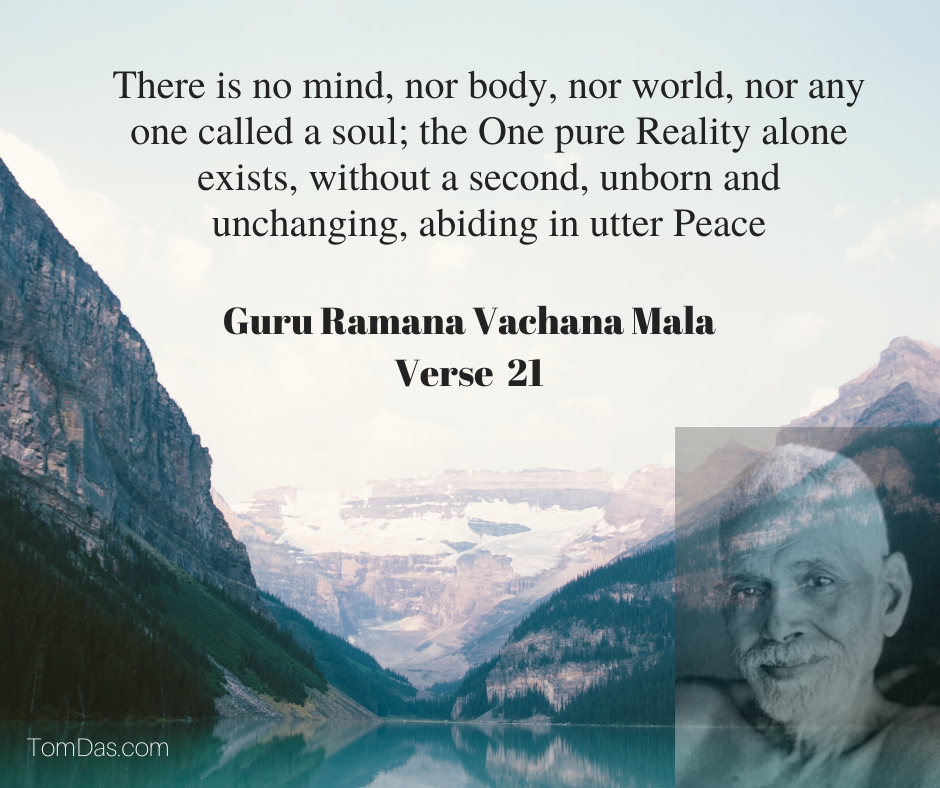
All that which is seen or perceived is an utter illusion. In reality there is no body, no mind and no world. There is only the One Formless Blissful Reality and You Are That. This must be discovered for oneself. The Reality, That which you ARE, which is unseen, is often overlooked, ignored.

When this is pointed out, those overly-attached to their individuality – ie. those overly attached to the notion of being a particular body-mind and their worldly life – they may cite this as being an offensive, impractical or life-denying teaching. In doing this they miss the Eternal Life of Unending Bliss!

But do not concern yourself with all of this: of course, this is all part of the illusion, the dream…Have faith in Bhagavan Sri Ramana and His Teachings and His Grace…press on with your Sadhana!

Ramana Maharshi: There are not many Jivas/egos/people (Eka Jiva Vada)

(Here a questioner asks are there not many jivas? Sri Ramana informs the questioner there is only one jiva)

A question was asked why it was wrong to say that there is a multiplicity of jivas. Jivas are certainly many. For a jiva is only the ego and forms the reflected light of the Self. Multiplicity of selves may be wrong but not of jivas.

Sri Ramana Maharshi: Jiva is called so because he sees the world. A dreamer sees many jivas in a dream but all of them are not real. The dreamer alone exists and he sees all. So it is with the individual and the world.

There is the creed of only one Self which is also called the creed of only one jiva*. It says that the jiva is only one who sees the whole world and the jivas therein.

~Talks 571

*Tom: This is called the doctrine of eka jiva vada (the view there is only a single jiva/ego/person). Our own body-mind, and the body-mind of apparent others are all projections of the Self. Like a dream, it appears we are many, but actually this entire dream world is an illusion, and there is only the Dreamer, the Self, the Consciousness from which all is projected. Tat Tvam Asi, You are That.

The above is an excerpt taken from this longer post that further explores this theme:

Ramana Maharshi: The world should be considered like a dream

Neo-advaita and the highest ‘teachings’ of Advaita Vedanta (ajata vada) – are they the same?

In Advaita Vedanta it is said that the Ultimate Truth is that Maya never existed, and that there never was a world (Jagat), individual person (Jiva), or a God (Isvara). This is known as Ajata Vada – see here for an example of this teaching. Here in Guru Vachaka Kovai we have Sri Muruganar stating the same:

‘…I have known that in truth there is never in the least any attainment of bondage, liberation, and so on, which are fabricated when one imagines one is separate from reality’ Guru Vachaka Kovai, verse 1241

Someone recently made a comment to me that this sounds remarkably like Neo-Advaita, to which my response was as follows:

They sound remarkably similar because on the verbal level both traditional and neo-Advaita talk about Ajata Vada (the view that there is no maya, no objects truly exist, and therefore no true meaning, no seeker, no teaching, no teacher, etc) as being the ultimate truth, but traditional advaita also talks about teachings from vivarta vada (world is a projected illusion) and shristi dristi vada (world is real) viewpoints and prescribes self-enquiry as a (paradoxically) valid method for this to be realised on these latter 2 levels for those who cannot fathom ajata vada. Upon this realisation it is ‘realised’ there was never a seeker and no real realisation either. Sri Ramana Maharshi explains it more fully here if you are interested.

Also see:

Advaita Vedanta: Gaudapada’s Method (Mandukya Upanishad Karika)

Ramana Maharshi – three theories of reality of the world (shristi-dristi vada, dristi-shristi vada/vivarta vada, ajata vada)

The Ultimate or Highest Truth according to the Upanishads

Ramana Maharshi – three theories of reality of the world (shristi-dristi vada, dristi-shristi vada/vivarta vada, ajata vada) – the 3 levels of the teaching

This is one of a series of introductory articles – please see the homepage of tomdas.com for more introductory articles. Also see: For those attached to the world, the world is considered to be a divine manifestation. For the advanced seeker, the world is considered to be an illusion

And The Suprising Meaning of ‘Real’ and ‘Unreal’ in Advaita Vedanta

In classical Advaita (Non-Dual) Vedanta, there are three main theories or viewpoints of reality, called shristi-dristi vada, dristi-shristi vada and lastly ajata vada. Whilst these Sanskrit words may appear complex, the idea is actually very simple, and Bhagavan Sri Ramana Maharshi explains the meaning of these terms below.

It may be helpful to note that ‘vada’ means ‘theory’ or ‘viewpoint’, ‘shristi’ means ‘the world’ or ‘creation’, ‘dristi’ literally means ‘sight’ but in this context refers to consciousness, and ‘jata’ means ‘birth’ (or creation). Adding ‘a’ as a prefix to ‘jata’ negates the meaning so that ‘ajata’ means ‘unborn’ or ‘no creation’.

Therefore:

1) Shristi-dristi vada is the view that the world is primary and gives rise to consciousness, which is the most commonplace model of the universe, ie. that first there was a universe in which life gradually evolved on planet Earth and eventually human life and human consciousness evolved. In Western philosophy this is known as the Realist view of reality. This view also broadly corresponds to the waking state and to the Dvaita (dualistic) world view.

2) Dristi-shristi vada is the view that consciousness is primary and gives rise to the world appearance, ie. like in a dream, consciousness exists first and then this consciousness manifests the apparent dream-world and dream-subject/object duality. In Western philosophy this is known as the Idealist view of reality. This view broadly corresponds to the dream state and the view of Vasistadvaita (qualified non-duality or partial non-duality as I like to call it). This view is also known as, or at least is very similar to vivarta vada, which is the view that the world and individual are both projected illusions that simultaneously appear, and that the world and individual appear to appear but do not actually appear, rather like a dream. Vivarta vada could therefore be considered to be a sub-type of Drist-Shristi-Vada.

and

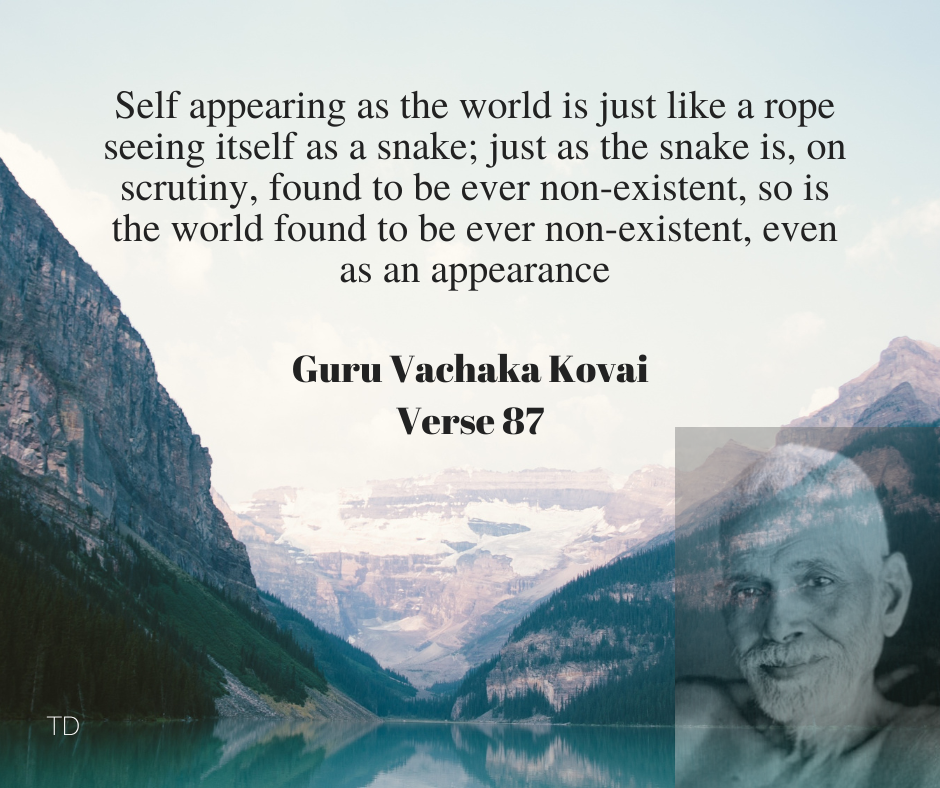
3) Ajata vada is the radical view that there never was any creation at all, and that there is only The Absolute, and that there never has even been the appearance of creation. This view broadly corersponds to the deep sleep state and also to Turiya, the ‘fourth’ state. This is the true Advaita (non-duality). In Vivarta-vada, it is said that Maya (the entire phenomenal appearance) appears to exist, but actually doesn’t, but in ajata vada it is almost imcomprehensibly stated that Maya never even came into existence, not even as an appearance. Hence the difference between Vivarta Vada and Ajata Vada. Vivarta vada states the snake appears to exist in the dimly lit rope, but that it isn’t real, whereas ajata vada states that the snake never even appeared to exist at ‘any time’ (‘any time’ is in quotes as the notion of time and space are also ‘seen’ to never have existed).

Note that whilst (1) and (2) can be understood conceptually with the mind, Ajata vada is an advanced and highly radical teaching that is very difficult to comprehend and it makes little sense to the mind. This is why liberation is said to be unfathomable. Ajata Vada is usually associated with Gaudapada’s commentary on the Mandukya Upanishad but also features in several other scriptures such as Ribhu Gita, Yoga Vasishtha, the final few verses of Shankara’s Vivekachudamani, the Ashtavakra Gita and Avadhuta Gita to name a few. Shankara’s commentaries on the Upanishads also commonly point to the radical ajata teachings.

Vedanta teachings often start by working in a Realist framework, which is the default conceptual framework of reality for most seekers especially at the start of their journey. Then the Idealist conceptual framework is introduced, and later the Ajata or no-creation viewpoint is brought in when the seeker is ready, in step-wise progression depending on how the seeker is progressing with the teachings. The nature and content of teachings differ depending on what framework of reality is being used. Note the purpose of the teachings is not that they are true, but the view is to be adopted in order to remove ignorance and reveal THAT which cannot be taught, explained or expressed in words – THAT which you – THAT which is all there is – beyond words.

Note that the stronger the ego (ie. the identification with being a body-mind), the stronger the attachment to the belief-concept that the world is real, and this means that the higher teachings are more likely to be rejected by the ego-mind. Conversely, the weaker the attachment to body-mind, the weaker the attachment to the belief in the world being real, and the more likely the higher teachings are to be accepted. This in turn facilitates Self-Enquiry and ‘attainment’ of Moksha (liberation).

Similarly, whenever we come across a teaching, it can be very helpful to see which of the 3 levels the teaching belongs to – this can be very helpful to avoid unnecessary confusion in what can otherwise seem to be contradictory teachings.

To explain further, here is an excerpt from Day by Day with Bhagavan from 15th March, 1946:

201908

[Ramana Maharshi:] I do not teach only the ajata doctrine. I approve of all schools. The same truth has to be expressed in different ways to suit the capacity of the hearer. The ajata doctrine says, “Nothing exists except the one reality. There is no birth or death, no projection or drawing in [of the world], no sadhaka [no seeker], no mumukshu [no one seeking liberation], no mukta [no liberated person], no bondage, no liberation. The one unity alone exists ever.”

‘To such as find it difficult to grasp this truth and who ask. “How can we ignore this solid world we see all around us?” the dream experience is pointed out and they are told, “All that you see depends on the seer. Apart from the seer, there is no seen.”

Tom: Note here how Sri Ramana is distinguishing and differentiating vivarta vada/drist-sristi vada from ajata vada. Many people erroneously think that ajata vada states that world appears as a dream and non-creation means that the world is merely a dream-like appearance (as a dream appears, but is not real, and in that sense has not been created) – ie. many people erroneously equate ajata vada with vivarta vada/dristi-sristi vada. However here in the section above, if we read carefully, we can see that Sri Ramana is stating the Ajata vada is actually different to the idea that ‘all appears as the Self’. See here and here for more on this.
In Sri Ramana Paravidyopanishad we also see this same teaching in verses 147 and 330:

147. Creation is not other than seeing; seeing and creating are one and the same process. Annihilation is only the cessation of seeing and nothing else, for the world comes to an end by the right awareness of oneself.

330. There is no creation apart from seeing; seeing and creation are one and the same. And because that seeing is due to ignorance, to cease seeing is the truth of the dissolution (of the world).

‘This is called the drishti-srishti vada, or the argument that one first creates out of his mind and then sees what his mind itself has created.

‘To such as cannot grasp even this and who further argue, “The dream experience is so short, while the world always exists. The dream experience was limited to me. But the world is felt and seen not only by me, but by so many, and we cannot call such a world non-existent,” the argument called srishti-drishti vada is addressed and they are told, “God first created such and such a thing, out of such and such an element and then something else, and so forth.” That alone will satisfy this class. Their mind is otherwise not satisfied and they ask themselves, “How can all geography, all maps, all sciences, stars, planets and the rules governing or relating to them and all knowledge be totally untrue?” To such it is best to say, “Yes. God created all this and so you see it.”’

Dr. M. said, ‘But all these cannot be true; only one doctrine can be true.’

Bhagavan said, ‘All these are only to suit the capacity of the learner. The absolute can only be one.’


In Guru Vackaka Kovai (Garland of Guru’s Sayings), Ramana says the following (with a comment by Sri Sadhu Om):

100. Although Guru Ramana taught various doctrines according to the level of understanding of those who came to Him, we heard from Him that ‘Ajata’ alone is truly His own experience. Thus should you know.

Sri Sadhu Om’s comments: ‘Ajata’ is the knowledge that nothing – neither the world, soul nor God – ever comes into existence, and that ‘That Which Is’ ever exists as IT is.

Tom: here in Sri Sadhu Om, we have a close and direct devotee of Sri Ramana’s clearing stating what Ajata Vada actually is.

114. When the limited light [which is used to project pictures on the cinema screen] is dissolved in the bright sunlight [which enters the cinema], the pictures also will disappear instantaneously. Similarly, when the limited consciousness [chittam] of the mind is dissolved in supreme Consciousness [Chit], the picture show of these three prime entities [God, world and soul] will also disappear.

Here Sri Ramana explains why the teachings may initially concede the existence of the three primal entities (the individual or jiva, the world or jagat, and God the ordainer or Isvara):

115. Thus, since the Truth of the Source is One, why do all religions [and sometimes even Sages] start their teachings by at first conceding that these three prime entities are real? Because the mind, which is tossed about by objective knowledge, would not agree to believe in the One unless the Sages condescended to teach It as three.

122. Whatever high and wonderful state of tapas one may have attained, if one still identifies oneself with an individuality, one cannot be a Sahaja-Jnani [i.e. One in the State of Effortlessness]; one is only an aspirant of, perhaps, an advanced stage.

Here it is explained that for the teaching to ‘condescend’ to vivartha vada is the most practical method for seekers:

83. From his condescending opening words, “Because we see the world”, it is to be understood that the Great Master, Bhagavan Sri Ramana, who gives the most practical assistance to aspirants, sets aside all other doctrines and teaches that only the ‘Doctrine ofVivartha’is suitable to be taken as true.

Sri Sadhu Om’s comments: Though His experience of the Truth can only be adequately expressed by the ‘Doctrine of Ajata’, Bhagavan Sri Ramana uses only the ‘Doctrine of Vivartha’ for His Teachings…The ‘Doctrine of Vivartha’ is recommended to explain the standpoint of Advaita, ie. to explain how the world-appearance, its seer, and the seer’s knowledge of the appearance all come into existence simultaneously, unconditioned by cause and effect. However, since this accepts the appearance of the world, souls and God, it is only a working hypothesis to help aspirants. The‘Doctrine of Ajata’, on the other hand, never accepts even the appearance of this trinity, but proclaims that the One Self-shining Reality alone exists eternally and without modification; Ajata is therefore the highest of all doctrines and it is only suitable for the fully-ripened aspirants. Bhagavan Sri Ramana therefore comes down condescendingly and, setting aside ‘Ajata’ and the two lower doctrines He advocates through His Forty Verses on Reality the ‘Doctrine of Vivartha’ which is suitable for the ripe aspirants who have no faith in the lower doctrines, yet do not have the maturity to grasp the highest, ‘Ajata’.

Also see Ramana Maharshi: how to abide as the Self, the world is not real, attend to yourself

and How spiritual teachings work and Ramana Maharshi on those who claim to have surpassed the traditional notion of enlightenment

and Manonasa and The nature of Liberation | Ramana Maharshi | PDF download

Ajata Vada as taught in the Bhagavad Gita

The True Nature of Turiya