J. Krishnamurti: How to truly listen

krishnamurti

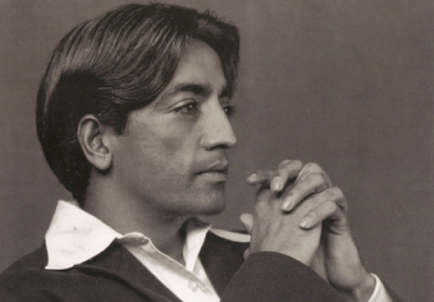
‘I hope that you will listen, but not with the memory of what you already know; and this is very difficult to do. You listen to something, and your mind immediately reacts with its knowledge, its conclusions, its opinions, its past memories. It listens, inquiring for a future understanding.

Just observe yourself, how you are listening, and you will see that this is what is taking place. Either you are listening with a conclusion, with knowledge, with certain memories, experiences, or you want an answer, and you are impatient. You want to know what it is all about, what life is all about, the extraordinary complexity of life. You are not actually listening at all.

…you are listening with a conclusion, with knowledge…you want an answer, and you are impatient…You are not actually listening at all.

You can only listen when the mind is quiet, when the mind doesn’t react immediately, when there is an interval between your reaction and what is being said. Then, in that interval there is a quietness, there is a silence in which alone there is a comprehension which is not intellectual understanding.

You can only listen when the mind is quiet, when the mind doesn’t react immediately, when there is an interval between your reaction and what is being said.

If there is a gap between what is said and your own reaction to what is said, in that interval, whether you prolong it indefinitely, for a long period or for a few seconds – in that interval, if you observe, there comes clarity. It is the interval that is the new brain. The immediate reaction is the old brain, and the old brain functions in its own traditional, accepted, reactionary, animalistic sense.

When there is an abeyance of that, when the reaction is suspended, when there is an interval, then you will find that the new brain acts, and it is only the new brain that can understand, not the old brain’

Jiddu Krishnamurti, The Book of Life, October 21st

I AM

bright lightsEverything is happening,
in every nook and cranny,
everything shining,
saying ‘I AM’

Sights, sounds, visions and sensations,
flurrying and flitting,
dancing for us,
each saying ‘I AM’

The auditory landscape whooshing through,
ceaselessly onwards,
speaking to me,
constantly saying ‘I AM’

The energy of life,
abundant and obvious,
Zip! Zap! Zoom!
right in our faces, everything:
‘I AM’

Something is watching you

leopards eyes

While the mind chatters endlessly
and the body does its thing,
have you ever noticed,
a Presence watching over you?

You’ve been
trying to do this, trying to do that,
and all the time,
feel it: Something watches over you.

Consumed by thoughts,
dramas and life,
Something stands still
– can you sense it, silently watching you?

Wherever you go,
whatever you do,
incessantly following you,
observing all, watching you.

You have gone around your life,
doing this, doing that,
and all the while,
a presence is here, everywhere, watching you.

The nature of Awareness

eye-881895_1920.jpg

This aware principle,
Is already always aware.
Without lifting a finger,
It is effortlessly present.

Within this awareness,
A multitude of phenomena spontaneously arise and fall.
Conceptually we say ‘multitude of phenomena’,
But in reality there is just One Seamless Experience.

Whatever phenomena awareness is aware of,
We can call ‘objects’.
No object is this aware principle,
No object is awareness.

There are no actual separate objects,
Just the appearance of separate objects.
The mind, using concepts like a sword,
Carves up our Seamless Experience into apparent parts.

Let us examine this awareness,
Which is not separate from the objects it observes.
Where does it come from?
What is its nature?

Observe, no particular object of awareness is awareness itself:
An object itself cannot be aware,
The perceived cannot perceive.
Therefore awareness is not an object.

There is no knowledge of awareness:
Awareness cannot be seen, touched, smelt, heard or tasted.
In this sense it cannot be known,
But awareness’s existence is self-evident.

What is this awareness?
– I don’t know!
But I know awareness exists. How?
– Because I am aware!

Observe, there is no awareness of awareness itself,
Only awareness of objects,
(Or in Deep Sleep or Samadhi,
the awareness of the absence of objects),
The existence of awareness,
Is inferred from the presence (or absence) of objects.

So what is awareness but an idea,
Based on the assumption of a subject, a seer?
Awareness is a merely a concept,
Indistinguishable from the objects it is aware of.

Objects are awareness,
Awareness is simply the presence of objects
(or the presence of an absence of objects,
as in Deep Sleep or Samadhi).
‘Objects’ and ‘awareness’ are two names for our One Total Seamless Experience.
See this at once!

All these words,
Simply trying to describe,
What is already our direct experience of life,
Right now.

Words simply point,
To the simplicity of this,
This which is so simple:
It is just our direct experience.

Truly,
What we conceive to be awareness.
Is nothing other than our everyday experience of objects,
This.

Truly,
What is conceived to be the Absolute (ie. the Subject)
Is none other than the relative (ie. objects),
This.

In this,
There is no object or subject,
No relative or absolute,
Just this, beyond words, beyond opposites.

There is only this,
Completely obvious,
Self evident,
Alive,
And elusive of conceptualisation.

Krishnamurti’s Method

krishnamurti

The following is an excerpt from a talk of Jiddu Krishnamurti that took place in Hamburg, Germany on 5th September 1956. For those of you who are familiar with Krishnamurti’s teachings, you will know that he abhorred the idea of a set method for liberation. However, in his talks he often outlined something that could be called a method in the wider sense, so I have rather cheekily titled this post ‘Krishnamurti’s Method’ 🙂

“So a serious person must surely ask himself this question: is it possible to experience something…beyond the fabrications of the mind? And if it is possible, then what is one to do? How is one to set about it? Continue reading

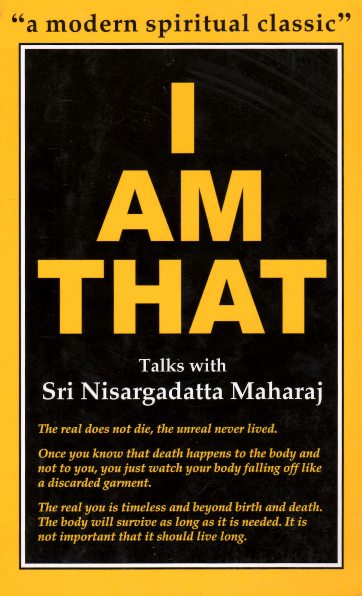
Nisargadatta Maharaj: How can I make my mind steady?

I Am That

Questioner: As a child fairly often I experienced states of complete happiness, verging on ecstasy: later, they ceased, but since I came to India they reappeared, particularly after I met you. Yet these states, however wonderful, are not lasting. They come and go and there is no knowing when they will come back.

Nisargadatta Maharaj: How can anything be steady in a mind which itself is not steady?

Q: How can I make my mind steady?

M: How can an unsteady mind make itself steady? Of course it cannot. It is the nature of the mind to roam about. All you can do is to shift the focus of consciousness beyond the mind.

Q: How is it done?

M: Refuse all thoughts except one: the thought ‘I am’. The mind will rebel in the beginning, but with patience and perseverance it will yield and keep quiet. Once you are quiet, things will begin to happen spontaneously and quite naturally without any interference on your part.

Q: Can I avoid this protracted battle with my mind?

M: Yes, you can. Just live your life as it comes, but alertly, watchfully, allowing everything to happen as it happens, doing the natural things the natural way, suffering, rejoicing — as life brings. This also is a way.

Q: Well, then I can as well marry, have children, run a business… be happy.

M: Sure. You may or may not be happy, take it in your stride.

Q: Yet I want happiness.

M: True happiness cannot be found in things that change and pass away. Pleasure and pain alternate inexorably. Happiness comes from the self and can be found in the self only. Find your real self (swarupa) and all else will come with it.

The above excerpt is from I Am That by Nisargadatta Maharaj

Tom’s comments:

There are so many gems in just this short passage! First Maharaj points out the mind need not be directly controlled and that the very nature of the mind is to roam, ruminate and be unsteady. Instead focus on something else: the sense ‘I AM’. Then the goal of a quiet mind will naturally arise.

Maharaj then gives us more: if we are not drawn to this sadhana (spiritual practice), then we can try an alternative. Instead we can surrender to whatever happens, keeping a watchfulness about ourselves whilst we do so. This, rather like the ‘I AM’ sadhana, also has the effect of quietening the mind and prevents the ego having room to manoevure. The ‘I’ which is always trying to meddle in things is cut off, restricted. There is much more to how these methods work and how they can be practised – I have written an article here explaining more on this.

Lastly Maharaj gives us a final nugget:  ‘True happiness cannot be found in things that change and pass away.’

Experience, knowledge, insight and consciousness all come and go – so where does this leave us? Where can we seek if we do not seek in this world of impermanent things? Here we pass from the domain of the mind to that which is beyond words. Call it ‘true self’ (swarupa) or ‘no-self’, words do not apply.

YOU ARE THAT WHICH KNOWS THE BODY, MIND, WORLD, AND CONSCIOUSNESS

What most people take themselves to be, the body-mind entity, is in fact a series of perceptions, images and sensations within consciousness, bound together by the (false) concept “I”.

The world too, as we experience it, is nothing but a play of consciousness, images and sensations rising and falling, creating the impression of a world. Continue reading

Muruganar: The Pre-eminent form of worship

Through the grace of my Lord’s glorious revelation I learned that the pre-eminent form of worship – which alone is worthy of him – who shines within the heart as the Self – is just to beThus did I learn to worship him without worshipping through the simple act of being.
Sri Guru Ramana Prasadam, verse 389

Sri Guru Ramana Prasadam was written by Muruganar (1890-1973), one of the most eminent of Sri Ramana Maharshi’s devotees. Muruganar was liberated shorty after meeting Ramana and thereafter continued to spend several decades alongside him. It is because of Muruganar’s questioning and urging that Ramana composed works such as ‘Self-Knowledge’, ‘The Essence of Instruction’ and ‘Forty Verses on Reality’. These succinct works contain the essence of Ramana’s (written) teachings. We are indeed indebted to Muruganar! Continue reading

Krishnamurti on The essence of meditation

ocean sky

“As you walked on the beach the waves were enormous and they were breaking with magnificent curve and force. You walked against the wind, and suddenly you felt there was nothing between you and the sky, and this openness was heaven.

To be so completely open, vulnerable – to the hills, to the sea, and to man – is the very essence of meditation. To have no resistance, to have no barriers inwardly towards anything, to be really free, completely, from all the minor urges, compulsions, and demands, with all their little conflicts and hypocrisies, is to walk in life with open arms.

And that evening, walking there on that wet sand, with the sea gulls around you, you felt the extraordinary sense of open freedom and the great beauty of love which was not in you or outside you – but everywhere.”

Jiddu Krishnamurti