3rd August, 1936
Q.: After conversing with several devotees here, I have arrived at a rough observation that Sri Bhagavan gives spiritual advice which pertains to every conceivable genre, depending upon the inclination, maturity or palate of the aspirant in question. What, if any, is his nativistic teaching?
B.: [no response]
Q.: Is it Silence?
B.: Yes.
Q.: For those unfit to understand it?
B.: They are advised to keep quiet. [Summa iru.]
Q.: For those even this?
B.: The inquiry ‘Who-am-I?’ is suggested.
Q.: For those like me who lack the determination to practise this inquiry?
B.: Unconditional surrender.
Q.: To whom shall I surrender? To Sri Bhagawan or to my Guru Sri Chandrasekara Barathi of the Sringeri Mutt?
B.: Does surrender need a recepient? Simply surrender or let go of everything.
Q.: If I let go of everything, is Mukti assured unto me?
B.: To let go of everything is to let go of this question also.
Q.: So, expecting a reward for surrender is not appropriate?
B.: How can one who has surrendered expect anything? To surrender is to give up the spurious ‘you’ once and for all. When you are not there at all, where is the question of expecting or anticipating anything? Who would be there to do the expecting or anticipating? If there is still anyone left to engage in expecting or anticipating, no surrender has really taken place.
Q.: If I give up everything, what will happen to my body? How then will it be able to find food for itself, leave alone earn a living or maintain a family?
B.: Were you asked to neglect the body? You were asked to not deliberately take care of the body – that is all. How is it that you translate the directive, ‘Let go of everything.’ into ‘Neglect the body and its duties.’? The problem in its totality lies in the fact that you are labouring under the delusive impression that it is you as the ego who are maintaining your body, attending to your vocation, taking care of the household and everything else that it has fallen upon the body’s prarabdha to execute in this lifetime. So, when asked to give up everything, that is to say give up the ego, you give yourself to understand that your regular routine will come to a standstill.
No. Whether you are aware of it or not, whether you like the fact or not, the truth is that it is the Higher Power that does everything. We imagine ourselves to be the doer. When asked to give up the personal self, we imagine that the body’s actions also should come to cessation, because according to us, it is the personal self that is the cause and source of all action. No. It is a mistake. The ego merely fraudulently assumes responsibility for the actions of the body. Doerless doing or actorless action is not for the Jnani only; it is true – as an actual fact – in the case of all. In the case of the ajnani, something called “I” rises up to falsely claim responsibility for the body’s actions. This fictitious accreation is absent in the case of the Jnani. That is the only difference between them.
If you give up the ego or ‘Body-am-I.’ idea completely, some power effortlessly takes over the body and makes it run through its ordained course of prarabdha without the need for the least mental involvement or participation on your part. This is a matter for experience. To surrender is to totally let go of everything. People attached to concepts of the intellect or things of the world cannot possibly let go; vairagyam is necessary to let go. How to cultivate vairagyam? Proximity to the Guru.
Worldly attachment and the Guru pull the mind in opposite directions. If Love for the Guru is unequivocal and unconditional, His pull eventually wins. Again, how to cultivate this Love? By nature the minds of most men are occupied with the problems of the personal self. What vocation shall I pursue? Shall I study further or shall I opt for employment? Shall I marry the girl I like, or shall I marry the other one, the rich, obese character that I was introduced to by my parents? What measures shall I take to safeguard myself from penury in old age? How shall I ideally invest my wealth so that it stands me in good stead when I am no longer in a position to actively work to earn a living? Will my children take care of me in old age or will they abandon me and go their seperate ways? And so on and so forth.
This is how lifetime after lifetime is wasted. If you would only keep quiet without thinking these thoughts, providence would admirably take care of you; but no, you must have your ‘knowledgeable say’.
It so happens that in rare cases a man ceases to take thought of his personal self and wholeheartedly gives himself to an ideal of beauty, be it sport, literature, art, patriotism or anything else. The quantum of importance attributed to the personal self becomes negligible when the loftier pursuit occupies the whole of his attention. Thus he begins, for the first time, to experience a Love in which the personal self has no space. Such is the sweetness of this passionate Love that he yearns to experience the pinnacle thereof. The desire for this feeling of Love is not motivated by the objective of personally experiencing it. The Love for the higher ideal eventually comes to dominate and possess the soul with such complete fervour that his desire for such Love is not on account of any motive to personally experience it, but simply for the sake of such Love itself.
He does not think, I must experience more of this Love. He thinks, this Love must shine forth with the utmost possible intensity! Then, the ideal towards which Love hitherto had been directed merges imperceptibly into Love itself. Thus, the man is left with Love and only Love in his hands: Love without rhyme or reason.
Feeling it but unable to attain it, he becomes crazed with longing. It is at this stage that God or Guru appears to him as the manifestation of his Love: the manifestation may or may not be an anthropomorphic form; it may be an abstract image or ideal altogether deviod of form or even name. Eager to consummate his Love, he surrenders totally to the Guru and Realisation devours him by operation of the Guru’s benevolent grace.
Swami Vivekananda has said, ‘Take up one idea. Make that one idea your life – think of it, dream of it, live on that idea. Let the brain, muscles, nerves, every part of your body, be full of that idea, and just leave every other idea alone. This is the way to success.’.
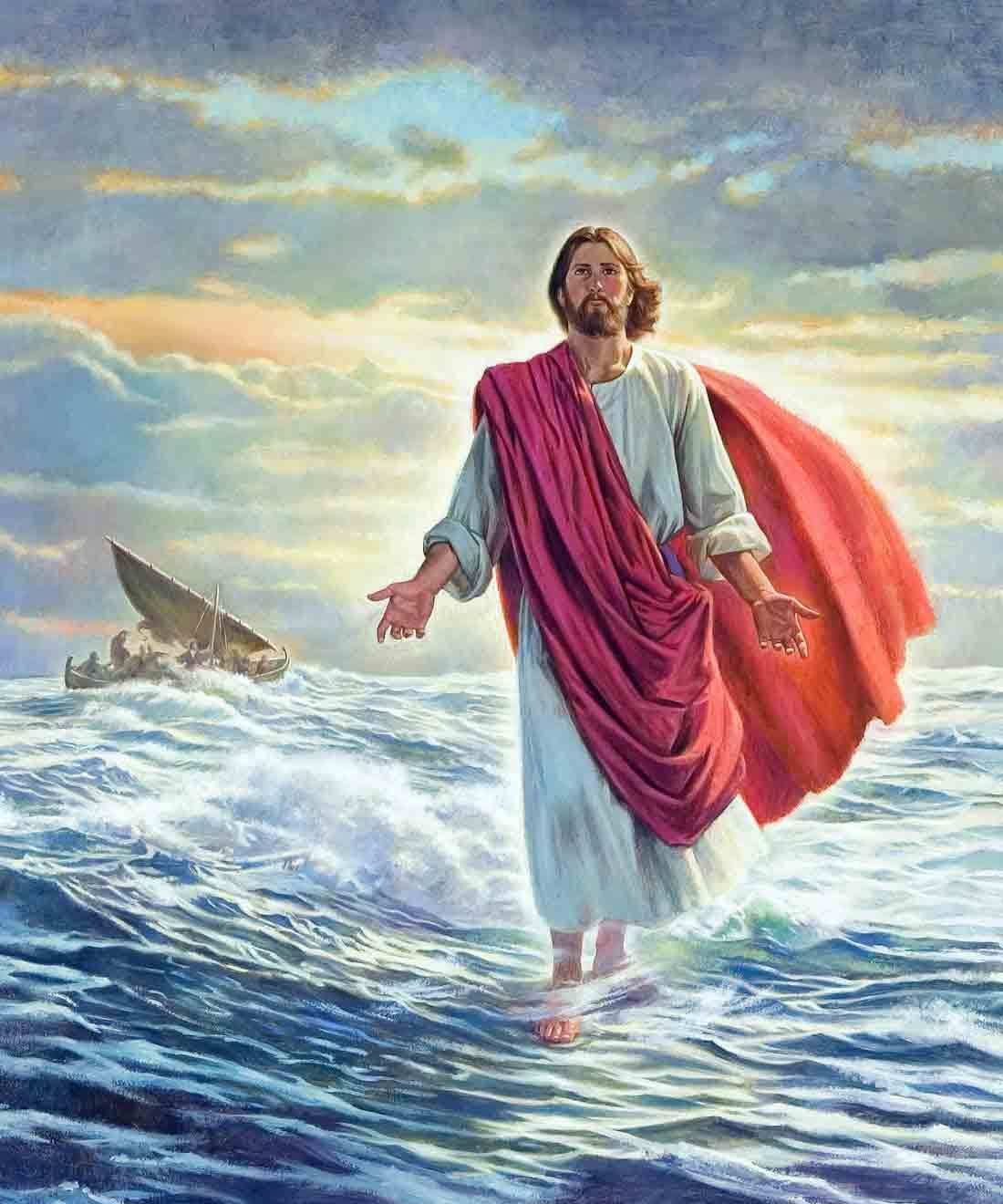
So, volitionless Love, which, allowed to wax indefinitely, surely leads to Kaivalyam, may as well come to an inveterate materialist or atheist: belief or faith in God is not of any considerable importance, for it stops at the level of the intellect – it is Love that matters, uncaused, blind, mad, unconditional Love. In the work The Pilgrim’s Progress by John Bunyan, when Christian is about to drown in the dreaded river of Death, he has a vision of the Christ who reminds him of the verse: ‘When thou passest through the waters, I will be with thee; and through the rivers, they shall not overflow thee…’. The next moment the Christian finds steady ground to stand upon, and he manages to ford the remaining strech of the river safely.
Likewise, when Vasudeva was travelling to the house of Nandagopa and Yashodha, carrying the infant Krishna in his arms, the Yamuna river was in full spate, ready to devour him should he behave so unwisely as to step into it. Vasudeva thought of God and was immediately assisted by the giant 10-headed celestial serpent, Vasuki; thus he managed to ford the flooded river without incident.
Again, when Sri Abbanacharyal heard the news that his Guru, Swami Raghavendra, was about to enter into his brindavanam, he forthwith rushed to Mantralayam, but did not know what to do when he was faced with the flooded Tungabhadra. He gathered courage, closed his eyes, thought of his Guru, and threw himself into the raging deluge. He was not swept away by the river, but landed safely on the other bank.
How did all this become possible? Is not genuine Love for the Lord on the part of the devotee the reason? Thus, develop a deep obsessive infatuation with any particular ideal, and of itself that will plunge you into unfathomable Love; such Love invariably leads to Kaivalyam.
Q.: I am too weak to surrender, in the total sense of the term that I find Bhagawan suggesting. Also, I do not feel attracted to any one particular ideal or idea. What am I to do?
B.: It is holding on or doing anything that requires strength. If you feel you are weak, letting go of everything should be very easy, for that alone is non-doing.
Nevertheless, if total surrender is found too hard, practise surrender as a sadhana. This is called partial surrender. In course of time it leads to complete surrender.
Q.: Various descriptions of God are given by scriptures belonging to the different religions. Which is the description that tallies with Bhagavan’s teachings?
B.: Words cannot convey the Real. Yet, the closest is, Ehyeh asher ehyeh.[Tom: Hebrew, from Exodus 3:14 meaning ‘I am that I am’]
Q.: What is the difference between attempting on one’s own to Realise the Self and taking the help of a Guru?
B.: Suppose you want to go to America. Which is the sensible method? Taking a spade in hand and digging into the Earth, saying, ‘I am confident that I shall eventually reach America, which must be located on the exact other side of this very spot.’ or booking a place for yourself on the next outbound steamer?
The above excerpt is taken from Aham Sphurana, 3rd August 1936, see here for more information on this text.


 Tom Das