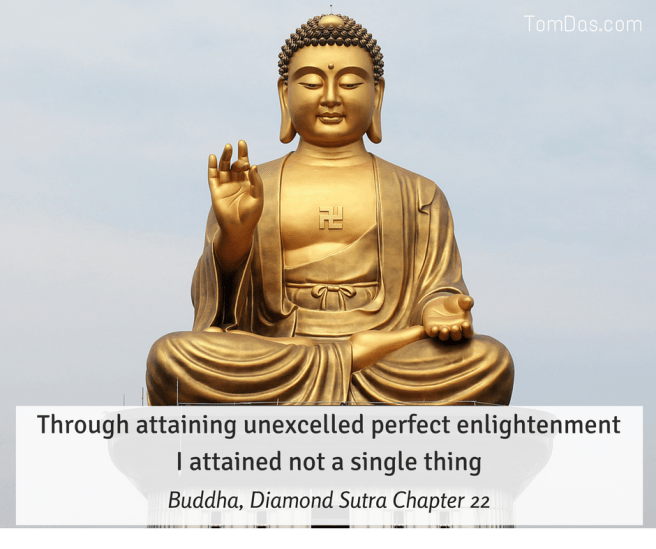
Find more quotes at tomdas.com/quotes/
To join me at one of my meetings see tomdas.com/events/
If you read the earlier Buddhist texts (the Pali Suttas) you get a very different feel of the Buddha’s teachings compared to the systematised versions of Buddhism that are often more prominently on display today. It becomes apparent that the Buddha taught in different ways to different people and that the true Dhamma (teaching) cannot be grasped.
The eight-fold path that we most often hear about was very probably a central and important part of the Buddha’s teaching, and a truly wonderful teaching in my view, but it is clear that many people came to enlightenment in various ways according to the suttas (Buddhist texts).
We read that some attained enlightenment without practising, and some attained enlightenment simply upon hearing the Buddha speak. Some had a great awakening before practice, and then a practice naturally developed afterwards. Others followed the more traditional way of engaging with spiritual practises first and then attaining arahantship (full enlightenment) afterwards. The fact that arahantship was preceded by many years of practice for the Buddha himself may have affected the way he taught. However the suttas indicate that the Buddha realised that not all came to the Dhamma in the same way. In the Yuganaddha Sutta, Ananda explains the 4 main ways arahantship can arise:
You can see here that two aspects of the teaching become very prominent, namely that of achieving tranquility and that of insight. The key is that both are required, but the order in which they are achieved varies. Some naturally are drawn towards becoming more tranquil and insight comes later. Others are more drawn to understanding and insight first and it is this insight that leads to tranquility as ‘fetters are abandoned’ and ‘obsessions destroyed’.
I explain in more detail what is meant by tranquility and insight here, but briefly insight is seeing there is no separate self (anatta in Pali), specifically that there is no separate doer entity. Tranquility when it is cultivated before insight usually refers to the lessening of thoughts and increasing of peace which in turn paves the way for insight. Tranquility after insight usually means a purification of the mind which naturally happens after insight; rather than reducing thoughts, this is the tranquility of freedom, of not being bothered by thoughts or circumstances and not depending on the mind, body or world (ie. anything) for one’s happiness.
In later Buddhist developments many schools developed ‘enlightenment first, practice later’ schools of teaching, notably in the Mahayana traditions, a prime example being Korean Zen master Chinul (1158-1210):
Chinul talks about the importance of first recognising your true original essence first (insight) before using this insight to purify the mind (tranquility after insight).
Going back to the Pali suttas, the Buddha also repeatedly warned against being attached to any particular teaching or teaching tradition:
This really is quite a stark warning, and we could see this as a very ‘modern’ and scientific way of approaching this search for freedom from suffering. Again in the Atthaavagga, perhaps the earliest of all the Buddhist texts we know of, the Buddha warns about having any fixed views:
The Buddha stresses non-clinging, including non-clinging to doctrines, teachings, knowledge and points of view. In fact the Atthaavagga goes even further. Most of the very earliest Buddhist texts do not even mention the four noble truths, let alone the eight-fold path (which is the fourth truth of the four noble truths).
The Atthaavagga appears to go further here by denying much of what is commonly taught. We are not to find this deeper ‘truth’ through seeing, hearing or by any kind of knowledge. We are not to cling to morality or purity, nor their opposites. We are to depend on nothing. Of course, reading the following lines and having insight into them reveals a core ‘truth’, a more sublime Dhamma that is not opposed to the classic eight-fold path at all:
So where does this leave us? Should we practice according to a path, or instead cultivate insight and wisdom? I answer this in more detail in this article, but for now, let’s go back to the Korean Zen Master Chinul for the last word:
Many ‘practice orientated paths’ just keep one going round and round samsara. Why? Because the assumption is that the Freedom we seek is not already here and that it has to be obtained.
Many instant-enlightenment teachings also do not result in fruition. Why? Because they shun the need for practice.
For some, diligent practice is required. For others, sporadic practice is required. For some, no practice is required.
For more read here:
Sufism: Infinite ways to an infinite god (even if you don’t believe in God)
Roadmap to enlightenment: a (fairly) comprehensive guide to spiritual practices

Q: Illusion can hide from us our own mind, but up to now you have not taught us how to get rid of illusion.

A: The arising and the elimination of illusion are both illusory. Illusion is not something rooted in Reality; it exists because of your dualistic thinking.
If you will only cease to indulge in opposed concepts such as ‘ordinary’ and ‘Enlightened’, illusion will cease of itself. And then if you still want to destroy it wherever it may be, you will find that there is not a hairsbreadth left of anything on which to lay hold.
This is the meaning of: ‘I will let go with both hands, for then I shall certainly discover the Buddha in my mind’.
The arising and the elimination of illusion are both illusory…If you will only cease to indulge in opposed concepts such as “ordinary” and “Enlightened,” illusion will cease of itself.
Q: If there is nothing on which to lay hold, how is the Dharma [The Teaching, Enlightenment] to be transmitted?
A: It is a transmission of Mind with Mind [Tom – note that the Chinese word for ‘mind’ can also be translated as ‘heart’, so this could be ‘heart to heart’ transmission].
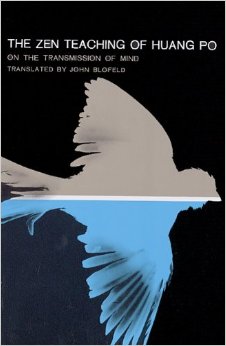
Q: If Mind is used for transmission, why do you say that Mind too does not exist?
A: Obtaining no Dharma whatever is called Mind transmission. The understanding of this implies no Mind and no Dharma.
Q: If there is no Mind and no Dharma, what is meant by transmission?
A: You hear people speak of Mind transmission and then you talk of something to be received. So Bodhidharma [the first Zen patriarch, the ‘founder of zen’] said:
The nature of the Mind when understood,
No human speech can compass or disclose.
Enlightenment is naught to be attained,
And he that gains it does not say he knows.
If I were to make this clear to you, I doubt if you could stand up to it.
Taken from The Zen Teaching of Huang Po (Chun Chou record no. 32)
You can now watch me being interviewed by Rick Archer from Buddha at the Gas Pump below.
Hope you find it interesting!
❤
If you now set about using your minds to seek Mind, listening to the teaching of others, and hoping to reach the goal through mere learning, when will you ever succeed? Some of the ancients had sharp minds; they no sooner heard the Doctrine proclaimed than they hastened to discard all learning. So they were called, ‘Sages who, abandoning learning, have come to rest in spontaneity’.
In these days people only seek to stuff themselves with knowledge and deductions, seeking everywhere for book-knowledge and calling this ‘Dharma-practice’ [true practice of The Way]. They do not know that so much knowledge and deduction have just the contrary effect of piling up obstacles. Merely acquiring a lot of knowledge makes you like a child who gives himself indigestion by gobbling too many curds.
Merely acquiring a lot of knowledge makes you like a child who gives himself indigestion by gobbling too many curds.
Those who study the Way according to the Three Vehicles [the 3 main Buddhist schools of Hinayana, Mahayana and Vajrayana Buddhism] are all like this. All you can call them is people who suffer from indigestion. When so-called knowledge and deductions are not digested, they become poisons, for they belong only to the plane of samsara [the plane of suffering, the unenlightened state]. In the Absolute, there is nothing at all of this kind.
So it is said: ‘In the armoury of my sovereign, there is no Sword of Thusness’. All the concepts you have formed in the past must be discarded and replaced by void…The canonical teachings of the Three Vehicles are just remedies for temporary needs. They were taught to meet such needs and so are of temporary value and differ one from another. If only this could be understood, there would be no more doubts about it.
Above all it is essential not to select some particular teaching suited to a certain occasion, and, being impressed by its forming part of the written canon, regard it as an immutable concept. Why so? Because in truth there is no unalterable Dharma [Teaching, Teaching method] which the Tathagata [The Buddha; a term the Buddha often referred to himself by] could have preached. People of our sect would never argue that there could be such a thing. We just know how to put all mental activity to rest and thus achieve tranquillity. We certainly do not begin by thinking things out and end up in perplexity.
Because in truth there is no unalterable Dharma…We certainly do not begin by thinking things out and end up in perplexity.
Taken from The Zen Teaching of Huang Po (Chun Chou record no. 30)
 Tom Das