Q. Is this world really a dream? I want proof! | Ramana Maharshi on Ramakrishna’s teachings | Aham Sphurana

The following excerpt is from the text Aham Sphurana 14th August 1936 – you can download the entire text here

Questioner: Is your teaching the same as Sri Ramakrishna’s?

Bhagavan Sri Ramana Maharshi: Absolutely.

Q.: If I-am-God is the Truth, does it not amount to arrogance?

B.: It does not mean you – as you incumbently imagine yourself to be – are God. It means, God is the Real “I”.

Q.: There is a self which is co-eval with the personality and attaches itself to the body. This is known as the mind. Then there is the Parabrahman mentioned in the Vedanta. This is known as the Impersonal Essence of man. Which is my true self? Can I have more than one self?

B.: The mind is a phantom. In the Impersonal Essence the mind is nowhere to be found.

Q.: How to reach it?

B.: There is nobody there to reach it. Thus there is no reaching it. Subside and let the Light shine forth. Subside as the mind and shine as the Self.

Q.: Practically what is the method for it?

B.: The investigation, ‘Who-am-I?’.

Q.: But this investigation also is made with mind only.

B.: It commences no doubt in the mind. It ends in no-mind.

Bhagavan asked Major Chadwick to read out ‘Who-am-I?’ to him in French. This was done and the creature listened carefully, cocking his huge head against a meagre shoulder, so that his left ear should be better exposed to the sounds emanating from Chadwick’s lips. Presently he extracted a small ear-trumpet from the folds of his laborious clothes and grooved the ear-piece of the same into his left ear.

The bell of the contraption was positioned to face Major Chadwick.’s direction. Bhagavan looked at the surprised faces in the Hall and laughed. Presently –

Q.: What is the authority for saying that the world is a dream? Where is the proof, I mean?

B.: Did you exist in sleep?

Q.: Yes.

B.: Do you exist now?

Q.: Yes.

B.: Then what is the difference [in the 2 states]?

Q.: I am not aware of my body and world [in sleep].

B.: Being aware of the body and world is called dreaming. Remain unaware of them now also. That verily is Jnana or Reality. This alone is the state of true wakefulness.

Q.: But how can we call this world a dream?

B.: Why not?

Q.: There are so many people on the Earth. If it is a dream, whose dream might it be?

B.: Yours.

Q.: But why pick me out specifically? For instance it may even be the dream of the amiable Monsieur Chadwick here.

B.: Only you are there.

Q.: What about you, then, sir?

B.: No, I am not here or there. I AM. There is no here or there or anywhere. I AM THAT I AM.

Q.: I comprehend not.

B.: Evidence produced by the sensory organs is merely mental in nature. All knowledge of diversity is fictitious mental information. Your Being is Real. There is nothing else.

Q.: I want proof.

B.: If proof is given to you, how will you be able to believe it?

Q.: I comprehend not.

B.: The proof given to you, if any, is also going to be mere mental information only.

Q.: What can be believed, then, as true?

B.: Whatever is believed is false only. Truth is in Being only.

Q.: How to attain this Being?

B.: By giving up the idea that there could be anything to be attained and all other ideas.

Q.: Practically, how can I go about it?

B.: Investigate ‘Who-am-I?’.

Q.: Will repetition of sacred syllables not be helpful? Do not the sacred incantations of your religion hold some sort of latent spiritual power? By unlocking this power or energy can we not reach the state of Enlightenment?

B.: You have been appraised of the direct method.

Q.: The others are by-lanes or diversions?

B.: Yes.

Q.: Should food restrictions be followed by a seeker after Enlightenment? Can I eat pork?

B.: Try to thrive on grain and fruit.

Q.: Can the investigation of ‘Who-am-I?’ be done in your presence only? If I do it at, say, Nantes, would I able to succeed in Enlightening myself? Is your physical presence needed? In order so as to bring about a successful outcome to the practise, I mean?

B.: It is the mind that matters. If the mind is kept steadily poised in introversion, such questions cannot arise even.

Q.: Is worship of, or even belief in, a personal God permissible?

B.: Yes.

Q.: Does it not thwart one’s progress toward Enlighenment?

B.: When you become ripe enough, you will no longer feel that it is you who are praying.

Q.: Is philanthropy a distraction or ought one to try to help the suffering world?

B.: It varies according to the temprament of the individual’s psyche.

Q.: I see. What about my case?

B.: When you see suffering, what thought first crosses your mind?

Q.: “I wish God had created a world in which there was no suffering.”

B.: Those destined to help think – impetuously- “Let me see what I can do here…”.

Q.: Is there any need to officially renounce my affirmed affiliation into the La Rochelle Temple?

B.: No.

Q.: Occasionally I become frightened when my health takes a turn for the worse. How to remain free from such fears?

B.: You already know that for this perishable body made of the elements, destruction is certain one day. Why crib over the inevitable?

Q.: But how do I keep fear at bay?

B.: By not identifying the Self with the body or mind.

Q.: But how to get rid of such erroneous identification?

B.: Only by relentless pursuit of the investigation, ‘Who am I?’.

Then the Distraught One proudly produced a gift for Bhagavan – a small tin box which rattled. Bhagavan opened it and smiled.

Q.: [beaming happily] They are roasted seeds belonging to the St. Ignatius fruit – fruits produced by the tree Strychnos ignatius! Very difficult to obtain ever since the War, sir! Specially procured for your consumption, if I may be permitted to say so, sir!
AJATA: Ramana Maharshi, Shankara and Upanishads | Does ego becomes like a burnt rope? Prarabdha karma destiny and self-knowledge

This post is only for those who are deeply interested in liberation, and it was originally posted here on Facebook

There is a teaching that says that after liberation, the liberated sage’s ego becomes dead, like a burnt rope, in that it continues to exist in superficial appearance, in name and form, but doesn’t actually have any robust structure or power.

Similarly, the same teaching says that the liberated sage’s body & mind continues after liberation, but there is no longer any individual will at play, and it is just the destiny of the body mind (known as prarabdha karma in Sanskrit) that plays out. An analogy is given of how a fan continues to rotate even when the power has been turned off, the idea being that in a similar way the sage’s body continues to act in the world according to its pre-existing energy and destiny but without anybody’s individual will or ego being present any longer..

Sri Ramana often gave this teaching himself, but he also said this was a lower teaching for those who were unable to accept the higher teachings. In his writings, and to his closest devotees, he often explained that in truth, in liberation there is no karma (action or activity) whatsoever, and there is no body or mind or world for the Jnani. It only appears this way due to the ignorant view of the ignorant onlooker.

33. The statement that the jnani retains prarabdha while free from sanchita and agami is only a formal answer to the questions of the ignorant. Of several wives none escapes widowhood when the husband dies; even so, when the doer goes, all three karmas vanish.
~ Supplement to the 40 verses on reality, written by Sri Ramana Maharshi

and

The Self-Realised Sage knows not whether the transient body comes and stays, or dies and leaves, even as a senseless drunkard knows not what happens to his clothes.
~ Guru Vachaka Kovai, Sri Bhagavan 24 (a verse written by Sri Ramana Maharshi)

AJATA

This teaching is known as Ajata, which is the teaching that the appearance of the body mind and world only appear due to ignorance or ego, and that the world, including the body and mind, never really appeared or existed in the first place. Ignorance never really came about at all. Duality, meaning the appearance of any rising phenomena whatsoever, never actually occurred.

SHANKARA & UPANISHADS

This is why the scriptures describe the truth, the true self, as being homogeneous, without multiplicity or variety, devoid of appearances, objects, forms and imagination. The scriptures say in Brahman there are no hands or feet or eyes or ears or thoughts, etc etc, and this is the meaning of those verses, as Shankara has also explained in his commentaries.

eg. Shankara writes the following:

‘Because I am without an eye*, I have no sight. As I have no ear either*, how could I have hearing? As I have no voice I can have no speech. As I have no mind, how could I have thought? There cannot be action on the part of that which does not have life force (prana). There cannot be knowership on the part of that which has no mind. Neither can there be knowledge or ignorance on the part of me who am the Light of Pure Consciousness
~Sri Shankara, Upadesa Sahasri 13.1, 13.2

*Shankara is quoting from Brihadaranyaka Upanishad 3.8.8

BUT HOW CAN THERE BE DIFFERENT LEVELS OF A NON-DUAL TEACHING?

Here is how Lakshmana Sarma (LS), a direct devotee of Sri Ramana’s, describes this in Maha Yoga pages 59-60; here LS speaks of 2 levels of the teaching, the higher (true) and lower (ultimately untrue); note that LS uses the English word ‘revelation’ to refer to Shruti (the revealed scriptures consisting primarily of the Vedas and Upanishads):

The ancient lore is twofold. One part of it is addressed to those who are not conscious of being in ignorance, and therefore have no use for a teaching intended to dispel that ignorance. The other part of the ancient lore is addressed to those that are conscious of the ignorance and are in earnest to escape from it. These two parts are quite distinct. But this feature of the ancient Revelation is not known to these believers. Besides they are offended by the inevitable corollary that theirs is a lower position; they also feel it a grievance that the world, which they believe to be real, should be dismissed as unreal, and often want to quarrel with us who are followers of the Sages; we however have no quarrel with them, as the Sages have pointed out, because we realise that for them it is all right to believe as they do, and, so believing, to make the best of the world while it lasts. They are like dreamers who are persuaded that their dreams are real, and do not want to awake. We have begun to see that this worldly life is only a dream, because the Sages tell us so; and we want to awake.’

See this post below for more on this topic – I share more quotes from Sri Ramana and Sri Shankara which further explains the above in more detail:

Does the liberated Jnani or Sage see the body, the mind, the world or the 3 states of deep sleep, waking and dream according to Sri Ramana Maharshi and Sri Adi Shankara?

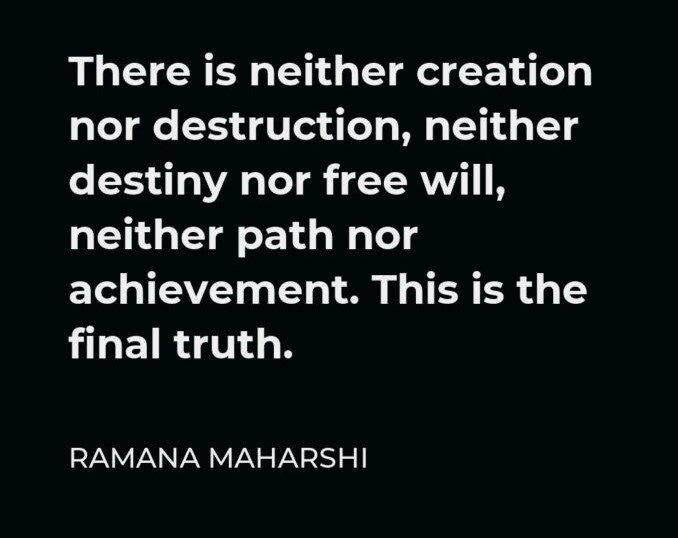
Misquoting Ramana Maharshi ‘neither destiny nor free will’ | Upanishads | Ramesh Balsekar

There is a quote I often see attributed to Sri Ramana Maharshi as follows:

‘There is neither creation nor destruction, neither destiny nor free will, neither path nor achievement. This is the final truth.’

This verse is actually a mistranslation of a verse that is found in several vedanta scriptures including two Upanishads, the writings of Gaudapada and in Shankara’s writings too. Here is how the verse appears in these texts:

There is neither destruction (Nirodha) nor creation (Utpatti), none in bondage (Bandha) and none practicing disciplines (Sadhaka). There is none seeking Liberation (Mumukshu) and none liberated (Mukta). This is the ultimate or highest truth (Paramartha).’

Sri Ramana Maharshi did himself write a version of this verse, which has been captured in verse B28 in Guru Vachaka Kovai (it can be found after verse 1227), which reads as follows:

There is no creation, no destruction.
None bound, none seeking, striving,
Gaining freedom. Know that this
Is the Truth supreme.

As far as I can tell, the mistranslated version of the text, which erroneously refers to destiny and free will, was popularised by Ramesh Balsekar and itself was a quotation from a book by Wei Wu Wei called ‘The Open Secret’. Ramesh often placed prominence on the concepts of destiny and free will in his teachings, so perhaps this was why he gravitated towards this version (ie. mistranslation) of the verse?

Admittedly the verses are not all too different from each other, but they are different nonetheless. I’ll let you decide on the significance of these differences for yourself.

Namaste

Tom