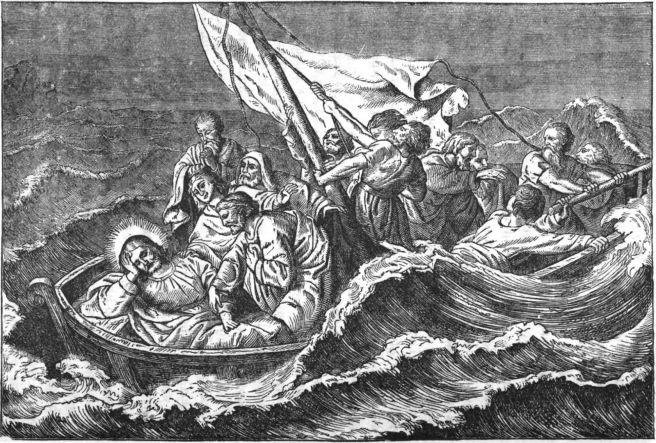
Jesus Calms the Storm
Jesus Calms the Storm
Q. Hi Tom, thank you so much for sharing your experiences through your blog. It’s very helpful. In my journey I have learned a lot from the folks you have read Ramana Maharshi, Kirshnamurti, etc. I have experienced the sense of oneness almost like a peaceful black hole, and this feeling is now always accessible to me, although the strength of it varies. This access has changed how I experience life and a lot of suffering has diminished.
However I have a pretty intense, stressful leadership job and I find that my reactions to some people that I think are not being effective in my jobs is just as intense as it used to be before I found this state. I find myself suffering in navigating these situations, but I have to address these types of problems as a natural part of my job responsibilities.
Is there some guidance you can share that might nudge me to navigate this differently? I really suffer every time I confront this situation, and I have found myself making good decisions but causing pain to both myself and the people who are impacted by this decision. I know you are busy, but anything you can nudge me on would be helpful. I want to stay in the world and be effective in whatever role I am playing at the time, but want to not cause suffering to me or others in my path.
Tom: Thank you for your kind words and sorry it has taken me some time to respond. It’s great that your suffering has reduced and that you have instant access to that state of peace whenever you need to take shelter there.
I think I understand what you mean by the situation you face at work. As you know, I also have a job and family life and am in some ways very much in the world.
With these kinds of issues, there is no one fixed solution that works for everyone. I can give you some suggestions, but it is for you to experiment and find what works for you.
My recommendation is to start the day with a sense of gratitude, perhaps even a formal ‘giving thanks’ meditation session/puja in the morning to start the day.
Thereafter try to love everything that happens to you. This sadhana is described here in more detail: Start the day with love, fill the day with love, end the day with love
Thanks again for writing to me, best wishes and let me know how it all goes 
The following is the last few verses of Advaita Bodha Deepika, a classical vedanta text that summarises the theories and methods of vedanta. It was also a favourite text of Ramana Maharshi’s. Here is the culmination of the teaching, as stated in the last verses of Chapter 8.
(Note, if you are unsure about why this chapter starts in this way and why we are even discussing ‘extinguishing the mind’, have a look at this post here Advaita Bodha Deepika: Vital Teachings for Self-Realisation which explains the rationale behind this first question):
Disciple: How can the mind be extinguished?
Master: To forget everything is the ultimate means. But for thought, the world does not arise. Do not think and it will not arise. When nothing arises in the mind, the mind itself is lost. Therefore do not think of anything, forget all. This is the best way to kill the mind.
To forget everything is the ultimate means
D.: Has anyone else said so before?
M.: Vasishta said so to Rama thus: ‘Efface thoughts of all kinds, of things enjoyed, not enjoyed, or otherwise. Like wood or stone, remain free from thoughts.
Rama: Should I altogether forget everything?
Vasishta: Exactly; altogether forget everything and remain like wood or stone.
Rama: The result will be dullness like that of stones or wood.
Vasishta: Not so. All this is only illusion. Forgetting the illusion, you are freed from it. Though seeming dull, you will be the Bliss Itself. Your intellect will be altogether clear and sharp. Without getting entangled in worldly life, but appearing active to others remain as the very Bliss of Brahman and be happy.
Unlike the blue colour of the sky, let not the illusion of the world revive in the pure Ether of Consciousness-Self. To forget this illusion is the sole means to kill the mind and remain as Bliss.
Though Shiva, Vishnu, or Brahman Himself should instruct you, realisation is not possible without this one means. Without forgetting everything, fixity as the Self is impossible. Therefore altogether forget everything.’
…altogether forget everything and remain like wood or stone….Though seeming dull, you will be the Bliss Itself. Your intellect will be altogether clear and sharp.
D.: Is it not very difficult to do so?
M.: Though for the ignorant it is difficult, for the discerning few it is very easy. Never think of anything but the unbroken unique Brahman. By a long practice of this, you will easily forget the non-self. It cannot be difficult to remain still without thinking anything. Let not thoughts arise in the mind; always think of Brahman.
In this way all worldly thoughts will vanish and thought of Brahman alone will remain. When this becomes steady, forget even this, and without thinking ‘I am Brahman’, be the very Brahman. This cannot be difficult to practise.
Now my wise son, follow this advice; cease thinking of anything but Brahman. By this practice your mind will be extinct; you will forget all and remain as pure Brahman.
Never think of anything but the unbroken unique Brahman…When this becomes steady, forget even this, and without thinking ‘I am Brahman’, be the very Brahman. This cannot be difficult to practise.
Tom’s commentary:
It is not only Sage Vasistha who tells us we need to ‘forget all’. In the Ashtavakra Gita, sage Ashtavakra says in chapter 16, verse 1:
‘My son! You may recite or listen to countless scriptures, but you will not be established in the Self unless you forget all.’
Similarly Ramana Maharshi says in his text ‘Who am I?’:
‘Eventually all that one has learnt will have to be forgotten’
In the traditional path of Knowledge or Jnana, first we are to know our True Self (Atman) and know this to be the same as the Absolute (Brahman). Then we are to be still and renounce all desires.
This spiritual knowledge (Jnana) of ‘I am Brahman’ (Aham Brahmasmi) allows the mind to become still and desireless. Note this does not mean that the body becomes totally inert – no – rather it continues to function naturally according to its destiny (Prarabdha Karma) until the body dies.
Shankara states this multiple times, eg, in Vivekachudamani, and also in his many commentaries, eg. in his commentary upon the Kena Upanishad – in his introduction to the Kena Upanishad Shankara writes:
And [the Self] being eternal, it is not to be secured by any means other than the cessation of ignorance. Hence the only duty is to renounce all desires after the realisation of the unity of the indwelling Self and Brahman.
This is akin to Self-Surrender, as spoken by Sri Ramana Maharshi:
There is no destiny. Surrender, and all will be well. Throw all the responsibility on God. Do not bear the burden yourself. What can destiny do to you then?”
(Talks 244)
and again here:
Question: Surrender is said to be Bhakti [the path of devotional love]. But Sri Bhagavan [Ramana Maharshi] is known to favour enquiry [ie. the path of Knowledge or Jnana] for the Self. There is thus confusion in the hearer.
Ramana Maharshi: Surrender can take effect only when done with full knowledge. Such knowledge comes after enquiry. It ends in surrender.
(Talks 462)

Continuing the series of Krishnamurti posts this week, the following is written by Jiddu Krishnamurti, taken from BULLETIN 4, 1969:
Out of silence look and listen. Silence is not the ending of noise; the incessant clamour of the mind and heart does not end in silence; it is not a product, a result of desire, nor is it put together by will.
The whole of consciousness is a restless, noisy movement within the borders of its own making. Within this border silence or stillness is but the momentary ending of the chatter; it is the silence touched by time. Time is memory and to it silence is short or long; it can measure. Give to it space and continuity, and then it becomes another toy.
But this is not silence. Everything put together by thought is within the area of noise, and thought in no way can make itself still. It can build an image of silence and conform to it, worshipping it, as it does with so many other images it has made, but its formula of silence is the very negation of it; its symbols are the very denial of reality.
Thought itself must be still for silence to be. Silence is always now, as thought is not. Thought, always being old, cannot possibly enter into that silence which is always new. The new becomes the old when thought touches it.
Out of this silence, look and talk.
The true anonymity is out of this silence and there is no other humility. The vain are always vain, though they put on the garment of humility, which makes them harsh and brittle.
But out of this silence the word ‘love’ has a wholly different meaning. This silence is not out there but it is where the noise of the total observer is not.

Meditation is a movement in and of the unknown.
You are not there, only the movement.
You are too petty or too great for this movement. It has nothing behind it or in front of it. It is that energy which thought-matter cannot touch.
Thought is perversion for it is the product of yesterday; it is caught in the toils of centuries and so it is confused, unclear.
Do what you will, the known cannot reach out for the unknown.
Meditation is the dying to the known.
Over the next few days I’ll be sharing a series of posts written by J. Krishnamurti. I hope you enjoy them, but also I hope you will take the time to slow down, read them carefully, ponder and see the simple profundity they indicate. Best wishes to you ❤
The following is written by Jiddu Krishnamurti, taken from BULLETIN 4, 1969
Death is only for those who have, and for those who have a resting place. Life is a movement in relationship and attachment; the denial of this movement is death.
Have no shelter outwardly or inwardly; have a room, or a house, or a family, but don’t let it become a hiding place, an escape from yourself.
The safe harbour which your mind has made in cultivating virtue, in the superstition of belief, in cunning capacity or in activity, will inevitably bring death.
You can’t escape from death if you belong to this world, to the society of which you are. The man who died next door or a thousand miles away is you. He has been preparing for years with great care to die, like you. Like you he called living a strife, a misery, or a jolly good show. But death is always there watching, waiting.
But the one who dies each day is beyond death.
To die is to love.
The beauty of love is not in past remembrances or in the images of tomorrow. Love has no past and no future; what has, is memory, which is not love. Love with its passion is just beyond the range of society, which is you.
Die, and it is there.
Question: In my experience, waking up is a preliminary step. The real work happens in manifesting that awakening in everyday life, and that is the most difficult part. Otherwise, there is a disconnect between the awakened state and everyday experience. What do you think?
Tom: In my experience it depends on the way awakening happens. I think what you call awakening, I call insight. What you call manifesting in everyday life, I call purification post-insight. Insight refers to seeing through the illusion of separation and doership and no longer believing happiness lies in gross or subtle objects. Purification refers to a process in which the habitual tendencies that are based on ignorance (ie. a lack of insight or belief in separation and seeking to derive happiness from objects) are let go of and removed.
The essential insight(s), once realised, doesn’t change, but the habitual thought patterns, behaviours and felt levels of suffering do change, and they change gradually over time for most people. Insight is like seeing something that is already here but was overlooked. It can occur like a flash, and when seen, it is realised that things were always this way but it just wasn’t acknowledged or understood to be so.
Purification is different. It is a process, one that takes time as the body-mind catches up with the insight. Purification can occur both prior to and after insight, but is generally only able to be complete once insight has occurred. In Vedanta this process is what is usually meant by the Sanskrit term nididhyansana.
However, purification is not necessarily the most difficult part – that varies from individual to individual, depending on how purified their minds were prior to insight occurring and the context of the awakening. For some it can be a very natural unfolding of the insight that occurs by itself and without prompting. For others it can be quite a difficult process in which a more formalised sadhana has to be continued in order to weed out the vasanas/habitual tendencies that are based on the root ignorance of separation and looking for happiness is objects.
This purification can also be seen as a process by which morality is instilled into the body-mind and through which ethical behaviour manifests. When the egoic I-centred tendencies fall away or are rooted out by post-insight sadhana, then what results is a naturally more ethical body-mind entity.
Either way, I do acknowledge this post-insight process is an important part of the spiritual path, and without it, in my view, the awakening/enlightenment is not complete.
For those of you do not have direct access to a ‘teacher’ and who are genuinely interested in discovering what I call Freedom, no matter where you are in the world, you are invited to attend one of my ONLINE MEETINGS.
Please feel free to join me. No prior experience or beliefs are required (in fact leave these at the door if you can!), but your interest must be deep and sincere for the teachings to work. My experience is that most people tend not to be deeply interested in this, and our meetings tend to be informal, friendly and small. They also create a space where fellow seekers/finders can connect.
The next meeting is this Thursday 8pm UK time.
Even online, the teachings are powerful pointers and reminders directing yourself back to yourself, clarifying this ever-present mystery of ‘what is’, so do come along if you feel moved to.
Interacting with a teacher who has seen this for themselves, and with whom you resonate, can save many years of unnecessary seeking in many cases. Do not underestimate the power of direct interaction. It’s completely different to reading articles and facebook posts. This is not about you coming to one of MY meetings necessarily, but you seeking a teacher with whom you resonate and with whom you can trust on some level. (Of course, if that teacher is me for now, so be it).
Best wishes to you
 🙏
🙏 ❤
❤
For details of meetings I hold please see here:
www.TomDas.com/events
To join ONLINE MEETINGS please register here:
https://www.meetup.com/Non-duality-Kingston-London/
 Tom Das