Love, happiness and non-duality

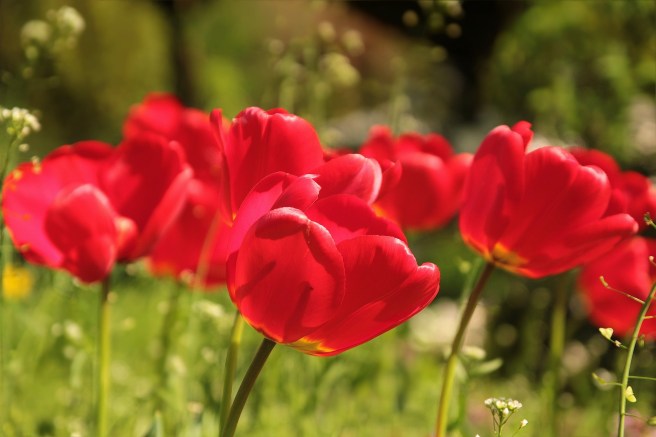
tulips red.jpg

When the ego is seen through, all there is is what is. This is actually love, this is the real love.

Q. What is the relationship between love and non-duality?

A. Non-duality, as you call it, when it is fully seen, has nothing to do with trying to become more loving. But when the intrinsic-Freedom-that-already-exists is recognised, there is a tendency to become more loving, more open. Not that that actually matters. Openness and love are just what tend to happen when the illusion of a separate doer-entity is seen to be illusory. They are side effects.

Q. If in seeing this Freedom one tends to become more loving, then why do you say non-duality has nothing to do with being more loving?

A. This is about what is true, not what you want to be true. You may want to be more loving, more ethical or more whatever, but so-called ‘non-duality’  is about seeing what already is, right now. It is the ego or person that wants to become more loving, more ethical, more radiant, more popular, and so on. So the desire to be more loving is actually a subtle form of ego. ‘Non-duality’, or whatever you want to call it, is not about a continuation of the ego, but seeing that this ego is a fiction, that the sense of doership is an imagined belief without any evidence to underpin it.

It is the ego or person that wants to become more loving, more ethical, more radiant, more popular, and so on.

Who cares about love? Who cares about being ethical? It’s the ego of course. The ego cares, the doer-entity cares and it is the ego that wants to improve itself and therefore perpetuate itself. Ask yourself, ‘what is this entity that cares about being loving, being ethical?’. If you really are interested and you look, then it can become obvious that there is no ego there, it was all just a belief all along, a false belief. The story of doership is false.

Then all there is is what’s happening. Nobody doing anything, just what’s happening. I call this Freedom, but it doesn’t really have a name. It is simply what’s happening. It is simply the way things actually are, not they way you want things to be based on your projection which is in turn based on beliefs and concepts. It is the simplicity of life stripped clean of false notions and narratives, in which false notions are seen through as they arise.

I call this Freedom, but it doesn’t really have a name. It is simply what’s happening.

In Freedom, you don’t care about love, or any other projected ideal. You don’t try to be more ethical. Maybe you are more loving, maybe you are not. That’s why this automatically tends towards love – because there is no motive, because the ego is not at play. It may go against intuition but love does not care about love. Love just is when things are seen for what they are. To put it more poetically, in seeing truth (of no-self), love is.

In seeing truth, love is

Q. What about happiness?

A. Again, who cares about happiness? It’s the ego! The ego cares, and the ego is a fiction. Relax your mind and look for the ego – where is it? It is just empty thoughts, there is no entity there! But you have to really want to know the truth to see this: by that I mean that you have to be willing to drop all your ideas and concepts about yourself and your life. Then you really have to actually look – at least most people do. Some people just see this spontaneously, but all you have to do is notice what is already true.

When this is seen, that there is no ‘self-entity’, the neurotic drive for happiness naturally dissipates, and then Joy naturally arises. Why? Because the (neurotic) drive for happiness is actually a form of suffering. When there is no concern for happiness, then Joy naturally tends to manifest. A feeling of wellbeing may not always be there, but who cares? That’s just the way things are. No feeling-state or mind-state is permanent. Everything changes. Nothing lasts forever. Who cares? That’s the freedom.

Investigate the present reality instead of chasing a future projection.

When you are trying to get somewhere, you are chasing a projected ideal, something conceptual, not something actual. Instead of chasing the conceptual, why not remain with the actual, with what is actually happening now? Investigate the present reality instead of chasing a future projection. When the ego is seen through, all there is is what is. This is actually love, this is the real love. The lack of a centre, the lack of a doer, that’s what love really is. It’s not an emotion at all. It’s not necessarily even feeling loving, although that may happen when it’s appropriate.

When the ego is seen through, all there is is what is. This is actually love, this is the real love.

Without the ego at play, all there is is natural functioning. Emotions then act accordingly when they are required. It’s not healthy to be happy all the time, nor is it likely to be physiologically possible. Our varied  emotions, fears and mental states are there to guide us as we navigate the world.

So, when the ego is seen through, this is what we could call love, although love is just a label for this as it actually is. This ‘love’ is not what most people mean by ‘love’. It is not an emotion, it includes everything that is happening, and it is not dependent on what is happening. It is un-conditional you could say. It is always here because it is none other that what is here. It is universal motion seeing through illusion. It is what is recognising what actually is.

Transforming pleasure into joy

Please click here to read my second article for naturalhealthstar.com. It’s called ‘Transforming pleasure into joy’.

[Update – the above link no longer works so I have posted the article below in full; the first article called ‘The Two types of Happiness’ can be read here.]

In a previous article I wrote about joy as opposed to pleasure. Joy, as I defined it, is a natural feeling of warmth and connectedness we feel when we are with someone we love, when we are doing something we love, or when we are with nature. Pleasure on the other hand, I defined as being to do with acquisition, such as acquiring possessions, or even more subtle ‘objects’ such as acquiring pride, power, sex, certain experiences or respect.

With joy, our sense of self or ego is dimished and so we feel whole. The barrier and resistance of the ego is lessened allowing joy to emerge. With pleasure our sense of self is reinforced and strengthened, and whilst this feels initially positive, it is actually trying to cover up a deeper sense of lack or emptiness and it ultimately destructive and self-isolating. Pleasure becomes addictive whilst joy is deeply soothing.

It’s worth pointing out that in different situations joy goes by different names. When we feel joy whilst looking at a piece of art or listening to music we call it Beauty. When we are with someone we call it Love. When it is through our work we call it Service or Vocation. It is all Joy. It is all Love. These all happen when the sense of self is no longer at play.

So if you want to explore this further I suggest the first thing to do is to simply notice this. Not change it, but just gently notice it. Notice what pleasure feels like, notice how it comes about, notice your thoughts, notice how your body feels, notice the circumstances that gave rise to it, notice how you feel afterwards – you get the idea. The same with joy. Don’t accept my descriptions, but discover for yourself what these two types of experience are like.

The tendency when hearing a teaching like this is to shun pleasure and try to do more joyous things. Whilst this is on the one hand commendable, I would also advise caution. The very desire to maximise joy is actually the same drive for pleasure only in a different guise. Now joy has become an object to be acquired, and this acquisitive desire is the characteristic of pleasure. If you have spent time exploring what joy and pleasure actually feel like in your body you will get an immediate sense of this. So in trying to seek joy, the naturalness of joy is transformed into seeking pleasure. Notice how subtle this is.

On the other hand, if you don’t try to seek or repress pleasure, and instead just look at it, just being with the feeling is actually a form of love, self-love. We can love ourselves, embrace ourselves and not judge or chastise ourselves for seeking pleasure. We can embrace and be with our pleasure seeking. We can accept ourselves for who we are right now, just as we may accept a child or pet animal who is playing up. We are no longer trying to acquire something, we are no longer trying to be joyous. We are also no longer judging ourselves as being good or bad. Instead we are loving ourselves as we are, we are being tender with ourselves and our emotions, and in doing so we transform pleasure into Joy.

Experiment with this if you want, and let me know how it goes.

Love and blessings to you

Two types of Happiness: Joy and Pleasure

I was invited to contribute a few articles for naturalhealthstar.com. The first one was published today and is on the two types of happiness, which I have called Joy and pleasure.

If you are interested please click here to read more.

[Update: the above link no longer works so I have reproduced the article below:]

Imagine strolling barefoot along a sandy tropical beach watching the sunset. Can you imagine what it feels like? Now imagine winning the lottery, and what that feels like. These two scenarios, whilst both pleasant, feel different don’t they? Take a few moments to feel both these imaginary scenarios in turn and get a sense for how they each feel.

For me with the sunset the feeling is more peaceful, connected, warm and gentle. With the lottery there is more excitement at the sense of gain. If you explore your feelings and sensations further, you can see that with the sunset the sense of self is diminished, perhaps even absent, and in its place is a sense of wholeness or connectedness. With the lottery the sense of self is reinforced and strengthened.

Here’s another example: imagine how it feels to interact with a young child, perhaps one you know, laughing and playing with them. Now contrast this with a situation when someone respected you or admired you and how that felt. You could take it one step further perhaps and remember how it felt when you were in a position of power over someone, when you were in control. Again, whilst these feelings are probably all positive feelings, interacting with a child is gentler and there is more of a sense of connection. When you are being respected or dominating someone there is a sense of self-aggrandisement.

So why am I pointing out this distinction? Because genuine fulfillment always comes when the sense of self lessens. I call this Joy. When this happens we feel more at ease, more connected, gentler and more loving. It is how we feel when we are with our loved ones, when we are following our hearts desire and when we are with nature. It is  a completely natural unlearnt emotion. We feel it more with the heart and abdomen – this may sound strange, but look for yourself where you feel the emotion in your body.

The positive feelings that come from self-reinforcement on the other hand are relatively short lived and actually fuel a sense of emptiness or lack that keeps us unfulfilled. I call this pleasure. We feel it more in the mind. It is ego-based, driven by a sense of lack, and something that has to be taught to us. We have to be conditioned through our society and upbringing to value social status, good grades, cheap-thrills and domination over others.

So, reflect on your life. How much time is spent chasing pleasures and thrills, and how much time is spent experiencing Joy? Pleasure comes though acquisition. Acquiring things, titles, sensations and experiences. It is essentially addictive in nature and leads to more suffering. Joy comes through letting go, through being with something, through playing, and through giving and service. It is a natural expression of who we really are deep down.