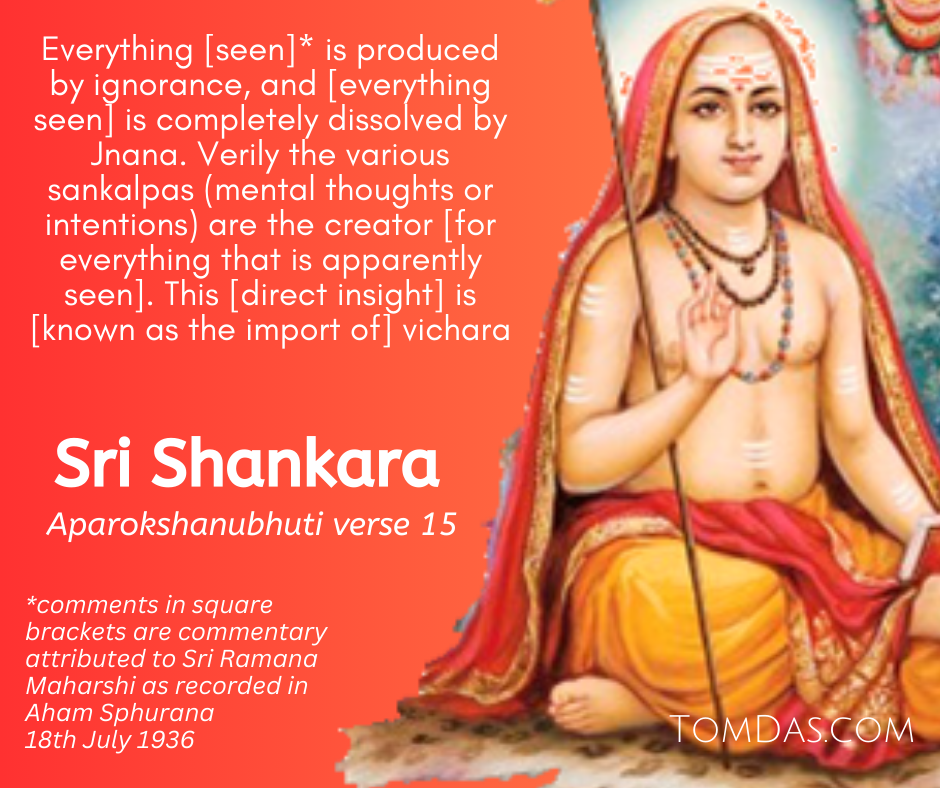
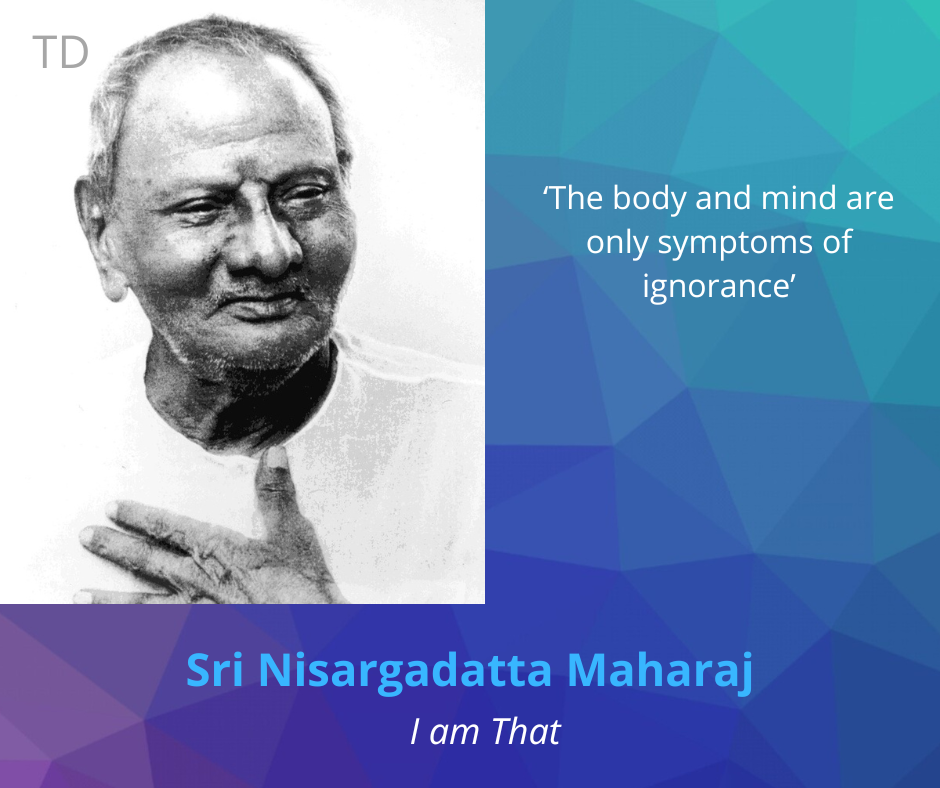
Sri Shankara, both in his commentaries and in his shorter works, often writes that the body and mind are symptoms (or effects) of ignorance, and when ignorance goes, the symptoms or effects of ignorance also go.
He also writes that the body, mind and world can never have any connection whatsoever with What You Truly Are, the Self, Pure Consciousness – and that only through ignorance can a connection between the two appear to be there.
eg. In Vivekachudamani Shankara writes:
195. But for delusion there can be no connection of the Self – which is unattached, beyond activity and formless – with the objective world, as in the case of blueness etc., with reference to the sky.
196. The Jivahood of the Atman, the Witness, which is beyond qualities and beyond activity, and which is realised within as Knowledge and Bliss Absolute – has been superimposed by the delusion of the Buddhi, and is not real. And because it is by nature an unreality, it ceases to exist when the delusion is gone.
197. It exists only so long as the delusion lasts, being caused by indiscrimination due to an illusion. The rope is supposed to be the snake only so long as the mistake lasts, and there is no more snake when the illusion has vanished. Similar is the case here.
198-199. Avidya or Nescience and its effects are likewise considered as beginningless. But with the rise of Vidya or realisation, the entire effects of Avidya, even though beginningless, are destroyed together with their root – like dreams on waking up from sleep. It is clear that the phenomenal universe, even though without beginning, is not eternal – like previous non-existence.
200-201. Previous non-existence, even though beginningless, is observed to have an end. So the Jivahood which is imagined to be in the Atman through its relation with superimposed attributes such as the Buddhi, is not real; whereas the other (the Atman) is essentially different from it. The relation between the Atman and the Buddhi is due to a false knowledge.
202. The cessation of that superimposition takes place through perfect knowledge, and by no other means. Perfect knowledge, according to the Shrutis, consists in the realisation of the identity of the individual soul and Brahman.
205. When the unreal ceases to exist, this very individual soul is definitely realised as the eternal Self. Therefore one must make it a point completely to remove things like egoism from the eternal Self.
“When the truth of this is not known, the spiritual teaching is distorted”, Tom says in this powerful and very clarifying video.
The Satsang member is describing his response to the introduction from the book, “The Seven Steps To Awakening” which is on Tom Das’s recommended reading list.
“The Seven Steps to Awakening is the most powerful collection of quotes ever assembled on the subject of how to directly experience the true Self whose nature is Infinite-Eternal-Awareness-Love-Bliss and how to bring the impostor self, its tricks and all suffering to a final end in this lifetime”.
This video was recorded live during a Satsang meeting with Tom Das on February 13th, 2025 and put together by volunteers.
‘All that is necessary is to be rid of the thought: “I have not realised.”’
~ Sri Ramana Maharshi, Talks with Sri Ramana Maharshi, talk no. 245
This teaching sounds so simple, but let us see what this teaching actually means. To do this, we have to take a look at the context in which this teaching was given, and not merely cling to a single quote taken out of context. The quote was taken from talk 245 from the book ‘Talks with Sri Ramana Maharshi’. Let us look at the talk in its entirely. We will see there are many wonderful and revealing teachings packed into this short talk. As usual my comments will be in italicised red and the text itself will be in black:
Devotee (D):“I understand that the Self is beyond the ego. My knowledge is theoretical and not practical. How shall I gain practical realisation of the Self?”
Sri Ramana Maharshi (M).: Realisation is nothing to be got afresh. It is already there. All that is necessary is to be rid of the thought: “I have not realised.”
Tom’s comments: we can see that the questioner is asking a very relevant question, namely how to covert their intellectual knowledge into genuine realisation. Bhagavan Sri Ramana is essentially pointing out that you are the Self already and that you simply have to remove any ideas of non-realisation. We will see below, based on the text itself, that this actually means removing the entirely of non-self, for any residue of non-self is synonymous with the idea ‘I have not realised’ or ‘the feeling of non-realisation’ (this term is used next below).
D.: Then one need not attempt it.
M.: No. Stillness of mind or peace is realisation. There is no moment when the Self is not. So long as there is doubt or the feeling of non-realisation, attempt must be made to rid oneself of these thoughts.
Tom: As Sri Ramana has said that you are already the Self, the questioner naturally follows up by asking – if that is the case, then there is no need to seek, no need to search, and by extension, no need to practice, correct? Bhagavan replies by stating ‘No’, this is not the case. As long as there is ‘the feeling of non-realisation’, one must attempt to remove or ‘rid oneself’ of these thought. He goes on to define realisation as ‘stillness of mind’. We will see later that this means cessation of mind, or pure mind, which is Self. But what is this ‘feeling of non-realisation’? What thoughts do we have to remove, and how? Do we have to remove some thoughts or all thoughts? Sri Ramana continues:
The thoughts are due to identification of the Self with the non-self. When the non-self disappears the Self alone remains. To make room anywhere it is enough that things are removed from there. Room is not brought in afresh. Nay, more – room is there even in cramping.
Absence of thoughts does not mean a blank. There must be one to know the blank. Knowledge and ignorance are of the mind. They are born of duality. But the Self is beyond knowledge and ignorance. It is light itself. There is no necessity to see the Self with another Self. There are no two selves. What is not Self is non-self. The non-self cannot see the Self. The Self has no sight or hearing. It lies beyond these – all alone, as pure consciousness.
Tom: there are a large number of points Sri Bhagavan makes in the above paragraph. Let us briefly go through them -each of the following can be derived from the above 2 paragraphs: -Thoughts appears due to identification with the non-self (ie. the body, the mind, the world) -Self alone remains when non-self disappears – Bhagavan gives the metaphor of clearing the rubbish from a room to make space. The idea is that we do not need to find the self or bring the self in from elsewhere, we just need to clear space and the self or room will remain over, self-shining. The junk we need to clear out is the non-self -The absence of thoughts is not a mere blank, but instead we are to know the One who knows the ‘blank, that is we must know the Self. -Knowledge and ignorance are both of the mind, whereas the Self is beyond the mind, Self is the Light that lights up knowledge and ignorance. -Knowledge and ignorance are born of duality, ie. they are false, non-self, born of primal ignorance or ego. They too must disappear, like all non-self, is the implication, for liberation to ensue. -The non-self (ie. body or mind in this case), cannot see the Self. It is the Self that ‘sees’ the Self by simply being the Self -The self has no sight and no hearing (because it has no body or mind, both of which are non-self, both of which must disappear for realisation to occur). -The Self is beyond all phenomena, it is Pure Consciousness. If we read carefully we will see that the word ‘Pure’ means without any objects or thoughts appearing in it. Bhagavan continues:
A woman, with her necklace round her neck, imagines that it has been lost and goes about searching for it, until she is reminded of it by a friend; she has created her own sense of loss, her own anxiety of search and then her own pleasure of recovery. Similarly the Self is all along there, whether you search for it or not. Again just as the woman feels as if the lost necklace has been regained, so also the removal of ignorance and the cessation of false identification reveal the Self which is always present – here and now. This is called realisation. It is not new. It amounts to elimination of ignorance and nothing more.
Tom: Here Bhagavan makes it very clear, using the traditional story of the woman and her necklace, that the Self is ever present. All we need to do is remove ignorance. This is the same as removal of the cessation of the false identification with non-self. Earlier Bhagavan said all we have to do is ‘be rid of the thought ‘I have not realised” and that we have to be rid of the ‘feelings of non-realisation’. It therefore follows that ignorance, identification with non-self, feelings or non-realisation and the thought ‘I have not realised’ are all the same thing.In each case, Bhagavan is simply saying ignorance must be removed. What does this actually mean? Bhagavan will explain further:
Blankness is the evil result of searching the mind. The mind must be cut off, root and branch. See who the thinker is, who the seeker is. Abide as the thinker, the seeker. All thoughts will disappear.
Tom: Bhagavan makes it clear: ‘The mind must be cut off, root and branch’. This is what Bhagavan means by removing the thought ‘I have not realised’. This is what it means to remove ignorance. This is what it means to remove identification with non-self and rid one of ‘feelings of non-realisation’. This is what he means when he says ‘realisation is stillness of mind’. He is speaking of manonasa. It is not just the peripheral thoughts (branches) that must go, but the root thought too, the thought ‘I am the body-mind’ – ‘The mind must be cut off, root and branch‘.
How to do this? Bhagavan says ‘See who the thinker is, who the seeker is’, meaning find out the Subject, the Self, know your Self, ie. Self-enquiry is the way. Bhagavan says then ‘All thoughts will disappear’. Not some thoughts will disappear, but all thoughts will disappear.
D.: Then there will be the ego – the thinker.
M.: That ego is pure Ego purged of thoughts. It is the same as the Self. So long as false identification persists doubts will persist, questions will arise, there will be no end of them. Doubts will cease only when the non-self is put an end to. That will result in realisation of the Self. There will remain no other there to doubt or ask. All these doubts should be solved within oneself. No amount of words will satisfy. Hold the thinker. Only when the thinker is not held do objects appear outside or doubts arise in the mind.
Tom: Does Bhagavan want us to hold onto thoughts or the thinker? Does he want us to hold onto the mind or the Self? Clearly when Bhagavan says ‘only when the thinker is held’, he is not speaking of the mind, but of the Self. Especially as he has already said ‘The mind must be cut off, root and branch’ and ‘all thoughts will disappear’ a few moments earlier. Self knowledge is the way. Self Enquiry is the way.
The questioner asks this very question – are we to hold onto the ego then? The thinker? Bhagavan gives us another wonderful and revealing answer: the ego purified or ‘purged of thoughts’ – that purified ‘ego’ or ‘I’ is Self. The Jiva (purified, purged of thoughts) is Siva.
In the Skanda Upanishad it is stated:
‘Jiva is Siva. Siva is Jiva. That Jiva is Siva alone. Bound by husk [non-self], it is paddy [jiva]. Freed from husk, it is rice [Self]‘
Shankara also wrote in verse 20 of Brahma Jnanavali Mala ‘Brahma satyam, jagat mithya, jivo brahmaiva naparah’ which means ‘Brahman is Truth/Reality, the world is illusion, the Jiva [when enquired into] is nothing but Brahman’
Concluding points
We have seen that Bhagavan has said ‘When the non-self disappears self alone remains‘ and ‘the mind must be cut off, root and branch‘ and ‘it amounts to elimination of ignorance, nothing more‘ and ‘the self has no sight or hearing‘.
We can therefore deduce that ‘the mind’, ‘non-self’ and ‘ignorance’ are essentially synonyms, as in each case Bhagavan has said only these have to be removed. Sure, these words may be used in different ways in different contexts, but essentially they are one, one ignorance, one maya (illusion).
How to do this? How to remove ignorance? How to end Maya? How to still the mind? How to remove non-self and clear ‘space in the room’? And to come back to our original question, How to be rid of the thought ‘I am not realised’? By going back to the Subject, all thoughts and objects disappear and only Self remains. This is known as Self-Enquiry and it results in liberation.
The following verses are taken from the excellent text ‘Sadhanai Saram‘ by Sri Sadhu Om. My (Tom’s) comments are written in italiscised red:
Question: How has ignorance or illusion (maya) come about?
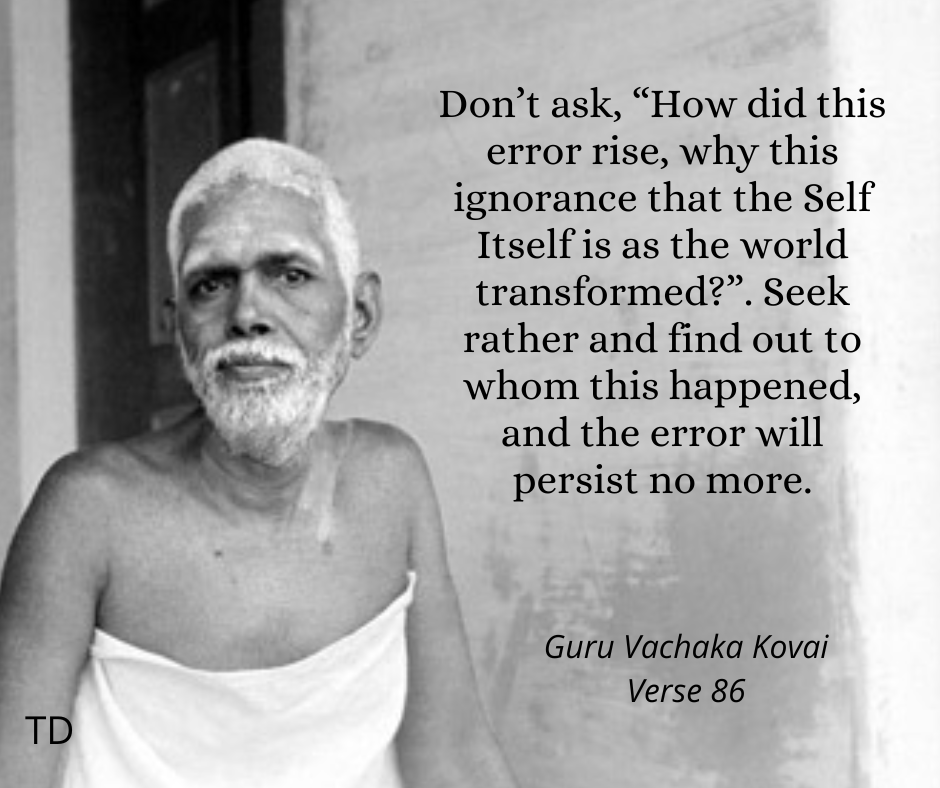
Listen now to the proper reason why, in answer to those people who asked due to bewilderment of thought, “Why has this illusion or phenomenal appearance (maya) come? How has it come?” Lord Ramana did not give a direct reply by telling why or how, but instead said, “See to whom illusion (maya) has come.”
Answer:
He who says that phenomenal existence (maya) has come into being is only you, whereas enlightened Sages (Jnanis), who have attained the great experience of Self, never accept that maya has come or that it now exists. Therefore, you, who assert that maya has come and exists, alone are the one who has the duty to investigate the truth in that assertion in order to prove its validity. Investigate thus.
How to remove this ignorance?
If you first attend to yourself, by investigating within yourself “To whom has this illusory appearance of the world (maya) come? To whom does it exist?” then in the mind that has merged in the state of Silence due to such Self-attention, the truth that you exist as the mere consciousness ‘I am’, devoid of any differentiation, diversity or imagination (vikalpa), will spontaneously reveal itself to you.
Maya never existed, not even as an appearance:
When the truth is known that you, the person who identifies the body as ‘I’, and who raises doubts and asks questions about phenomenal existence (maya), do not exist even in the least, then you will know as a matter of direct experience that in no place, at no time and in no way did phenomenal existence (maya) ever come or exist, and that the existence of the illusory world (maya) cannot be accepted even as a false appearance.
The questioner is itself illusion (maya):
He (the mind) who says that the illusion of phenomenal existence (maya) has come into existence is himself an illusion (maya). Therefore, the one path of Self-attention, which puts an end to the mind, is alone the means that the pure Jnana-Guru, Sri Ramana Bhagavan, has bestowed upon us as the apt medicine to put an end to all the arguments that arise about phenomenal existence (maya).
Instead of asking ‘why is this world as it is?’, etc, we should ask ‘Who am I?’ and discover the Truth-Self:
Even though our Guru has instructed us, “See ‘Who am I’?”, people of dull intellect ask, “Why has this world and the pleasures and pains herein come into existence?” instead of investigating “Who am I?” within themselves; only for such dull-minded people who ask thus, the Guru and the scriptures say, “Ah! That is all illusion (maya).”
Concluding verse in this section:
But since people of pure faith who sincerely engage in the practice of Self-attention as instructed by the Guru, drown in the true consciousness ‘I’ by turning their attention again and again towards the false self (the mind) whenever it rises, to raise any kind of further questions, this talk of maya is not intended for them.
Tom: if there is any sense of individuality whatsoever, then that is ego; if there is any sense or something apart or outside of you, then that is ego; if there is any sense of multiplicity, that is ego; if there is any notion ‘I am the body-mind’, then that is ego. The ego, no matter how refined, is suffering. The ego is the body-mind-world appearance.
In Reality, there has never been any ego, there has never been any duality or multiplicity, there has never been any suffering whatsoever. Reality is only Infinite Love & Bliss, Infinite Being-Consciousness, Formless-Spirit-Bliss.
To realise this one must turn within.
Furthermore:
To say ‘there is no ego’ without turning within and dissolving into Reality – that is merely the ego-mind saying ‘there is no ego’.
To say ‘all is One’ without venturing inwards and discovering the Self (by Being That) – that is merely the ego-mind saying ‘all is One’.
In this way (through not turning within, through not inquiring into the Subject-Self) ego-mind-suffering-duality continue.
Hence the instruction to turn within.
Furthermore:
The true teachings always emphasise the Subject (Reality or Self) and to turn towards and discover That, whereas false teachings emphasise objects, stating things like ‘all these objects are already That so no need to turn within’ and ‘there already is no ego so no need to turn within for what entity could even turn within?’. So egotism, duality and suffering are perpetuated.
Therefore turn within and discover what you truly are
Why did ignorance arise? Why is there maya or illusion at all? Why do we suffer if we are really the Self? What does Advaita Vedanta say about this? What was Sri Ramana Maharshi’s view? What does Tom think about this? The Law of attraction will also be mentioned and we will also hear a story from the Buddha about this…
Questioner: I have a question, if Ajnanam (ignorance) is removed* that means the whole source of Samsara is removed. In such a case why should the Jnani (realised sage) even have Prarabdha Karma*. That also should not be present right?
Tom: In Truth, there is not even any such thing as a Jnani (meaning a person or body-mind that is ‘realised’) – there is only That Objectless Subject-Self-Brahman. So there is no karma whatsoever for ‘a Jnani’ (a Jnani here meaning the Self). The self has no duality, and no karma. Karma is born of ignorance and is maya, unreal. They are one and the same – karma and ignorance – or one comes from the other. This is also what is taught in the Upanishads (eg. Adhyatma Upanishad) and by Shankara, both in his commentaries and in texts such as Vivekachudamani.
*Removal of ignorance is the same as Self-Realisation, so say the Upanishads, so says Shankara.
**Tom: Prarabdha Karma is the portion of karma that, according to the Vedas, gives rise to the body in the present birth and will play out and determine the specifics of the present life. A simple translation could be ‘destiny’ or ‘what is destined for this life’. The idea of this question is that, for example, if you have ‘been bad’ in the past and have accumulated negative karma as a result, even though you have realised the Self, this negative karma may continue and cause suffering for you even after Self-Realisation. The Upanishads are clear that all karmas and all suffering end upon Self-Realisation, so one need not even fear the negative results of one’s past actions if one realises the Self.

 Tom Das