The following is taken from the text Aham Sphurana, 7th July 1936. Please see here to find out more about this text:
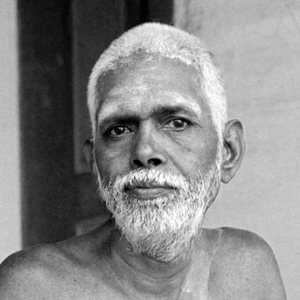
Questioner: I am aware that Bhagavan is a solipsist. However, to dismiss all human problems as being imaginary requires a giant leap of faith towards the Idealism end of the spectrum.
Bhagavan Sri Ramana Maharshi: It merely needs disillusionment with materialism.
Q.: According to Sri Aurobindo’s claims, he has probed beyond the experience of the Vedic Rishis. What is Sri Bhagavan’s opinion? Is it authentic or not?
B.: Aurobindo’s talk of bringing down divine consciousness from above overlooks the same being already Self-effulgent in the Heart. Reality simply IS. Where arises the question of moving it from place to place, etc.? People keep asking me about Sri Aurobindo’s yoga system; and if I give my reply according to my capacity, they go away disgruntled saying, “These Jnanis are always contradicting each other.” What can I do?
Q.: What about Sri Aurobindo’s claim that one must commence from Self-Realisation and then proceed to bring down the Divine to the Earth?
B.: Let us first Realize and then discuss, if need be; not now.
[Tom’s comments: Sri Aurobindo’s view was that once the truth was realised, it should be ‘brought back down’ into the level of the world, in what he called Purna Yoga or Intergral Yoga. Sri Aurobindo rejected the notion of Shankara or Vedanta that the world was unreal or ‘maya’, stating that the world is a real expression of the divine, and that the purpose of spiritual teachings is not nirvana or escape from samsara, but instead to enrich and enliven the lives of people here in this world and help people live divine lives here on Earth. Sri Aurobindo felt that the Vedic rishi’s had discovered the Truth, but had not learnt to or were not able to or even inclined to bring it back down to Earth, and that the notion of the world being an illusion was a result of the failure to bring the Divine back down to the Earth.
Here is a link to a chapter on Integral Yoga by Sri Aurobindo for those interested on these points, where he defines Purna Yoga and explains his view on the above points I have made: https://sri-aurobindo.co.in/workings/sa/37_28/02_004_e.htm
Sri Ramana in response to the questioner is saying how can Truth be ‘moved’ anywhere, let alone ‘back down’ into the world? ‘Reality simply IS’. The implication is that the very notion of bringing truth back into the world is based on ignorance or non-realisation of the actual truth]
Q.: What is the ultimate purpose of a man’s life?
B.: To find an answer to the question of “Why am I, apparently, limited to, and therefore by, a body? Am I nothing more?”. This question finally resolves itself into the question of “Who am I, who am apparently bound by this limitation of being or carrying a body?”. This much is certain: one who foolishly takes his bodily existence for granted, who thinks that it is an inevitable finality that he is, in fact, born, will never succeed in the Quest no matter what austerities or penance he might perform.
Only the Unborn can know the Unborn. The Unborn knows itself only – that is, it knows no birth or death. The intellectual understanding that the bodily existence is futile, undesirable, useless and delusory is the very first step towards Realisation. If you accept the existence of limitations [Tom: eg. if you accept or start with the premise that you are a body-mind entity, or that the world is real], any Sadhana performed will have precisely only one result – it will make the Ego grow stronger and stronger and stronger. One who wants to transcend limitation should cease to imagine himself to be limited – that will do; yes, it indeed is as simple as that. Instead of simply giving up the unreal, people want to do Sadhana to eradicate it! Is it not funny?!
Q.: Is Sadhana not useful?
B.: Only if it is done without assuming the existence of limitations. The only useful Sadhana is the investigation “Who am I?”. Everything else is just “release-of-concept-gas” [movement of mental ideas or churning of vrittis within the mind], because existence of limitations is implicitly assumed and accepted. If non-existent limitations are accepted to exist, how can any Sadhana performed on the basis of that wrong acceptence have any use, and how can such spurious Sadhana help you transcend those very limitations?
Q.: The logic seems to suggest that the Self can be discovered by the mind.
B.: The dead mind becomes the Self or discovers itself to be the Self.
Q.: I understand Nietzsche talks about the concept of Eternal Reccurrance of the same in Also sprach Zarathustra. Does B. agree with it? Each time the universe is recreated after the cosmic dissolution, does it exactly repeat itself? If that were to be true, both free-will and Self-Realisation would be impossible. If everything is going to unfold now exactly as it did previously, my incumbent free will is obviously just a myth. If everything is going to unfold in exactly the same manner in the future as now, I am never going to escape from the cycle of births and deaths!
B.: All these are only mental concepts. Even now you are not born. Realize it.
Q.: The body was born.
B.: Are you it?
Q.: It is part of me – Bhagavan’s teachings tell me that I am Brahman and therefore immanent everywhere.
B.: Leave Brahman alone. Talk about yourself first. Who are you?
Q.: I really don’t know… I am Pure Consciousness, is it not?
B.: Is Pure Consciousness now conversing with me? Is it is saying, “I am Brahman.”, etc.?
Q.: Then what is the answer?
B.: The effortless thought-free state is the answer.
Q.: How to attain it?
B.: There is no question of attaining anything. BE – don’t ask how to be. It is your very nature.
Q.: I am unable to realize it.
B.: This is also only a thought. Get rid of it and all will be well.
Q. I have heard of the Jnana-vichara technique expounded by Sri Bhagavan. How could asking oneself the question ‘Who am I?’ lead to transcendence of mind, when asking the question itself is only an activity initiated and sustained on the level of the mind?
B.: The vichara begins with the mind and ends in the Self. Mind turned fully inward discovers itself to be the Self.
Chadwick was asked by Bhagavan to give the man Bhagavan’s ‘Who am I?’ to read. He read it and then asked –
Q.: I find it shocking to consider seriously Advaita’s proclamation that the Jagrat state [Tom: waking state] is nothing better than a dream. It amounts to saying that I am now dreaming whereas I believe to the contrary, that whatever I am experiencing through the senses exist independantly of my perception thereof… How is it that the numerous disciples of yours – or followers or devotees or worshippers or afficionados or whatever it is that one would be justified in calling them take gladly to the idea that the world – the same world they experience everyday – is a dream?
B.: You say it is the same world you saw yesterday that you are seeing today. How do you know that? Through memory. Memories are also illusory. They create a deceptive fabric of intellectual continuity where in fact none exists.
What actually exists is only Beingness or Self. Even in dreams you have memories, go to familiar places, etc. How is it? Jagrat or Swapna, the same mind draws the poisonous veil of objectification or differentiation over the pure Self, hiding it. This veil is called the screen of avidya maya. Don’t ask, who cast this veil? Instead, ask, who sees the veil? Then you will see there was never any veil. This is called Self-Realisation. The desire to do sadhana to attain it is itself meaningless because it presupposes the existence of someone apart from the Self who is doing Sadhana to reach the Self.
Q.: Is it the realisation you speak of as Sahaja Nirvikalpa Samadhi? Should I not do any Sadhana? Is Sadhana useless then?
B.: Yes, it is the same realisation. Sadhana is the means to gain the Self. Only the idea “I am doing Sadhana” renders the Sadhana totally pointless and useless. Sadhana becomes natural if attraction to worldly pleasures stands removed. Desire for worldly pleasures take to their heels when you realise the world is only a dream.
Q.: I still find it impossible to believe this solid world could only be a mere dream.
B.: [smiling] Two different categories of spiritual aspirants or sadhakas exist. One is the Spülauftrag [Kritopasaka] and the other is the Wischauftrag [Akritopasaka]. [Bhagavan sometimes used words in the questioner’s native tongue to drive the impact home, or where technical terms were involved.]
[Tom: Kritopasaka refers to those who have done sadhana previously, eg. in a previous life, and so who are mature seekers, akriopasaka is the opposite; Spulauftrag (‘rinsing task’) means that task which only needs to be washed or rinsed, whereas Wischauftrag (‘wiping task’) refers to a task in which some wiping or scrubbing is first required before rinsing/washing can take place]
The former is born with the intellectual conviction, born of aeons of serious and steadfast spiritual practice directed along the correct channel [that of making the mind turn Selfwards or Sourcewards], that the cosmos he sees around him is the merest of illusions, and that expending one’s mental faculties upon it would be the ruin of one’s inherent nature of abiding peace and unshakeable happiness; whereas the latter is shocked and unsettled when informed that there is no difference – for all practical purposes – between the Jagrat [Tom: waking] and swapna [Tom: dream] states.
The firm intellectual conviction that the perceived cosmos is seen, owing to delusion, as being constituted by multiple disparate entities while the truth is that it is vested in the same Substratum, Adhishtanum [Tom: substratum], or Sadhvasthu [Tom: Sad = true or real; vastu = thing or substance or reality] as the Seer, is born only as a result of arduous spiritual practice which is possible only if the Sadhguru’s abundant Grace is available as a catalyst, which Grace descends unto him alone who perpetually bathes his heart in the effulgent glow of unselfish and non-reciprocation-expecting love of God, Humanity or any other single-minded ideal of pure, ecstatic devotion or parabhakti, and this intellectual conviction [as to the world’s objective unreality] is the seed of Jnana that grows into the tree that chokes the poisonous weed of Egotism or Ahankara at its root, destroying it once and for all, such seed having been planted long ago in the fathomless, dark misty depths of the mind by way of the Supremely merciful glance of Grace of the infinitely compassionate Sadhguru.
Q.: So, the widely held perception that without a Guru, even Atmajigyasa [Tom: the desire for self-knowledge], leave alone Atmasakshatkara [Tom: Self-realisation], is totally impossible, is…?
[he left his words trailing in the air, for the Sage to rythimically conclude,]
B.: Unequivocally and absolutely correct.
 Tom Das