Shankara: Absolute separation from the body is liberation | Bliss (Ananda) and the Self | Advaita Vedanta | Commentary on Upanishads

Tom: Shankara writes the following in his commentary of Brihadaranyaka Upanishad 3.9.29.7. My comments are interspersed in italicised red with Shankara’s writings in black.

Here Shankara is making the point that strictly speaking there is no knowing or knowledge in Self-Knowledge/Self-Realisation/The Self, meaning there is no existence of or involvement of the mind in Self. He gives the analogy of water being thrown into a larger tank of water – that initial water does not retain its separateness by which it can know the larger body of water into which it was thrown. Self-knowledge is just a phrase used to point to That which cannot be put into words.

If there was an entity that could know Brahman or know of Brahman, then that would imply 2 entities, Brahman and and knower of Brahman. Or it would imply differentiation of Brahman. Either of these would contradict shruti (revealed scripture/revealed knowledge).

Similarly, Shankara states that bliss is not cognised in Self-Realisation for the same reasons. Rather Bliss is the nature of Self, not something experienced by the Self or by some self-realised entity or person (which is another illusion).

Incidentally, Shankara also reveals just how radical liberation is, stating that in liberation there is no body, no organs, no mind, no knowledge:
Also see: What exactly is Jnana (knowledge) according to Shankara and Gaudapada and the scriptures?

[Shankara:] Absolute separation from the body is liberation, and when there is no body there can be no organs, for they will have no support . Hence too there will be no knowledge, there being no body and organs. If knowledge could arise even in the absence of the body and organs, there would be no necessity for any one to possess them. Moreover (if Brahman as Knowledge Absolute cognises the bliss in liberation), it will contradict the oneness of Brahman.

Tom: Shankara clearly states in liberation there is total or absolute separation from Body, and then says there is no body in liberation. Without a body, there can be no mind and without a mind there can be no cognition or knowledge (in the ordinary sense of these words).

We see similar teachings from Sri Ramana Maharshi: in Ulladu Narpadu verse 12, Sri Ramana Maharshi writes:

True Knowledge is Being, devoid of knowledge as well as ignorance of objects. Knowledge of objects is not true knowledge. Since the Self shines self-luminous, with nothing else for It to know, with nothing else to know It, the Self is Knowledge. Nescience [ignorance] It is not.

In Upadesa Saram verse 27, Sri Ramana Maharshi writes:

That is true knowledge which transcends
Both knowledge and ignorance,
For in pure knowledge
Is no object to be known
.

OBJECTION: Suppose we say that the Supreme Brahman, being eternal Knowledge, ever knows Itself as Bliss Absolute?

REPLY: No, (this has just been answered). Even the person under bondage, when freed from relative existence, would regain one’s real nature (Brahman). (So the same argument would apply also) .

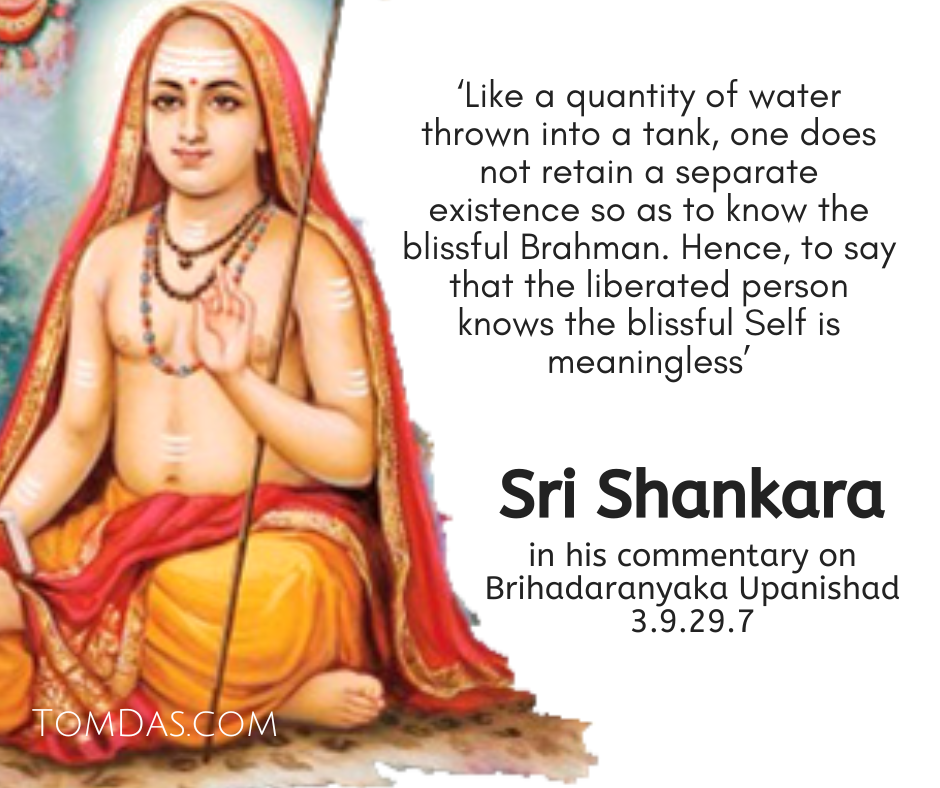
Like a quantity of water thrown into a tank, one does not retain a separate existence so as to know the blissful Brahman. Hence, to say that the liberated person knows the blissful Self is meaningless. If, on the other hand, the liberated one, being different from Brahman, knows the bliss of Brahman and the individual self as, “I am the Bliss Absolute”, then the oneness of Brahman is contradicted, which would be against all Srutis; and there is no third alternative.

Tom: See my explanation in the introduction above
Moreover, if Brahman ever knows Its own bliss, it is superfluous to distinguish between awareness and unawareness. If It is constantly aware of this bliss, then that is Its nature; hence there is no sense in maintaining that It cognises Its own bliss.

Tom: the point here is that if Brahman is ‘constantly aware of it’s own bliss’, then this bliss is simply the nature of the Self, as Self is One, and it doesn’t make sense to think of an entity that cognises or perceives bliss in some way in Self-Realisation.

Such a view would be tenable if ever there was the possibility of Its not knowing that bliss, as for instance one knows oneself and another (by an act of will). There is certainly no sense in distinguishing between a state of awareness and one of unawareness in the case of one whose mind is uninterruptedly absorbed in making an arrow, for instance.

Tom: Shankara’s argument here is saying that to speak of ‘constantly knowing bliss’ during self-realisation would only make sense if there would be a possibility of not knowing bliss during self-realisation, which is not possible, so again, bliss is the nature of Self and not a cognised object.

If, on the other hand, Brahman or the Self is supposed to be knowing Its bliss interruptedly, then in the intervals when It does not cognise Itself, It must know something else; and the Self would become changeful, which would make It non-permanent.

Tom: If the bliss of Brahman came and went, or increased and decreased, then that would mean the Self is subject to change (which it isn’t) and is therefore impermanent (which it isn’t).

Hence the text, ” Knowledge , Bliss “, etc, must be interpreted as setting forth the nature of Brahman, and not signifying that the bliss of the Self is cognised.

Tom: Regarding the initial statement of Shankara’s above, namely that there is no body in Liberation, here are some quotes of Sri Ramana Maharshi’s that say the same, taken from Guru Vachaka Kovai:

86 Don’t ask, “How did this error rise,
Why this ignorance that the Self
Itself is as the world transformed?”
Seek rather and find out to whom
This happened, and the error [Tom: of the world appearance] will
Persist no more
.

87 What is the Self’s self-transformation
As the world? A coil of straw
Appearing as a snake? Look hard,
You see no snake at all. There is
No transformation, no creation, none,
No world at all
.
[Tom: ie. ajata vada]

97 Only the mind, by maya’s might
Deluded, and looking outward sees
The body. The true Self knows no body.
To call the Self of Pure Awareness
The body’s owner or indweller
Is an error.

[Tom: This is reference to Chapter 13 of the Bhagavad Gita where Krishna states the Self is the knower of the body, and various other scriptures which advise that the Self is somewhere deep within the body, dwelling in each and everyone’s body, here Bhagavan Ramana is saying even this is not true, pointing us to a deeper teaching]

1230 The things you think of as existing
Do not exist
. But That of which
You know not if it does exist
Or does not [Tom: ie. the supreme birthless deathless unchanging ever-pure blissful Self], That alone exists.

The paths of Devotion and Knowledge – Bhakti vs Jnana | Advaita Vedanta

The following is taken from the wonderful text Sadhanai Saram (The Essence of Spiritual Practice) written by Sri Sadhu Om, a direct devotee of Sri Ramana’s. This text not only gives us the essence of Sri Ramana Maharshi’s teaching, but also directs us to the true Vedanta teachings. The notes are written by Sri Sadhu Om himself. You can download the full text as a PDF using the above link.

The paths of knowledge and devotion are more fully explained in the text The Path of Sri Ramana which you can download for free here. This is one of the few texts that goes into detail into both the paths of knowledge and love.

Also see Recommended Reading: Books for Enlightenment, Liberation and Self-Realisation

The Paths of Devotion (Bhakti) and Knowledge (Jnana)

79. To the extent to which love for God arises in one’s heart, to that extent will one acquire knowledge about Him. And to the extent to which one knows the nature of God, to that extent will the mind gain steadfast love for Him. Thus, knowledge (jnana) will be increased by devotion (bhakti), and devotion (bhakti) will be increased by knowledge (jnana).

80. By means of our love for God, He will give us more knowledge of Him, and by means of our knowledge of Him, He will give us more love for Him. Therefore, of these two paths, bhakti and jnana, follow that one for which you first gain a liking, because that one path will lead you to follow the other one into the heart.

81. In the life of an aspirant who is seeking liberation, bhakti and jnana will be experienced as inseparable, like the two sides of one sheet of paper. Hence, each one is equal to the other. They are not two different things, for the true nature of both of them is one and the same; know that bhakti and jnana are merely two names for that one thing. (Garland of Guru’s Sayings (Guru Vachaka Kovai) verses 722, 731)

82. The state of abiding firmly in Self-alone is wisdom (jnana). Would it be possible to abide thus in Self if one did not have love for Self? Love for Self-alone is bhakti; abiding firmly in Self on account of that love alone is jnana. What difference is there between these two? Discriminate and know this truth. (Maharshi’s Gospel p.24)

83. If there did not exist the power of gravity, which attracts and pulls everything towards the earth, would anything remain stable on earth? On scrutiny, devotion (bhakti) is found to be similar to the gravitational power of attraction, while the state of wisdom (jnana) is found to be similar to the state of objects remaining stable on earth as a result of that attraction. If either one of these two, the power of attraction or bhakti and the state of abidance or jnana, were absent, the other one would not exist.

84. An aspirant who practices Self-inquiry, which is the path of jnana, denies his own individuality by knowing, “I, this insignificant ego, am not the doer of any action”; while a devotee denies his own individuality by knowing, “God alone is the doer of all actions.” Thus, since an aspirant who follows either of these two paths refrains from assuming the sense of doership, understand that these two paths are not different even during the time of practice, and follow either of them.

85. We should not allow our minds to become bewildered and confused by trying to deliberate and decide, “Which of these two, the practice of bhakti or the practice of jnana is the best means for attaining liberation?” For whichever path a liking arises in the heart of a person, for that person that path alone is the best.

86. According to the strength of habit continuing from former lives, in this life the mind will acquire a liking either for the path of devotion or the direct and unfailing path of Self-inquiry, and will feel that particular path to be the best and most suited to itself. Therefore, follow at least one of these two paths to its very end.

Inquiry Becoming Easy Due to Devotion

87. When, having wept and wept with intense yearning for a long time, unceasingly thinking of and adoring the Gracious Feet (of the Lord), the mind which rises (as “I am so-and-so”) dissolves and becomes pure, the blemishless Self-inquiry (jnanatmavichara) will become firmly settled (in the heart) and the experience of Self (swarupa-anubhava) will of its own accord arise very easily indeed. (Sri Muruganar, Sri Ramana Jnana Bodham v.1286)

88. O, you who say, “We have never seen you closing your eyes and practicing Self-abidance (nishtha); tell us, how did you attain the state of inner silence (mauna)?” Understanding the above verse, know the secret of (how to attain the true experience of) God, who is not seen even though one waits closing one’s eyes (for a long time in expectation of seeing His true vision).

Note: the previous verse is the answer to the above question

Tom: The paths of knowledge and love are more fully explained in the text The Path of Sri Ramana which you can download for free here. This is one of the few texts that goes into detail into both the paths of knowledge and love.

Also see:

Non-dual devotion, worship and prayer

Ramana Maharshi on those who ridicule idol-worship or image-worship

Does Jnana (or Self-Enquiry) lead to Bhakti (or Self-Surrender) or the other way round? Sri Ramana Maharshi

Bhakti Yoga as a complete path to Final Liberation

Sri Ramana Maharshi: the necessity of Meditation

Does prarabdha karma* and suffering persist after realisation/liberation?

Questioner: I have a question, if Ajnanam (ignorance) is removed* that means the whole source of Samsara is removed. In such a case why should the Jnani (realised sage) even have Prarabdha Karma*. That also should not be present right?

Tom: In Truth, there is not even any such thing as a Jnani (meaning a person or body-mind that is ‘realised’) – there is only That Objectless Subject-Self-Brahman. So there is no karma whatsoever for ‘a Jnani’ (a Jnani here meaning the Self). The self has no duality, and no karma. Karma is born of ignorance and is maya, unreal. They are one and the same – karma and ignorance – or one comes from the other. This is also what is taught in the Upanishads (eg. Adhyatma Upanishad) and by Shankara, both in his commentaries and in texts such as Vivekachudamani.

*Removal of ignorance is the same as Self-Realisation, so say the Upanishads, so says Shankara.

**Tom: Prarabdha Karma is the portion of karma that, according to the Vedas, gives rise to the body in the present birth and will play out and determine the specifics of the present life. A simple translation could be ‘destiny’ or ‘what is destined for this life’. The idea of this question is that, for example, if you have ‘been bad’ in the past and have accumulated negative karma as a result, even though you have realised the Self, this negative karma may continue and cause suffering for you even after Self-Realisation. The Upanishads are clear that all karmas and all suffering end upon Self-Realisation, so one need not even fear the negative results of one’s past actions if one realises the Self.

Isn’t Brahma-Jnanam (Knowledge of Brahman) also Adhyasa (a superimposition or false appearance)?

Questioner: Isn’t Brahma-Jnanam (Knowledge of Brahman) also adhyasa* (superimposition or false appearance)?

Tom: It depends what you mean by ‘Knowledge of Brahman’. If you mean knowledge in the mind, then this too is certainly maya/illusion/adhyasa.

However True ‘Knowledge of Brahman’ just means the Self devoid of all objective phenomena. It is also called Silence or Samadhi and is also what is meant by Yoga. This ‘knowledge’ is just the Pure Self-Shining Reality (and so it is not adhyasa and not the result of any action/karma or teaching/dharma).

It is only this ‘knowledge’ (the Self) that removes ignorance.

(*Tom: Note that adhyasa is a Sanskrit word that means superimposition, false attribution or false appearance. It essentially refers to any object that appears, such as the body, mind and world and includes thoughts, feelings, imaginings, states of consciousness, teachings, teachers, tables, chairs, the sun, the sky, etc. The idea is that these objects are falsely ‘superimposed’ onto pure consciousness like the movie is superimposed onto the cinema screen. According to the Upanishads and Advaita Vedanta, all these superimposed appearances/objects may appear to be real to us out of ignorance, but they are actually totally false or unreal, like a dream may appear to be real, but is actually not real at all – rg. was that four-headed dinosaur you dreamt of real? Put simply, adhyasa is another word for maya (cosmic illusion) or ignorance or duality, all of which are also synonyms.)

Shankara: The Self or Brahman cannot be known!

A definition of Jnana by Shankara

The Brihadaranyaka Upanishad, verse 4.4.20, states the following:

20. It [Brahman] should be realised in one form only, (for) It is unknowable and eternal. The Self is taintless, beyond the (subtle) ether, birthless, infinite and constant.

Here we can see that the Upanishad is stating that Brahman is unknowable. So what of Self-Knowledge or knowledge of Brahman that is so often spoken about? Shankara explains this contradiction in his commentary on this verse:

The knowledge of Brahman too means only the cessation of the identification with extraneous things (such as the body). The relation of identity with It [Brahman] has not to be directly established, for it is already there. Everybody always has that identity with It, but it appears to be related to something else. Therefore the scriptures do not enjoin that identity with Brahman should be established, but that the false identification with things other than That should stop. When the identification with other things is gone, that identity with one’s own Self which is natural, becomes isolated; this is expressed by the statement that the Self is known. In Itself It is unknowable – not comprehended through any means. Hence both statements are consistent.

We can see that Shankara is stating that Brahman is indeed unknowable, and that Jnana, or knowledge, only signifies the cessation of identification with extraneous things, ie. loss of identification with objects, specifically the body-mind. Jnana is not of the mind and is not for the jiva or individual.

We do not need to affirm our identity as Brahman, as we already are and always have been and always will be Brahman. Any affirmation of Brahman would simply be on the level of thought or concepts, and so it would be Maya, or more ignorance. But once the false identification has been removed, then the Self naturally shines as itself, and this lack of wrong-knowledge, or lack of wrongly identifying as the body-mind, is what is called ‘Jnana’ or ‘knowledge’.

In Ulladu Narpadu verse 12, Sri Ramana Maharshi writes:

True Knowledge is being devoid of knowledge as well as ignorance of objects. Knowledge of objects is not true knowledge. Since the Self shines self-luminous, with nothing else for It to know, with nothing else to know It, the Self is Knowledge. Nescience It is not.

In Upadesa Saram verse 27, Sri Ramana Maharshi writes:

That is true knowledge which transcends
Both knowledge and ignorance,
For in pure knowledge
Is no object to be known.

The above is an excerpt from the following post which further explores this topic: What exactly is Jnana (knowledge) according to Shankara and Gaudapada and the scriptures?