liberation
Simply let go of seeking! (and why that doesn’t work)
This was originally post on Facebook here
1. Seeking will necessarily continue until the ego is completely destroyed. You cannot simply chose to stop seeking or ‘let go of seeking’. THE EFFECTS WILL BE TEMPORARY AT BEST, and this is ultimately dissatisfactory. Seeking (and its counterpart, suffering) will always come back until ego is completely gone. That’s just the way it is. There will always be a sense of lack until the self is discovered.
2. And ego is not destroyed by trying to destroy the ego… Your true nature prior to the arising of ego (ie. source) must be discovered, and the ego ends as a side effect of this discovery of truth.
3. Only when ego is completely destroyed in this way, is it then seen that the ego never existed in the first place. Ego never arose at all! The world (which is a projection of ego, and is also known as duality) never came into existence at all, not even as an appearance! (Why would anyone want this? Because it is heaven, because it is bliss, because it is what you are truly seeking for and have always been seeking for. It is total love, it is your own true self.)
4. Merely saying ‘there is already no such thing as ego’, without having truly discovered the formless objectless worldless Source-Subject-Self, doesn’t work to genuinely end seeking or genuinely end suffering. This is merely an empty proclamation for the mind.
5. This discovery of your true nature is never for the mind (or the body, or the body-mind). Mind is the same as ego. Ego is the same as mind. There is literally no difference. If the discovery is for the mind, suffering may be reduced, but suffering and seeking will still persist on a subtle level until the self is truly known, devoid of thought, devoid of mind.
6. If realisation is for the mind or in the mind, then you are still on the level of seeking, and the true formless self, the source of all, the subject, is yet to be truly discovered – you are still a seeker. The general advice here is to find a teacher, learn the genuine method of self-enquiry and put the teaching into practice.
7. Without a teacher it is very difficult for most to truly learn self-enquiry, which cannot usually be taught from books or from static words, but is transmitted in a variety of ways, including through the well-timed words/interactions of a teacher and through the silence and the presence of the sage. For some the technique can be revealed by simply going/sinking within, towards the I AM (which is the true or ultimate teacher), away from objective phenomena, but this seems to be very rare. The exact path to self-inquiry and self-realiaation (or self-knowledge) for each apparent individual person varies greatly, and so for most a teacher is necessary, or at least very helpful.
8. ‘To know the (worldless objectless) self, is merely to be the (worldless objectless) self.’
9. Eternal love, adoration and gratitude to my beloved guru and teacher, Bhagavan Sri Ramana Maharshi, who is truly the nature of my very own Self, residing in the Heart of all beings, whose radiant presence shines forth in all times and in all places, whose teachings can be discovered by simply turning within and searching within, and who has revealed these teachings to me both in his precious words and within my Heart.
Om Namo Bhagavate Sri Arunachala Ramanaya Om
🙏🙏🙏
Can I have the world and liberation? Why must I let go of the world for Liberation? Ramana Maharshi on Shiva and Shakti | Tantra and Vedanta | 1st August 2024
This video was excerpted from the Satsang dated 1st August 2024:
The Attachment That Purifies You of All Attachments | 4th July 2024 | Sri Ramana’s devotional poetry
How to make the false ego fall away | Ramana Maharshi
Very Important Foundational Practices
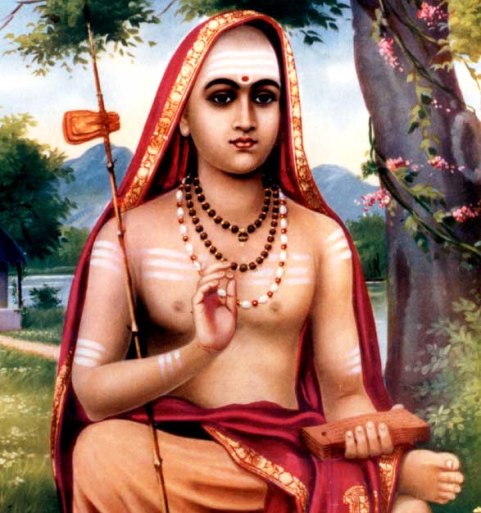
Shankara: Absolute separation from the body is liberation | Bliss (Ananda) and the Self | Advaita Vedanta | Commentary on Upanishads
Tom: Shankara writes the following in his commentary of Brihadaranyaka Upanishad 3.9.29.7. My comments are interspersed in italicised red with Shankara’s writings in black.
Here Shankara is making the point that strictly speaking there is no knowing or knowledge in Self-Knowledge/Self-Realisation/The Self, meaning there is no existence of or involvement of the mind in Self. He gives the analogy of water being thrown into a larger tank of water – that initial water does not retain its separateness by which it can know the larger body of water into which it was thrown. Self-knowledge is just a phrase used to point to That which cannot be put into words.
If there was an entity that could know Brahman or know of Brahman, then that would imply 2 entities, Brahman and and knower of Brahman. Or it would imply differentiation of Brahman. Either of these would contradict shruti (revealed scripture/revealed knowledge).
Similarly, Shankara states that bliss is not cognised in Self-Realisation for the same reasons. Rather Bliss is the nature of Self, not something experienced by the Self or by some self-realised entity or person (which is another illusion).
Incidentally, Shankara also reveals just how radical liberation is, stating that in liberation there is no body, no organs, no mind, no knowledge:
Also see: What exactly is Jnana (knowledge) according to Shankara and Gaudapada and the scriptures?
[Shankara:] Absolute separation from the body is liberation, and when there is no body there can be no organs, for they will have no support . Hence too there will be no knowledge, there being no body and organs. If knowledge could arise even in the absence of the body and organs, there would be no necessity for any one to possess them. Moreover (if Brahman as Knowledge Absolute cognises the bliss in liberation), it will contradict the oneness of Brahman.
Tom: Shankara clearly states in liberation there is total or absolute separation from Body, and then says there is no body in liberation. Without a body, there can be no mind and without a mind there can be no cognition or knowledge (in the ordinary sense of these words).
We see similar teachings from Sri Ramana Maharshi: in Ulladu Narpadu verse 12, Sri Ramana Maharshi writes:
True Knowledge is Being, devoid of knowledge as well as ignorance of objects. Knowledge of objects is not true knowledge. Since the Self shines self-luminous, with nothing else for It to know, with nothing else to know It, the Self is Knowledge. Nescience [ignorance] It is not.
In Upadesa Saram verse 27, Sri Ramana Maharshi writes:
That is true knowledge which transcends
Both knowledge and ignorance,
For in pure knowledge
Is no object to be known.
OBJECTION: Suppose we say that the Supreme Brahman, being eternal Knowledge, ever knows Itself as Bliss Absolute?
REPLY: No, (this has just been answered). Even the person under bondage, when freed from relative existence, would regain one’s real nature (Brahman). (So the same argument would apply also) .
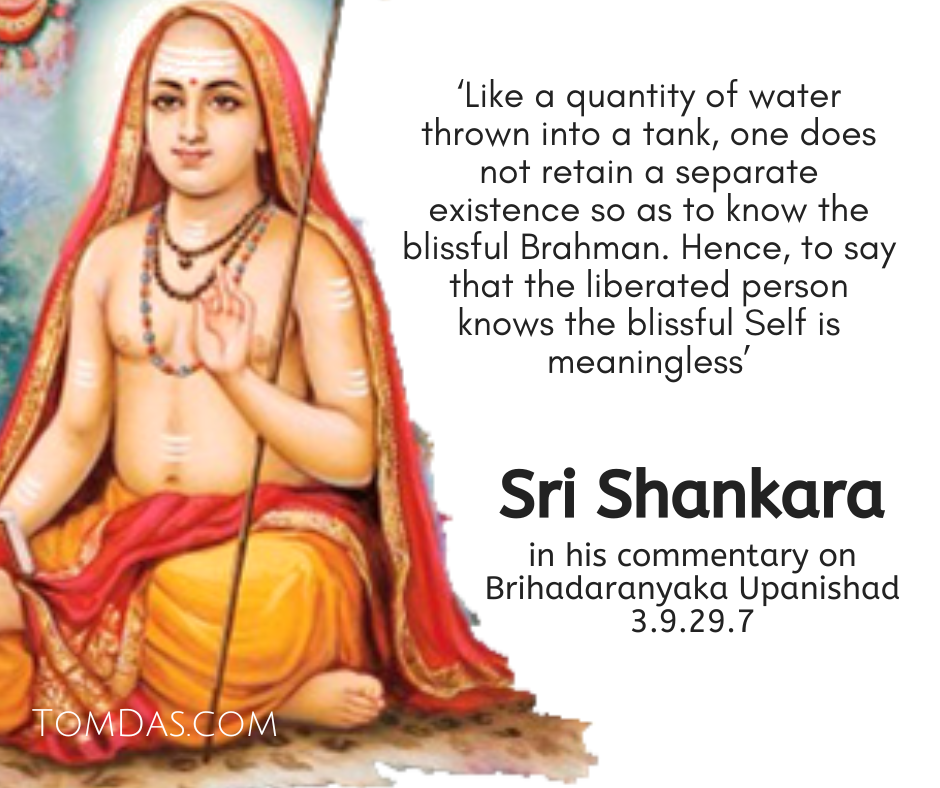
Like a quantity of water thrown into a tank, one does not retain a separate existence so as to know the blissful Brahman. Hence, to say that the liberated person knows the blissful Self is meaningless. If, on the other hand, the liberated one, being different from Brahman, knows the bliss of Brahman and the individual self as, “I am the Bliss Absolute”, then the oneness of Brahman is contradicted, which would be against all Srutis; and there is no third alternative.
Tom: See my explanation in the introduction above
Moreover, if Brahman ever knows Its own bliss, it is superfluous to distinguish between awareness and unawareness. If It is constantly aware of this bliss, then that is Its nature; hence there is no sense in maintaining that It cognises Its own bliss.
Tom: the point here is that if Brahman is ‘constantly aware of it’s own bliss’, then this bliss is simply the nature of the Self, as Self is One, and it doesn’t make sense to think of an entity that cognises or perceives bliss in some way in Self-Realisation.
Such a view would be tenable if ever there was the possibility of Its not knowing that bliss, as for instance one knows oneself and another (by an act of will). There is certainly no sense in distinguishing between a state of awareness and one of unawareness in the case of one whose mind is uninterruptedly absorbed in making an arrow, for instance.
Tom: Shankara’s argument here is saying that to speak of ‘constantly knowing bliss’ during self-realisation would only make sense if there would be a possibility of not knowing bliss during self-realisation, which is not possible, so again, bliss is the nature of Self and not a cognised object.
If, on the other hand, Brahman or the Self is supposed to be knowing Its bliss interruptedly, then in the intervals when It does not cognise Itself, It must know something else; and the Self would become changeful, which would make It non-permanent.
Tom: If the bliss of Brahman came and went, or increased and decreased, then that would mean the Self is subject to change (which it isn’t) and is therefore impermanent (which it isn’t).
Hence the text, ” Knowledge , Bliss “, etc, must be interpreted as setting forth the nature of Brahman, and not signifying that the bliss of the Self is cognised.
Tom: Regarding the initial statement of Shankara’s above, namely that there is no body in Liberation, here are some quotes of Sri Ramana Maharshi’s that say the same, taken from Guru Vachaka Kovai:
86 Don’t ask, “How did this error rise,
Why this ignorance that the Self
Itself is as the world transformed?”
Seek rather and find out to whom
This happened, and the error [Tom: of the world appearance] will
Persist no more.
87 What is the Self’s self-transformation
As the world? A coil of straw
Appearing as a snake? Look hard,
You see no snake at all. There is
No transformation, no creation, none,
No world at all. [Tom: ie. ajata vada]
97 Only the mind, by maya’s might
Deluded, and looking outward sees
The body. The true Self knows no body.
To call the Self of Pure Awareness
The body’s owner or indweller
Is an error.
[Tom: This is reference to Chapter 13 of the Bhagavad Gita where Krishna states the Self is the knower of the body, and various other scriptures which advise that the Self is somewhere deep within the body, dwelling in each and everyone’s body, here Bhagavan Ramana is saying even this is not true, pointing us to a deeper teaching]
1230 The things you think of as existing
Do not exist. But That of which
You know not if it does exist
Or does not [Tom: ie. the supreme birthless deathless unchanging ever-pure blissful Self], That alone exists.
Is there only one path to Liberation?| Come back to your True Self | Ramana Maharshi
Q. Tom, if you can, please can you summarise the basic essential teaching in a paragraph? | Advaita | Liberation | Enlightenment
Questioner: Tom, if you can, please can you summarise the basic essential teaching in a paragraph?
Tom: It cannot be fully put into words, but it is something like this: You are actually and already the One Infinite Divine Spirit whose nature is Eternal Happiness and Bliss.
You are not the body-mind at all, and thinking that you are is the prime illusion, or ignorance, that brings all suffering.
In order to discover this Truth (that is already the case, ie. it is a fact), one must turn away from all objective phenomena, including thoughts, feelings, etc, and intuitively go towards the I AM and discover this for oneself. Cultivating a spirit of love, happiness, affection and devotion can be a great help in this endeavor.
The reason we must turn away from all objects is that in attending to various objective phenomena the notion ‘I am the body-mind’ is perpetuated. This is very important to understand and realise. Only when we turn away from objects, either intentionally or spontaneously/by grace, is there a possibility of Self-Realisation. Otherwise we remain trapped in the (false) beliefs ‘I am a body-mind or person’ and ‘the world is real’.
Once we realise the Self, there is no need to integrate this understanding into daily life or anything like that, as Self-realisation is not an understanding for the mind, and in Self-realisation, all duality ceases: there is no entity left to integrate, no understanding or knowledge to integrate, and nothing left to integrate with. There is only the Infinite Blissful Self.
Teachings, such as those that talk about being adverse to the world, and all genuine spiritual teachings in fact, are just there to encourage and facilitate this discovery, and the form the teaching takes depends on the context in which they are given, including where the apparent seeker is at.
It is not about being some block of wood (a body-mind) that is detached and cut off, but about discovering something, the only thing, that is true and real – your True Nature, your Self.
This discovery is truly the most wonderful ‘thing’. (It is not a thing)
This discovery is not for or by the body-mind (or ego) at all, but is ‘by the Self’ so to speak…here words fall short, but poetically we say the Self itself discovers or realises the Self.
Hope that makes sense
Thank you

(much longer than a paragraph, I know!)
Questioner: can you support the above teaching you have given using authoritative quotes from Sri Ramana Maharshi or the Scriptures?
Tom: yes, sure, if you carefully read this article here, you will see all these above points mentioned and backed up by quotes from Sri Ramana Maharshi. The only point not backed up by quotes in that article is about not needing to integrate the teachings after realisation/liberation, for more on that see here. For quotes from the Vedanta scriptures see here.
Best wishes & namaste.
Updated – 2 key mistakes to avoid on the path to liberation
I have significantly updated this post that was originally posted last week, you can read it here:
The 2 Key Mistakes to avoid on the path to liberation and self-realisation
 Tom Das