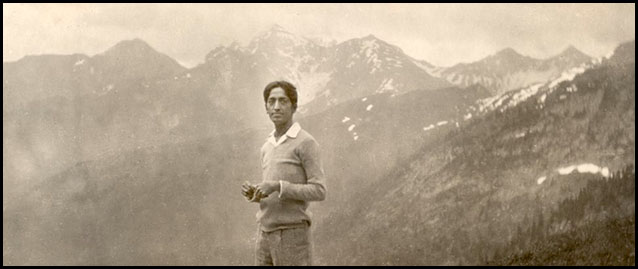
Jiddu Krishnamurti famously did not prescribe any methods and was generally against spiritual paths and spiritual authorities including gurus. However, sometimes on rare occasions, he did prescribe a method and give hints and clues about meditation, often when speaking with children at the various schools he visited. This is what we will look at here.
Here is a wonderful example of how he simply and profoundly explains meditation to a student. It is a rare example. The following excerpt is taken from ‘On Education’ page 58.
Bold type has been added by myself for emphasis, and my comments are interspersed in red, with Krishnamurti’s words in black. Try reading the text both with my comments and without them to get a feel for it. If you can, try to see how my comments are related to the specific words and phrases in the text. I hope you will clearly see where I have added my own thoughts, and feel free let me know what you think.
Best wishes to you all!
With love
Tom
Krishnamurti: Do you know anything about meditation?
Student: No, Sir.
Krishnamurti: But the older people do not know either. They sit in a corner, close their eyes and concentrate, like school boys trying to concentrate on a book. That is not meditation. Meditation is something extraordinary, if you know how to do it. I am going to talk a little about it.
First, Krishnamurti introduces the topic of meditation in a wonderful way. He states its extraordinariness and implies its non-mechanical and non-formulaic nature.
First of all, sit very quietly; do not force yourself to sit quietly, but sit or lie down quietly without force of any kind. Do you understand? Then watch your thinking. Watch what you are thinking about. You find you are thinking about your shoes, your saris, what you are going to say, the bird outside to which you listen; follow such thoughts and enquire why each thought arises.
Here we see how gentle Krishnamurti’s approach to meditation is. Everything is unforced. Even the initial sitting is unforced. His approach is to be gentle, relaxed and uncontrived throughout, whilst allowing the natural intelligence to function. He says to sit or lie quietly without force of any kind.
Next Krishnamurti will follow on from that, how we are not to suppress, but to remain with each and every thought and feeling. This is not to be done in a mechanical unconscious way as is often taught, but one should notice patterns in how thoughts and feelings arise, without suppressing them or judging them as good or bad. Incidentally, this is completely in line with the Buddha’s teachings on mindfulness as found in the Pali suttas, eg. the Maha-satipatthana Sutta, where the Buddha urges us to notice patterns as they arise in order to generate insight.
Then Krishnamurti goes one step further: not only are we to watch the thoughts but crucially we are to enquire why each thought arises.
Do not try to change your thinking. See why certain thoughts arise in your mind so that you begin to understand the meaning of every thought and feeling without any enforcement. And when a thought arises, do not condemn it, do not say it is right, it is wrong, it is good, it is bad. Just watch it, so that you begin to have a perception, a consciousness which is active in seeing every kind of thought, every kind of feeling. You will know every hidden secret thought, every hidden motive, every feeling, without distortion, without saying it is right, wrong, good or bad. When you look, when you go into thought very very deeply, your mind becomes extraordinarily subtle, alive. No part of the mind is asleep. The mind is completely awake.
Again Krishnamurti emphasises not trying to change things, but rather to observe things as they are, and also to look to see why certain thoughts are being thought. What is the motivation behind the thoughts?
Krishnamurti indicates that through this being with thoughts and feelings without force or suppression, an observing consciousness naturally arises. This observing consciousness (my words) is often referred to by Krishnamurti as ‘choiceless awareness’, meaning awareness without the sense of a ‘me’ or egoic centre which is judging, condemning, suppressing, etc.
Also implied in the paragraph above is that through this process of meditation, all the unconscious tendencies will rise to the surface. What was unconscious, suppressed and hidden will be revealed and become conscious. At other times Krishnamurti sometimes refers to this process as the beginning of self-knowledge. When Krishnamurti uses the term ‘self-knowledge’ he is referring to learning about the psychological self and how it egoically operates, rather than how the term self-knowledge is used in Vedanta and yoga to mean knowledge of Brahman/the absolute or enlightenment.
Throughout this process, we are not to condemn or judge or suppress which Krishnamurti says would be a distortion. Similarly, although this is not stated, I would add that we are not to act out and indulge in thoughts and feelings, at least not too much, as this too is distorting.
Exactly how this works can be discovered for oneself but trying this practice out. When you come upon this for yourself, the words make much more sense. The correct balance of awareness, stillness and intellect naturally arises through this process of meditation. The mind becomes still yet intelligent and active, as opposed to still and dull. My interpretation is that in Vedanta, the still and active state is known as sattva (peace and intelligence) whilst the still and dull is known as tamas (dullness).
That is merely the foundation. Then your mind is very quiet. Your whole being becomes very still. Then go through that stillness, deeper, further – that whole process is meditation. Meditation is not to sit in a corner repeating a lot of words; or to think of a picture and go into some wild, ecstatic imaginings.
So, after doing this, we realise that this is just the start of meditation. Initially we are allowing the mind to rise up, we are allowing thoughts and feelings to rise up. Through allowing them to arise without judgement, suppression [or acting them out], and through seeing why thoughts arise as they do, ie. through having insight into the hidden (egoic) motivations that underlie the thoughts and feelings, the mind, over time, naturally becomes still.
Very importantly, we have not made the mind still. We have not forced the mind to become still. The mind has naturally become still because what needed to come up and be felt and understood has come up and been felt and understood. In doing so, without trying to become still, which is egoic effort and egoic activity, without trying to become still, the mind becomes still.
So, what do we do now? Nothing. In doing nothing, we are deepening the meditation. We are not really doing anything per se – the choiceless awareness acts ‘of its own accord’. We are going deeper and deeper into the stillness. It happens by itself, without contrivance or effort. It is the natural unfolding of intelligence and the natural dissolution of ego/self.
Krishnamurti reminds us in the last sentence of the paragraph above what meditation is not; it is not a mechanical process such as mechanically repeating a slogan or mantra; it is not going off into flights of fancy brought on by images or idols; it is not to enter ecstatic states of mind where one is filled with supercharged bliss and love. It is this dynamic stillness which has its own quiet momentum, which naturally unfolds and cleanses without effort or intention.
To understand the whole process of your thinking and feeling is to be free from all thought, to be free from all feeling so that your mind, your whole being becomes very quiet. And that is also part of life and with that quietness, you can look at the tree, you can look at people, you can look at the sky and the stars. That is the beauty of life.
Krishnamurti now makes a leap. He describes how this unfolding into silence is discovering a freedom in which there is silence together with total freedom from thoughts and feelings. He does not go into this more here, but he is describing what could be thought of as the outcome or culmination of this ongoing process or movement that is meditation. A freedom, a total freedom, free from perceptual phenomena, one with this quietness and one with life: beauty itself. The silence he is speaking of is that which is without a centre, or without a ‘me’ or ego. The beauty he speaks of is the beauty of no-me, no-self.
———————————————
A summary of ‘Krishnamurti’s Method of Meditation’
Based on the above, we can briefly summarise Krishnamurti’s method of meditation as follows:
- One needs to, at least initially, make space and time for meditation.
- In a gentle and unforced way, sit or lie quietly. This itself should be without any force of any kind.
- Allow and don’t suppress or judge: Allow thoughts and feelings to arise. As they arise, do not suppress or judge them as being good or bad, but allow them to arise. Also do not indulge or act out the thoughts and feelings, but instead remain quiet and aware.
- Develop insight and understanding: Gently and patiently question and observe why certain thoughts and feeling occur. Notice if there any patterns arising. Notice any underlying motivations present in the thinking and feeling.
- Natural self-healing/purification: In this way, the once hidden and unconscious mind will, over time, reveal itself and become conscious. Naturally, though the above steps of allowing and insight, the mind will heal itself and empty itself of pain, suffering, addictive tendencies and egoic tendencies (ie. purification). This is just the foundation or first step of meditation in which the unconscious pain and egoic ways are naturally and non-egoically cleansed.
- Unforced silence: This, over time, and without being forced or contrived, will naturally give rise to a silence. This is the deeper or true meditation, the second step you could say. This silence is an active dynamic and alive silence, one that is suffused with intelligence (sattva), and not dull and dead like the silence that is trained or forced through a mechanical method such as mantra repetition (tamas).
- Go further still, allow silence to deepen: This is where many prematurely stop after an initial taste of silence only. When the mind is naturally still without being forced, do not ‘stop’. Continue. Allow the still mind to naturally deepen of its own accord, going further and further, deeper and deeper into stillness. The aware-intelligence energy naturally recognises egoic thought and the egoic movement and effortlessly cleanses it as it arises. Purification is happening on a deeper and moe subtle non-verbal level now.
- Freedom: There one will naturally discover a freedom beyond words, a freedom that is not sought, that cannot be sought, that has no authority, that is natural, present, ungraspable and uncontrived. A freedom that is non-separate from life. It is simultaneously silent (ie. no ego), free from life (ie. thoughts, feelings, sensations, the world) and one with life.
———————————————
What if this meditation is too difficult?
I would add that for many people this type of meditation is very difficult due to the strength and force of mental and egoic tendencies. Krishnamurti seems to have naturally had a quiet mind which did not require much else to enter into meditation.
However my view is that we can add a preceding stage in which one can, again in a gentle and unforced way, steady the mind by following the breath or repeating a mantra.
Whist this is clearly a mechanical process, and one that Krishnamurti did not recommend, my experience is that it can allow an unruly mind to become stable enough to take up ‘Krishnamurti’s method’. The key point is that this mechanical process is not the end-all and be-all of meditation, but just a mechanical trick to get one started. It of course must be let go of.
Similarly, the eyes can be kept open initially for 10-15 minutes, which can also aid mental stability, as I have found that for most people closing the eyes too early in meditation is not conducive to taming a mind that is used to extroversion and stimulation. Thereafter one may open or close the eyes as one pleases.
At other times, Krishnamurti recommended keeping the eyes looking straight ahead, with the eyeballs unmoving. Again, this is something that is not always easy to do, but feel free to experiment with this too.
Concluding comments and further analysis: purification and insight
We can see how Krishnamurti’s approach is wonderfully natural and non-violent to the body and mind. It does require, at least initially, time and mental space in which the meditation can occur, and may also need other preliminary steps for some people, in my view.
It also beautifully and naturally allows our innate intelligence to arise and function, and heal ourself. As the mind is allowed to rise up and become fully conscious, it heals itself (ie. purification), and the egoic process dissolves and disappears (ie. insight, then end of vasanas and the dawn of liberation).
The healing process by which the egoic tendencies and past hurts arise and are cleansed is what I would usually call purification. A natural choiceless awareness arises and functions, free from life and one with it simultaneously. This is the start of the ending of the egoic movement (vasanas or habitual egoic tendencies).
Initially the egoic process is seen and transcended in ‘step 1’, where it is allowed to function and be felt but without indulging in the ego/acting out the tendencies. Later the egoic process almost completely disappears and becomes temporarily dormant and the mind becomes still (‘step 2’). When one is not meditating, the ego again rises out of its dormancy.
During these times, what I call insight (into no-self) dawns: it can become clear that there is no separate self, no doer, no thinker, no centre, just one unitary movement in Freedom. This insight can initially seem to come and go, as the egoic process/ego is present or absent to varying degrees, and the apparent insight will also vary accordingly.
As this silence continues further and deepens further, what is really happening is that purification/cleansing of ego is deepening and spreading through all aspects of the body-mind system. The ego is naturally and effortlessly being rooted out by the innate intelligent, one could say. The ego/egoic tendency, initially periodically dormant, over time becomes annihilated, meaning that the ego-tendency does not rise again (ie. the egoic vasanas are annihilated). The illusion of separation and duality has ended, not temporarily or partially as before, but totally and irrevocably. This is tantamount to liberation in the Buddhist, Vedanta and yogic traditions.
For more on my approach to purification and insight, see here.



 Tom Das