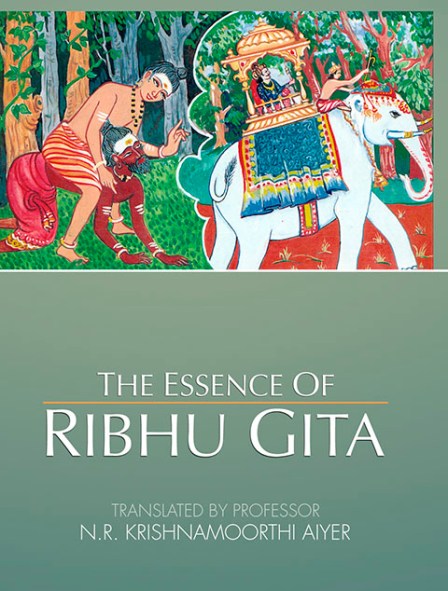
Tom: This wonderful text provides a hard-hitting summary of essential Advaita Vedanta teachings. Blessings to you who have found these teachings and put them into practice.
Also see Ribhu Gita – Chapter 26 which Sri Ramana Maharshi reportedly specifically recommended recitation of for attainment of Self-Realisation.
PREFACE
The Ribhu Gita forms the sixth section of the Sanskrit work known as Siva Rahasya. It is the teachings of Lord Siva in Mount Kailas to His devotee Ribhu, from whom the Gita derives its name.
The Tamil version is a free translation of the original Sanskrit text, consisting of 1,924 verses of such scintillating brilliance that Bhagavan Sri Ramana Maharshi recommended its recital as a strong support for spiritual sadhana. He used to say that the recital itself leads to spontaneous abidance in the Self.
The book presented herewith consists of 122 verses from the original Tamil work, being a free translation into English prose, conveying the essence of the original, rather than a mere mechanical word for word translation.
Benedictory verses
To Siva
1. Salutations to the Supreme Lord Siva, the pure Awareness in the sky of consciousness in the Heart, by meditation on whom, Ganesa, Guha, Mother-Sakti who is the embodiment of Siva’s Grace, and myriads of Devas, saints and devotees have attained their cherished goals. (Chapter 1, Verse 1).
To Nataraja
2. From the sky of consciousness of the Heart springs forth the dancer Nataraja with his blissful consort Freedom, to the delectation of his devotees who are thus liberated forever. Unto that Ananda Natesa do we render our devout salutations. (Ch.1, v.2)
To Ardhanareeswara
3. Unto that Form whose left half is the Mother of all manifestation and whose right half is the Father of the same, the jingle of the gems enclosed within the hollow golden anklet of whose foot is the source of all scriptures, and whose three eyes (Fire, Sun and Moon) are the illuminants of the universe, to that Form be our devout salutations. May that divine Form ever be our protection. (Ch.1, v.3)
To Siva, Sakti, Vinayaka and Shanmukha
4. Salutations to Siva, the Lord of the universe of infinite power, to Sat-Chit-Ananda-Sakti, the Mother of the universe, to Vinayaka the dispeller of all impediments to freedom, and to Shanmukha the Sat-Guru, who dispenses to his worthy devotees the divine wisdom of Siva-Self leading to salvation. (Ch.1, v.4)
THE ESSENCE OF THE RIBHU GITA
The following verses constitute the teachings of Siva to Ribhu, who in turn transmits those teachings to his disciple Nidhaga Rishi. The treatise goes by the name Ribhu Gita.
5. The universe was neither born, nor maintained, nor dissolved; this is the plain truth. The basic screen of pure Being-Awareness-Stillness devoid of all the moving shadow pictures of name and form of the universe is the sole, eternal Existence. (Ch.2, v.33)
6. Some may argue that this universe of duality (multiple existences) is a factual second reality, clearly seen by the senses operated by the mind. But then, are the senses anything apart from the mind? Can they function without the support of the mind in which they are imbedded? What is this mind except a bundle of thoughts? What are thoughts except evanescent ripples in the still, limitless ocean of pure Being-Awareness-Self, which is the sole Existence without a second? (Ch. 2, v.34)
7. The existence of the illusion of silver in mother of pearl is not a reality apart from the reality of mother of pearl, which is the basic reality. The illusion of the universe is based on the mind, which again is an illusion based on the still Awareness-Being-Self. (Ch.2, v.35)
8. In the unitary, undifferentiated still ocean of Existence-Awareness-Self, body, senses, mind, intellect and jivas (embodied souls) are nothing but evanescent ripples not apart from that sole Self. (Ch.4, v.6)
9. The universe of name and form, the embodied creatures and their creator, mind, desire, Karma (action), misery and everything other than the Self, are merely thought formations projected by the powers of the Self on its screen — Self. (Ch.5, v.25)
10. The state of firm abidance in that thought-free alert Awareness-Self, constitutes integral perfection, yoga, wisdom, Moksha, Sahaja Samadhi, the state of Siva and the state of Atman-Self, which scriptures proclaim by the title of Brahman. (Ch.5, v.26)
11. There never was a mind nor any of its countless forms like world, jivas, etc. There isn’t the least doubt that all these are the form of the eternally undifferentiable Supreme Brahman-Self. This is the Truth. The one who hears this great secret diligently and understands completely, abides as Brahman-Self (Ch.5, v.28)
Greatness of Videha Mukta
12. With all objective knowledge banished, with no trace of thought or nescience, with all the three states of waking, dream and sleep wiped out, with all thought of death and birth abolished, and ever established in the spontaneous blissful state of Brahman-Self, the condition of the Videha Mukta cannot be conceived, and much less expressed in words. (Ch.5, v.39)
13. The continued repetition of ‘I am Self-Brahman’ constitutes the sole mantra-japa leading to Mukti (Liberation). All other mantra-japas connected with diverse gods should be firmly eschewed, as they aim at mundane objectives other than the Self. All other mantra-japas always entangle one inextricably in the bondage of worldly enjoyments. (Ch.6, v.37)
Sat-Chit-Ananda-Self Siva and His worship
14. On the eternal and infinite screen of Sat-Chit-Ananda-Self Siva, by His own power, Sakti is projected as the moving shadow picture of the universe in manifestation and into that again it is absorbed in dissolution.
All luminaries like the sun, moon, fire, stars and lightning derive their luminosity as a gracious gift from the Sakti inherent in that screen of Self-Siva only. Though bright in themselves, they can only obscure and cannot reveal the Siva-Screen which they cover up.
Out of fear of that Siva, their creator, Devas and Asuras (gods and demons) are ever alertly engaged in their ordained duties.
That Siva must be meditated upon and realised to be the Self, by making the restless mind stay still and alert after it has been adequately restrained, and completely prevented from the pursuit of sense objects, namely, the shadow pictures on the screen of the Self. All shadow pictures removed, what remains is pure Awareness, the spotlessly effulgent screen. Thus, Siva reveals Himself spontaneously as the sole eternal Sat-Chit-Ananda-Self, the very essence of the nature of the worshipper. (Ch.7, v.35)
The Jivan Mukta
15. The Jivan Mukta is a person liberated during his lifetime, who continues to have consciousness of the body and the world (as Brahman) along with his firm abidance in his Siva-Self. He ever abides in the blissful peace of Sat-Chit-Ananda. He is poised rock-firm in the conviction that he is not the body, and that his Being is the sole existence, the sole alert-awareness-bliss of Siva-Self Supreme. (Ch.8, v.1)
16. The Jivan Mukta has his consciousness completely dissolved beyond recognition in his Brahman-Self. Eternally alone in his Self, he is ever lost in the enjoyment of the bliss of his Brahman-Self. (Ch.8, v.25).
The Videha Mukta
17. The Videha Mukta [The term literally means the ‘disembodied-liberated person’] is free from the least trace of thought; he abides all alone in his effulgent pure-Awareness-. He is the matured adept, who at the moment of death, abides as the pure Sat-Chit-Ananda-Self. Figuratively the term means mature liberated being who, while still alive, abides as the pure Sat-Chit-Ananda-Self without awareness of body and the world around him. Self in intense unbroken bliss, totally oblivious of limited forms, in a state of Maha-Mounam (stillness of body, speech and mind). (Ch.9, v.1)
18. He is the pure embodiment of Sat-Chit-Ananda, all pervasive as ether, infinite as the sky, all alert with Awareness, spontaneously abiding as the perfect Brahman-Self in a state of still, unbroken, peaceful bliss. (Ch.9, v.15)
19. There is not an atom apart from the Self, which is the integral undifferentiated perfection of whole Being. Soul, world and Creator are inseparable from the Self. The reality of these is the reality of the Self only. (Ch.10, v.34)
20. All ignorance and illusion, all objects inert and living, all beings and non-beings, all the five elements, all the diverse worlds, all bodies and the lives that arise in them, not being apart from Brahman-Self, are Brahman-Self only. Existence alone is, for even non-existence acquires meaning only in Existence. Simply put, everything exists always as Brahman-Self only. (Ch.12, v.2)
21. All objective knowledge, all thought forms, all visible objects, all things heard, all questions and answers, all the food consumed and all other illusions, not being apart from the Self, should be regarded as Brahman-Self only. (Ch.13, v.2)
22. Therefore one should practise the habit of regarding everything as Brahman-Self only; until all thought of things other than the Self is lost. This condition once achieved, one should not give room for any thought and should ever abide in Maha-Mounam (peace of total stillness). (Ch.14, v.38)
23. Anything seen as other than Brahman-Self is bound to cause fear and trouble. Therefore, it behoves one to stick to the single attitude that everything sensed is Brahman-Self alone. In due course even this one thought must be given up, in order to abide firmly in the free undisturbed blissful state of the sole Brahman-Self. (Ch.15, v.5)
24. The total discarding of the mind is alone victory, achievement, bliss, yoga, wisdom and liberation. The sacrifice of the mind is, in fact, the totality of all sacred sacrifices. (Ch.15, v.7)
25. The firm denial of the existence of the mind and the firm belief in the existence of Brahman-Self, is the sure way to the conquest of mind, leading to the experience of the sole effulgent Self. (Ch.15, v.11)
26. If one gives the slightest room for the thought that the mind exists, pure Awareness itself will vibrate as the ruffled mind, which is the parent of all trouble and illusions. Therefore, one should ever abide in the conviction that there is no mind, and that the pure Awareness-Self is the sole Existence. This is the easy way to conquer the mind with all its vagaries. (Ch.15, v.12)
27. There is no such thing as the troublesome mind, no world of names and forms, not the least bit of ego. All these are nothing but the perfect Brahman-Self, which I am. In this conviction one should abide firmly, until one achieves the state of sleepless-sleep which is alert-peace-eternal. (Ch.16, v.7)
The True Samadhi
28. To hold on to the conviction born of Self-enquiry that “I am no doubt the Screen — Brahman-Self, and the world picture thereon, though evanescent, is no doubt ‘I am Self’ only”, and to abide still and blissful in that conviction is the acme of all sadhanas, like divine worship, charitable gifts, spiritual austerities, mantra-japa and samadhi as well. (Ch.16, v.41)
29. The Self alone is the spontaneous self effulgent Awareness; that alone is eternal bliss; that alone is Existence everlasting; that alone is all embracing perfection, the sole Godhead without a rival and the sole primordial stuff of the Universe. In the conviction born of this experience, one should ever abide, as the sole I AM, the Supreme Self. (Ch.17, v.29)
Sahaja Samadhi
30. Remaining alertly aware and thought-free, with a still mind devoid of differentiation of Self and non-Self even while being engaged in the activities of worldly life, is called the state of Sahaja Nirvikalpa Samadhi (the natural state of abidance in the Self when all differentiation has ceased). This is called Akhandakara vritti, the ‘I’ of infinite perfection as contrasted with the ‘I am the body’ notion of those who have not realised the Self. (Ch.18, v.40)
Maturing of Sahaja Samadhi
31. Abidance in Sahaja Samadhi is the hallmark of a Jivan Mukta. With progressive development towards this state, an intensity of blissful peace is attained, leading on to the four successive stages of perfection in samadhi. Nothing short of this Sahaja Samadhi will be of any avail in destroying the fearsome cycle of births and deaths. (Ch.18, v.41)
32. That realised person who abides in the Brahman-Self, and has lost all feelings of differentiation of self and non-self, is the Jnani or Mukta Purusha. Such a Jnani is rare to find even by searching among millions of people. If one has the lucky opportunity of getting his darshan (personal view and contact) one attains purification from all his sins, and what is more, such a person’s ego gets liquidated at once. (Ch.19, v.10)
33. Darshan of the matured Jnani constitutes the acme of purification of baths taken in sacred waters, divine worship, mantra-japa, spiritual austerities, charitable acts and devotional worship of Lord Siva Himself. To find and to gain access to the sacred presence of such a Jnani is the luckiest of opportunities that one could ever obtain in this world. (Ch.19, v.11)
34. Worshipful service rendered unto such a Jnani-SatGuru quickens one’s spiritual wisdom to attain the bliss of jivan mukti. If continued further, it bestows on the disciple even the status of videha mukti. Therefore, if one is keen on being released from bondage into the freedom of mukti, the one infallible means of achieving that aim is the loving and worshipful service of the Jnani-Sat-Guru. (Ch.19, v.13)
35. Firmly established in the Self, undisturbed by the least ripple of thought, as still as an idol of stone or wood, dissolved completely in Brahman-Self, even as water is in milk, with awareness devoid of all impurities of thought and drowsiness, standing clear as the pure sky, the grandeur of the Jnani’s nishta (firm stance in the Self) defies thought and expression. (Ch.19, v.21)
The sine qua non of Mukti is Siva’s grace
36. That in which the whole universe is born and into which it is absorbed in dissolution, is the Siva-Self. Devoted worship of and meditation on that Siva-Self of pure Consciousness alone will attract Siva’s Grace, which is indispensable for liberation. (Ch.19, v.60)
37. Those engaged in the pursuit of knowledge of the Brahman-Self, happening to get involved in the mundane pleasures of sex, should regard such pleasures as merely faint shadows of the bliss of the Self. They should never even dream of worldly pleasures. (Ch.20, v.45)
38. As the Self is Sat, meditative contact with the Self is the true Sat Sanga (association with sadhus who abide in the Self). As Brahman-Self is the highest, association with the Self is Mahat Sanga (highest association). (Ch.21, v.28)
39. The sadhaka practising meditation on the Self, should always think firmly that all diversities of soul, world and creator are the undifferentiated Brahman-Self only. By practice, his consciousness is freed from thoughts, after which he should give up the above thought also and abide always in the thought-free state of the Self (Ch.21, v.39)
40. Abidance in the state of thought-free alert Awareness, is the state of mukti beyond thought and expression. The emergence of thought is the bondage of untold suffering. Abidance in the Self is the true non-dual samadhi, and that alone leads one to the eternal bliss of mukti. (Ch.21, v.41)
41. The great illusions: maya (associated with God Iswara), avidya (associated with individual souls), mind and jivas (souls), world and its creator, all names and forms, and all mental conceptions are nothing but the Self. One should ever abide in this conviction. (Ch.22, v.23)
42. All worlds and creatures are only thought forms. They are nothing but the mind, which is a bundle of thoughts, which again are nothing more than ripples in the still ocean of Awareness-Self, and certainly nothing apart from that Self. Therefore, one should abide in the firm conviction that all objects are only I Am Self-Brahman. (Ch.22, v.24)
43. There are no such things as achieved objectives and the efforts leading to them, association with the wise or the ignorant, efforts of learning and knowledge acquired, acts of enquiry and practice, the learner or the learned, and any goals achieved. What exists is only Brahman, the effulgent Awareness-Self. (Ch.23, v.10)
44. One should be firm in the conviction that there are no charitable acts, sacred waters and kshetras (pilgrim centres), no loss or gain and no loser or gainer, no karma, bhakti and wisdom, and no knower or known. All these thought-forms are bound to be dissolved and lost in the Brahman-Self, which is the sole existence. (Ch.23, v.11)
45. The bhavana* ‘I-am-Brahman-Self’ swiftly takes one to mukti. As the continued reading of the texts generating that bhavana, takes the aspirant unerringly to the goal, he should always dwell on the written words dealing with the Brahman-Self. (Ch.24, v.27)
46. The illusion that one is the body and that the world is the basic reality has remained soaked over a long, long time, and cannot be got rid of by the casual reading and mere understanding of the truth. The basic illusion can be effaced only by a long and unremitting practice of the bhavana that all this is ‘I-am-Brahman-Self’. (Ch.24, v.28)
47. Everything is only a concoction of time, space and energy. All else is the trite talk of people who dislike the effort of sadhana which takes them to the Self. This talk is based on their dense ignorance of the Self. Only by persistent practice and experience of sadhana, can one arrive at the truth that all concepts of souls, world, and the cause thereof are just evanescent shadows on the screen of Siva-Self-Brahman. (Ch.24, v.31)
48. There is never such a thing as conception of names and forms, no such thing as the conceiving mind, no such thing as a person lost in samsara, and no such things as the world and its creator. Everything that is seen to exist must be realised to be no other than the sole, pure Awareness-Being-Brahman-Self. (Ch.25, v.8)
Everything is Sat-Chit-Ananda-Self only
49. Whatever is found to exist is Sat (Existence) only. Whatever is pleasurable is Ananda (Bliss) only. One should ever abide in the bedrock bhavana of Sat-Chit-Ananda. Never for once should one slip, even inadvertently, into the disastrous bhavana that one is the body and that the world is real. (Ch.25, v.12)
50. One should abide in the rock-firm bhavana that ‘Everything is only Brahman-Self and I am that Brahman-Self’. By this bhavana all thought movements and nescience will disappear, resulting in the eternal abidance in the sole Sat-Chit-Ananda-Self. (Ch.25, v.14)
Verses 51 to 60 herein deal with practice of ‘Abedha Nishta or Atma Nishta’ — non-dual state or abidance in the Self
51.By abiding in the Self, the wandering mind is reduced to perfect stillness after being freed from all nescience and thought currents. It gets lost in the Sat-Chit-Ananda-Self in the same way that water is lost when mixed with milk. This unitary state of abidance in the Self is called Atma Nishta by the wise who have attained perfection. (Ch.26, v.2)
‘Sahaja Nishta’ or The Natural State
52. Having realised that the world picture on the screen-Self is evanescent and essentially non-existent, one should ever remain still and blissful in the firm conviction of ever being the sole Brahman-Self only. This conviction should be maintained even while functioning as an individual in the world of name and form. This matured state of abidance in the Self is called Sahaja Nishta (the Natural State). (Ch.26, v.3)
53. In that blissful Self wherein there is no action of body, speech and mind, no virtuous or sinful karma (action) and the fruits thereof, one should remain still, eschewing the least trace of thought. (Ch.26, v.7)
54. In that Self wherein there is neither conceiver nor conception of the world of names and forms, one should remain blissfully still, eschewing the least trace of thought. (Ch.26, v.8)
55. In that Self wherein desire, anger, covetousness, confusion, bigotry and envy are all absent; in that Self wherein there is no thought of bondage or release, one should abide blissfully still, eschewing the least ripple of thought. (Ch.26, v.13)
56. Firmly abiding in the Self one acquires the totality of all knowledge and achieves the successful completion of all endeavours and duties. In that state one should abide blissful and still, eschewing the least ripple of thought. (Ch.26, v.25).
57. Mind merged completely in the Self, one becomes a lord without rival-steeped in bliss beyond compare. In that state one should abide still, free from the least trace of thought. (Ch.26, v.28)
58. I am that Self which is integral existence-awareness-bliss, the sole impartite Brahman-Self. Firm in the conviction born of this experience, one should abide still, free from the least trace of thought. (Ch.26, v.29)
59. In the conviction that ‘I am the Self’ in which no thought, ego, desire, mind or confusion can exist one should abide still, free from trace of thought. (Ch.26, v.31)
60. The firm faith of being the Self is sufficient to dispel all thought and establish one in Brahman-Self. In due course of this practice, even the thought involved in that faith fades away leading to the spontaneous effulgence of the Self. If a person hearkens to this teaching and practises the faith, even if he is a great sinner, he is washed clean of all his sins and is established in Brahman-Self. (Ch.26, v.42)
61. There is certainly no such thing as mind with its constituents of thought and thought forms of objects. In this conviction one should ever abide still and at peace, in the state of thought-free alert Awareness-Self which endures after all sadhanas and its rigours have exhausted themselves in Brahman-Self. (Ch.27, v.29)
62. Having gained the experience that there is no creator, no maya, no duality, and no objects at all, and that pure Awareness-Self alone exists, one should ever remain still and peaceful in that state of Selfhood. (Ch.27, v.34)
63. If a person gives heed to these teachings he would certainly gain the grace of Lord Siva and attain the state of Selfhood even though he is immersed in the dense darkness of nescience which could not be banished by the glare of a million suns. (Ch.27, v.43)
64. Why waste words? This is the truth in a nutshell. Only those who have earned the Grace of our Lord Siva by long devotional worship will get the rare opportunity of reading this scriptural text which leads to the bliss of peace everlasting in Brahman-Self. (Ch.27, v.44)
65. Only that Jnani who teaches ‘Thou art the thoughtfree, alertly aware, absolutely still, ever blissful, intensely peaceful, unqualified Brahman-Self’, is the true Sat Guru, and others are not. (Ch.28, v.28)
66. Unbroken abidance in the state of alert awareness, unruffled by thoughts, is Self-realization. That is at once the spotless jivan mukti and the magnificent videha mukti. This state is easily attainable only for those who have earned the divine Grace of Siva by deep devotion to Him, and not for others. What is stated here is the import in a nutshell of the message of that charming crest jewel of the Vedas known as the Upanishads. (Ch.29, v.37)
67. Those who give heed to this message and abide in accordance with it will forthwith attain mukti (liberation). They will not suffer from the least particle of affliction; they will enjoy a bliss far greater than the bliss attained from this and all other worlds; they and their environments will be filled with the plenitude of auspicious events. Totally free from all trace of fear, they will never again enter the cycle of births and deaths. They will become the immutable Brahman-Self. All this we swear is the truth beyond doubt. By our Lord Siva, again and again we swear that this is the fundamental truth. (Ch.29, v.40)
68. That state of still, pure, effulgent awareness is moksha, the state beyond compare. Those who maintain an unbroken abidance in that supreme state will never more be touched by suffering or confusion, and will be absolved from all duties. Such duties if any will somehow be completed without any volition on their part. They will eternally abide as the sole supreme Self. (Ch.30, v.31)
In all the 13 verses of Chapter 32, the term bhavana is to be understood as faith or firm belief in ‘Aham Brahmam’ (I am the Self)
69. By the persistent and continued bhavana of ‘I am the Brahman-Self’ all thoughts and feelings of differentiation of Self and non-Self will drop off and permanent abidance in Brahman-Self will be achieved. This bhavana is possible only for those with a keen inquiring mind intent on knowing the Self and not for those who are indifferent about Self-knowledge. (Ch.32, v.18)
70. Ignorance and indifference in regard to the enquiry of the truth about one-self is the store house of nescience and trouble, blocking the view of the Self, and creating in a split second all sorts of illusions and harassment of mental worry. Non-enquiry renders bhavana impossible. (Ch.32, v.19)
71. In short, non-enquiry will steep one for ever in the ocean of samsara (earthly suffering). There is no greater enemy for one than non-enquiry. Therefore, this habit must be overcome in order to fix the mind in the bhavana which leads to abidance in the Self. (Ch.32, v.20)
72. Enquiry should be made this wise: With the kind help of the Sat Guru one should enquire ‘Who am I? what is this world? what is the reality behind all these?’ (Ch.32, v.21)
73. Staying in the company of sadhus (those engaged in the pursuit and enjoyment of the bliss of the Sat-Self) and respectfully questioning the Sat-Guru-Jnani, one should first make oneself clear about the objective to be obtained. This is an important aspect of the enquiry. After thus making sure of the objective, one must firmly abide in that objective of sole Brahman-Self until the Self is unmistakably experienced. (Ch.32, v.22)
74. The conscious introspective concentration of Self enquiry (‘Who am I’?) kills all thoughts and destroys the dense darkness of nescience; it effaces all worry; it illuminates the intellect with the radiance of pure awareness; it wipes out all conceptual confusions; it fixes one in Siva-Self; it transforms a host of impending disasters into auspicious events; and lastly, it destroys the ego-mind utterly with all its afflictions. (Ch.32, v.24)
75. Only by those strong willed persons who make earnest and persistent Self-enquiry will the turbulent mind be controlled and fixed still in the practice of firm bhavana. In due course all thoughts and nescience will disappear, yielding place to the effulgent Awareness-Self of mukti. (Ch.32, v.26)
76. One should relentlessly pursue Self-enquiry until all conceptual forms of creature, world and creator merge and disappear in the pure thought-free, alert Awareness-Self, enabling one to abide in that bhavana of the experience, ‘I am the Brahman-Self’. (Ch.32, v.27)
77. It is only the mind which appear as the world and bondage; there is no world other than the mind. On enquiry this mind turns out to be nothing more than a group of ripples (thoughts) in the still ocean of pure Awareness-Siva-Self. I am that Siva-Self only and there is nothing apart from me, one should ever abide in the conviction born of this experience. (Ch.32, v.33)
78. There is no world apart from the mind. What appears as the world is only the mind. If this mind is investigated, it turns out to be nothing more than a bundle of thoughts based on the primary thought of ‘I am the body’ called the ego. If this ego — I is enquired into and its identity searched, it gets swallowed up without a trace in the pure Awareness-Being-Siva-Self. One should maintain this firm bhavana ‘I am Self-Siva’ until that state of being the Siva-Self — becomes the spontaneous experience free from the effort of bhavana. (Ch.32, v.34)
79. In me, the pure Awareness-Self, the universe is born, maintained and dissolved as the mind. Therefore, there are no mind and thought forms of objects apart from me the Self. In this firm experience one should ever abide. (Ch.32, v.35)
80. One should ever abide as pure Siva-Self by the firm experience that there are no thought forms of creature, world and creator apart from the mind which is just an array of ripples in me the still ocean of pure Awareness-Self and therefore I am the sole Being Siva-Self only. (Ch.32, v.36)
81. Even as the world, seen in my dream, is not apart from me but only my creation, even so, the world of the waking state is only a creation made by me and seen by me in the medium of my pure Awareness-Self. In this experience one should firmly abide. (Ch.32, v.37)
82. The rock-firm conviction of ‘I am the Self ‘ is the sure mark of firm abidance in the Self. Abidance in that conviction under all conditions is, true divine worship, meditation on God, incantation of mantras, practice of right conduct in life, contemplation, integral yoga, wisdom of the Self and moksha as well. (Ch.33, v.16)
83. Whatever appears as maya, creator, creature, mind, world, names and forms are the pure Brahman-Self only and not apart from that Self. (Ch.34, v.15)
84. Steady abidance in the rock-firm conviction born of the experience of ‘I am the Self’, is the greatest yoga, total dissolution of the mind, true renunciation, true wisdom, and jivan mukti as well. (Ch.34, v.46)
85. Whatever names and forms are seen by me in my dream are not anything apart from me. Even so, this world seen by me in my waking state is not anything apart from me, the Awareness-Self that I am. The wise one should give up all differentiation of Self and non-Self, and abide as pure Self only. (Ch.35, v.23)
86. If this world of the waking state is not evanescent in its nature, whatever is seen in the waking state must be seen during sleep also. Since I as pure Self exist alone and always, there is no room for thought of non-Self-world. I-Self-Brahman is the sole Existence. (Ch.35, v.24)
87. No world exists during the absence of the mind, and there is no mind apart from my awareness. So, mind and world are nothing apart from the Self, and I am ever that sole Existence-Awareness-Brahman-Self. The wise one should abolish all thought of differentiation of self and non-Self. (Ch.35, v.25)
88. I see neither mind nor world during my sleep. In my dream there is mind with its creation, the dream world. The dream world is falsified in my waking state. But I-Self exist always. Arguing thus, one must give up all differentiation of self and non-Self, and ever abide firmly as the thought-free alert Awareness-Self-Brahman. (Ch.35, v.26)
89. All diversities of world, mind, maya (confusing power of Brahman), wakefulness, dream, sleep, talk of you and me are evanescent, and yet, not apart from the Self. Thus wise one should give up all thought of Self and non-Self and abide as Self only. (Ch.35, v.27)
90. In dim light the illusion of a serpent is seen in a rope, and this serpent is nothing but the rope. Even so all illusion of non-Self exists in the Self only. Thus wise one should give up all thought of Self and non-Self and ever abide firmly in the peace of the Self. (Ch.35, v.28)
91. In the wisdom of integral experience, I am the nondual, transcendental, motionless, peaceful, bondagefreedom-notion-free, sky of pure consciousness only. With this experience one should reject all differentiation of Self and non-Self and ever abide firmly in the peace of Brahman-Self. (Ch.35, v.33)
92. One should give up all hatha yogic practices like breath control, all religious dogmas and their diverse sadhanas 19 and be ever satisfied in simple abidance as the Self only. (Ch.35, v.38)
93. Only those who contemplate on Lord Siva-Self, the pure supporting screen of all manifestation, gain the pure experience of sahaja nirvikalpa samadhi. Apart from this devotion to Lord Siva (the Pure-Alert-Awareness-Self ) there are no other means leading to liberation. (Ch.35, v.44)
94. The non-dual sole being existing in deep sleep conjures up a world in the dream state. Even so, the shadow world conjured up in the waking state is the work of the power, inherent in one’s own Brahman-Self. Abiding firmly in the experience of pure Brahman-Self, one finds that the mind and all its confabulations are lost forever. (Ch.36, v.25)
95. One should remain firm in the conviction ‘I am the Self’ and reject all thoughts like ‘I am this body’ and ‘This world is real’. If one maintains this habit unremittingly, this false belief will drop away even as a flower held in the hand slips away when one falls into deep slumber. (Ch.37, v.33)
96. One is solely responsible for one’s own liberation or bondage, since the choice of destroying the restless mind or allowing it to roam at large rests with that one only. Therefore, one should conquer the restless mind by steady abidance in the pure thought-free Alert-Awareness-Self only. This steady abidance is moksha. (Ch.38, v.7)
97. You are the sole supreme Godhead, the Self. There is nothing apart from you. This, we declare to be the ultimate truth after a complete analysis of all the scriptures. By the holy feet of Siva, we swear this to be the truth beyond all doubt. By the feet of the Sat Guru, we swear again that this is the truth declared by the Upanishads. (Ch.38, v.9)
98. All charitable gifts, all pilgrimages to sacred places, all sorts of mantra-japa and worship of diverse gods must be firmly given up in favour of steady practice of the teachings of this book only. (Ch.38, v.24)
99. All yogic practices, all philosophic pursuits, all devotional exercises, and all faiths and beliefs should be abandoned. One should confine oneself to practice of the teachings of this book only. (Ch.38, v.25)
100. By the sole practice of the teachings of this book, all confusion and ignorance will be destroyed. Firm abidance in the Self will be the positive result. With the fusion of the wisdom and peaceful bliss in the Self, mukti will be attained. (Ch.38, v.29)
101. Only when all sins are washed off by the practice of virtues running through many lives, one gets the rare opportunity of securing this treatise and practising its tenets. By the feet of Lord Siva we declare that only those whose cycle of births and deaths has come to an end with this life will ever get this treatise in their hands and practise its teachings. (Ch.38, v.40)
Verses 102 to 121
These 20 verses contain the declarations of the disciple Nidaga before his teacher Ribhu, expressing the spiritual achievements secured by him by the grace of his teacher, and expressions of his gratitude to his teacher, Ribhu.
102. O My Lord Sat Guru! By thy grace I have, in a split second, shed all sense of differentiation of Self and non-Self; I have attained the certainty that all is Brahman and I am that Brahman-Self; I have become settled in the eternal bliss of Brahman-Self. (Ch.39, v.7)
103. I am verily the Sat-Chit-Ananda-Brahman-Self. I am the eternal undisturbed peace devoid of name and form. I am the flawless integral whole of all existence. Firmly I am settled in my sole Brahman-Self. (Ch.40, v.10)
104. Oh! I have become Brahma, Vishnu, Rudra, Mahesa, Sadasiva, Parameswara and his spouse Parvati, Vinayaka, Subrahmanya, cohorts of sides hosts (Siva ganas) and devotees of Lord Siva, all rolled into one! (Ch.41, v.-15)
105. I am myself all the devas (celestials beings) and asuras (denizens of the nether world), Indra the Chief of the devas, the Lord of the eight cardinal directions, the community of sages, the swarm of rakshasas (demons), and in fact, the denizens of this and all other worlds. (Ch.41, v.16)
106. I have become the five elements, multitudinous worlds scattered in the skies, all existing things and their histories, all the Vedas, and all the diversities of name and form. (Ch.41, v.17)
107. At one stroke I have become the bodies, senses, and souls owning them, the mind, intellect, intuition, ego, the primal nescience and the restless commotion of spirit, and in short all that is seen and known. (Ch.41, v.19)
108. That gracious person who gives these teachings is no doubt the embodiment of Lord Parameswara, His Devi Parvati, Vinayaka and God Shanmukha all rolled into one. (Ch.4, v.5)
109. He is again, Nandikeswara, Dattatreya, Dakshinamurti, and in short, the Supreme Lord Siva Himself (Ch.42, v.6)
110. After being duly initiated into these teachings by the Sat Guru, the disciple must, as long as life lasts in him, provide his teacher liberally with money, food, clothing and shelter and loving devotion. This is the sine qua non for the disciple’s mukti. (Ch.43, v.11)
111. Further, he should adorn his forehead and body with vibhuti (sacred ash) in the prescribed manner, as this use of vibhuti alone will entitle him to Lord Siva’s grace which removes all impediments to salvation. (Ch.43 v.12)
112. The habitual smearing of the body with vibhuti is called pasupatha vratham (austerity in devotion to Siva). This practice quickens the attainment of Self-knowledge. O Lord Sat Guru! By this practice I earned the merit for arriving at thy holy feet which have led me to salvation. (Ch.43, v.13)
113. I am ever the eternal, pure, all knowing, free, unshakeable, non-dual, integral Self. This is the firm conviction of the experience of the jivan mukta in the Self. (Ch.43, v.28)
114. That mature Jnani who is lost in the maha mounam (total stillness) of the pure effulgent Awareness-Brahman-Self, devoid of the least trace of nescience, totally devoid of all consciousness of the body and its three states of waking, dream and sleep, devoid of all distinctions of name and form and devoid of any thought of bondage or freedom is a videha mukta. (Ch.43, v.29)
115. Thou hast, O Lord Sat Guru, taken me across the boundless ocean of samsara in the boat of Self-knowledge. To me, floundering in the misery of the belief that ‘I am the body’ thou hast taught that ‘I am the Brahman-Self’ and vouchsafed to me the bliss of all embracing Awareness-Being. To thee, I render these devout salutations. (Ch.44, v.16)
116. Salutations to thee, my Lord Sat Guru! Thou hast destroyed my illusion that I am the body and that the world is apart from me and is real. Thou hast given me the experience of my own Brahman-Self. Thou hast destroyed my wrong belief that karma (action) is the road to salvation, and showing that knowledge alone could make one free. Thou hast given me my salvation in the Self (Ch.44, v.17)
117. To that divine Grace-embodied, to that Omnipresence beyond compare, to that Siva-Self Sat Guru, I render devout salutation. (Ch.44, v.18)
118. To that Sat Guru who is the core of my Self, who destroyed my nescience by the gift of Awareness-Self, to that embodiment of Self-knowledge, do I offer these salutations. (Ch.44, v.19)
119. Salutations to the Sat Guru who is the embodiment of undisturbed peace, without attributes, eternal purity, all 23 pervasive infinite sky of consciousness and integral perfection (Ch.44, v.20)
Note:-The following verses 120 and 121 contain Ribhu’s exhortation to Nidaga.
120. In reply to the words of Nidaga, Ribhu replies thus: O my son! You are now no doubt firmly settled in the bliss of Brahman-Self, having been freed from all illusion and nescience. All the same, as abundant precaution, until you attain videha mukti you must assiduously practise continued abidance in the Self. (Ch.44, v.22)
121. Aspirants of Self-knowledge will find their success accelerated by practical bodily worship of Siva. Living in a Siva kshetra (neighbourhood of Siva Temple) they should offer worship to Siva Maha Lingam, wearing the sacred vibhuthi and rudraksha (garland of a specified sort of beads), and repeating the name of Siva with loving devotion. (Ch.44, v.39)
122. Benedictory Verse offering salutations to Siva-Self.
Salutations to Sat-Chit-Ananda-Siva-Self!
Salutations to that Peace undisturbed, the Self!
Salutations to that integral Perfection, the Self!
Salutations to that Effulgent-Awareness, the Self!
Salutations to that blemish-free Self without attributes!
Salutations to that indivisible Unity, the Self!
Salutations to that pure sky of consciousness, the Self!
Salutations to that supreme integral Existence, the Self!
(Ch.44, v.51)





 Tom Das