nirvikalpa samadhi
SHANKARA – WHY YOU NEED TO COMPLETELY STILL THE MIND FOR LIBERATION
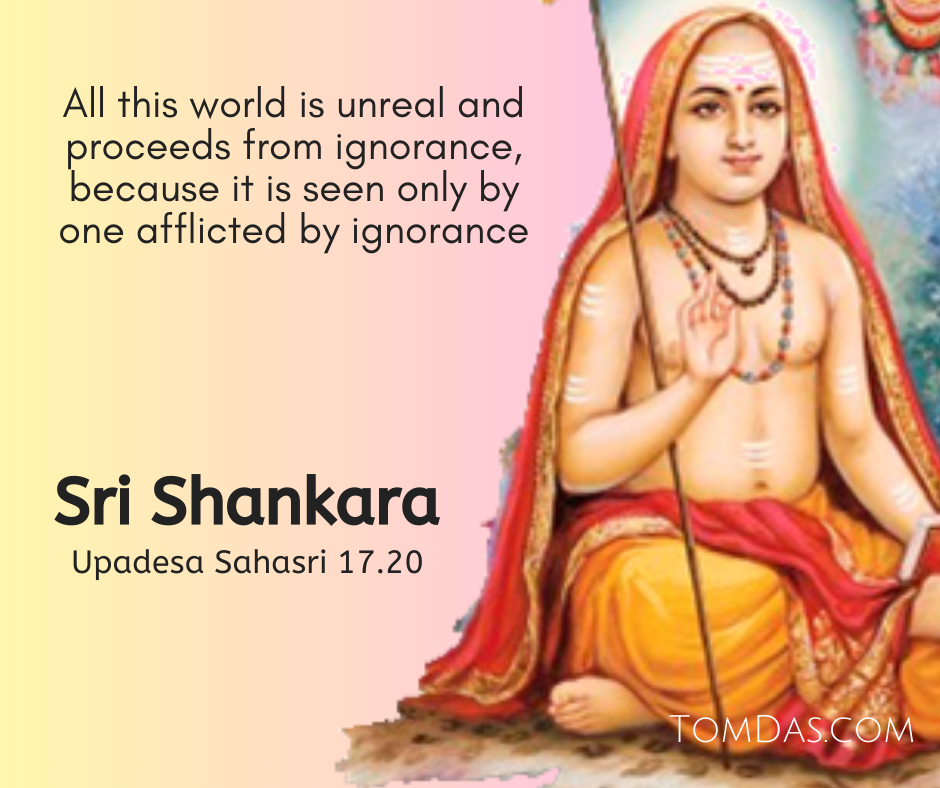
[Tom: The following verses were written by Sri Shankara. First he explains that the entire universe is a projection of the mind, and then he will go on to explain that this projection veils the self and therefore needs to be removed in total silence of the mind, also known as self-knowledge or nirvikalpa samadhi:]
170. In dreams, when there is no actual contact with the external world, the mind alone creates the whole universe consisting of the experiencer etc. Similarly in the waking state also; there is no difference. Therefore all this (phenomenal universe) is the projection of the mind.
342. Even wise men cannot suddenly destroy egoism after it has once become strong, barring those who are perfectly calm through the Nirvikalpa Samadhi. Desires are verily the effect of innumerable births.
344. …But the victory is undoubtedly (complete and) free from obstacles when there is no oscillation of the mind due to the unreal sense-objects.
[Tom: The term Samadhi refers to a state of mind that is completely stilled but also aware and not asleep, it is attained only through self-enquiry and is synonymous with self-knowledge (Jnana):]
353. When the Atman, the One without a second, is realised by means of the Nirvikalpa Samadhi, then the heart’s knot of ignorance is totally destroyed.
354. Such imaginations as “thou”, “I” or “this” take place through the defects of the Buddhi. But when the Paramatman, the Absolute, the One without a second, manifests Itself in Samadhi, all such imaginations are dissolved for the aspirant, through the realisation of the truth of Brahman.
355. The Sannyasin, calm, self-controlled, perfectly retiring from the sense-world, forbearing, and devoting himself to the practice of Samadhi, always reflects on his own self being the Self of the whole universe. Destroying completely by this means the imaginations which are due to the gloom of ignorance, he lives blissfully as Brahman, free from action and the oscillations of the mind.
[Tom: Shankara again stresses the importance of Samadhi, stating those alone are free or liberated.]
356.Those alone are free from the bondage of transmigration who, attaining Samadhi, have merged the objective world, the sense-organs, the mind, nay, the very ego, in the Atman, the Knowledge Absolute – and none else, who but dabble in second-hand talks.
[Tom: The above verse is a rendering of a verse from the Amritabindu Upanishad]
357. Through the diversity of the supervening conditions (Upadhis), a man is apt to think of himself as also full of diversity; but with the removal of these he is again his own Self, the immutable. Therefore the wise man should ever devote himself to the practice of Nirvikalpa Samadhi, for the dissolution of the Upadhis.
[Tom: Again, Shankara uses the word ‘only’ to drive home the importance of Samadhi:]
360. The truth of the Paramatman is extremely subtle, and cannot be reached by the gross outgoing tendency of the mind. It is only accessible to noble souls with perfectly pure minds, by means of Samadhi brought on by an extraordinary fineness of the mental state.
361. As gold purified by thorough heating on the fire gives up its impurities and attains to its own lustre, so the mind, through meditation, gives up its impurities of Sattva, Rajas and Tamas, and attains to the reality of Brahman.
[Tom: Nirvikalpa Samadhi refers to the complete absence of ‘mind waves’ or modifications of consciousness, in which there is only pure awareness or consciousness present devoid of thoughts and perceptions. Again and again Shankara states that it is Samadhi of the Nirvikalpa variety (ie. no thoughts and no objects) that leads directly to self-realisation:]
362. When the mind, thus purified by constant practice, is merged in Brahman, then Samadhi passes on from the Savikalpa to the Nirvikalpa stage, and leads directly to the realisation of the Bliss of Brahman, the One without a second.
363. By this Samadhi are destroyed all desires which are like knots, all work is at an end, and inside and out there takes place everywhere and always the spontaneous manifestation of one’s real nature.
[Tom: How much clearer can Shankara make the case for the essential practice of Nirvikalpa Samadhi?]
364. Reflection should be considered a hundred times superior to hearing, and meditation a hundred thousand times superior even to reflection, but the Nirvikalpa Samadhi is infinite in its results.
[Tom: Shankara continues to stress the importance of the thoughtless aware state of samadhi, or, to put it more simply, being still of mind:]
365. By the Nirvikalpa Samadhi the truth of Brahman is clearly and definitely realised, but not otherwise, for then the mind, being unstable by nature, is apt to be mixed up with other perceptions.
398. When the mind-functions are merged in the Paramatman, the Brahman, the Absolute, none of this phenomenal world is seen.
[Tom: the Jnani does not see the phenomenal world]
407. This apparent universe has its root in the mind, and never persists after the mind is annihilated. Therefore dissolve the mind by concentrating it on the Supreme Self, which is thy inmost Essence.
408. The wise man realises in his heart, through Samadhi, the Infinite Brahman, which is something of the nature of eternal Knowledge and absolute Bliss, which has no exemplar, which transcends all limitations, is ever free and without activity, and which is like the limitless sky, indivisible and absolute.
409. The wise man realises in his heart, through Samadhi, the Infinite Brahman, which is devoid of the ideas of cause and effect, which is the Reality beyond all imaginations, homogeneous, matchless, beyond the range of proofs, established by the pronouncements of the Vedas, and ever familiar to us as the sense of the ego.
410. The wise man realises in his heart, through Samadhi, the Infinite Brahman, which is undecaying and immortal, the positive Entity which precludes all negations, which resembles the placid ocean and is without a name, in which there are neither merits nor demerits, and which is eternal, pacified and One.
411. With the mind restrained in Samadhi, behold in thy self the Atman, of infinite glory, cut off thy bondage strengthened by the impressions of previous births, and carefully attain the consummation of thy birth as a human being.
[Tom: Shankara again makes it clear that when he speaks of Samadhi, he is speaking of that aware state in which there are no objects or ‘limiting adjuncts’ present:]
412. Meditate on the Atman, which resides in thee, which is devoid of all limiting adjuncts [Tom: ie. objects], the Existence-Knowledge-Bliss Absolute, the One without a second, and thou shalt no more come under the round of births and deaths.
[Tom: Manonasa (destruction of the mind), a synonym for moksha, is declared by this scripture. As Shankara has already explained that the mind projects the entire world as well as thoughts, this means, and you will see this if you read the verses carefully, that no thoughts or phenomenal objects appear in the self in truth:]
481. My mind has vanished, and all its activities have melted, by realising the identity of the Self and Brahman; I do not know either this or not-this; nor what or how much the boundless Bliss (of Samadhi) is
502. How can there be merits and demerits for me, who am without organs, without mind, changeless, and formless – who am the realisation of Bliss Absolute? The Shruti also mentions this in the passage “Not touched”, etc.!
~ All the above verses were written by Sri Shankara, taken from his masterpiece ‘Vivekachudamani’
SAHAJA SAMADHI (THE ‘NATURAL STATE’) – Sri Ramana Maharshi
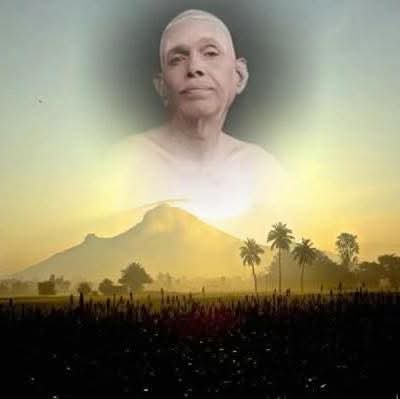
Bhagavan Sri Ramana Maharshi explains the nature of self-realisation, also known as sahaja samadhi, or ‘the natural state’. He explains that in the natural state of self knowledge, the body, mind, world and three states of waking, dream and deep sleep are not perceived by the liberated sage (jnani), but only the ignorant onlookers see the sage with an apparent body and a mind:
Ramana Maharshi: ‘So also a Jnani in sahaja samadhi is unaware of the happenings, waking, dream and deep sleep…In sahaja samadhi the activities, vital and mental, and the three states are destroyed, never to reappear.
‘However, others notice the Jnani active e.g., eating, talking, moving etc. He is not himself aware of these activities, whereas others are aware of his activities. They pertain to his body and not to his Real Self, swarupa.
‘For himself, he is like the sleeping passenger – or like a child interrupted from sound sleep and fed, being unaware of it. The child says the next day that he did not take milk at all and that he went to sleep without it. Even when reminded he cannot be convinced. So also in sahaja samadhi.’
~ Talks with Sri Ramana Maharshi, Talk 82
Aham Spurana book excerpt – for complete beginners, is meditation on an object easier than Self-Enquiry? Sri Ramana Maharshi
The following is a teaching excerpt from a large unedited manuscript, well over 1000 pages long, called ‘Aham Sphurana’. You can download the entire text here.
Aham Sphurana [‘I Shining’ or ‘I vibration’ or ‘I Am shining’ or ‘Shining of the I AM’] claims to contain a collection of previously unpublished talks with Sri Ramana Maharshi as apparently recorded by a visitor to Sri Ramana Ashrama, Sri Gajapathi Aiyyer, in 1936.
The authenticity of the teachings as being genuinely from Sri Ramana Maharshi cannot be confirmed, a fact acknowledged in the manuscript preamble itself, but I share these teachings here in case they are of interest to you.

5th July 1936
Questioner: Is it true that for complete beginners, meditation on an object is easier than attempting to practise vichara [Tom: self-enquiry]?
Sri Ramana Maharshi: Yes. As the aspirant gains one-pointedness (ekagrata) of mind, then he can commence with vichara.
Questioner: Should sadhakas [Tom: seekers] then be discouraged from taking up vichara whilst yet being neophytes?
Sri Ramana Maharshi: Leave each one to take up that method or path which appeals the most to him. All other methods, if persevered with long enough, eventually lead up to vichara only. Vichara begins to have significant effect after the aspirant is able to plainly distinguish between the inward-turned and outward-turned mind, and hastens to avoid the latter and inhere in the former as soon as he observes that his mind is wandering.
Questioner: How shall I get vairagya [Tom: dispassion, ie. turining away from objects or loss of interest in objects or objective phenomena]?
Sri Ramana Maharshi: A correct understanding of the actual nature of happiness will lead you to it. Now you seek happiness but think that happiness flows into you from the outside world, or that your mind absorbs happiness from the external, objective world. But what is the truth? Far from causing happiness, the appearance of manifestation is the cause for all our wretchedness. The pleasure that is got by interaction of the mind with objects of sensory perception also has the obverse side of pain. The desire for happiness is right but you have been deluded (by avidya maya) into imagining pain-associated and transient pleasures to be real happiness. Sensory perceptions yield short-lived pleasure which moreover causes pain in its wake. Pain and pleasure alternate with one another in the world. To ascertain the difference between fleeting, momentary, and pain-associated happinesses with the Supreme Happiness of the Self and confine oneself wisely to exclusively the latter is known as vairagya. Knowing that pursuit of sensory fascinations leads only to pain, why do you go in that direction? It is owing to the pull of the old habits of the mind. After these habits (vasanas) wear off, you will have abiding peace. The habits cannot suddenly be shaken off one day. They will go only by prolonged abhyasa [Tom: practice] and steady vairagya.
Questioner: What is the role of the Guru in making the mind steady?
Sri Ramana Maharshi: The Guru will only suggest that you surrender yourself unconditionally. He will not give you anything new which you have not got already.
Questioner: The mind is peaceful for a while, but after some time, again the old mischievous tendencies assume control over the mind and lead it astray. I don’t know what to do.
Sri Ramana Maharshi: By continuous practise you will succeed in retaining the mind in its source. The state of submergence of mind in its source is its natural state. If you want to regain the natural state, a tremendous fight is inevitable.
Questioner: What is the one thing which I should know properly so as to gain the upper hand in this fight?
Sri Ramana Maharshi: That you should never trust anything revealed into the field of your consciousness that may pull you away from the path leading into further and further introversion of mind.
Questioner: So visions are not necessarily a sign of spiritual progress?
Sri Ramana Maharshi: Do not be deceived by visions. Even if I appear before you, do not believe it. Only unintermittently attend to the task of keeping the mind incessantly submerged in the Heart. This is the only thing you need to do: Remain permanently submerged in the Heart.
Questioner: Guru’s Grace or God’s Grace is required for it. Please bless me with your Grace.
Sri Ramana Maharshi: Introversion of mind and Grace are the same thing. Why go searching outside for Grace? Is it not fruitless to do so? Is there anything outside you?
Questioner: So Grace is something I can win by my own efforts?
Sri Ramana Maharshi: Certainly. Grace is the same as the Self.
Questioner: I am not able to come here as often as I would like to. My work commitments prevent it.
Sri Ramana Maharshi: You regard the physical body as real and hence all your troubles. Whereas there are no limitations in the Self. Time and space are operative on the physical plane. Since we think that we are physical, we are enslaved by time and space. Realisation means not imagining that you are this and that, not thinking that you are conditioned by so-and-so circumstances. Are you in the world or is the world in you? In deep sleep did the world come and announce itself to you? Nevertheless, did you not exist in deep sleep? Are you different from the one that existed in deep sleep? Why then bother about time and space, which are merely concepts conjured up by the effervescent mind? Know that what you are in sleep is your true nature. That sleep continues even now; hold on to the state of sleepless sleep and see if these questions arise.
Questioner: How to sleep without sleeping?
Sri Ramana Maharshi: By always retaining the mind in its source and never allowing it to stray outwards. By practise, the state will gradually become spontaneous. That perfectly spontaneous state of continuous, volitionless and effortless thoughtlessness is the coveted state of sleepless sleep. That is the object of our efforts. It will come only by long practice.
Questioner: How to remind myself that I am not the body?
Sri Ramana Maharshi: Compare the present state with deep sleep. Were you with a body in sleep? Did you not exist all the same? The same ‘I’ which slept is now also present. Hold on to Him. The experience of bodilessness that was in deep sleep is also now. Even now you are bodiless. Only rein in the malefic force that asserts contrariwise: thought.
Questioner: How shall I get nirvikalpa samadhi?
Sri Ramana Maharshi: What is nirvikalpa samadhi? It is to remain permanently submerged in the Heart. In sleep, swoon, death and so on we merge into the Heart unconsciously. In samadhi we merge into the Heart consciously. Why remain apart from the source? Who is that one who wishes to remain apart from his source? Is his existence not mere pretension? The idea of your existence as an individual being is called moola avarana [Tom: root veiling, ie. root ignorance]. The idea is false, because as soon as he is steadily called upon to investigate himself and announce his existence the ego flies away. Then only Reality is left. This process is known as Realising the Self. But there is nothing to be newly gained. The one who dissipates the clouds does not create sky.
Q. Is it your view that Nirvikalpa Samadhi leads to Liberation? | Advaita Vedanta | The 108 Upanishads PDF Download
See below for the link to download the 108 Upanishads as a PDF file
Tom: note this is not my view, but the view of Vedanta, ie. the Upanishads, also known as Shruti. The Upanishads and Jnanis state this again and again in various ways. The highest authority in the Vedanta teachings are the Upanishads. In fact, strictly speaking, ‘Vedanta’ simply refers to the teachings found in the Upanishads. If we actually read the Upanishads for ourselves – there are 108* classical Upanishads – we will see this same teaching being given again and again.
eg.
The knot of ignorance in the heart is broken completely only when one sees his Self as secondless through Nirvikalpa Samadhi
~ Adhyatma Upanishad 1.17
Hasn’t Guru Bhagavan Sri Ramana Maharshi told us that all paths must end in Silence, also known as Nirvikalpa Samadhi, also known as Jnana, which is nothing other than the Pure Objectless Self!
However, to answer your question directly, it is also my own view. My views on this remain unchanged – what made you think otherwise?**
Namaste and Pranams 🙏
*There are classically 108 Upanishads, all of which are considered to be authoritative in Vedanta teachings. However 10-12 of the Upanishads have more recently been designated ‘Major Upanishads’ as these are the ones that Sri Shankara wrote commentaries upon, and the remaining 96-98 Upanishads are often referred to as ‘Minor Upanishads’. However strictly speaking the so-called Minor Upanishads are no less important than the so-called major ones, and traditionally many think the Minor Upanishads are for the more advanced students of Vedanta. Often the ‘Minor’ Upanishads teach a very clear and direct approach to Vedanta, so perhaps Shankara just commented on those Upanishads that were less easy to understand? Either way, read them for yourself if you get the chance. You can find them here:
**This reply was given to someone who thought my views on this matter had changed
The need for nirvikalpa samadhi according to Advaita Vedanta – Swami Advayananda | Swami Chinmayananada
Here Swami Advayananda of the Chinmaya International Foundation explains the need for Nirvikalpa Samadhi according to Advaita Vedanta and how to overcome the obstacles to it:
 Tom Das