nonduality
Nonduality: the key to ending suffering
Where can enlightenment be found?

Healing addictions and finding peace/ coming into contact with reality
Advaita vedanta scholars and false teachers
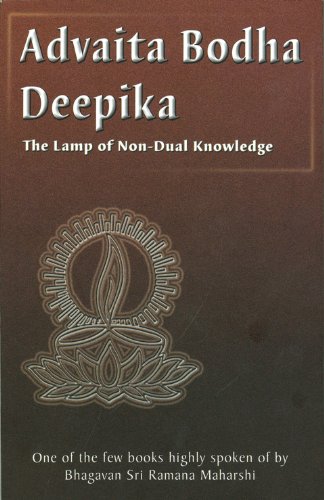
The following taken from a traditional vedanta text called Advaita Bodha Deepika (The Lamp of Nondual Knowledge). This text was one of Ramana Maharshi’s favourites and was often recommended by him. This is taken from Chapter 3 which is entitled ‘Sadhana’, or Spiritual Practice, and the bold has been added by myself for emphasis:
Verses 50-51:
Disciple: How is it that even scholars in Vedanta have not succeeded in the pursuit of enquiry?
Master: Though they always study Vedanta and give lessons to others yet in the absence of desirelessness they do not practise what they have learnt.
D.: And what do they do otherwise?
M.: Like a parrot they reproduce the Vedantic jargon but do not put the teachings into practice.
D.: What does Vedanta teach?
M.: The Vedanta teaches a man to know that all but the non-dual Brahman is laden with misery, therefore to leave off all desires for enjoyment, to be free from love or hate, thoroughly to cut the knot of the ego appearing as `I’, you, he, this, that, mine and yours, to rid himself of the notion of `I’ and `mine’, to live unconcerned with the pairs of opposites as heat and cold, pain and pleasure, etc., to remain fixed in the perfect knowledge of the equality of all and making no distinction of any kind, never to be aware of anything but Brahman, and always to be experiencing the Bliss of the nondual Self.
Though Vedanta is read and well understood, if dispassion is not practised, the desire for pleasures will not fade away. There is no dislike for pleasing things and the desire for them cannot leave the person. Because desire is not checked, love, anger, etc., the ego or the `false-I’ in the obnoxious body, the sense of possession represented by `I’ or `mine’ of things agreeable to the body, the pairs of opposites like pleasure and pain, and false values, will not disappear.
However well read one may be, unless the teachings are put into practice, one is not really learned. Only like a parrot the man will be repeating that Brahman alone is real and all else is false.
D.: Why should he be so?
M.: The knowers say that like a dog delighting in offal, this man also delights in external pleasures. Though always busy with Vedanta, reading and teaching it, he is no better than a mean dog.
What will never let you down?
Everyone and everything will eventually let you down. Make no mistake about this – it’s just a matter of time. Be sure to understand this.
This is not pessimism but reality. You can then enter into life knowlingly. We can enter into love and engage with life out of understanding rather than ignorance.
Know that everything will eventually let you down. You cannot rely on anyone or anything to give you lasting happiness, so dont expect that from people or things. Anything else leads to suffering.
The only exception is the ever-present Self, which of course is no particular object, yet is non-separate from everything. It is all there is. It is the essence of who you are. It is you.
And luckily its nature is sat-chit-ananda.
Therefore take refuge only in the Self.

What does ‘there is no person’ actually mean? (The doer-perceiver split)
Roger Castillo and Tom Das: a Joint Satsang 2018
Please join us for Satsang this week:
A Joint Satsang with Roger Castillo and Tom Das
Thursday 16th August, 7pm
The Druids’s Head Pub, Kingston Upon Thames, UK
For more details see link below. Please RSVP if you would like to attend so we can get an idea of numbers:
https://www.meetup.com/Non-duality-Kingston-London/events/brwqlpyxlbvb/
Ramana Maharshi: How to bring spiritual practice (sadhana) into daily life

Many people find it difficult to engage in spiritual practices (sadhanas) during the ups and downs of daily life. In the following dialogue recounted by Devaraja Mudaliar, a questioner asks Ramana Maharshi 5 questions related to this:
Mr. Joshi put five questions. I give below the questions and Sri Bhagavan’s answers:
Question 1: Should I go on asking ‘who am I?’ without answering? Who asks whom? Which bhavana (attitude) should be in the mind at the time of inquiry? What is ‘I’, the Self or the ego?
Answer: In the inquiry Who am I? ‘I’ is the ego. The question really means, ‘what is the source or origin of this ego?’ You need not have any bhavana in the mind. All that is required is, you must give up any bhavana that you are the body, of such and such description, with such and such a name, etc., There is no need to have a bhavana about your real nature. It exists as it always does. It is real and no bhavana.
Question 2: I cannot be always engaged in this inquiry, for I have got other work to do, and when I do such work, I forget this quest.
Answer: When you do other work, do you cease to exist? You always exist. Do you not?
Question 3: Without the sense of doership, – the sense ‘I am of doing’ – work cannot be done.
Answer: It can be done. Work without attachment. Work will go on even better than when you worked with the sense that you were the doer.
Question 4: I don’t understand what work I should do and what not.
Answer: Don’t bother. What is destined as work to be done by you in this life, will be done by you, whether you like it or not.
Question 5: Why should I try to realize? I will emerge from this state, as I wake up from a dream. We do not make an attempt to get out of a dream during sleep.
Answer: In a dream, you have no inkling that it is a dream and so you don’t have the duty of trying to get out of it by your own effort. But in this life, you have some intuition, by your sleep experience, by reading and hearing, that this life is something like a dream, and hence the duty is cast on you to make an effort and get out of it. However, who wants you realize the Self if you don’t want it? If you prefer to be in the dream, stay as you are.
With reference to question 4, Mrs. P.C. Desai quoting the Bhagavad Gita asked Bhagavan: If (as Arjuna was told) there is a certain work destined to be done by each and we shall eventually do it however much we do not wish to do it or refuse to do it, is there any freewill?
Bhagavan said: ‘It is true that the work meant to be done by us will be done by us. But it is open to us to be free from the joys and pains, pleasant and unpleasant consequences of the work, not identifying ourselves with the body or that which does the work. If you realize your true nature, and know that it is not you, that does any work, you will be unaffected by the consequences of whatever work the body may be engaged in according to destiny or past karma or divine plan, however you may call it. You are always free and there is no limitation of that freedom.’
(The above excerpt is from Day by Day with Bhagavan, pages 88-90)
Tom’s Comments:
Here we can distil several key points:
1. You always exist, regardless of whether you are thinking about it or not, regardless of what you are doing.
2. The issue is that you take yourself to be the body-mind and therefore you take yourself to be a doer who has to choose what actions to do and suffer the consequences thereof. Instead relinquish the idea that you are the body-mind, and don’t take yourself to be the doer of any actions or receiver of pleasure/pain. You do not need to cultivate a specific bhavana (attitude or feeling).
3. When you don’t take yourself to be the body-mind-doer-receiver, life still continues and the body-mind appearance still is able to fulfil its responsibilities – in fact it becomes more efficient in doing so.
4. Whatever is destined to happen will happen regardless of your desires about this.
5. Effort must be made to cast off the ignorance ‘I am the body-mind-doer-receiver’. However there is no obligation for you to do this. If you wish to remain in ignorance, in the dream in which you believe yourself to be a separate body-mind, that is fine.
6. You are, in truth, always ever free. You are the Self. Know this and remain naturally unaffected by the life-appearance. In this way sadhana (spiritual practice) is in no way opposed to daily life.
 Tom Das