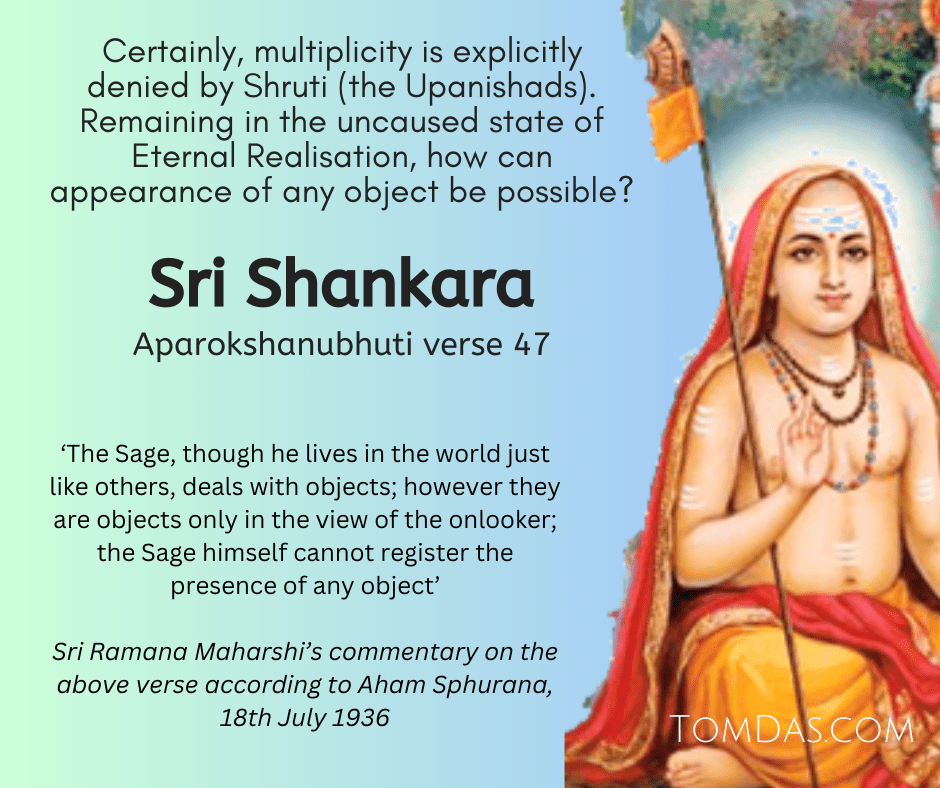
SRUTI (THE UPANISHADS) DENY THE EXISTENCE OF EVEN A TRACE OF MULTIPLICITY | Aparokshanubhuti | Swami Chinmayananda


Swami Chinmayananda writes the following:

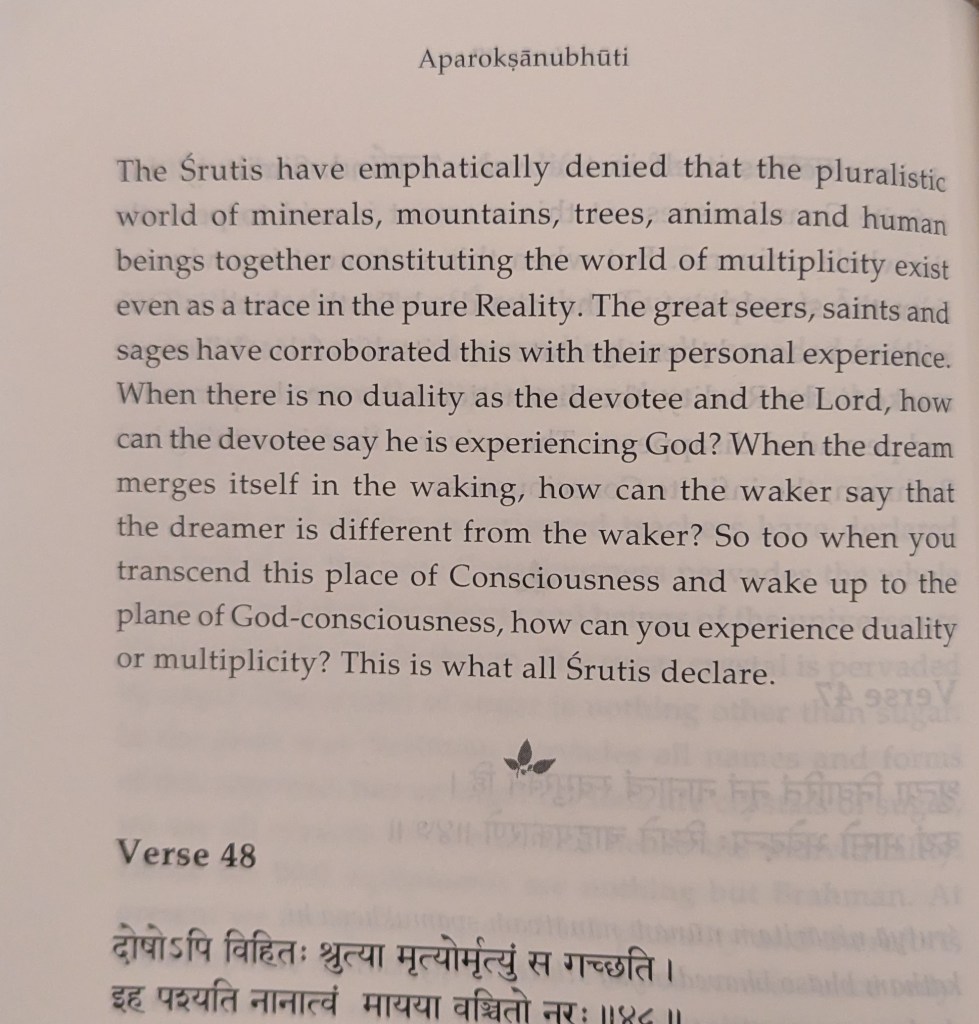
The Śrutis have emphatically denied that the pluralistic world of minerals, mountains, trees, animals and human beings together constituting the world of multiplicity* exist even as a trace in the pure Reality.

The great seers, saints and sages have corroborated this with their personal experience. When there is no duality as the devotee and the Lord, how can the devotee say he is experiencing God?

When the dream merges [Tom: ie. dissolves and disappears] itself in the waking, how can the waker say that the dreamer is different from the waker?

So too when you transcend this place of Consciousness and wake up to the plane of God-consciousness, how can you experience duality or multiplicity? This is what all Śrutis declare.

~ Swami Chinmayananda, commentary on Aparoksanubhuti (a text by Shankara), verse 47

*Swamiji defines plurality and multiplicity as being the world of objects, such as minerals mountains trees animals and human beings. He states that not even a trace of these exist in the reality. He is following the definition of multiplicity given by the Upanishads and by Shankara when he writes this, both of whom are unequivocal that this world of multiplicity and plurality refers to the appearance of objects such as mountains trees etc, and these only appear to exist due to ignorance, and cease to appear to exist once ignorance has been removed.

When Swamiji explains that ‘not a trace’ of multiplicity exists in the reality, meaning in self-realization, when only reality is there, nothing else, no ignorance, he is also copying the language of Shankara and the Upanishads who also say ‘not a trace’ of multiplicity exists in self-realisation.

Multiplicity, plurality and polarity ARE duality | Non-duality | Sri Ramana Maharshi

Seeing multiplicity/plurality and seeing the underlying oneness within the plurality or multiplicity is not the real non-duality at all.

This false notion of non-duality, which is very commonplace, is actually an ego-preservation strategy where the notion of the ‘false-I’ is subtly continued, and suffering still continues in this state – seeking still continues too, as does a subtle sense of individuality.

Non-duality is that in which there is no duality/multiplicity/plurality/individuality whatsoever. Only then will seeking end. Only then will suffering end. Until this is discovered, seeking will continue, and with it the suffering and sense of individuality (ie. duality) will too. To discover the true non-duality one must turn within and discover the Self for oneself, which is indivisible Oneness-Love-Being-Bliss.

At least this is my experience.

This is why Bhagavan Sri Ramana Maharshi states in Guru Vachaka Kovai verse 931:

  1. “The mukta [liberated sage] like the rest of us perceives
    The world in all its vast variety
    And yet he sees non-difference in it”,
    So people say. This is not true.

Sri Sadhu Om comments upon the above verse as follows:
‘People have many wrong conceptions about the state of a Jnani or Jivanmukta, and one such misconception is refuted here. “What people see as water, the Jivanmukta also sees as water, and what they see as food, He also sees as food. Therefore, in His experience of sense-objects, the Jivanmukta is the same as other people. But even while the Jivanmukta thus sees these differences, He sees the non-difference in them” – are there not many pandits and lecturers who talk and write thus, even though they themselves have no experience of Advaita but have only read about it in books? But who is the proper authority to say what is the actual experience of a Jivanmukta? Only a real Jivanmukta! Thus Bhagavan Sri Ramana, who has actually experienced the reality and who is the true Loka Maha Guru, declares in this verse that such statements are wrong, and in the next verse He explains how and why they are wrong.’

In his commentary to the next verse Sri Sadhu Om continues, relating to us his own direct hearing of Sri Ramana’s teaching:
‘…Regarding this erroneous theory of bheda-abheda or unity in diversity, Sri Bhagavan used to say that if the least difference or diversity is perceived, it means that the ego or individuality is there, so if difference is experienced, non-difference or unity would merely be a theoretical proposition and not an actual experience.’