ramana maharshi
How to Surrender in daily everyday life | Sri Ramana Maharshi
The path of the Brave and Fearful | Sri Ramana Paravidyopanishad | Guru Vachaka Kovai |
Thank you for those who attended Satsang with me yesterday. It was wonderful to be with you all 🙏 Here is a video from the meeting:
Here are some the verses that I mentioned during the Satsang that I wasn’t able to fully remember and quote verbatim at the time, plus a few extra verses at the end (the last 3 verses):
Sri Ramana Paravidyopanishad, verses 211 & 212:
211. Only two paths are laid down for the aspirant to deliverance: for the valiant, the quest of one’s own Self, and for the fearful, self-surrender to God. In these two all the paths are included.
[Commentary by Lakshmana Sarma: A great many paths are known and followed, but all come under these two. The valiant one has been already described. The other is the one who is afraid of samsara, but is unable to take to the quest taught by Bhagavan as being the direct path. On this direct path all preconceived notions are dropped, as will be seen later. Self-surrender is the final step in the practice of devotion to God, which is the only other alternative to the direct path.]
212. This two-fold path has been taught by the most holy one, Ramana, thus: ‘Either seek the root of the ego-sense [the ‘I’ that rises within the body] or surrender that ego-sense to God to have it destroyed [by His grace].’
Verses from Guru Vachaka Kovai:
745.
To say that someone practising
Sustained enquiry for the Self, the God
Who is all Awareness, suffered from
Mental derangement, would be like
Saying that some poor fellow died,
Alas, by drinking nectar.
354.
Don’t ask in fear and doubt, “What, what
Will happen if I once for all
Give up this separate self of mine?”
Whoso lets go the bough he clings to
Lands safe on solid earth. You are bound
To reach the real Self.
394.
Forgetfulness of Self is real death.
To overcome the fear of body’s death
We needs must constantly remember
The Self. For self-enquiry then,
There is no fixed rule of time or place.
834.
Courageous ones who know no fear
Find and renounce the world as worthless,
And so gain wisdom true. Others
Are foolish folk by falsehood blinded.
174.
In meditation deep, while yet
A trace of ego lingers, fear
And trembling may sometimes occur.
But when the ego dies at last
In Pure Awareness, quaking stops.
Stillness alone prevails.
Give everything to God. What remains is what you ARE
Give everything to God. We give everything to God and what’s left is what we are. What remains is love, love in your heart. The tranquility that feels whole that feels right, it feels gentle, it feels right. Feels like home, that’s what we are looking for.
This video was recorded live during a Satsang meeting with Tom Das.
Q. Why does traditional Advaita Vedanta reject Ramana Maharshi’s Self Enquiry as a method to attain liberation
Question. Why do the traditional Advaita-Vedanta schools based solely on the Upanishads and Vedanta scriptures, etc, reject Ramana’s Self-Enquiry approach as a method to attain liberation?
Tom: I do not think this is true. Ramana’s teachings are the same as those found in the Upanishads and Vedanta Scriptures & Ramana teaches us the true Vedanta in my opinion.
However, there are several teachings that claim to teach Vedanta in a traditional way but do not really go beyond the mind or beyond duality, and so suffering and ignorance does not end. Their teachings distort the scriptures in my view. My advice therefore is to stick to Sri Ramana’s teachings. However, what teachings you prefer is of course for you to decide.
Namaste
Tom
Why faith IS required for liberation | Advaita Vedanta
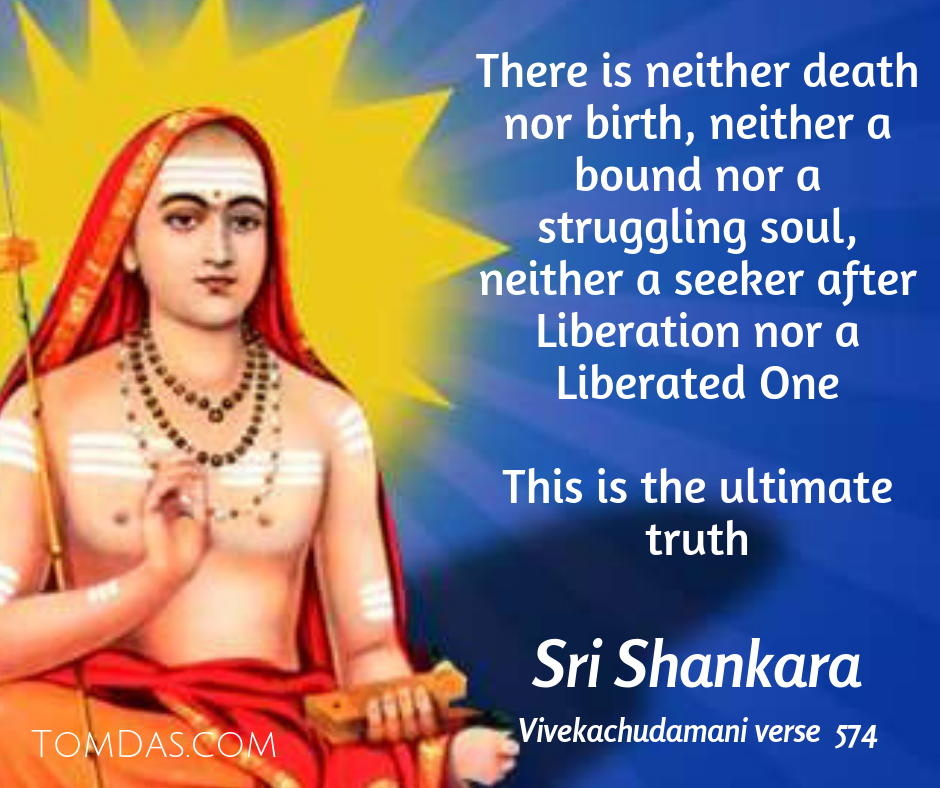
I have heard some Advaita Vedanta teachers say that there is no need for faith in Vedanta. However, what do the Advaita scriptures say? Is faith simply blind belief? Is faith based on logic and conceptual knowledge? Or is faith something else?
Here we shall look at some selected quotes from Shankara and the Bhagavad Gita below which state both the importance and necessity of faith on the Path to Liberation, and explore why this is the case.
WHY IS FAITH IMPORTANT?
Why is faith important? Simply put, because without sufficient faith one will not have the dedication, love and perseverance to continue with self-enquiry (vichara), until liberation is attained. And Self-Enquiry, as taught by the Upanishads, by Shankara and by Sri Ramana Maharshi, is the only practice that ultimately leads to Moksha.
SOME TEACHERS SAY FAITH IS NOT REQUIRED
There are some teachers that say faith is not required for Vedanta as one can discover this all for oneself like a scientist can discover the various laws of nature.
Whilst this truth needs to be discovered for oneself and realised for oneself, I have noticed these teachings that push out the need for faith tend to be the teachings that predominately stay on the level of the mind. They tend to teach that prolonged meditation on the Self/Self-Enquiry is not required for liberation, and that essentially one can come to liberation through qualities such as having a keen intellect combined with exploring the nature of our present experience only.
This being the case, these teachings alone do not lead to the end of individuality, duality and suffering – ie. they do not actually lead to Moksha (liberation) at all, and the ego-separation remains.

‘FAITH PENDING RESULTS’?
Some say that Shraddha, the Sankrit word for faith, does not refer to blind faith or mere belief, but to a ‘faith pending results’, similar to the ‘faith’ required for a science student to follow a scientific experiment in order to discover the truth it yields.
Whilst there is some truth in this, it is not the whole truth, and also note that the scriptures do not define faith in this way (see the quotes section below). It is true that faith, as spoken of in the Advaita scriptures, is not the end goal in itself, meaning one doesn’t simply believe in God or in a dogma or creed of some kind and leave it at that, which would be rather superficial and on the level of the intellect predominantly. Rather faith is a ferry to take us to the shore of liberation, and this liberation is the goal, and this goal of liberation or God must be ‘experienced’ or ‘realised’ or ‘known’ for oneself, for want of a better phrase.
However, the faith spoken of in the Vedanta scriptures is much deeper than what has been described above. It is not just a mere willingness to try something until you see the results, like a scientist, or even a simple trust that the teachings will show you the way, but something that throbs in our very core, a deep conviction, in our very heart, in our Being. It is a deep resonance, a magnetic pull, intertwined with an intuitive knowing.
This faith cannot be taught, but is something that at some point in our journey springs into our very Being and takes us Home to Liberation. Perhaps it comes to us having listened to and studied the Advaita (or similar) teachings for some time, or perhaps faith dawns after having experienced the various ups and downs of life, or perhaps it comes to us unasked for, as Divine a Gift from God, a Gift of His Grace.
This true faith is inextricably linked with Bhakti, or devotional love of the Divine, which culminates in love to be with Self as Self, otherwise known as Self-Enquiry or Dhyana (meditation).
For me this Faith arose through the Presence and Teachings of Sri Ramana Maharshi, and for that I am forever grateful. His Presence and His Teachings unfailingly guide Homeward those who have come under His Spell and Grace. He is the Lord, He is the very Self, he resides within your very Heart – turn inwards and dis-cover (ie. uncover and reveal) your identity with Him.
QUOTES FROM THE VEDANTA SCRIPTURES
Let us see what kind of person, according to Vedanta, attains Jnana, or ‘divine knowledge’, otherwise known as liberation:
Bhagavan Lord Krishna states in the Gita Chapter 4, verse 39: ‘Those whose faith is deep and who have practiced controlling their mind and senses attain divine knowledge.’
But what if this faith is not present?
Lord Krishna also states in the Gita in the next verse, chapter 4, verse 40: ‘But persons who possess neither faith nor knowledge, and who are of a doubting nature, suffer a downfall. For the skeptical souls, there is no happiness either in this world or the next.’
In Chapter 5, Krishna further states in verse 17: ‘Those whose intellect is fixed in God, who are wholly absorbed in God, with firm faith in Him as the supreme goal, such persons quickly reach the state from which there is no return, their sins having been dispelled by the light of knowledge.’
What is the definition of faith?
Shankara defines faith and states it is necessary for realisation in Vivekachudamani: ‘Acceptance by firm judgment as true of what the Scriptures and the Guru instruct, is called by sages Shraddha or faith, by means of which the Reality is perceived‘
Shankara also writes in Aparokshanubhuti that Shraddha is required for liberation and defines Shraddha as follows: ‘Implicit faith in the words of the Vedas and the teachers (who interpret them) is known as Shraddha‘
Lets leave the last quote of this post to Bhagavan Sri Krishna, this time from the last verse of Chapter 6 of the Bhagavad Gita where he states: ‘Of all yogis, those whose minds are always absorbed in me, and who engage in devotion to me with great faith, them I consider to be the highest of all.’
Q. I read your articles about Tony Parsons and Rupert Spira and I was wondering how you feel about the teachings of Byron Katie?
Question: Dear Tom, how are you? I read your articles about Tony Parsons and Rupert Spira and I was wondering how you feel about the teachings of Byron Katie. Do you think with her saying ‘loving what is’, that she actually means devotion to the Self? Could this be the same? ‘Loving what is’ is like a surrender to what is, just like Bhakti devotion right? 

Is loving what is, kind of the same thing as giving it to God? The same surrender? I ask this question because I hope the the teachings of Byron Katie can help, but Sri Ramana is the one for me and I think I just want the teachings to be the same 

Tom: Hi _____, I’m well thanks. To answer your question, please note that most teachings that you are drawn/attracted to, as long as they are not unethical, are probably good teachings for you. There are many wonderful and varied teachings that can help us in a variety of ways. There are many ways of reducing ignorance and thinning the ego, and this will lead to less suffering and more happiness, relatively speaking. So any teaching that you are drawn to is probably right for you for now.
That said, there only very few teachings are ultimately liberating, that is, only very few teachings direct us to actually truly ending the ego and so ending duality and suffering completely by tackling the root issue.
These teachings of ‘ultimate liberation’ urge us, in essence, to turn away from objects towards the subject, and abide as the Self, as this is the only doorway to removing ignorance completely and thus end suffering, whereas all other teachings that do not advise this in some way or other perpetuate the ego and the suffering therefore continues. Here is an article on why other teachings are not ultimately liberating.
Not everyone’s ego-mind is able to accept this ‘ultimate teaching’ initially, due to attachment to worldly things and the body-mind, so often there is a process by which we gradually let go of worldly things and the body-mind until the ego-mind is ripe enough to be open to and fall in love with this True Teaching. Until then we will, generally speaking, be more attracted to other more-worldly type teachings that direct our attention to various gross and subtle objects.
Ramana Maharshi wrote down the basic sequential teachings that most go through in his text Upadesa Saram. Here is an article of mine that outlines the method to attain liberation in brief and also goes through several common objections to this teaching, as well as citing various ‘spiritual authorities’ in support of the teaching.
If you haven’t already, I also recommend you read The Path of Sri Ramana as it clearly explains both what the True Teachings are and what they are not in clear and simple language.
I hope this answer is helpful for you.
Namaste
Tom
Remove Nama-Rupa (Name & Form) to reveal Sat-Chit-Ananda (the Self)

Here we will see how a clear teaching is given and then distorted by the mind, only for Bhagavan Sri Ramana to make clear the essential teaching again in order to keep us on the clear and direct path. The following passage is taken from Day by Day with Bhagavan, page 193, recounting events from 10th April 1946:
Dr. Masalavala gave Bhagavan a letter addressed to him by a friend of his. Bhagavan perused it. Some portions of it were not cogent. With other portions there could be no quarrel.
The letter said that all is contained in asti (sat), bhati (chit), priya (ananda), nam and rup, that the first three constitute reality, and the rest the fleeting and unreal; that jnana consists in seeing only the reality and not the nam-rup, that the first three constitute aham and the next two constitute idam (this).
Tom: we can see here the teaching of ‘nama, rupa, sat, chit, ananda’. ‘Nama’ means name, ‘rupa’ means form, ‘sat’ means being or reality or truth, ‘chit’ means consciousness or knowingness and ‘ananda’ means happiness or bliss. Note that here the word ‘priya’ (which means beloved) is used instead of the more commonly used ‘ananda’,
The first two of these, nama-rupa (name and form) constitute the entire observable world of objects, including trees, cars, people, buildings (ie. gross objects), but also subtle objects such as thoughts, feelings, emotions, spiritual experiences, dreams, visions, etc, etc. These objects, gross and subtle, come and go, and together can be considered to be Maya (illusion).
The latter three, sat-chit-ananda, refers to the Self, the Unchanging Ever-Present Reality, the Pure Consciousness that you are. The text clearly states that Jnana (knowledge, ie. spiritual knowledge or liberation) consists of seeing only Reality and not nama-rupa, ie to remove objects and abide only as Self.
In the next line Ramana agrees that sat-chit-ananda refers to ‘aham’, aham meaning ‘I’, as the true ‘I’ is the Self, and nama-rupa refers to ‘idam’, idam meaning ‘this’, referring to all perceived phenomena, ie. all objects, gross or subtle:
Bhagavan agreed and said, “‘I’ and ‘this’ between them exhaust everything.” The letter also said that seeing Brahman alone in everything and everywhere is jnanottara bhakti. With reference to this, Bhagavan said, “This is a matter of mere words, whether you call the stage of seeing only Brahman, jnanottara bhakti or bhakti-uttara jnana.
Tom: Jnanottara bhakti means ‘Bhakti (love), which is higher than Jnana (knowledge)’. This term is often used by schools of vedanta that prefer Bhakti and state that Bhakti is superior to Jnana (knowledge). Bhakti-uttara Jnana means the opposite, namely ‘Jnana which is higher than Bhakti’. Ramana here makes it clear that this is all just linguistic juggling, implying that there is no need to quibble about which is higher, Jnana or Bhakti. In fact they are, ultimately, one and the same.
In reality, saying ‘We must see Brahman in everything and everywhere’ is also not quite correct. Only that stage is final, where there is no seeing, where there is no time or space. There will be no seer, seeing and an object to see. What exists then is only the infinite eye.”

Tom: many teachers state that we should see everything as Brahman and Brahman in everything, and this is true Jnana or Liberation. Here Sri Ramana corrects this mistaken view, stating that we must eventually go beyond this too and renounce name and form in order to discover and abide as the pure Self, devoid of objects, devoid even of notions or perception of time and space. That is which there are no triads of object, subject or seeing. In that ‘place’, there is only the Self and no objective universe whatsoever. Nama and Rupa are completely removed, as per the original teaching stated above.
This is where our sadhana should take us!
We should not get off the sadhana train at an earlier stop thinking we have reached the destination!
In Who Am I? Ramana is asked the following:
Question: How long should inquiry be practised?
Sri Ramana: As long as there are impressions of objects in the mind, so long the inquiry ‘Who am I?’ is required
Let us give thanks to Sri Ramana’s teachings that point out the direct path and encourage us not to leave the sadhana early and remain caught and bound in Maya’s clutches!
To learn more about this path please see:
The entire path explained: the Path of Sri Ramana
I also explain this is more detail in this video – many have said this video helped them understand the teachings in a deeper way – so please have a listen:
The Shining of My Lord – Quotes explaining the Essential Spiritual Practice
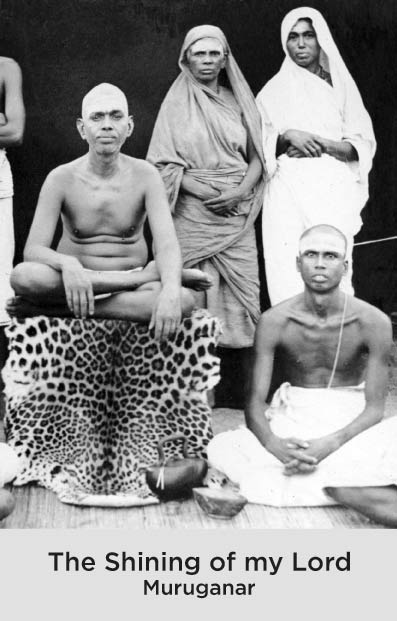
The following quotes, taken from the publication ‘The Shining of my Lord’ by Sri Muruganar, clearly and concisely explain the direct path to Self-Realisation.
In this context, the words ‘sadhana‘ and ‘tapas‘ both essentially mean spiritual practice.
‘Swarupa‘ means your own true nature, referring to the Self, the Ultimate Reality that you ARE.
The word ‘pure’ in the phrase ‘pure consciousness’ refers to consciousness devoid of any objects or arising phenomena, a reference again to the Self, your Swarupa.
I recommend you listen to this video in which the following quotes are read aloud for you, as this can often result in the same teachings being heard in a different and more powerful way:
502. The sadhana is to withdraw the mind from the sense objects of the world, which arise through the ignorance of taking the body to be ‘I’, and fix it in the feet of the Lord’s grace, pure consciousness. For those who are fully convinced of the efficacy of this sadhana, and who are able to practise it, there will be no need to abandon it to perform any other great tapas
503. Until everything shines wholly as swarupa, eschew all [perceived phenomena] as your enemies.
508. Those who abide as pure consciousness will experience the truth, the Self that exists as their own intimately close associate, but if the mind is allowed to move about among the senses through the pathways of the five senses, life will become shameful, losing its beauty.
509. If consciousness leaves the heart and manifests outwardly, it will experience perplexity through the false and deceitful sense objects. If it becomes extremely clear and remains firmly settled in consciousness-the-supreme, pure grace, and then merges with it, life will become blissful.
516. The ego deserves to be stigmatised whereas the Self alone deserves to be worshipped and saluted. Save and protect yourself completely from the treacherous maya, whose form is the ego, by the daily practice of abidance in the pure Self in order that the abidance may become firm and habitual.
492. For those who keenly desire as their principal priority a merger with the beauty of grace, the swarupa that abides in the heart as pure consciousness, it is not even slightly acceptable to have any connection with objects enjoyed by the senses, which are concepts of the fake entity, the deluding consciousness.
417. If we perform sadhana to the limit of our abilities, the Lord will accomplish for us that which is beyond our capabilities. If we fail to do even that which is within our capabilities, there is not the slightest fault in the grace of the Lord.
423. Devotion exists in many different forms, varying according to the quality of the devotee’s mind. However, only devotion to grace, the swarupa that shines as pure consciousness, enables one to reach directly the unsurpassed state of the supreme.
Do we need to turn away from the world of objects to realise the Self? | The need to turn within according to Advaita Vedanta | Sri Ramana Maharshi | Upanishads | Shankara | Gaudapada

Also see:
Ramana Maharshi: how to abide as the Self
Shankara: How to Meditate for Self-Realisation
Shankara: How to realise the Self (Brihadaranyaka Upanishad Commentary)
The entire path explained: the Path of Sri Ramana
Turn Within? Really? Isn’t this dualistic and doesn’t this just strengthen the ego?
Here is what the Vedanta scriptures, such as the Upanishads and the writings of Sri Shankara and Sri Gaudapada say, together with quotes from Sri Ramana Maharshi:
The Lord created the senses out-going: therefore, one sees outside and not the Self within. Some intelligent man, with his senses turned away (from their objects), desirous of immortality, sees the Self within.
~ Katha Upanishad 2.1.1
In his commentary on this above verse (Katha Upanishad 2.1.1), Shankara writes:
‘…the perceiver sees the external objects which are not-Self/not the Atman, such as sound, etc., and not the Self within. Though this is the nature of the world, some (rare) discerning man, like turning back/ reversing the current of a river, sees the Self within…The group of sense organs, beginning with the ear, should be turned away from all sense-objects. Such a one, who is purified thus, sees the indwelling self. For it is not possible for the same person to be engaged in the thought of sense-objects and to have the vision of the Self as well.‘
Dwelling on external objects will only increase evil propensities, so wisely recognising this fact, one should abandon external objects and and constantly attend to one’s true nature within, the Atman [the Self].
~ Shankara, Vivekachudamani
(Note, there are so many quotes from Shankara’s Vivekachudamani which advocate turning within/away from objects that they would ovewhelm this post, but you can find some of these quotes compiled together here in a separate post.)
The knot of the ignorance in the heart is broken completely only when one sees his Self as secondless through Nirvikalpa Samadhi
~Adhyatama Upanishad 1.17
By expelling (from the mind) without any remainder all objects which are superimposed on one’s Atma, one becomes himself Parabrahman the full, the secondless and the actionless
~Adhyatma Upanishad 1.21
Turiya is not that which is conscious of the inner (subjective) world, nor that which is conscious of the outer (objective) world, nor that which is conscious of both…It is the cessation of all phenomena…This is what is known as the Fourth (Turiya). This is Atman and this has to be realised. ~Mandukya Upanishad
In Shankara’s commentary on the Mandukya Upanishad, in his introduction to the text he writes:
Just as the normal state of a man, afflicted by disease, consists in his getting cured of the disease, similarly the normalcy of the Self, stricken with identification with misery, is regained through the cessation of the phenomenal universe of duality…since the phenomenal world of duality is a creation of ignorance, it can be eradicated through knowledge…
In his commentary on Katha Upanishad verse 1.2.20 Sri Shankara writes:
‘…One whose intellect has been withdrawn from all objects, gross and subtle, when this takes place, this is known as ‘inactivity of the sense organs’. Though this ‘inactivity of the sense organs’ one sees that glory of the Self. ‘Sees’ means he directly realises the Self as ‘I am the Self’ as thereby becomes free from suffering’
When the mind…remains unshakable and does not give rise to appearances, it verily becomes Brahman.
~ Gaudapada, Mandukya Upanishad Karika
When the mind, after realizing the knowledge that Atman alone is real, becomes free from imaginations and therefore does not cognize anything, for want of objects to be cognized, it ceases to be the mind.
~ Gaudapada, Mandukya Upanishad Karika
The mind severed from all connection with sensual objects, and prevented from functioning out, awakes into the light of the heart, and finds the highest condition. The mind should be prevented from functioning, until it dissolves itself in the heart. This is Jnana, this is Dhyana, the rest is all mere concoction of untruth.
~ Amritabindu Upanishad
As long as the objective universe is perceived one does not realise the Self.
~ Yoga Vasishta
The Self (Atman) is beyond all expression by words beyond all acts of mind; It is absolutely peaceful, it is eternal effulgence free from activity and fear and it is attainable by Samadhi
~ Gaudapada, Mandukya Upanishad Karika 3.37
Shankara’s commentary from the above verse from Gaudapada 3.37 states:
…The Self (Atman) is denoted by the word Samadhi as it can be realised only by the knowledge arising out of the deepest concentration (on its essence), Samadhi. Or the Self (Atman) is denoted by Samadhi because it is the object of concentration, the Jiva concentrates his mind on the Self (Atman)…
In the next verse Gaudapada writes in verse 3.38 of his Mandukya Karika:
There can be no acceptance or rejection where all mentation stops. Then knowledge is established in the Self and is unborn, and it becomes homogenous
Shankara’s commentary on this verse 3.38 is as follows:
…therefore there is no rejection or acceptance in It, where thought does not exist. That is to say, how can there be rejection or acceptance where no mentation is possible in the absence of the mind? As soon as there comes the realisation of the Truth that is the Self, then, in the absence of any object, knowledge (Jnanam) is established in the Self, like the heat of fire in fire. It is then birthless (ajati) and becomes homogenous.
In his commentary on the Katha Upanishad, verse 2.1.2, Shankara writes:
‘The natural tendency to see external objects, which are not-Self, is the cause of ignorance, the obstacle to the realisation of the Self. The desire of external/outward enjoyments pertaining to this world and the next, which are presented by ignorance, is another obstacle. The realisation of the Self being impeded by these two, ignorance and desire, men with little intelligence pursue only external objects of desire….This being so, the intelligent, knowing the certain immortality of concentration in the inner Self…
When the five organs of perception become still, together with the mind, and the intellect ceases to be active: that is called the Supreme State [Brahma-Vidya or Self Knowledge]
~Katha Upanishad 2.3.10
Shankara’s commentary on this above verse (Katha Upanishad, verse 2.3.10) states the following:
‘At the time when the five senses…, together with the mind…, which is now no longer functioning and thinking, are at rest in the Self alone, after turning away from objects, and with the intellect…no longer engaging with its functioning, that they call the highest state [Brahma-Vidya or Self-Knowledge].’
That which is not seen, though within us, is called the eternal and indestructible Self.
~ Yoga Vasishta
After knowing that by which you know this world, turn the mind inward, and then you will realise the effulgence of the Self.
~ Yoga Vasishta
Strenuously withdrawing all thoughts from sense objects, one should remain fixed in steady, non-objective [ie. subjective] enquiry. This, in brief, is the means of knowing one’s own real nature; this effort alone bring about the sublime inner vision.
~ Sri Ramana Maharshi, Sri Ramana Gita
If, on the contrary, you withdraw your mind completely from the world and turn it within and abide thus, that is, if you keep awake always to the Self, which is the substratum of all experience, you will find the world, of which alone you are now aware, just as unreal as the world in which you lived in your dream.
~ Sri Ramana Maharshi, Maharshi’s Gospel
So long as all objects are not renounced, the Self is not won. What remains after the renunciation of the entire objective manifold is said to be the Self. Therefore, in order to realize the Self, renounce everything. Having cast off all (objects), assimilate yourself to that which remains.
~ Annapurna Upanishad 1.45-1.46
Q. When will the realization of the Self be gained?
Sri Ramana: When the world which is what-is-seen [ie. objects] has been removed, there will be realization of the Self which is the seer.
Q. Will there not be realization of the Self even while the world is there?
Sri Ramana: There will not be.
~ Sri Ramana Maharshi, Who Am I?
When the mind, which is the cause of all cognition’s and of all actions, becomes quiescent, the world will disappear…All the texts say that in order to gain release one should render the mind quiescent; therefore teaching is that the mind should be rendered quiescent.
~ Sri Ramana Maharshi, Who Am I?
Therefore, when the world appears, the Self does not appear; and when the Self appears the world does not appear.
~ Sri Ramana Maharshi, Who Am I?
When the mind comes out of the Self, the world appears.
~ Sri Ramana Maharshi, Who Am I?
When the mind that is subtle goes out through the brain and the sense organs, the gross names and forms appear; when it stays in the heart, the names and forms disappear. Not letting the mind go out, but retaining it in the Heart is what is called “inwardness” (antarmukha). Letting the mind go out of the Heart is known as “externalisation” (bahir-mukha). Thus, when the mind stays in the Heart, the ‘I’ which is the source of all thoughts will go, and the Self which ever exists will shine.
~ Sri Ramana Maharshi, Who Am I?
Desirelessness is wisdom. The two are not different; they are the same. Desirelessness is refraining from turning the mind towards any object. Wisdom [Jnana] means the appearance of no object.
~ Sri Ramana Maharshi, Who Am I?
Q. How long should inquiry be practised?
Sri Ramana Maharshi: As long as there are impressions of objects in the mind, so long the inquiry “Who am I?” is required
~ Sri Ramana Maharshi, Who Am I?
According to Sri Ramana Ashram, the text Guru Vachaka Kovai ‘provides the most precise, systematic and authoritative exposition of Sri Bhagavan’s [Ramana Maharshi’s] teaching‘, and here is a definitive teaching given in verse 291:
291. If one wants to be saved, one is given the following true and essential advice: just as the tortoise draws all its five limbs within its shell, so one should draw the five senses within and turn one’s mind Selfward. This alone is happiness.
Compare with Bhagavad Gita 2.58:
‘One who is able to fully withdraw the senses from their objects, just as a tortoise withdraws its limbs into its shell, is established in Divine Knowledge’.
Here, once again, the method to attain Self-Realisation, which is perfect infinite eternal Happiness, is made clear by Sri Ramana Maharshi in verse 293 of Guru Vachaka Kovai:
293. Having known for certain that everything which is seen, without the least exception, is merely a dream, and that it [the seen] does not exist without the seer, turn only towards Self – Sat-Chit-Ananda – without attending to the world of names and forms, which is only a mental conception.
 Tom Das