Robert Adams: there’s only one problem

robert adams ramana maharshi

Robert Adams:

There is only one problem that affects everyone. And that is, you think. It’s your thoughts that get you into trouble.

You have an opinion on almost everything. If you would only learn to control your thoughts you would become absolutely free.

Even now, while I’m talking to you, there are many thinking of something else. Your mind appears to have complete control over you. Now if your mind were real you would have a battle on your hands.

But, since your mind doesn’t even exist, you merely have to see the mind for what it really is, the Self.

There is no mind. There are no thoughts. There is only the Self.

All the scriptures of the world have tried to explain this. Be still and know that I am God. Focus you mind on God, and all will go well with you. They’re saying the same thing.

Ramana Maharshi on mantras

ramana maharshi

The following excerpt is taken from ‘Be As You Are’ by David Godman

Question: For controlling the mind, which of the two is better, performing japa of the ajapa [unspoken] mantra or of omkar [the sound of `om’]?

Ramana Maharshi: What is your idea of unspoken and involuntary japa [ajapa]? Will it be ajapa if you go on repeating with the mouth `soham, soham’ [`I am he, I am he’]? Ajapa really means to know that japa which goes on involuntarily without being uttered through the mouth. Without knowing this real meaning people think that it means repeating with the mouth the words `soham, soham’ hundreds of thousands of times, counting them on the fingers or on a string of beads.

Before beginning a japa breath control is prescribed. That means, first do pranayama [regulating of breath] and then begin repeating the mantra. Pranayama means first closing the mouth, doesn’t it? If, by stopping the breath, the five elements in the body are bound down and controlled, what remains is the real Self. That Self will by itself be repeating always `aham, aham’ [`I, I’]. That is ajapa.

Knowing this, how could that which is repeated by mouth be ajapa? The vision of the real Self which performs japa of its own accord involuntarily and in a never-ending stream, like the flowing down continuously of oil, is ajapa, gayatri and everything. If you know who it is that is doing japa you will know what japa is. If you search and try to find out who it is that is doing japa, that japa itself becomes the Self.

Question: Is there no benefit at all in doing japa with the mouth?

Ramana Maharshi: Who said there is no benefit? Such japa will be the means for chitta suddhi [purifying the mind]. As the japa is done repeatedly the effort ripens and sooner or later leads to the right path. Good or bad, whatever is done never goes to waste. Only the differences and the merits and demerits of each will have to be told, looking to the stage of development of the person concerned.

Question: Is not mental japa better than oral japa?

Ramana Maharshi: Oral japa consists of sounds. The sounds arise from thoughts, for one must think before one expresses the thoughts in words. The thoughts are form the mind. Therefore mental japa is better than oral japa.

Question: Should we not contemplate the japa and repeat it orally also?

Ramana Maharshi: When the japa becomes mental, where is the need for the sounds? Japa, becoming mental, becomes contemplation. Dhyana, contemplation and mental japa are the same. When thoughts cease to be promiscuous and one thought persists to the exclusion of all others, it is said to be contemplation. The object of japa or dhyana is the exclusion of several thoughts and confining oneself to one single thought. Then that thought too vanishes into its source – absolute consciousness. The mind engages in japa and then sinks into its own source.

Question: The mind is said to be from the brain.

Ramana Maharshi: Where is the brain? It is in the body. I say that the body itself is a projection of the mind. You speak of the brain when you think of the body. It is the mind which creates the body, the brain in it and also ascertains that the brain is its seat.

Question: Sri Bhagavan has said that the japa must be traced to its source. Is it not the mind that is meant?

Ramana Maharshi: All these are only the workings of the mind. Japa helps to fix the mind on a single thought. All other thoughts are first subordinated until they disappear. When it becomes mental it is called dhyana. Dhyana is your true nature. It is however called dhyana because it is made with effort. Effort is necessary so long as thoughts are promiscuous. Because you are with other thoughts, you call the continuity of a single thought meditation or dhyana. If that dhyana becomes effortless it will be found to be your real nature.

Question: People give some names to God and say that the name is sacred and that repetitions of the name bestow merit on the individual. Can it be true?

Ramana Maharshi: Why not? You bear a name to which you answer. But your body was not born with that name written on it, nor did it say to anyone that it bore such and such a name. And yet a name is given to you and you answer to that name, because you have identified yourself with the name. Therefore the name signified something and it is not a mere fiction. Similarly, God’s name is effective. Repetition of the name is remembrance of what it signifies. Hence its merit.

Question: While making japa for an hour or more I fall into a state like sleep. On waking up I recollect that my japa has been interrupted. So I try again.

Ramana Maharshi: `Like sleep’, that is right. It is the natural state. Because you are now associated with the ego, you consider that the natural state is something which interrupts your work. So you must have the experience repeated until you realize that it is your natural state. You will then find that japa is extraneous but still it will go on automatically. Your present doubt is due to that false identity, namely of identifying yourself with the mind that does the japa. Japa means clinging to one thought to the exclusion of all other thoughts. That is its purpose. It leads to dhyana which ends in Self-realization or jnana.

Question: How should I carry on japa?

Ramana Maharshi: One should not use the name of God mechanically and superficially without the feeling of devotion.

Question: So mechanical repetition is unproductive?

Ramana Maharshi: Acute diseases will not be cured merely by repeating the name of the medicine but only by drinking the medicine. Similarly, the bonds of birth and death will not cease merely by doing many repetitions of mahavakyas such as `I am Siva’. Instead of wandering about repeating `I am the supreme’, abide as the supreme yourself. The misery of birth and death will not cease by vocally repeating countless times `I am that’, but only by abiding as that.

 

Ramana: quoting other scriptures and the role of the Guru

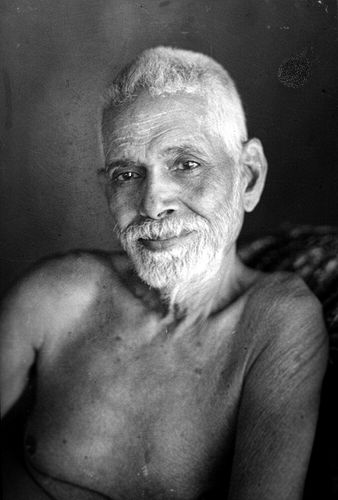
Ramana Maharshi sitting

One of the many things I admire about Ramana Maharshi is that he didn’t try to re-invent the wheel. He used to frequently refer people to traditional texts if it was relevant to their path, and even translated a number scriptures into Tamil for those who were unable to read or understand classical Sanskrit.

For me this was really brought home to me when reading Ramana’s Supplement to 40 Verses on Reality. This is a collection of 40 verses that Ramana composed, except that he didn’t compose all of the verses himself. Several were taken from other scriptures, but, I assume, as they said what he wanted to convey, he just copied the verses and gave the reference of where he took them from.

Here are the first 5 verses of Ramana’s Supplement to 40 Verses on Reality. Note how he places emphasis on the role of the guru and the guru’s power to lead those around him/her into freedom through darshan:

Verse 1

In the company of sages, attachment vanishes; and with attachment, illusion. Freed from illusion, one attains stability, and thence liberation while yet alive. Seek therefore the company of sages.

from Bhajagovindam by Shankaracharya


Verse 2

Not by listening to preachers, nor by study of books, not by meritorious deeds nor by any other means can one attain that Supreme State, which is attainable only through association with the sages and the clear quest of the Self, 

from Yoga Vasishta


Verse 3

When one has learned to love the company of sages, wherefore all these rules of discipline? When a pleasant, cool southern breeze is blowing, what need is there for a fan? 

from Yoga Vasishta


Verse 4

Fever is overcome by the cool light of the moon; want, by the good wish-yielding tree; and sin by the Holy Ganges. Those three — fever and want and sin — all flee at the august sight of the peerless sage.

from Subhashita Ratna Bhandargara, chapter 3 verse 6


Verse 5.

Holy rivers, which are only water, and idols, which are made of stone and clay, are not as mighty as the sages. For while they make one pure in course of countless days, the sage’s eyes by a mere glance purify at once.

from Srimad Bhagavatam, Tenth canto, chapter 48 verse 31


❤ Om Namo Bhagavate Sri Ramanaya ❤


Why do so many people practice self inquiry by Ramana Maharshi incorrectly?

ramana maharshi

Q. Why do so many people practice self inquiry by Ramana Maharshi incorrectly? Ramana said the question ‘who am I’ should not be asked but one should put the attention on the “I” inner feeling. Sadhu Om and Sri Muruganar confirmed that that’s the correct way to practice.

Tom: Yes, true. Perhaps it was because Ramana gave slightly different instructions to different people. For some he said to ask the question verbally, to others he said be with the feeling ‘I’, to others he simply said ‘Summa iru’ (Be still).

A common instruction he gave was to dive into the heart…Anyway, all these methods culminate in the same place, and that is the key.

A living teacher can be very useful in finding how the living teaching interacts with the living seeker.

To confuse things more, Ramana also said there is no fixed teaching, and to some he prescribed work and chores, to others meditation, and so on.

That said, here is a collection of quotes from Ramana’s teachings that I compiled that may be helpful to some, with a brief summary at the end, best wishes:

Ramana Maharshi: the path to self-realisation

Here is one possible summary of the essence of Ramana’s teachings:

Ramana Maharshi: Self-abidance, the ‘vision of God’ and the end of suffering

The ‘ultimate means’ to liberation

om1

The following is the last few verses of Advaita Bodha Deepika, a classical vedanta text that summarises the theories and methods of vedanta. It was also a favourite text of Ramana Maharshi’s. Here is the culmination of the teaching, as stated in the last verses of Chapter 8.

(Note, if you are unsure about why this chapter starts in this way and why we are even discussing ‘extinguishing the mind’, have a look at this post here Advaita Bodha Deepika: Vital Teachings for Self-Realisation which explains the rationale behind this first question):


Disciple: How can the mind be extinguished?

Master: To forget everything is the ultimate means. But for thought, the world does not arise. Do not think and it will not arise. When nothing arises in the mind, the mind itself is lost. Therefore do not think of anything, forget all. This is the best way to kill the mind.

To forget everything is the ultimate means

D.: Has anyone else said so before?

M.: Vasishta said so to Rama thus: ‘Efface thoughts of all kinds, of things enjoyed, not enjoyed, or otherwise. Like wood or stone, remain free from thoughts.

Rama: Should I altogether forget everything?

Vasishta: Exactly; altogether forget everything and remain like wood or stone.
Rama: The result will be dullness like that of stones or wood.

Vasishta: Not so. All this is only illusion. Forgetting the illusion, you are freed from it. Though seeming dull, you will be the Bliss Itself. Your intellect will be altogether clear and sharp. Without getting entangled in worldly life, but appearing active to others remain as the very Bliss of Brahman and be happy.

Unlike the blue colour of the sky, let not the illusion of the world revive in the pure Ether of Consciousness-Self. To forget this illusion is the sole means to kill the mind and remain as Bliss.

Though Shiva, Vishnu, or Brahman Himself should instruct you, realisation is not possible without this one means. Without forgetting everything, fixity as the Self is impossible. Therefore altogether forget everything.’

…altogether forget everything and remain like wood or stone….Though seeming dull, you will be the Bliss Itself. Your intellect will be altogether clear and sharp.

D.: Is it not very difficult to do so?

M.: Though for the ignorant it is difficult, for the discerning few it is very easy. Never think of anything but the unbroken unique Brahman. By a long practice of this, you will easily forget the non-self. It cannot be difficult to remain still without thinking anything. Let not thoughts arise in the mind; always think of Brahman.

In this way all worldly thoughts will vanish and thought of Brahman alone will remain. When this becomes steady, forget even this, and without thinking ‘I am Brahman’, be the very Brahman. This cannot be difficult to practise.

Now my wise son, follow this advice; cease thinking of anything but Brahman. By this practice your mind will be extinct; you will forget all and remain as pure Brahman.

Never think of anything but the unbroken unique Brahman…When this becomes steady, forget even this, and without thinking ‘I am Brahman’, be the very Brahman. This cannot be difficult to practise.


Tom’s commentary:

It is not only Sage Vasistha who tells us we need to ‘forget all’. In the Ashtavakra Gita, sage Ashtavakra says in chapter 16, verse 1:

‘My son! You may recite or listen to countless scriptures, but you will not be established in the Self unless you forget all.’

Similarly Ramana Maharshi says in his text ‘Who am I?’:

‘Eventually all that one has learnt will have to be forgotten’

In the traditional path of Knowledge or Jnana, first we are to know our True Self (Atman) and know this to be the same as the Absolute (Brahman). Then we are to be still and renounce all desires.

This spiritual knowledge (Jnana) of ‘I am Brahman’ (Aham Brahmasmi) allows the mind to become still and desireless. Note this does not mean that the body becomes totally inert – no – rather it continues to function naturally according to its destiny (Prarabdha Karma) until the body dies.

Shankara states this multiple times, eg, in Vivekachudamani, and also in his many commentaries, eg. in his commentary upon the Kena Upanishad – in his introduction to the Kena Upanishad Shankara writes:

And [the Self] being eternal, it is not to be secured by any means other than the cessation of ignorance. Hence the only duty is to renounce all desires after the realisation of the unity of the indwelling Self and Brahman.

This is akin to Self-Surrender, as spoken by Sri Ramana Maharshi:

There is no destiny. Surrender, and all will be well. Throw all the responsibility on God. Do not bear the burden yourself. What can destiny do to you then?”
(Talks 244)

and again here:

Question: Surrender is said to be Bhakti [the path of devotional love]. But Sri Bhagavan [Ramana Maharshi] is known to favour enquiry [ie. the path of Knowledge or Jnana] for the Self. There is thus confusion in the hearer.
Ramana Maharshi: Surrender can take effect only when done with full knowledge. Such knowledge comes after enquiry. It ends in surrender.
(Talks 462)

Clarifications on Self-Enquiry

Q. ​Hi Tom, when Ramana says in the book  ‘Who am I’ ‘cultivate the constant and deep contemplative ‘remembrance’ (smrti) of the true nature of the Self’ – would this be like repeatedly bringing the attention back to what is here now with the understanding that the Self is all that is?

Tom: Not quite, although that can be part of it. It means to know:

(1) the essence of who you are, experientially, is unchanging and is also unaffected by gross and subtle objects

(2) there is no lasting fulfillment in objects, which are all transient

(3) the essence of you does nothing (the self is not a doer)

(4) it means to lose interest in objects as sources of pleasure, happiness or fulfillment as we bathe in the bliss of simply being (ourselves).

All this is captured by the words sat-chit-ananda (being-consciousness-bliss), which indicate the nature of the Self.

Turn away from the gross and subtle world-objects.

Not allowing the concept/thought ‘I’ to rise up, wielding the weapon ‘who am I’ to strike down any such thoughts, remain as the Self.

If this all sounds too complex, don’t worry: it is intuitively ‘grasped’, so to speak, through simply allowing the mind to rest and be still and allowing ‘the truth’, so to speak, to arise within naturally.