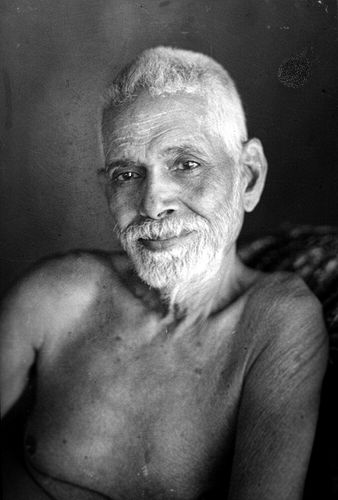
Ramana Maharshi on non-doership and self-realisation

Ramana smiling

The following are verses from Guru Vachaka Kovai, one of the most authoritative texts of Ramana Maharshi’s teachings. The text was written by his disciple Muruganar and thereafter thoroughly checked and amended by Ramana. Here are some verses on the root cause of suffering, our notion of being a doer, with some commentary from Sri Sadhu Om, another devotee of Ramana:

466 The pure Bliss of peace will shine within only for those who have lost the sense of doership. For, this foolish sense of doership alone is the poisonous seed that brings forth all evil fruits.

467 Instead of going on, driven by the restless thoughts, performing actions such as ‘I should do this, I should give up that’ as if they were worthy to be done, acting according to how the Grace of God, the Lord of our soul, leads us, is the right form of truly worshipping Him

476 Whether or not one is performing actions, if the delusion of individuality – the ego, ‘I am the doer of actions’ – is completely annihilated, that is the attainment of actionlessness.

Sri Sadhu Om’s Comments: People generally think that the attainment of actionlessness is a state in which one should remain still, giving up all activities. But this is wrong. Sri Bhagavan Ramana proclaims that the loss of doership alone is the right kind of actionlessness, and this alone is nishkamya karma – action done without any desire for result. 

470 The Lord who has fed you today will ever do so well. Therefore, live carefree, placing all your burden at His feet and having no thought of tomorrow or the future.

471 Know well that even performing tapas (spiritual practice) and yoga with the intention ‘I should become an instrument in the hands of the Lord Siva’ is a blemish to complete self-surrender, which is the highest form of being in His service.

Sri Sadhu Om’s Comments: Since even the thought ‘I am an instrument in the Lord’s hand’ is a means by which the ego retains its individuality, it is directly opposed to the spirit of complete self-surrender, the ‘I’-lessness. Are there not many good-natured people who engage themselves in prayers, worship, yoga and such virtuous acts with the aim of achieving power form God and doing good to the world as one divinely commissioned? It is exposed here that even such endeavours are egotistical and hence contrary to self-surrender. 


Ramana Maharshi: Non-duality and how to be Self-Realised (Atma-Jnana)

Ramana Maharshi sitting.jpg

In the following excerpts, Ramana Maharshi is telling us that we are already free, totally and completely. Can you accept this? Can you allow these words to move you? Can you intuit the truth to which they point?


If we talk of knowing the Self, there must be two selves, one a knowing self, another the self which is known, and the process of knowing. The state we call realization is simply being oneself, not knowing anything or becoming anything. If one has realized, one is that which alone is and which alone has always been. One cannot describe that state. One can only be that.


Questioner: How long does it take to reach mukti (liberation)?
Maharshi: Mukti is not to be gained in the future. It is there for ever, here and now.
Q: I agree, but I do not experience it.
M: The experience is here and now. One cannot deny one’s own Self.


Questioner: How shall I reach the Self?
Maharshi: There is no reaching the Self. If Self were to be reached, it would mean that the Self is not here and now and that it is yet to be obtained. What is got afresh will also be lost. So it will be impermanent. What is not permanent is not worth striving for. So I say the Self is not reached. You are the Self, you are already that. The fact is, you are ignorant of your blissful state. Ignorance supervenes and draws a veil over the pure Self which is bliss. Attempts are directed only to remove this veil of ignorance which is merely wrong knowledge. The wrong knowledge is the false identification of the Self with the body and the mind. This false identification must go, and then the Self alone remains. Therefore realization is for everyone; realization makes no difference between the aspirants. This very doubt, whether you can realize, and the notion `I-have-not-realized’ are themselves the obstacles. Be free from these obstacles also.


Q: There must be something that I can do to reach this state.
M: The conception that there is a goal and a path to it is wrong. We are the goal or peace always. To get rid of the notion that we are not peace is all that is required.
Q: All books say that the guidance of a Guru is necessary.
A: The Guru will say only what I am saying now. He will not give you anything you have not already got. It is impossible for anyone to get what he has not got already. Even if he gets any such thing, it will go as it came. What comes will also go. What always is will alone remain. The Guru cannot give you anything new, which you don’t have already. Removal of the notion that we have not realized the Self is all that is required. We are always the Self only we don’t realize it.


Q: When a man realizes the Self, what will he see?
M: There is no seeing. Seeing is only being. The state of Self-realization, as we call it, is not attaining something new or reaching some goal which is far away, but simply being that which you always are and which you always have been. All that is needed is that you give up your realization of the not-true as true…At one stage you will laugh at yourself for trying to discover the Self which is so self-evident.


Q: But how to do this and attain liberation?
M: Liberation is our very nature. We are that. The very fact that we wish for liberation shows that freedom from all bondage is our real nature. It is not to be freshly acquired. All that is necessary is to get rid of the false notion that we are bound. When we achieve that, there will be no desire or thought of any sort. So long as one desires liberation, so long, you may take it, one is in bondage.


Q: Is not the realization of one’s absolute being, that is, Brahma-jnana, something quite unattainable for a layman like me?
M: Brahma-jnana is not a knowledge to be acquired, so that acquiring it one may obtain happiness. It is one’s ignorant outlook that one should give up. The Self you seek to know is truly yourself.


Q: How to realize the Heart?
M: There is no one who even for a moment fails to experience the Self. For no one admits that he ever stands apart from the Self. He is the Self. The Self is the Heart.


Q: How can I attain Self- realization?
M: Realization is nothing to be gained afresh; it is already there. All that is necessary is to get rid of the thought `I have not realized’. Stillness or peace is realization. There is no moment when the Self is not. So long as there is doubt or the feeling of non-realization, the attempt should be made to rid oneself of these thoughts. They are due to the identification of the Self with the not-Self. When the not-Self disappears, the Self alone remains. To make room, it is enough that objects be removed. Room is not brought in from elsewhere.


Q: However often Bhagavan teaches us, we are not able to understand.
M: People say that they are not able to know the Self that is all pervading. What can I do ? Even the smallest child says, `I exist; I do; this is mine.’ So, everyone understands that the thing `I’ is always existent. It is only when that `I’ is there that there is the feeling that you are the body, he is Venkanna, this is Ramanna and so on. To know that the one that is always visible is one’s own Self, is it necessary to search with a candle ? To say that we do not know the atma swarupa (the real nature of the Self) which is not different but which is in one’s own Self is like saying, `I do not know myself.`


Q: But how is one to reach this state?
M: There is no goal to be reached. There is nothing to be attained. You are the Self. You exist always. Nothing more can be predicated of the Self than that it exists. Seeing God or the Self is only being the Self or yourself. Seeing is being. You, being the Self, want to know how to attain the Self. It is something like a man being at Ramanasramam asking how many ways there are to reach Ramanasramam and which is the best way for him. All that is required of you is to give up the thought that you are this body and to give up all thoughts of the external things or the not-Self.


Q: It is cruel of God’s leela (play) to make the knowledge of the Self so hard.
M: Knowing the Self is being the Self, and being means existence, one’s own existence. No one denies one’s existence any more than one denies one’s eyes, although one cannot see them. The trouble lies with your desire to objectify the Self, in the same way as you objectify your eyes when you place a mirror before them. You have been so accustomed to objectivity that you have lost the knowledge of yourself, simply because the Self cannot be objectified. Who is to know the Self ? Can the insentient body know it? All the time you speak and think of your `I’, yet when questioned you deny knowledge of it. You are the Self, yet you ask how to know the Self. Where then is God’s leela and where is its cruelty ? Because of this denial of the Self by people the sastras speak of maya, leela, etc.


Q: Yes, I still understand only theoretically. Yet the answers are simple, beautiful and convincing.
M: Even the thought `I do not realize’ is a hindrance. In fact, the Self alone is. Our real nature is mukti. But we are imagining we are bound and are making various, strenuous attempts to become free, while we are all the while free. This will be understood only when we reach that stage. We will be surprised that we were frantically trying to attain something which we have always been and are.


Q: Is mukti the same as realization?
M: Mukti or liberation is our nature. It is another name for us. Our wanting mukti is a very funny thing. It is like a man who is in the shade, voluntarily leaving the shade, going into the sun, feeling the severity of the heat there, making great efforts to get back into the shade and then rejoicing, `How sweet is the shade! I have reached the shade at last!’ We are all doing exactly the same. We are not different from the reality. We imagine we are different, that is we create the bheda bhava [the feeling of difference] and then undergo great sadhana (spiritual practices) to get rid of the bheda bhava and realize the oneness. Why imagine or create bheda bhava and then destroy it?


Q: Since realization is not possible without vasana-kshaya (destruction of mental tendencies/habits), how am I to realize that state in which the tendencies are effectively destroyed?
M: You are in that state now.
Q: Does it mean that by holding on to the Self, the vasanas (mental tendencies) should be destroyed as and when they emerge?
M: They will themselves be destroyed if you remain as you are.


Q: Is one nearer to pure consciousness in deep sleep than in the waking state?
M: The sleep, dream and waking states are mere phenomena appearing on the Self which is itself stationary. It is also a state of simple awareness. Can anyone remain away from the Self at any moment ? This question can arise only if that were possible.
Q: Is it not often said that one is nearer pure consciousness in deep sleep than in the waking state?
M: The question may as well be `Am I nearer to myself in my sleep than in my waking state?’ The Self is pure consciousness. No one can ever be away from the Self. The question is possible only if there is duality. But there is no duality in the state of pure consciousness.
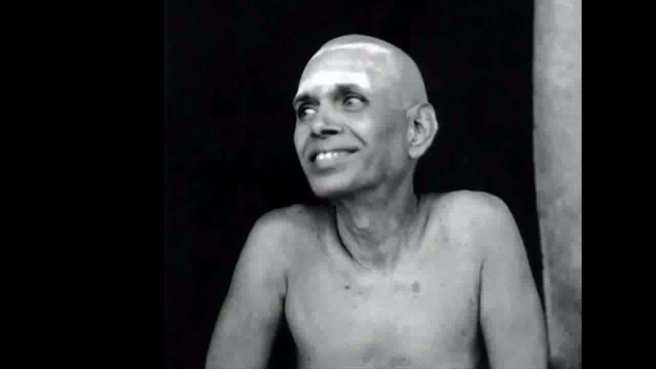
Ramana Maharshi: Self-Realisation is simply being one’s self

Ramana smiling

The state we call Realisation is simply being one’s self, not knowing anything or becoming anything.

If one has realised, one is that which alone is and which alone has always been. One cannot describe that state, but only be That.

Of course, we talk loosely of Self-Realisation for want of a better term.

Ramana Maharshi
(taken from the book Day by Day with Bhagavan, p. 296)

Tom’s comments:

Notice that the search for ‘understanding’ and the search for becoming ‘enlightened’ or ‘self-realised’ are both pursuits of the ego. The ego is looking for security and pleasure and has projected/created these fantasies which it tries to attain.

Instead of trying to attain a projected fantasy, why not instead look at what is actually happening? Look at yourself, look at the ego, the ‘I’. Ask yourself ‘what is this ego? Who am I?’ Investigate for yourself repeatedly and you will see that the ego, the ‘you’ is illusory – it’s just a bundle of thoughts that occur by themselves, spontaneously. ‘Your thoughts’ are not yours at all: note how you cannot chose to stop thinking, stop worrying, stop your addictions. You cannot chose to believe something you don’t. You cannot chose to not believe something you do believe. You cannot stop your ‘bad thoughts’. In fact you probably do not even know what exactly you will be thinking in 5 minutes time let alone tomorrow or 5 days from now.

Another point: if you happen to think you are a dinosaur, it doesn’t necessarily make you one. Similarly if you think that you are an ego (a doer, a thinker, an agent who has authorship over his/her actions), it doesn’t make it true. Yes, the idea of being a doer is just that: it is an idea, a belief that has been tacitly repeated to us and drummed into us since childhood. An oft-repeated lie is then (mistakenly) taken to be true.

In seeing this first-hand, there is no specific intellectual understanding or state of mind gained. It’s just that an illusion has been seen through, like seeing that a frightening snake is in fact just a harmless rope in poor light (or like realising that you are not in fact a dinosaur after all!).

No dogmas, no metaphysics, no complex body-twisting acrobatics, no beliefs and no rituals are necessary (although they may be a part of the apparent journey).

Then all there is is ‘what’s happening’, and what you thought was you is actually just a part of that happening. Or as Bhagavan puts it, all there is is ‘simply being one’s self’.

Nisargadatta Maharaj: In reality there is no person

Nisargadatta_Maharaj

The person is merely the result of a misunderstanding. In reality, there is no such thing.

Feelings, thoughts and actions race before the watcher in endless succession, leaving traces in the brain and creating an illusion of continuity.

A reflection of the watcher in the mind creates the sense of “I” and the person acquires an apparently independent existence.

In reality there is no person, only the watcher identifying himself with the ‘I’ and the ‘mine’.

Taken from I Am That by Nisargadatta Maharaj

Continue reading

We don’t have to define reality

Leopard

We don’t have to define reality
We don’t even need to see things as they are.
We don’t need to do anything.
Just this.
That’s it.

Naturally,
We already see things as they are,
Effortlessly,
It’s our natural intelligence,
(It’s not ‘ours’)
And wrong concepts are naturally dropped,
(Or maybe they are not).

Reality shines through all of this.
How could it not?

Unknowable yet known (Upanishads, Sufism, Ramana and Taoism)

sparrow branch

If you think: “I know Brahman well,” then surely you know but little of Its form
Kena Upanishad

One of the astounding things about this is that it is impossible to put this into words. Put what into words you may ask?….this! Just this! Call it Tao, God or call it Brahman – these are really just meaningless words unless we understand what the words are pointing to.

All the great teachings have tried to express the Inexpressible. They have tried to indicate That which gives meaning to life but is beyond meaning, That which is transformative but at the same time nothing changes when It is ‘realised’ (how can that be?), That in which suffering and separation are seen to be imaginary and illusory. When That is understood, all the scriptures can be made sense of, and all of the scriptures are also seen to be ultimately inaccurate.

The Tao Te Ching, that wonderful poem from ancient China, starts with the confession that what it is writing about cannot be written about:

The Tao that can be spoken of is not the eternal Tao
Tao Te Ching, verse 1

What you are seeking is constantly being realised, whether you realise it or not! One of the advantages of the concept of God is that God is not meant to be knowable. However with the concept of self-realisation and the ever increasing preponderance of the all-knowing guru on the spiritual scene, it is often thought that this is something that can be known by the mind. Here’s what our Sufi friend Abol-Hasan has to say about it.

One may speak of those absent,
but one who is Ever Present,
one can say nothing of
Sheikh Abol-Hasan, saying 92

Throughout the ages, people from all walks of life have spontaneously awoken to this ‘understanding’: scholars and illiterates, men and women and children, those with a spiritual tradition and those without one.

All true knowers of truth are always fuzzy when it comes to how to realise this for oneself, for there is no single path and no single practice that has the monopoly here. This is not always a popular message, and certainly not one that is easy to grasp (it’s impossible to grasp) and pass on through the generations.

Here we can see the Kena Upanishad trying to express the futility of organising a spiritual system around this understanding:

The one who has thought it out does not know it.
It is not understood by those who understand it;
it is understood by those who do not understand it.
Kena Upanishad

This is ever present, it is none other than Our-True-Self, which is simply life devoid of the illusion of doership. It is here, yet cannot be known by the mind or senses. It cannot be captured in words.

I do not think I know It well, nor do I think I do not know It. 
He among us who knows the meaning of “Neither do I not know, nor do I know”
— knows Brahman.

Kena Upanishad

This realisation is nothing to be gained. When you realise, there is no realisation at all. It all just falls away. What is there to realise? Who is there to realise? There is just this. This is enough. Realisations come and go in this. And this is not a concrete thing that you can grasp or possess, but it is life just happening right now as it is.

Boddhidharma, the Indian monk and founder of Zen (Chan) Buddhism tells us just this, and he says it repeatedly – here is just one example:

“To say he attains anything at all is to slander a Buddha. What could he possibly attain?”
Boddhidharma from the Bloodstream Sermon

Ramana Maharshi was someone who had a spontaneous realisation of all of this as a teenage boy. He had no guru and knew little of any spiritual teaching. Over the years he learnt the language of Advaita Vedanta and found that its teachings described that which he was already experiencing. Here’s what he has to say about self-knowledge (Atma-Jnana in Sanskrit):

Q: When a man realises the Self, what will he see?

M: There is no seeing. Seeing is only being. The state of Self-realisation, as we call it, is not attaining something new or reaching some goal which is far away, but simply being that which you always are and which you always have been.

All that is needed is that you give up your realization of the not-true as true…At one stage you will laugh at yourself for trying to discover the Self which is so self-evident.
Ramana Maharshi

And he repeats this again and again (italics added by me):

If we talk of knowing the Self, there must be two selves, one a knowing self, another the self which is known, and the process of knowing.

The state we call realisation is simply being oneself, not knowing anything or becoming anything. If one has realised, one is that which alone is and which alone has always been. One cannot describe that state. One can only be that.
Ramana Maharshi

So if this is unknowable, how to reach this ‘understanding’ at all? Let us listen to the Maharshi:

Q: But how is one to reach this state?
M: There is no goal to be reached. There is nothing to be attained. You are the Self. You exist always. Nothing more can be predicated of the Self than that it exists. Seeing God or the Self is only being the Self or yourself. Seeing is being.

You, being the Self, want to know how to attain the Self. It is something like a man being at Ramanasramam asking how many ways there are to reach Ramanasramam and which is the best way for him.
Ramana Maharshi

Ramana Maharshi: Is the world an illusion?

Ramana smiling

In many spiritual traditions, such as some schools of of Buddhism, vedanta and yoga, seekers are advised to consider the world to be like a dream: ephemeral, transient and illusory. But is the world really an illusion, or is this merely a teaching method?

Many well-versed pandits and scholars have debated this very issue over the centuries, but for those that have glimpsed the reality that lies beyond mere verbal assertions, such debates are missing the essential point.

Here are two powerful quotes from Ramana Maharshi explaining how the teachings work:


Question: “Brahman (the Supreme Spirit) is real. The world is illusion” is the stock phrase of Sri Sankaracharya. Yet others say, “The world is reality.” Which is true?
Sri Ramana Maharshi: Both statements are true. They refer to different stages of development and are spoken from different points of view. The (spiritual) aspirant starts with the definition, that which is real exists always. Then he eliminates the world as unreal because it is changing.
The seeker ultimately reaches the Self and there finds unity as the prevailing note. Then, that which was originally rejected as being unreal is found to be a part of the unity. Being absorbed in the reality, the world also is real. There is only being in Self-realisation, and nothing but being.
From Talks with Sri Ramana Maharshi, talk no. 33

We can clearly see Ramana says the teaching that the world is an illusion is itself a ‘thorn used to remove a thorn’. The teaching is a concept, and it is used to remove another concept, before they are both thrown away.

Here is another instructive quote:

Sri Ramana Maharshi: At the level of the spiritual seeker you have got to say that the world is an illusion. There is no other way. When a man forgets that he is Brahman, who is real, permanent and omnipresent, and deludes himself into thinking that he is a body in the universe which is filled with bodies that are transitory, and labours under that delusion, you have got to remind him that the world is unreal and a delusion.
Why? Because his vision which has forgotten its own Self is dwelling in the external, material universe. It will not turn inwards into introspection unless you impress on him that all this external material universe is unreal.
When once he realises his own Self he will know that there is nothing other than his own Self and he will come to look upon the whole universe as Brahman.
There is no universe without the Self. So long as a man does not see the Self which is the origin of all, but looks only at the external world as real and permanent, you have to tell him that all this external universe is an illusion. You cannot help it.
Take a paper. We see only the script, and nobody notices the paper on which the script is written. The paper is there whether the script on it is there or not. To those who look upon the script as real, you have to say that it is unreal, an illusion, since it rests upon the paper. The wise man looks upon both the paper and script as one. So also with Brahman and the universe.
From letters from Sri Ramanasramam

Here in the next excerpt Ramana is asked directly if the world is perceived after realisation:

A visitor: Is the jagat (world) perceived even after Self-Realization?
M.: From whom is this question? Is it from a Jnani or from an ajnani?
D.: From an ajnani.
M.: Realise to whom the question arises. It can be answered if it arises after knowing the doubter. Can the jagat or the body say that it is?
Or does the seer say that the jagat or the body is? The seer must be there to see the objects. Find out the seer first. Why worry yourself now with what will be in the hereafter?

[Tom – Ramana is telling the questioner not to worry about this question and rather attend to himself ie. to do self-enquiry]

Sri Bhagavan continued: What does it matter if the jagat is perceived or not perceived? Have you lost anything by your perception of jagat now? Or do you gain anything where there is no such perception in your deep sleep? It is immaterial whether the world is perceived or not perceived.

[Tom: Now Ramana answers the question directly:]

The ajnani sees the Jnani active and is confounded. The jagat is perceived by both; but their outlooks differ. Take the instance of the cinema. There are pictures moving on the screen. Go and hold them.
What do you hold? It is only the screen. Let the pictures disappear.
What remains over? The screen again. So also here. Even when the world appears, see to whom it appears. Hold the substratum of the ‘I’. After the substratum is held what does it matter if the world appears or disappears?
The ajnani takes the world to be real; whereas the Jnani sees it only as the manifestation of the Self. It is immaterial if the Self manifests itself or ceases to do so.
From Talks with Sri Ramana Maharshi, talk no. 65

Annamalai Swami: How to calm the mind

annamalai swami final talks

The following is an excerpt from the book ‘Annamalai Swami Final Talks’ (bold added by me):

Annamalai Swami: ….Your mind is an insubstantial shadow that will follow you around wherever you go. Attempts to eliminate or control it cannot succeed while there is still a belief that the mind is real, and that it is something that can be controlled by physical or mental activity.

Question: But this shadow mind must still be eliminated by some means.
Continue reading

Annamalai Swami: How to stabilise in the Self

annamalai swami final talks

The following is an excerpt from the book ‘Annamalai Swami Final Talks’ (bold added by me):

Question: One can have a temporary experience of the Self, the underlying reality, but then it goes away. Can you offer any guidance on how to stabilise in that state?
Continue reading

Ramana Maharshi: How to get peace

Ramana Maharshi downward gaze

Questioner: …how to get peace?

Ramana Maharshi: As I said already, that which is, is peace. All that we need do is to keep quiet.

Peace is our real nature. We spoil it. What is required is that we cease to spoil it. We are not going to create peace anew. There is space in a hall, for instance. We fill up the place with various articles. If we want space, all that we need do is to remove all those articles, and we get space.

Similarly if we remove all the rubbish, all the thoughts, from our minds, the peace will become manifest. That which is obstructing the peace has to be removed. Peace is the only reality.

Excerpt taken from Day by Day with Bhagavan