2 new books have now been added to the recommended reading list: Maha Yoga and Sri Ramana Paravidyopanishad by Lakshmana Sarma

Two new books, Maha Yoga and Sri Ramana Paravidyopanishad, both by Lakshmana Sarma, have been added to the recommended reading list – please see the relevant section there for more information and links.

May these books help seekers determine the true path and thereby discover their true nature

Namaste & best wishes

Tom

Sri Ramana Maharshi explains the truth of Dakshinamurti’s Silent Teaching | Silence | Mouna | Self-Realisation

The Self alone, the Sole Reality,
Exists for ever.
If of yore the First of Teachers
Revealed it through unbroken silence
Say, who can reveal it in spoken words?
– Ekatma Panchakam, Sri Bhagavan.

Sri Bhagavan once told the story that follows to Sri Muruganar. This brings out the profound significance of the Supreme Silence in which the First Master, Sri Dakshinamurti is established.

Sri Bhagavan said, “When the four elderly Sanakadi rishis first beheld the sixteen-year-old Sri Dakshinamurti sitting under the banyan tree, they were at once attracted by Him, and understood that He was the real Sadguru. They approached Him, did three pradakshinas around Him, prostrated before Him, sat at His Feet and began to ask shrewd and pertinent questions about the nature of reality and the means of attaining it.

Because of the great compassion and fatherly love (vatsalya) which He felt for His aged disciples, the young Sri Dakshinamurti was overjoyed to see their earnestness, wisdom and maturity, and gave apt replies to each of their questions.

But as He answered each consecutive question, further doubts arose in their minds and they asked further questions. Thus they continued to question Sri Dakshinamurti for a whole year, and He continued to clear their doubts through His compassionate answers.

Tom: Dakshinamurti is often said to have taught in silence. However here Bhagavan Sri Ramana corrects that view and notes that initially there was a 1 year period in which Dakshinamurti answered questions and the devotees underwent hearing the teachings (sravana), asking questions and reflecting on the teachings (manana) before the silent teaching was given.

Finally, however, Sri Dakshinamurti understood that if He continued answering their questions, more doubts would arise in their minds and their ignorance (ajnana) would never end. Therefore, suppressing even the feeling of compassion and fatherly love which was welling up within Him, He merged Himself into the Supreme Silence. Because of their great maturity (which had ripened to perfection through their year-long association with the Sadguru), as soon as Sri Dakshinamurti assumed Silence, they too automatically merged into Supreme Silence, the true state of the Self.”

Tom: Eventually listening to teachings, asking questions and contemplating upon the answers (ie. sravana and manana), important as they may appear to be initially, must cease, and we must turn towards the Self (ie. nididhyasana). That is, sravana and manana should lead to nididhyasana.

Wonderstruck on hearing Sri Bhagavan narrating the story in this manner, Sri Muruganar remarked that in no book was it mentioned that Sri Dakshinamurti ever spoke anything. “But this is what actually happened”, replied Sri Bhagavan curtly.

From the authoritative way in which Sri Bhagavan replied and from the clear and descriptive way in which He told the story,
Sri Muruganar understood that Sri Bhagavan was none other than Sri Dakshinamurti Himself!

~ From ‘The Silent Power’ (selections from The Mountain Path and The Call Divine, the above piece was contributed by Sri Sadhu Om, with Tom’s additional comments in italiscised red)

Authentic living, authentic spirituality – teachings by Sri Ramana Maharshi

The following teaching verses on how to live a truly authentic life are taken from the text Guru Vachaka Kovai (The Garland of Guru’s sayings, you can download the entire text here). According to Sri Ramana Ashram, as explained in the foreward of the book ‘…[Guru Vachaka Kovai] provides the most precise, systematic and authoritative exposition of Sri Bhagavan’s teaching, explaining step by step the theory, the practice and the experience of jnana, the Truth supreme which is Being as Life Eternal, Pure Awareness, Perfect Bliss. Thus, the most comprehensive collection of the Maharshi’s sayings is Guru Vachaka Kovai…’

Chapter 40: Authentic Living

1089 Life you desire. But how to live
You know not. Thinking that this sinking
Deep in this void, vain, illusive
Waking-dream is ‘life’, you proudly
Claim you ‘live’. Pierce this illusion,
Go, grasp the Truth, eternal life.

Tom: Bhagavan Sri Ramana gives a radical interpretation as to what true authentic living actually is. Thinking this world to be real and living in it in this way is not authentic living at all. People who proudly strut about the world proclaiming how authentic their life is are merely dabbling in ego and illusion, so says the Ever-Living-Sage. What is authentic living then? Let us see what Bhagavan says in the following verses:

1090 Shun anger and desire; destroy
Illusions false that cause confusion,
Behave at all times with detachment
Calm. This is authentic living.
To this hold fast.

Tom: What should we hold fast to? Let us see:

1091 Abiding as Self-being, living
A life that is a steady flow
Unhindered of true love welling up
In the heart, this is the bright, joyous
Sivahood, which ends forever
The inveterate, false, deceitful ego.

Tom: we should know by now that all of Bhagavan Ramana’s teaching point to turning within to attain Self-Knowledge, to discover that which we truly are, which is the same as being that which you truly are. Here we are specifically advised to shun anger and desire, be calm and detached, and turn within to discover our true radiant being as Being, Self, Love. The discovery of what we truly are ends this false deceitful ego as well as the ‘void and illusive’ waking-dream.

1092 The seers who have placed at Siva’s Feet
All their life’s burdens and now live
Lives sublime of calm detachment
And shine in radiant purity,
They alone possess true beauty,
They alone enjoy true bliss.

Tom: Surrender life’s burdens to Shiva, the Self Supreme

1093 That Heart which truly knows the Self
Is full of love whence Bliss supreme
Wells up forever. There desire,
And its shadow, sorrow, have no place.
Such a life whose nature pure,
From Being flows serenely calm.

Tom: with self-knowledge, desire and sorrow naturally fall away, there being no ‘place’ for them to sustain themselves and exist. Here is the next verse Sri Ramana makes the teaching especially clear. What is authentic living? It is simply to Be or Abide As the Self.

1094 The only goal worth seeking is
The bliss supreme of Self-Awareness
.
Constant remembering and abiding
As That within the heart amounts
To plenitude of life.

Tom: Sri Ramana drives the point home that living a worldly life in the waking dream, which is a false illusion, is not at all the truly authentic life at all. Rather it is maya, illusion, with all its suffering and seeming-separation.

1095 Such a life of Grace alone
Is life lived in full, real Being.
This worldly life of false phenomena
Full of fear is sinking deeper
In illusion, not authentic living.

Tom: In the next verse that which was previously implied but not stated is now stated: the senses are turned within, no longer seeing the world, no longer interested in that which is not at all real or existent.

1096 Those whose five senses turn no longer
Towards the world which once seemed real,
Those who have learned to live without
Their minds being moved by the illusive
Universe of forms, they need
Perform no penance.

Tom: Revelling only in the Self Supreme, total Bliss, Love and Peace. This is the only authentic life – eternal life.

!Om Namo Bhagavate Sri Ramanaya Om!

Misquoting Ramana Maharshi ‘neither destiny nor free will’ | Upanishads | Ramesh Balsekar

There is a quote I often see attributed to Sri Ramana Maharshi as follows:

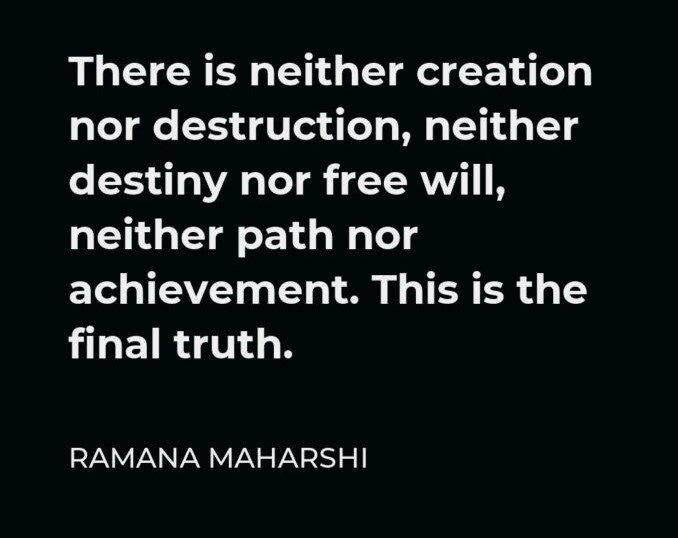
‘There is neither creation nor destruction, neither destiny nor free will, neither path nor achievement. This is the final truth.’

This verse is actually a mistranslation of a verse that is found in several vedanta scriptures including two Upanishads, the writings of Gaudapada and in Shankara’s writings too. Here is how the verse appears in these texts:

There is neither destruction (Nirodha) nor creation (Utpatti), none in bondage (Bandha) and none practicing disciplines (Sadhaka). There is none seeking Liberation (Mumukshu) and none liberated (Mukta). This is the ultimate or highest truth (Paramartha).’

Sri Ramana Maharshi did himself write a version of this verse, which has been captured in verse B28 in Guru Vachaka Kovai (it can be found after verse 1227), which reads as follows:

There is no creation, no destruction.
None bound, none seeking, striving,
Gaining freedom. Know that this
Is the Truth supreme.

As far as I can tell, the mistranslated version of the text, which erroneously refers to destiny and free will, was popularised by Ramesh Balsekar and itself was a quotation from a book by Wei Wu Wei called ‘The Open Secret’. Ramesh often placed prominence on the concepts of destiny and free will in his teachings, so perhaps this was why he gravitated towards this version (ie. mistranslation) of the verse?

Admittedly the verses are not all too different from each other, but they are different nonetheless. I’ll let you decide on the significance of these differences for yourself.

Namaste

Tom

Non-duality, Self-Realisation and the appearance of the world | Sri Sadhu Om

The following is taken from the wonderful text Sadhanai Saram written by Sri Sadhu Om. My comments are in italiscised red:

Duality only appears due to a lack of self-enquiry:

  1. Know that the world, soul and God have all seemingly come into existence only because of our pramada or slackness in Self-attention.

It is the unreal and illusory ego that sees the (illusory and unreal) world:

  1. The entire universe composed of the five elements, earth, water, fire, air and space, appears only due to our error of mistaking as ‘I’ the ego that rises from Self like a spark rising from fire, and which appears as different from Self whose nature is Being, and as identical with the mind, whose nature is rising.

Self-enquiry ends the ego illusion and duality:

  1. The entire appearance of this world that is seen, including we (the individual or jiva) who see it, is a mere false appearance like a dream. If we keenly scrutinize the source (the real ‘I am’) from which the seeing ego rises, and thereby enter the heart and firmly abide there, the reality will shine forth (and the appearance of the triad – the seer, seeing and object seen – will disappear).

There is no desire or fear in the Self (or in Self-realisation), both of these being due to ignorance/ego or illusion:

  1. If we attain the otherness-free knowledge (ananya jnana), that this world is nothing but our own Self, seen wrongly in our self by our self through our power of imagination, then the delusion of desire for or fear of the world (the objects we see in front of us), will never rise again; and we will merge in and become one with Self. This alone is our natural state.

The formless Self alone exists:

  1. Self alone exists. Except oneself, nothing exists. But if one takes this pure consciousness, which exists and shines as ‘I’ to be the body, every thing will assume a form and appear to exist. If one inquires, “Is this ‘I’ only the body, or is it something else?” and thereby sees the true nature of “I,” every thing will cease to exist. See thus.

A summary and reiteration of what has been stated above:

  1. If you ask, “For what reason is it said, that if one inquires and knows oneself, this entire world would disappear?” The reason is that the result at tained by the inquiry “Who am I?” is the destruction of the unreal individual (jiva), the ego, who is immersed in activity due to his taking the body to be himself. (That is, since the entire world-appearance depends for its seeming existence upon the ego who sees it, and since the ego itself has no real existence of its own, when the real ‘I’ is known, the ego will be found to be truly non-existent; where upon, the world-appearance will vanish, having no one to see it and thereby to give it a seeming exis tence).

The false ‘I’ is the ego, also known as maya. Enquire into the ‘I’, that is, do self-enquiry, and this illusion will vanish, along with the body, the mind and the world. Compare to Revelation Verse 31.

  1. The ‘I’ which cannot shine without being joined with a body-form, is alone the ghost-like ego ‘I’, the great illusion (maya). If one courageously and without fear inquires, “Who is this I?” it will become non-existent, and along with it everything else will cease to exist.

  1. If this ‘I’ the self-rising ego-appearance, is destroyed by the inquiry “Who am I?”, then everything else, which till then appeared only in him (in the mind) but which was seen as if existing outside of him, will cease to exist. The ever-existing Whole or purna, which then shines forth as ‘I-I’ the blissful existence which neither appears nor disappears, is the real Self, the true import of the word ‘I’.

The true Self does not come and go, unlike the body and mind and world:

  1. The ‘I’ which is the Whole, which is the true import of ‘I’, which shines by its own light without appearing due to the functioning of the five sense-knowledges (and disappearing when they cease to function); which is the exalted and ever unleaving experience of Self, and which is the true nature of everyone, alone is the one non-dual reality; it alone is true knowledge.

The true nature of Jnana (knowledge) is simply the Self. The Self is itself the nature of Knowledge.

  1. This true knowledge is not anything other than oneself; it is our own existence-consciousness ‘I am’. Why should we suffer by imagining and seeing the soul [Jiva or ego], world and God in this knowledge? Abiding firmly as mere Being, experience this knowledge correctly; then what thing other than oneself will appear there?

True destruction of maya/duality occurs with destruction of the ego:

  1. The destruction of the entire universe together with the space and other elements that constitute it is not the state of absolute destruction (pralaya). The state in which the wicked ego, which rises in the form of the feeling “This body of flesh is I” (abhimana), drowns in Self and is destroyed entirely, is alone the glorious state of absolute destruction (maha-pralaya).

  1. After being destroyed in the ordinary destruction at the end of an eon (yuga-pralaya), the heaven and earth will appear again at the proper time. The state in which the Fire of Knowledge (Jnanagni), which blazes forth on being ignited as the churning process of investigation “Who am I?” pervades and shines everywhere, having destroyed the feeling, “I am this body” (dehatma-buddhi), is alone the absolute destruction (maha-pralaya); be cause the ego, which is thus destroyed by the Fire of Knowledge (Jnana) will never appear again.

  1. The “I,” which continues to live even after the mind has died (as a result of the above said inquiry “Who am I?”) is indeed the Supreme Reality (Brahman), which alone exists after the universal destruction (pralaya). The mind expanding as everything, having risen from the heart (that is, the mind slipping down from the true state of Brahman due to inadvertence or lack of Self-attention (pramada), and thereby becoming the cause for the creation and sustenance of the false appearance of this en tire universe), is not the state of true power; the mind merging and abiding firmly in Self is alone the true state of supreme power.

Note by Sri Sadhu Om: The supreme and truly divine power is not the power of the mind (maya), which creates and sustains the false appearance of the universe, but is only the power of Self-abidance, which reveals the truth that illusion (maya) is ever non-existent.

The cause of duality and of liberation:

  1. Your appearance as an ego, an individual soul who rises in the form “I am this body,” alone is the root-cause for the appearance of this unreal world. If this root-appearance, the rising of yourself as an individual soul, does not rise even in the least, that state will be the state of liberation, which is completely devoid of the imaginary appearances of the world and God.

  1. If one has the ability to deny oneself and thereby to destroy the rising of the ego in its very source, what other tapas need one perform? The real Self, the source in which the ego thus subsides and dies, alone is the state which is worth to purchase and attain by selling (or renouncing) all the three worlds.

The paths of Devotion and Knowledge – Bhakti vs Jnana | Advaita Vedanta

The following is taken from the wonderful text Sadhanai Saram (The Essence of Spiritual Practice) written by Sri Sadhu Om, a direct devotee of Sri Ramana’s. This text not only gives us the essence of Sri Ramana Maharshi’s teaching, but also directs us to the true Vedanta teachings. The notes are written by Sri Sadhu Om himself. You can download the full text as a PDF using the above link.

The paths of knowledge and devotion are more fully explained in the text The Path of Sri Ramana which you can download for free here. This is one of the few texts that goes into detail into both the paths of knowledge and love.

Also see Recommended Reading: Books for Enlightenment, Liberation and Self-Realisation

The Paths of Devotion (Bhakti) and Knowledge (Jnana)

79. To the extent to which love for God arises in one’s heart, to that extent will one acquire knowledge about Him. And to the extent to which one knows the nature of God, to that extent will the mind gain steadfast love for Him. Thus, knowledge (jnana) will be increased by devotion (bhakti), and devotion (bhakti) will be increased by knowledge (jnana).

80. By means of our love for God, He will give us more knowledge of Him, and by means of our knowledge of Him, He will give us more love for Him. Therefore, of these two paths, bhakti and jnana, follow that one for which you first gain a liking, because that one path will lead you to follow the other one into the heart.

81. In the life of an aspirant who is seeking liberation, bhakti and jnana will be experienced as inseparable, like the two sides of one sheet of paper. Hence, each one is equal to the other. They are not two different things, for the true nature of both of them is one and the same; know that bhakti and jnana are merely two names for that one thing. (Garland of Guru’s Sayings (Guru Vachaka Kovai) verses 722, 731)

82. The state of abiding firmly in Self-alone is wisdom (jnana). Would it be possible to abide thus in Self if one did not have love for Self? Love for Self-alone is bhakti; abiding firmly in Self on account of that love alone is jnana. What difference is there between these two? Discriminate and know this truth. (Maharshi’s Gospel p.24)

83. If there did not exist the power of gravity, which attracts and pulls everything towards the earth, would anything remain stable on earth? On scrutiny, devotion (bhakti) is found to be similar to the gravitational power of attraction, while the state of wisdom (jnana) is found to be similar to the state of objects remaining stable on earth as a result of that attraction. If either one of these two, the power of attraction or bhakti and the state of abidance or jnana, were absent, the other one would not exist.

84. An aspirant who practices Self-inquiry, which is the path of jnana, denies his own individuality by knowing, “I, this insignificant ego, am not the doer of any action”; while a devotee denies his own individuality by knowing, “God alone is the doer of all actions.” Thus, since an aspirant who follows either of these two paths refrains from assuming the sense of doership, understand that these two paths are not different even during the time of practice, and follow either of them.

85. We should not allow our minds to become bewildered and confused by trying to deliberate and decide, “Which of these two, the practice of bhakti or the practice of jnana is the best means for attaining liberation?” For whichever path a liking arises in the heart of a person, for that person that path alone is the best.

86. According to the strength of habit continuing from former lives, in this life the mind will acquire a liking either for the path of devotion or the direct and unfailing path of Self-inquiry, and will feel that particular path to be the best and most suited to itself. Therefore, follow at least one of these two paths to its very end.

Inquiry Becoming Easy Due to Devotion

87. When, having wept and wept with intense yearning for a long time, unceasingly thinking of and adoring the Gracious Feet (of the Lord), the mind which rises (as “I am so-and-so”) dissolves and becomes pure, the blemishless Self-inquiry (jnanatmavichara) will become firmly settled (in the heart) and the experience of Self (swarupa-anubhava) will of its own accord arise very easily indeed. (Sri Muruganar, Sri Ramana Jnana Bodham v.1286)

88. O, you who say, “We have never seen you closing your eyes and practicing Self-abidance (nishtha); tell us, how did you attain the state of inner silence (mauna)?” Understanding the above verse, know the secret of (how to attain the true experience of) God, who is not seen even though one waits closing one’s eyes (for a long time in expectation of seeing His true vision).

Note: the previous verse is the answer to the above question

Tom: The paths of knowledge and love are more fully explained in the text The Path of Sri Ramana which you can download for free here. This is one of the few texts that goes into detail into both the paths of knowledge and love.

Also see:

Non-dual devotion, worship and prayer

Ramana Maharshi on those who ridicule idol-worship or image-worship

Does Jnana (or Self-Enquiry) lead to Bhakti (or Self-Surrender) or the other way round? Sri Ramana Maharshi

Bhakti Yoga as a complete path to Final Liberation

Sri Ramana Maharshi: the necessity of Meditation
Maya & Ignorance – how and why did they arise and how to remove them? | Sadhana Saram | Sri Sadhu Om

The following verses are taken from the excellent text ‘Sadhanai Saram‘ by Sri Sadhu Om. My (Tom’s) comments are written in italiscised red:

Question: How has ignorance or illusion (maya) come about?

  1. Listen now to the proper reason why, in answer to those people who asked due to bewilderment of thought, “Why has this illusion or phenomenal appearance (maya) come? How has it come?” Lord Ramana did not give a direct reply by telling why or how, but instead said, “See to whom illusion (maya) has come.”

Answer:

  1. He who says that phenomenal existence (maya) has come into being is only you, whereas enlightened Sages (Jnanis), who have attained the great experience of Self, never accept that maya has come or that it now exists. Therefore, you, who assert that maya has come and exists, alone are the one who has the duty to investigate the truth in that assertion in order to prove its validity. Investigate thus.

How to remove this ignorance?

  1. If you first attend to yourself, by investigating within yourself “To whom has this illusory appearance of the world (maya) come? To whom does it exist?” then in the mind that has merged in the state of Silence due to such Self-attention, the truth that you exist as the mere consciousness ‘I am’, devoid of any differentiation, diversity or imagination (vikalpa), will spontaneously reveal itself to you.

Maya never existed, not even as an appearance:

  1. When the truth is known that you, the person who identifies the body as ‘I’, and who raises doubts and asks questions about phenomenal existence (maya), do not exist even in the least, then you will know as a matter of direct experience that in no place, at no time and in no way did phenomenal existence (maya) ever come or exist, and that the existence of the illusory world (maya) cannot be accepted even as a false appearance.

The questioner is itself illusion (maya):

  1. He (the mind) who says that the illusion of phenomenal existence (maya) has come into existence is himself an illusion (maya). Therefore, the one path of Self-attention, which puts an end to the mind, is alone the means that the pure Jnana-Guru, Sri Ramana Bhagavan, has bestowed upon us as the apt medicine to put an end to all the arguments that arise about phenomenal existence (maya).

Instead of asking ‘why is this world as it is?’, etc, we should ask ‘Who am I?’ and discover the Truth-Self:

  1. Even though our Guru has instructed us, “See ‘Who am I’?”, people of dull intellect ask, “Why has this world and the pleasures and pains herein come into existence?” instead of investigating “Who am I?” within themselves; only for such dull-minded people who ask thus, the Guru and the scriptures say, “Ah! That is all illusion (maya).”

Concluding verse in this section:

  1. But since people of pure faith who sincerely engage in the practice of Self-attention as instructed by the Guru, drown in the true consciousness ‘I’ by turning their attention again and again towards the false self (the mind) whenever it rises, to raise any kind of further questions, this talk of maya is not intended for them.

Also see this video for more on this topic:

Love and Desire | Teachings for Self-Realisation | Sri Sadhu Om | Sadhanai Saram | Sri Ramana Maharshi

The following is taken from the wonderful text Sadhanai Saram (The Essence of Spiritual Practice) written by Sri Sadhu Om, a direct devotee of Sri Ramana’s. This text not only gives us the essence of Sri Ramana Maharshi’s teaching, but also directs us to the true Vedanta teachings. The notes are written by Sri Sadhu Om himself. You can download the full text as a PDF using the above link.

  1. When by one’s own inexpressible power one imaginarily sees the one real Self as many objects (the soul, world and God) and thinks oneself to be one among those objects, then one’s own natural self-love, which transcends thought, will assume the form of a thought and will appear to oneself, the individual who imagines thus, as desires for those objects, which are seemingly other than oneself.

Note: What is called “love” is truly nothing but the non-dual love (ananya priya), which the real Self has for itself in the state in which it alone exists and shines. And what is called “desire” is nothing but the dual love (anya priya), which springs towards other objects, which are truly not other than Self, in the state in which the one real Self seems to be many objects. Therefore, the only way to put an end to desire is for one, by means of one’s own perfect freedom (brahma-swatantra), to use one’s own inexpressible power to see Self as one and not as many. In order to see Self thus as One, as it ever really is, one must cease attending to the many objects which seem to be other than oneself, and must instead attend only to the first person singular feeling “I”.

  1. Of all things, is not oneself the most beloved? When one limits oneself by imagining oneself to be a body, one sees all these things (the world and God), which are truly nothing but one’s own Self, as objects other than oneself, and hence one has desire for those objects. That desire is only a distorted form of the true self-love that is one’s own very nature.
  2. The love, which one always has for oneself, is not a thought; that supreme love is one’s own real Self that is existence-consciousness-bliss (sat-chitananda). When a wrong knowledge rises in the form of a thought whereby one mistakenly sees the one Self as many objects which are seemingly other than oneself, even the true self-love will become a petty thought in the form of desire.
  3. When self-love, which is not a thought, forsakes its own real nature of mere being and springs towards other things in the form of desires, it becomes ever-moving thoughts. When love remains as the thought-free love for Self instead of becoming thoughts in the form of desires for other things, that state of Self-abidance is true tapas (austerities or severe spiritual discipline).
  4. This original love for Self, which has now become the three desires, will cease to assume the form of thoughts and will remain as supreme bliss only by means of Self-realization, the state in which one sees all the five elements and the entire world constituted by those elements, as not other than oneself.

Note: The three basic human desires are: (1) the desire for relationships (uravu-asai), that is, the desire for relatives, wife, husband, children, friends or any kind of human relationship, whether sensual, emotional or otherwise; (2) the desire for possessions in any form whatsoever (porul-asai); and (3) the desire for praise, that is, the desire for fame, honor, esteem or any kind of appreciation from others (puhazh-asai). The reason for classifying these three desires is explained in more detail in verses 102 to 109 of this text.

  1. The love for happiness is only the love for Self, because Self alone is happiness. But if one imagines that this world, which is nothing but Self, is something other than oneself, then on account of self-love the objects of the world will seem to be objects of pleasure, and hence the love for that Self, which appears as objects other than oneself, will assume the form of desire. This is the great wrong.
  2. When the true knowledge dawns that everything is only “I”, then the extroverted love which desirously springs towards other objects, will remain pervading everywhere in the form of mere Being and will no longer spring towards anything else. The love that thus remains as mere Being, having ceased to move in the form of thoughts, alone is Siva, who is Self.
  3. Since Self is happiness itself, so long as one sees other things, which are in truth only Self (but whose names and forms are a mere appearance), how can one not think that those other things are pleasurable? This alone is the reason why all living beings, beginning with celestial beings and including men and all other creatures, are drowning and burning in the great fire of desires for external objects.
  4. When our true nature of mere being is transformed into the nature of rising as an ego, know that the three real aspects of our nature, namely existence, consciousness and bliss, will seemingly become their opposites, namely non-existence, igno12 A Light on the Teaching of Ramana Maharshi rance and misery, and will thus assume the form of the dyads (the pairs of opposites).
  5. Just as a single ray of white light becomes seven different colors when it passes through a prism, so the single and undivided existenceconsciousness “I am” is seemingly diffracted into the triads (the triputis, or three factors of objective knowledge, namely the knower, the act of knowing and the objects known) when it passes through the petty senses.
  6. When we limit our true nature of undivided existence-consciousness-bliss by wrongly accepting an insignificant body to be “I”, desire arises for those objects of the world that are favorable to this limited “I”, and aversion arises for those objects which are not favorable to it. This desire and aversion are a twofold reflected shadow of our real nature, which is bliss (ananda) or love (priya).

Note: Though in the realm of cause and effect happiness and love appear to be two different things, each being the cause of the other, in the state of Self-knowledge they are realized to be one and the same. That is why existenceconsciousness-bliss (sat-chit-ananda) is alternatively known as being-luminosity-love, or asti-bhatipriya. When our nature to “be” is mistaken as a nature to “rise,” the bliss aspect of our nature appears as the dyad pleasure and pain, which automatically gives rise to desire and aversion, or likes and dislikes. Thus, likes and dislikes are a two-fold reflection of the bliss or love aspect of our true nature.

(Compare with Letters from Sri Ramanasramam of April 11, 1946 (pp. 55) and Sept. 25, 1947 (pp. 253-4); also with Sri Bhagavan’s Tamil translation of Drik-Drisya Viveka, v. 20).

  1. Likes and dislikes are a dyad which arises as a reflection of bliss (ananda); existence and nonexistence are a two fold appearance assumed by the ever-indestructible existence (sat); knowledge and ignorance are a dyad which arises as a reflection of consciousness (chit); know this truth by abiding as Self, which is existence-consciousness-bliss.
  2. Only by the experience of Self-knowledge will all desires be burnt and destroyed in such a manner that they can never again revive. Nobody has ever overcome the power of desires merely by fighting and struggling for any number of years against the wandering nature of the five senses.
  3. Know that this indeed is the reason why our Father, Guru Ramana, always gave the advice “Know yourself” and unfailingly taught the path of Self-inquiry as the most powerful practice (sadhana), and as the only weapon to destroy all the desires existing within us.