Through devotional chanting, sacred silence, presence, and words, Tom spontaneously weaves Bhakti and Jnana, love and knowledge, in this edited first half of one of his Satsangs.
May this support your inquiry practice and awakening to your True Nature.
This video was recorded live during a Satsang meeting with Tom Das on April 10th, 2025, and put together by volunteers.
Ramana Maharshi
Seven Steps to Awakening – Introduction and Chapter 1 | Michael Langford | Free PDF download
One of the best books ever written on the subject of Self-Realisation/Liberation is the Seven Steps to Awakening, compiled by Michael Langford. It contains wonderful, clear and rare teachings for those who are able to truly take in what is presented here:
You can download the Introduction and Chapter 1 here
Sri Ramana Maharshi – In His Own Words – How to Abide as the Self | Self-Enquiry
Ramana Maharshi on people ‘Mutilating’ the Truth | The 2 levels of non-dual teachings | Advaita Vedanta
(SEE PENULTIMATE PARAGRAPH FOR THE ‘MUTILATING TRUTH’ PART)
One devotee of Sri Ramana Maharshi’s, a certain Lakshmana Sarma (LS), was unhappy about how Sri Ramana’s teachings had been misrepresented – even by other devotees – so after consulting with Sri Ramana Maharshi he wrote several texts aimed at correcting these distorting teachings.
Lakshmana Sarma, who was with Sri Ramana for over 20 years, was uniquely qualified to comment on Sri Ramana’s teachings as he was one of only 2 people who received personal 1 to 1 tuition from Sri Ramana on the deeper meaning of Sri Ramana’s teachings which went on for several years. He was also a Vedic and Sanskrit scholar, having studied the Upanishads and Shankara’s vast works as well as many other works too. Many of his books were published during Sri Ramana’s lifetime and were recommended by Sri Ramana himself. Ramana Maharshi said that LS’s commentary on Ramana’s work ’40 verses on reality’ was the best one availabile. Being fluent in English, LS translated his books himself into English so we can be sure the English translations are accurate.
In LS’s book entitled ‘Maha Yoga‘, he explains Sri Ramana Maharshi’s teachings in the context of the Upanishads and Advaita Vedanta; and he also gives Sri Ramana’s view on how the Sage sees the world.
In Maha Yoga LS explains there are 2 levels of the teaching, the higher (true) teachings for those who can accept there the world is not real and lower (ultimately untrue) teachings for those who cannot. Note that LS uses the English word ‘revelation’ to refer to Shruti (the revealed scriptures consisting primarily of the Vedas and Upanishads). Here is Maha yoga pages 59-60:
‘The ancient lore is twofold. One part of it is addressed to those who are not conscious of being in ignorance, and therefore have no use for a teaching intended to dispel that ignorance. The other part of the ancient lore is addressed to those that are conscious of the ignorance and are in earnest to escape from it. These two parts are quite distinct. But this feature of the ancient Revelation is not known to these believers. Besides they are offended by the inevitable corollary that theirs is a lower position; they also feel it a grievance that the world, which they believe to be real, should be dismissed as unreal, and often want to quarrel with us who are followers of the Sages; we however have no quarrel with them, as the Sages have pointed out, because we realise that for them it is all right to believe as they do, and, so believing, to make the best of the world while it lasts. They are like dreamers who are persuaded that their dreams are real, and do not want to awake.’
LS testifies about how he often saw Bhagavan Sri Ramana ‘water down’ the teachings to suit those who were unwilling or unable to hear the true teachings. Even many devotees of Sri Ramana were often not able to accept the higher teachings. See here in Maha Yoga pages 160-161:
‘Even among the Sage’s disciples, there are some who cannot understand the answer [that the world is not real and has never even actually appeared]; but that is so because they are believers in a fascinating, but complicated creed, in which the chief tenet is that the world is real as such; it is therefore quite natural that they should refuse to understand the Sage’s teachings, of which the essential part is that the world is not real as such. They are dualists in fact, and as such violent haters of Advaitic teaching.
‘In this connection we may take note of the tenderness the Sage shows for the weaknesses of believers. The Sage observes the rule enunciated in the Gita (3.26) that no one’s faith should be disturbed. Therefore when ardent dualists are present, the Sage is very careful in what he says. He does not, while they are present, give out clear Advaitic teaching. But as soon as the dualists go out, he turns round to the Advaitis that remain, and apologetically explains to them that he had to water down the teaching to suit the dualists.’
This is important to note, as Sri Ramana’s closest devotees were all in agreement about this point, that Sri Ramana’s highest teaching to those who knew him best was Ajata Vada (see here for more on this) and that the body-mind-world does not even appear to a Jnani, not even as an appearance. Lower teachings stating that the world still remained were often given out to those who were not willing or able to receive these higher teachings.
In the Bhagavad Gita verse 3.26, referred to above by LS, Lord Krishna recommends that we do not disturb the minds of the ignorant who are attached to a life of doing and action (karma) and who are not yet ready to hear the higher teaching:
3.26 Let not the wise disrupt the minds of the ignorant who are attached to action, they should not be encouraged to refrain from work, but to engage in work in the spirit of devotion
LS continues:
‘He thus treats the latter as immature ones, and the Advaitis as adults who can understand that allowances have to be made to the immature. But he leaves us in no doubt at all, that the Advaitic teaching is the highest there can be.
‘On many occasions the Sage has clearly testified to this. One such occasion was this. Somebody had written in a book, that the Truth would be whole only if the world be real as such – with all its variety – not else. When this writer was reading this, the Sage [Sri Ramana Maharshi] exclaimed: ‘As if the Truth would be mutilated otherwise.’’
How many times have we heard the (false) teaching that true non-duality would and must include the world! Here above Sri Ramana is clearly refuting this.
🙏🙏🙏
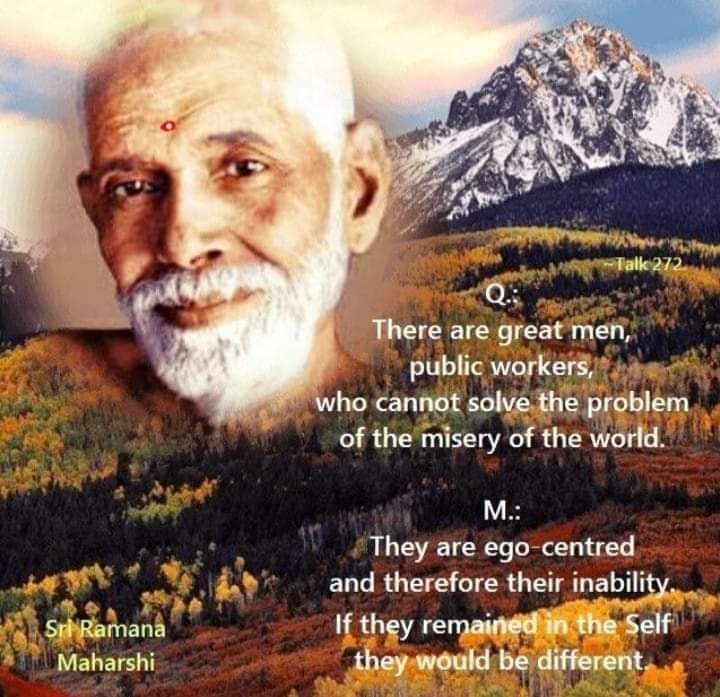
Sri Ramana Maharshi on great public workers trying to reduce misery and suffering in the world

Excerpt from Talks with Sri Ramana Maharshi, Talk 272
Devotee: There are widespread disasters spreading havoc in the world e.g., famine and pestilence. What is the cause of this state of affairs?
Sri Ramana Maharshi: To whom does all this appear?
D: That won’t do. I see misery around.
M: You were not aware of the world and its sufferings in your sleep; you are conscious of them in your wakeful state. Continue in that state in which you were not afflicted by these. That is to say, when you are not aware of the world, its sufferings do not affect you. When you remain as the Self, as in sleep, the world and its sufferings will not affect you. Therefore look within. See the Self! There will be an end of the world and its miseries.
D: But that is selfishness.
M: The world is not external. Because you identify yourself wrongly with the body you see the world outside, and its pain becomes apparent to you. But they are not real. Seek the reality and get rid of this unreal feeling.
D: There are great men, public workers, who cannot solve the problem of the misery of the world.
M: They are ego-centred and therefore their inability. If they remained in the Self they would be different…
The Rope and Snake: the true meaning may surprise you, as explained by Sri Ramana Maharishi | Advaita Vedanta
Does it really just begin and end with ME?
You have done ENOUGH (You Don’t Have To Pretend To Be A Person Anymore)
The meaning of ‘Real’ and ‘Unreal’ in Advaita Vedanta | The Mirage analogy vs the Rope and Snake | The world and self-realisation
Also see this post on Ajata Vada and this post on Turiya
‘Unreal’, both in Vedanta and in common parlance, means that which doesn’t actually exist; ‘real’ means that which exists.
This means that if something exists it is real, and vice versa. This is highlighted by the fact that in Sanskrit, the most common word for both ‘real’ and ‘exists’ is the same word ‘satya’ or ‘sat’. ie. the Sanskrit word ‘sat’ means both ‘real’ and ‘exists’. I have seen some commentators say that something can be unreal but still exist, and vice versa. In doing so they have uncoupled the meaning of these synonymous words, ‘real’ and ‘exists’, which is particularly ironic as in Sanskrit they are one and the same word, ‘sat’.
Vedanta texts say that which changes is unreal, or the things that are subject to change are unreal, meaning that which changes does not truly exist (ie. They do not exist in self-realisation, or they are non-existent when the self is realised).
Vedanta texts do not define ‘real’ as being ‘that which doesn’t change’, nor does the word ‘unreal’ simply refer to things that exist but change/are subject to change. Never do we see this false definition in the Vedanta scriptures.
I hope you can see the difference. If you cannot see the difference, then please reflect on the above as it is in important part of the teaching, and this is an important way the teaching is distorted by the ego-mind.
Note that if the teaching is distorted in this way it is likely not to lead to liberation.
So how does this all fit together?
The idea is that if you discover Sat (reality) in its true essence, meaning as it really or truly is, devoid of illusion or ignorance, all that is anitya (impermanent) will disappear, and so be revealed to be asat (unreal or non-existent), its only having appeared to exist due to ignorance/error.
This has been explained by Sri Ramana Maharshi many times, for example, see the following verses of Sri Ramana Paravidyopanishad:
88. That which survives in the experience of the real Self is the supreme state. [That] alone is real. All else is only unreal. This is the distinction between the real and the unreal, revealed to us by the teachings of all the sages.
91 As the dream world is known to be unreal for the reason that it vanishes upon waking, so this waking world is also proved to be unreal by its vanishing in the light of the real Self.
92 But ignorant men, who are averse to winning the supreme state, put forth an endless series of arguments, [trying to refute this teaching]. The sages clear the doubts generated by these arguments so that earnest aspirants may not be deluded by them.
We are then cautioned about teaching this teaching to those who are attached to the notion that they are the body mind (living in a world), or those who cling to the notion of the self being the owner of the body mind:
93 This teaching of the unreality of the world is not addressed to those who look upon the body itself as the Self, or consider the Self to be the owner of the body. For these people the world is real, not unreal.
However, for those who genuinely seek liberation, this teaching is given:
95 To those who seek deliverance, the teaching is that all these three are equally unreal. This teaching must [therefore] be accepted, exactly as it is taught, by those who are earnestly seeking to win deliverance by the extinction of ignorance.
How can something that we perceive be unreal? Sri Ramana explains:
98 Everyone who is ignorant [of the real Self] thinks the world is real because it is seen. This is no proof because it proves too much. The same reason would prove the reality of the mirage, the rope in the snake, etc.
And so the text continues in this vein, drumming home the teaching. See the introductory articles on tomdas.com to explore this further, especially this article. I have made a YouTube video on this that explains this more here.
AN OBJECTION TO THIS TEACHING – THE MIRAGE vs ROPE & SNAKE
Q. Tom, a mirage exists yet it is unreal. In the same sense a separate ego-mind-body-world exists yet is unreal in the sense that its existence is dependent. Knowing that on which it depends as oneself is bliss…..
Just some early morning musings…
Tom: this is not the vedanta teaching given in the Upanishads. This is a modern re-writing of the vedantic teaching.
Vedanta usually uses the rope and snake metaphor, eg, Sri Ramana Maharshi writes in Who Am I?:
Q. When will the realization of the Self be gained?
A. When the world which is what-is-seen has been removed, there will be realization of the Self which is the seer.
Q. Will there not be realization of the Self even while the world is there?
A. There will not be.
Q. Why?
If the mind, which is the cause (and base) of all knowledge (all objective knowledge) and all action, subsides, the perception of the world (jagat-drishti) will cease. Just as the knowledge of the rope, which is the base, will not be obtained unless the knowledge of the snake, the superimposition, goes, so the realization of Self (swarupa-darsanam), which is the base, will not be obtained unless the perception of the world (jagat-drishti) which is a superimposition, ceases.
And later from the same text:
When the mind comes out (rises) from Self, the world appears. Therefore, when the world appears, Self will not appear; and when Self appears (shines), the world will not appear.
And later:
The mind will subside only by means of the enquiry Who am I?’. The thought ‘Who am I?’ (which is but a means for turning our attention Selfwards), destroying all other thoughts, will itself finally be destroyed like the stick used for stirring the funeral pyre.
And later:
By repeatedly practising thus, the power of the mind to abide in its source increases. When the mind (the attention), which is subtle, goes out through the brain and sense-organs (which are gross), the names-and-forms (the objects of the world), which are gross, appear; when it abides in the heart (its source, Self), the names-and-forms disappear. Keeping the mind in the heart (through the above-described means of fixing our attention in Self), not allowing it to go out, alone is called ‘Selfwardness’ (ahamukham) or ‘introversion’ (antarmukham). Allowing it to go out from the heart alone is called ‘extroversion’ (bahirmukham). When the mind thus abides in the heart, the ‘I’ (the thought ‘I’, the ego), which is the root of all thoughts, having vanished, the ever-existing Self alone will shine.
And later:
The place (or state) where even the slightest trace of the thought ‘I’ does not exist, alone is Self (swarupam). That alone is called ‘Silence’ (maunam). To be still (summa iruppadu) in this manner alone is called ‘seeing through (the eye of) knowledge’ (jnana-drishti). To be still is to make the mind subside in Self (through Self-attention). Other than this, knowing the thoughts of others, knowing the three times (past, present and future), knowing events in distant places – all these can never be jnana-drishti (knowledge realisation).
And later:
What really exists is Self (atma-swarupam) alone. The world, soul and God are superimpositions in it like the silver in the mother-of-pearl; these three appear simultaneously and disappear simultaneously.
🙏🙏🙏
Aham Sphurana – Scintillations of Jnana from Sri Ramana Maharshi – PDF download of the complete unedited text
This is one of several recommended reading texts (click on the link to see the others). You will also find a list of introductory articles on the homepage of this website which share and clarify the essential teachings.
Aham Sphurana [‘I Shining’ or ‘I vibration’ or ‘I Am shining’ or ‘Shining of the I AM’], an unedited text of over 1000 pages, claims to contain a collection of previously unpublished talks with Sri Ramana Maharshi as apparently recorded by a visitor to Sri Ramana Ashrama, Sri Gajapathi Aiyyer, in 1936.
This is a controversial text and the authenticity of the teachings as being genuinely from Sri Ramana Maharshi cannot be confirmed, a fact acknowledged in the manuscript preamble itself, but I share these teachings here in case they are of interest to you. Whilst I have not read the entire text, I have found the teachings I have read so far to be wonderfully clear and unusually deep. Note that the essential teachings presented here are no different to the teachings from Sri Ramana Maharshi you will find elsewhere, but the way they are presented may be helpful to many.
At the time of writing this post, there is also a 280 page version of this text which is available from Open Sky Press – this is a beautifully arranged set of teachings collated from Aham Sphurana – but the teachings have been edited and therefore subtly changed. Sometimes this makes the teachings easier to access, but sometimes the meaning of the text may inadvertently be altered.
For example, this post, which I have presented in unedited form, is also present in the Open Sky Press version but the word ‘solipsism’ was removed from the edited version of the text on page 57 and for some reason replaced with the word ‘egoism’; the reference to Berkeley was also removed and the Latin phrase was (slightly) wrongly translated. For some this may make it easier to access, as the word solipsism is a philosophical term that some may not be familiar with, but for others reading Sri Ramana’s alleged view on solipsism may be fascinating and useful, and the removal of this term could take away from the depth of the teaching; similarly with the reference to the philosopher Berkeley.
Having read many spiritual texts, my personal preference is to read as near to the source material as possible (and where possible to go to primary sources themselves), as this gives the most accurate presentation of the teachings. I have read many texts that try to be helpful through editing but many end up inadvertently distorting the teachings. This is also why when I make comments on texts, I try to make it very clear what is added by me as opposed to what is present in the original, so the reader has an opportunity to assess my comments in light of the actual source material. To this end I am sharing the unedited PDF here for those who find it useful.
Best wishes & Namaste
Tom