real
The meaning of ‘Real’ and ‘Unreal’ in Advaita Vedanta | The Mirage analogy vs the Rope and Snake | The world and self-realisation
Also see this post on Ajata Vada and this post on Turiya
‘Unreal’, both in Vedanta and in common parlance, means that which doesn’t actually exist; ‘real’ means that which exists.
This means that if something exists it is real, and vice versa. This is highlighted by the fact that in Sanskrit, the most common word for both ‘real’ and ‘exists’ is the same word ‘satya’ or ‘sat’. ie. the Sanskrit word ‘sat’ means both ‘real’ and ‘exists’. I have seen some commentators say that something can be unreal but still exist, and vice versa. In doing so they have uncoupled the meaning of these synonymous words, ‘real’ and ‘exists’, which is particularly ironic as in Sanskrit they are one and the same word, ‘sat’.
Vedanta texts say that which changes is unreal, or the things that are subject to change are unreal, meaning that which changes does not truly exist (ie. They do not exist in self-realisation, or they are non-existent when the self is realised).
Vedanta texts do not define ‘real’ as being ‘that which doesn’t change’, nor does the word ‘unreal’ simply refer to things that exist but change/are subject to change. Never do we see this false definition in the Vedanta scriptures.
I hope you can see the difference. If you cannot see the difference, then please reflect on the above as it is in important part of the teaching, and this is an important way the teaching is distorted by the ego-mind.
Note that if the teaching is distorted in this way it is likely not to lead to liberation.
So how does this all fit together?
The idea is that if you discover Sat (reality) in its true essence, meaning as it really or truly is, devoid of illusion or ignorance, all that is anitya (impermanent) will disappear, and so be revealed to be asat (unreal or non-existent), its only having appeared to exist due to ignorance/error.
This has been explained by Sri Ramana Maharshi many times, for example, see the following verses of Sri Ramana Paravidyopanishad:
88. That which survives in the experience of the real Self is the supreme state. [That] alone is real. All else is only unreal. This is the distinction between the real and the unreal, revealed to us by the teachings of all the sages.
91 As the dream world is known to be unreal for the reason that it vanishes upon waking, so this waking world is also proved to be unreal by its vanishing in the light of the real Self.
92 But ignorant men, who are averse to winning the supreme state, put forth an endless series of arguments, [trying to refute this teaching]. The sages clear the doubts generated by these arguments so that earnest aspirants may not be deluded by them.
We are then cautioned about teaching this teaching to those who are attached to the notion that they are the body mind (living in a world), or those who cling to the notion of the self being the owner of the body mind:
93 This teaching of the unreality of the world is not addressed to those who look upon the body itself as the Self, or consider the Self to be the owner of the body. For these people the world is real, not unreal.
However, for those who genuinely seek liberation, this teaching is given:
95 To those who seek deliverance, the teaching is that all these three are equally unreal. This teaching must [therefore] be accepted, exactly as it is taught, by those who are earnestly seeking to win deliverance by the extinction of ignorance.
How can something that we perceive be unreal? Sri Ramana explains:
98 Everyone who is ignorant [of the real Self] thinks the world is real because it is seen. This is no proof because it proves too much. The same reason would prove the reality of the mirage, the rope in the snake, etc.
And so the text continues in this vein, drumming home the teaching. See the introductory articles on tomdas.com to explore this further, especially this article. I have made a YouTube video on this that explains this more here.
AN OBJECTION TO THIS TEACHING – THE MIRAGE vs ROPE & SNAKE
Q. Tom, a mirage exists yet it is unreal. In the same sense a separate ego-mind-body-world exists yet is unreal in the sense that its existence is dependent. Knowing that on which it depends as oneself is bliss…..
Just some early morning musings…
Tom: this is not the vedanta teaching given in the Upanishads. This is a modern re-writing of the vedantic teaching.
Vedanta usually uses the rope and snake metaphor, eg, Sri Ramana Maharshi writes in Who Am I?:
Q. When will the realization of the Self be gained?
A. When the world which is what-is-seen has been removed, there will be realization of the Self which is the seer.
Q. Will there not be realization of the Self even while the world is there?
A. There will not be.
Q. Why?
If the mind, which is the cause (and base) of all knowledge (all objective knowledge) and all action, subsides, the perception of the world (jagat-drishti) will cease. Just as the knowledge of the rope, which is the base, will not be obtained unless the knowledge of the snake, the superimposition, goes, so the realization of Self (swarupa-darsanam), which is the base, will not be obtained unless the perception of the world (jagat-drishti) which is a superimposition, ceases.
And later from the same text:
When the mind comes out (rises) from Self, the world appears. Therefore, when the world appears, Self will not appear; and when Self appears (shines), the world will not appear.
And later:
The mind will subside only by means of the enquiry Who am I?’. The thought ‘Who am I?’ (which is but a means for turning our attention Selfwards), destroying all other thoughts, will itself finally be destroyed like the stick used for stirring the funeral pyre.
And later:
By repeatedly practising thus, the power of the mind to abide in its source increases. When the mind (the attention), which is subtle, goes out through the brain and sense-organs (which are gross), the names-and-forms (the objects of the world), which are gross, appear; when it abides in the heart (its source, Self), the names-and-forms disappear. Keeping the mind in the heart (through the above-described means of fixing our attention in Self), not allowing it to go out, alone is called ‘Selfwardness’ (ahamukham) or ‘introversion’ (antarmukham). Allowing it to go out from the heart alone is called ‘extroversion’ (bahirmukham). When the mind thus abides in the heart, the ‘I’ (the thought ‘I’, the ego), which is the root of all thoughts, having vanished, the ever-existing Self alone will shine.
And later:
The place (or state) where even the slightest trace of the thought ‘I’ does not exist, alone is Self (swarupam). That alone is called ‘Silence’ (maunam). To be still (summa iruppadu) in this manner alone is called ‘seeing through (the eye of) knowledge’ (jnana-drishti). To be still is to make the mind subside in Self (through Self-attention). Other than this, knowing the thoughts of others, knowing the three times (past, present and future), knowing events in distant places – all these can never be jnana-drishti (knowledge realisation).
And later:
What really exists is Self (atma-swarupam) alone. The world, soul and God are superimpositions in it like the silver in the mother-of-pearl; these three appear simultaneously and disappear simultaneously.
🙏🙏🙏
For those attached to the world, the world is considered to be a divine manifestation. For the advanced seeker, the world is considered to be an illusion | Advaita Vedanta | Sri Ramana Maharshi | Ajata Vada
For those seekers who are attached to the world, the world is considered to be a divine manifestation. For the more advanced seeker, the world is considered to be an illusion. Many teachers teach this the wrong way around – this, of course, is itself due to their attachment to the world, ie. this wrong teaching is due to ignorance.
This is why Sri Ramana says, right at the start in the beginning few verses of The Garland of Gurus Sayings (Guru Vachaka Kovai), in verse 21:
21. For those who take the world appearance as real and enjoy it, it is the Lord’s creation. But for those who, free from fear, have known the Truth, the undeluded Self, it is no more than a mere mental image projected by desire.
For those who are fearful of the world, Sri Ramana gives the following even more radical advice in the same text, verse 28:
28. Ye who in fear shrink from the world, know that the place has no existence. Fear of this phenomenal world is like being frightened by a rope mistaken by you for a snake.
In verse 35 he uses the same analogy as Gaudapada (in his commentary on Mandukya Upanishad, Mandukya Karika), of a glowing flame whirled in a circle:
35. The empirical world of jostling names and forms is false and has no real existence in bright, full Awareness. Like a ring of fire formed in the dark when one whirls fast a glowing joss-stick, ’tis an illusion, mind-created.
The idea here is that in the dark (ie. in ignorance), a whirling flame appears as a world (that is a body, a mind and a world), but in the light (ie. in self-knowledge or self-realisation, also known as liberation), it is not seen at all.
Sri Ramana explains this in page 193 of Day by Day with Bhagavan when he states:
‘In reality, saying ‘We must see Brahman in everything and everywhere’ is also not quite correct. Only that state is final, where there is no seeing, where there is no time or space. There will be no seer, seeing and an object to see. What exists then is only the infinite eye.’

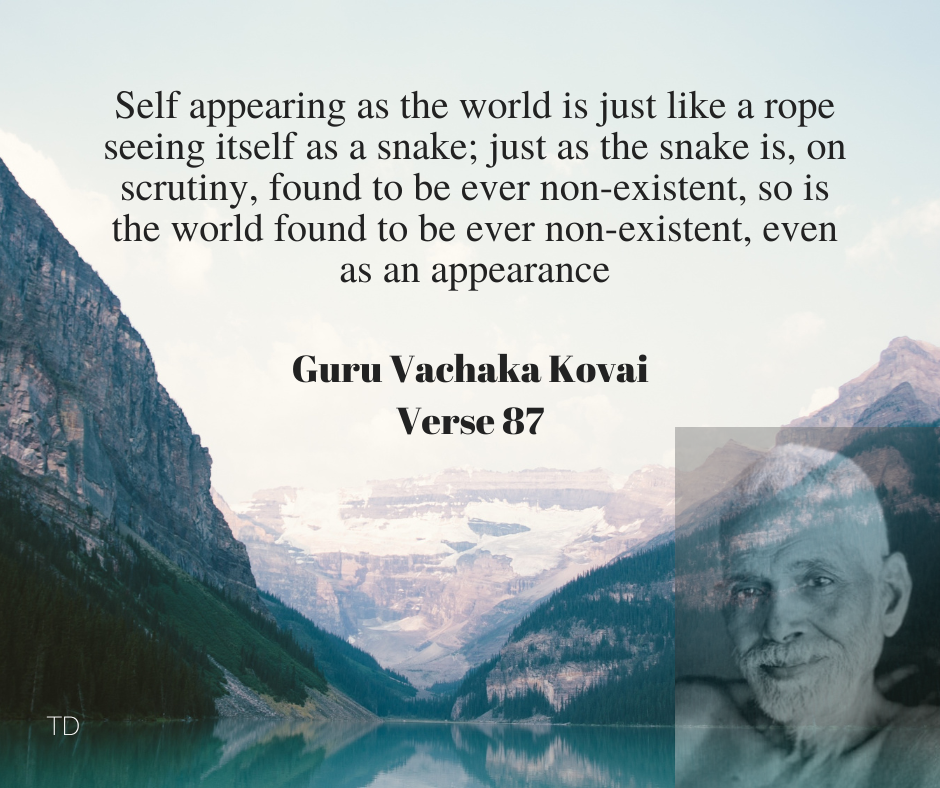
Similarly, Sri Ramana says in Guru Vachaka Kovai, verse 87:
‘…just as the snake is, on scrutiny, found to be ever non-existent, so is the world found to be ever non-existent, even as an appearance‘
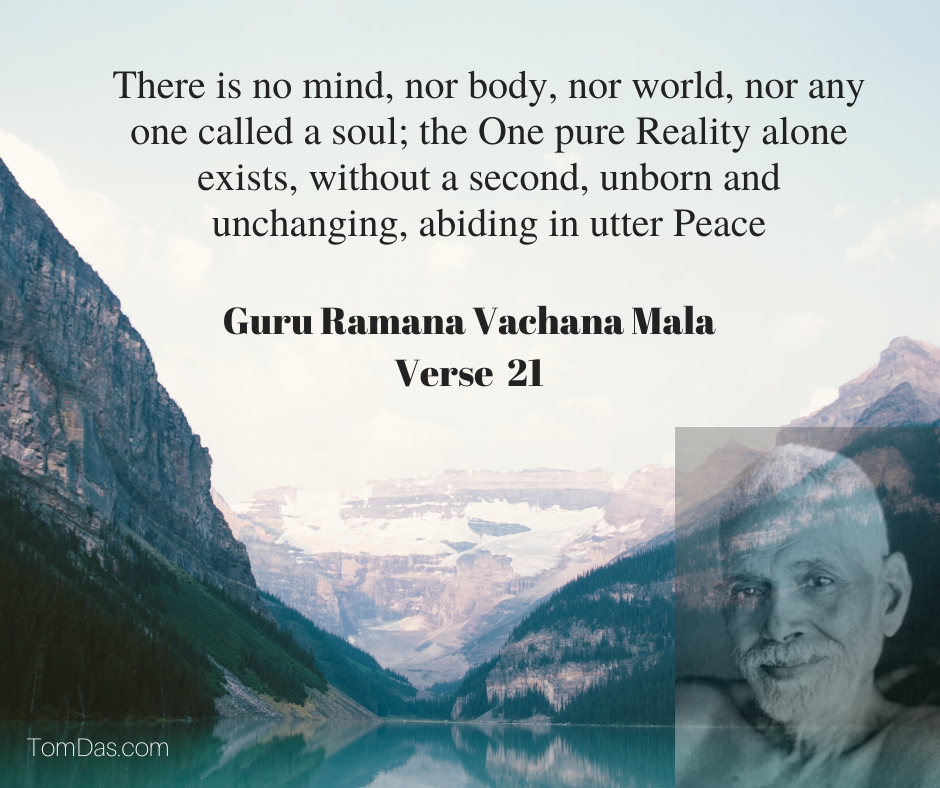
And in Guru Ramana Vachana Mala, verse 21, Sri Ramana gives us the Ajata teaching, that no-thing ever really came into existence at all:
‘There is no mind, nor body, nor world, nor anyone called a soul; the One pure Reality alone exists, without a second, unborn and unchanging, abiding in utter Peace’
For more on this teaching see here and here
Namaste
Is this world real or an illusion? | Verses from Guru Vachaka Kovai | Ramana Maharshi
Shakara did not teach ‘The world is an illusion, only Brahman is real, the world is Brahman’
As far as I’m aware Shankara never actually taught ‘The world is an illusion, only Brahman is real, the world is Brahman.’ – this appears to be a misquote.
The actual teaching is ‘Brahma satyam, jagat mithya, jivo brahmaiva naparah’
..which means:
‘Brahman is Truth/Reality, the world is illusion, the Jiva (individual Self or ‘I’ or ‘I Am’) [when enquired into] is nothing but Brahman’
The true meaning of ‘real’ and ‘unreal’ in Vedanta (Sat and asat) | False Vedanta Teachings
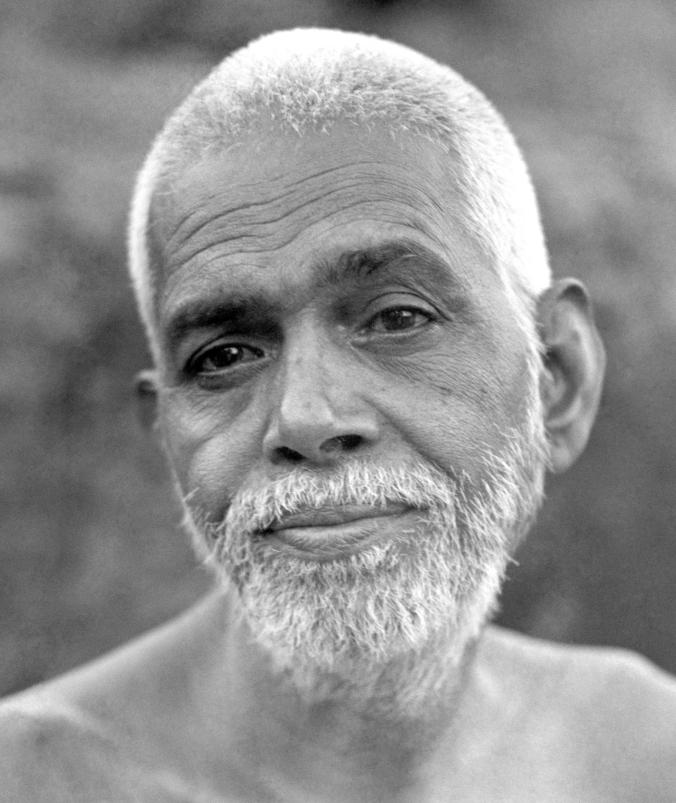
Ramana Maharshi: ‘…unless you give up the idea that the world is real…’
Question: I cannot say it is all clear to me. Is the world that is seen, felt and sensed by us in so many ways something like a dream, an illusion?
Sri Ramana Maharshi: There is no alternative for you but to accept the world as unreal, if you are seeking the Truth and the Truth alone.
Question: Why so?
Sri Ramana Maharshi: For the simple reason that unless you give up the idea that the world is real, your mind will always be after it. If you take the appearance to be real you will never know the Real itself, although it is the Real alone that exists. This point is illustrated by the analogy of the ‘snake in the rope’. As long as you see the snake you cannot see the rope as such. The non-existent snake becomes real to you, while the real rope seems wholly non-existent as such.
Question: It is easy to accept tentatively that the world is not ultimately real, but it is hard to have the conviction that it is really unreal.
Sri Ramana Maharshi: Even so is your dream world real while you are dreaming. So long as the dream lasts, everything you see, feel, etc., therein is real.
Question: Is then the world nothing better than a dream?
Sri Ramana Maharshi: What is wrong with the sense of reality you have while you are dreaming? You may be dreaming of something quite impossible, for instance, of having a happy chat with a dead person. Just for a moment you may doubt in the dream saying to yourself, ‘Was he not dead?’, but somehow your mind reconciles itself to the dream vision, and the person is as good as alive for the purposes of the dream.
In other words, the dream as a dream does not permit you to doubt its reality. Even so, you are unable to doubt the reality of the world of your wakeful experience. How can the mind which has itself created the world accept it as unreal? That is the significance of the comparison made between the world of wakeful experience and the dream world. Both are but creations of the mind and so long as the mind is engrossed in either, it finds itself unable to deny the reality of the dream world while dreaming and of the waking world while awake.
If, on the contrary, you withdraw your mind completely from the world and turn it within and abide thus, that is, if you keep awake always to the Self, which is the substratum of all experience, you will find the world, of which alone you are now aware, just as unreal as the world in which you lived in your dream.
The above excerpt was taken from Maharshi’s Gospel
 Tom Das