realisation
Is there more to be done after Self-Realisation? | Vivekachudamani | Adi Shankara
How long did it take for Sri Ramana Maharshi to realise the Self?
Also see: Was Ramana Maharshi’s self-realisation final and complete when he was a teenager?
Tom: as usual my explanatory comments are inserted in italiscised red
Questioner: How long did it take Maharshi to realise the Self?
Bhagavan Sri Ramana Maharshi: This question is asked because the name and form are perceived. These are the perceptions consequent on the identification of the ego with the gross body.
Tom’s comments: Bhagavan Sri Ramana is stating that perception of name and form only occur after ignorance, ignorance being the notion that I am the body (or body-mind). This is consistent with his writing in ‘Who Am I?‘:
When the mind comes out (rises) from Self, the world appears. Therefore, when the world appears, Self will not appear; and when Self appears (shines), the world will not appear
Therefore, Sri Ramana is stating this question only is asked due to ignorance of taking Sri Ramana to be a person (ie. a body-mind entity) who at one time attained realisation, when in fact Sri Ramana is just the ever-realised Self, which is the only existent reality. That said, the fact that Sri Ramana gave out this teaching to this devotee in itself meant that the devotee was spiritually developed enough to receive this higher teaching.
If the ego identifies itself with the subtle mind, as in dream, the perceptions are subtle also. But in sleep there are no perceptions. Was there not the ego still? Unless it was, there cannot be the memory of having slept. Who was it that slept? You did not say in your sleep that you slept. You say it now in your wakeful state. The ego therefore is the same in wakefulness, dream and sleep.
Tom’s comments: Sri Ramana is stating that objects are seen in dream but not seen in deep sleep. In this instance he states that the ego is present in all 3 states of waking/dream/deep sleep and next he will say we are to find the reality that underlies these 3 states. When that is found, the 3 states are no longer present, he will say:
Find out the underlying Reality behind these states. That is the Reality underlying these.
In that state there is Being alone.
There is no you, nor I, nor he; no present, nor past, nor future. It is beyond time and space, beyond expression.
It is ever there.
Just as a plantain tree produces shoots at its roots, before yielding fruits and perishing, and these shoots, being transplanted, do the same again, so also the original primeval Master of antiquity (Dakshinamurti), who cleared the doubts of his rishi disciples in silence, has left shoots which are ever multiplying. The Guru is a shoot of that Dakshinamurti.
The question does not arise when the Self is realised.
~ Talks with Sri Ramana Maharshi, Talk no. 17
Faith & Inner-knowing are the same thing | Sri Ramana Maharshi
The Self can Never be a Witness
The Self is not a witness at all, and it can never be a witness in Truth, but as long as we think we are a body-mind entity, and as long as we see a world outside of or apart from ourself, the Self is indicated or pointed out as being the Subject or the Witness merely for the purposes of the teaching.
When in Self-Enquiry we turn our attention away from the objects, which means we turn our attention away from the various gross and suble phenomena that are perceived, and towards the Subject or Self (‘Witness’), also known as the I AM or the 1st person, eventually the ego-mind which takes itself to be a body-mind entity dissolves or dies and all that is left is the Subject-Witness-Self.
This Self can no longer truly be said to be either a Subject (for there are no objects present), nor can it be said to be a Witness, as there is nothing to witness. It is All, it is the Sole Reality, ‘One without a second’, as it is often described as being in the Upanishads.
Hence Bhagavan Ramana is recorded as saying:
If you refrain from looking at this
Or that or any other object
Then by that overpowering look
Into absolute Being you become
Yourself the boundless space of pure
Awareness which alone is Real Being.
~ Sri Ramana Maharshi, Guru Vachaka Kovai, Verse 647
The ego/mind, when attending to objects, considers itself to be an object (the body-mind). However, when the ego attends or pays attention to itself (also known as the I-sense, or first person, or I am), and in so doing no longer pays attention to the objects it was previously attending or paying attention to, it discovers its true nature without objects, ie it’s true formless nature, then it has actually discovered its actual or real nature which is Self.
This is why Sri Ramana states In Day by Day with Bhagavan:
‘The mind turned inwards is the Self; turned outwards, it becomes the ego and all the world’

What happens to the mind whilst realising the Self? | Clarity of mind during realisation | Maya
Nothing exist except the Self | Ajata Vada | Drishti-Srishti Vada
What happens to the mind whilst realising the Self? | Clarity of mind during self- realisation | Maya
If God is everywhere, why do we have to turn within? Why can’t we see God in the World? How is God to be seen? Sri Ramana Maharshi
Also see:
Ramana Maharshi: how to abide as the Self
The need to turn within according to Advaita Vedanta
‘We must see Brahman in everything and everywhere’ is also not quite correct
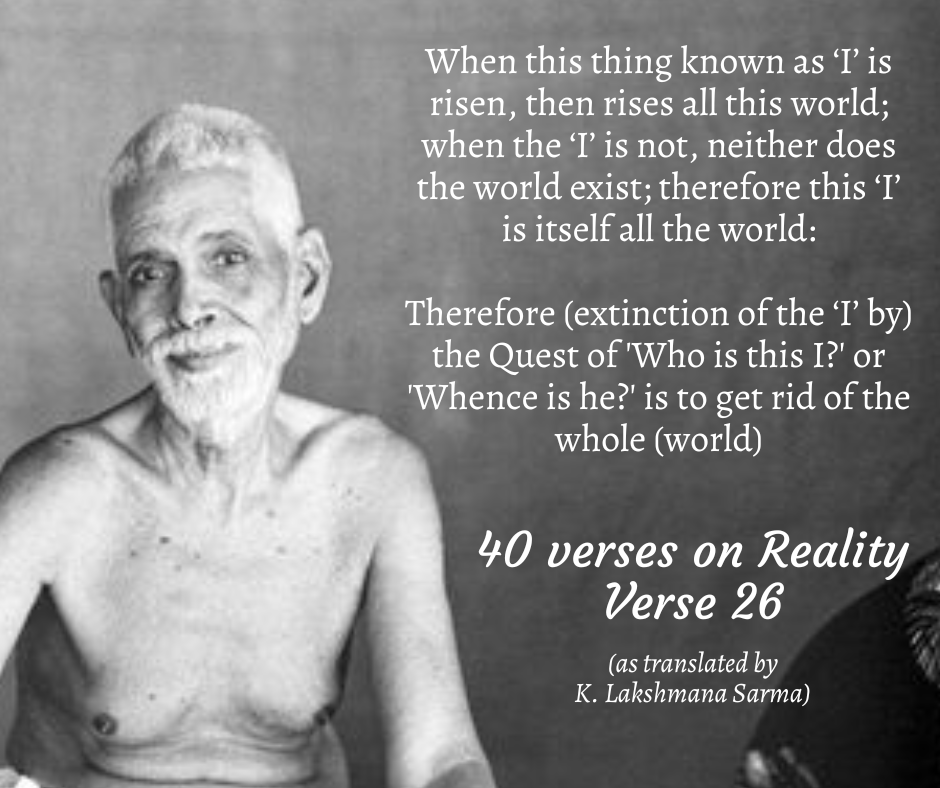
The following is from Talks with Sri Ramana Maharshi, Talk no. 244:
Question: How is God to be seen?
Sri Ramana Maharshi: Within. If the mind is turned inward God manifests as inner consciousness.
Tom: here Bhagavan Sri Ramana gives us the essential teaching – God is to be found within – not outside, meaning not in the body, mind or world, but within, meaning in the non-conceptual Self that is the Subject. As Ramana himself wrote in the text ‘Who Am I?’:
Question: When will the realization of the Self be gained?
Answer: When the world which is what-is-seen has been removed, there will be realization of the Self which is the seer.
And in the same text, Who Am I?, in the answer to question 16 it is written:
‘the Self itself is God’
However, the questioner poses a seemingly logical question, namely that if God is everywhere, why cannot be see God everywhere? Why the need to look within when we can just as easily look outside at ‘God’s creation’, through our senses and see God there? Let us see:
Q: God is in all – in all the objects we see around us. They say we should see God in all of them.
Sri Ramana Maharshi: God is in all and in the seer. Where else can God be seen? He cannot be found outside. He should be felt within. To see the objects, mind is necessary. To conceive God in them is a mental operation. But that is not real. The consciousness within, purged of the mind, is felt as God.
Tom: here Sri Ramana is stating that to see God outside is merely to see a projection of the mind, for according to Sri Ramana, as we shall see shortly, all objective phenomena are mere thoughts, or projections of the mind, much like a dream objects are projection of the mind. An alternative explanation is that to see God in objective phenomena is actually a subtle act of the mind, a conceptual framework we are overlaying onto objects.
However, the questioner persists in pursuing their line of enquiry by challening Sri Ramana – are not various objects beautiful? Are not colours lovely to look at? Can we not see God in these objects too? Let us see:
Q: There are, say, beautiful colours. It is a pleasure to watch them. We can see God in them.
Sri Ramana Maharshi: They are all mental conceptions.
Q: There are more than colours. I mentioned colours only as an example.
Sri Ramana Maharshi: They are also similarly mental.
Tom: the questioner states that we can see God in objects and through the senses, but Sri Ramana dismisses this as mere concepts. The questioner, having raised objective qualities such as colour, then having raised other senses, not just colour now goes onto the body and the mind:
Q: There is the body also – the senses and the mind. The soul makes use of all these for knowing things.
Sri Ramana Maharshi: The objects or feelings or thoughts are all mental conceptions. The mind rises after the rise of the I-thought or the ego. Wherefrom does the ego rise? From the abstract consciousness or Pure intelligence.
Tom: Here Sri Ramana again states that the body, senses and mind are all mental conceptions (or mental projections), as are all objects, feelings and thoughts.
He then goes on to give a teaching given in the aforementioned text ‘Who Am I?’, that the first though is the ‘I-thought’ also known as the ego, and only once this has risen can other thoughts or objective phenomena arise such as the body, the mind and the world. In this way Bhagavan Sri Ramana is repeating his teaching, a teaching also taught in the Upanishads and by Sri Shankara, that the body-mind-world is actually a projection of ego or ignorance.
What is the source of this ego or I-thought? It is the Self, or Pure Consciousness as he refers to it here. The word ‘pure’ denotes the absence of arisising objective phenomena, which is consistent with the teaching explained in my above paragraph.

Later in the same dialogue (Talk 244) Sri Ramana explains that the ego or ‘I-thought’ gives rise to (or projects out) the mind, and the mind then projects out a body:
Sri Ramana Maharshi: The sense of body is a thought; the thought is of the mind, the mind rises after the ‘I-thought’, the ‘I-thought’ is the root thought. If that is held, the other thoughts will disappear. There will then be no body, no mind, not even the ego.
Q: What will remain then?
Sri Ramana Maharshi: The Self in its purity.
Tom: We can see that Sri Ramana is re-iterating that the body and mind are both projections of thought, and that their root is the ego, also known as the I-thought. When this ego-root (ie. ignorance) is cut down, by self-enquiry, all thoughts cease and the Self remains in its purity. As the body, mind and ego are all thoughts, Bhagavan Sri Ramana here explicitly states that in Self-Realisation there is no body, mind or ego. All that remains is the pure Self, again ‘pure’ denoting the lack of objective phenomena such as body, mind, world, feelings, sensations, etc.
As always, please do not simply accept teachings at face value. It is always good to read teachings in their proper context, so I encourage you to not just accept my commentary above, but to read the full talk for yourself so you can see it in its context. You will find many other valuable teachings in this talk too, such as Sri Ramana’s exposition of the three states and how he equates deep sleep with the Self, how he says that the world is a mere dream, his insistence that Self-Enquiry is the easiest path, and that Happiness or Pleasure or God can only truly be found Within.
Non-duality, Self-Realisation and the appearance of the world | Sri Sadhu Om
The following is taken from the wonderful text Sadhanai Saram written by Sri Sadhu Om. My comments are in italiscised red:
Duality only appears due to a lack of self-enquiry:
- Know that the world, soul and God have all seemingly come into existence only because of our pramada or slackness in Self-attention.
It is the unreal and illusory ego that sees the (illusory and unreal) world:
- The entire universe composed of the five elements, earth, water, fire, air and space, appears only due to our error of mistaking as ‘I’ the ego that rises from Self like a spark rising from fire, and which appears as different from Self whose nature is Being, and as identical with the mind, whose nature is rising.
Self-enquiry ends the ego illusion and duality:
- The entire appearance of this world that is seen, including we (the individual or jiva) who see it, is a mere false appearance like a dream. If we keenly scrutinize the source (the real ‘I am’) from which the seeing ego rises, and thereby enter the heart and firmly abide there, the reality will shine forth (and the appearance of the triad – the seer, seeing and object seen – will disappear).
There is no desire or fear in the Self (or in Self-realisation), both of these being due to ignorance/ego or illusion:
- If we attain the otherness-free knowledge (ananya jnana), that this world is nothing but our own Self, seen wrongly in our self by our self through our power of imagination, then the delusion of desire for or fear of the world (the objects we see in front of us), will never rise again; and we will merge in and become one with Self. This alone is our natural state.
The formless Self alone exists:
- Self alone exists. Except oneself, nothing exists. But if one takes this pure consciousness, which exists and shines as ‘I’ to be the body, every thing will assume a form and appear to exist. If one inquires, “Is this ‘I’ only the body, or is it something else?” and thereby sees the true nature of “I,” every thing will cease to exist. See thus.
A summary and reiteration of what has been stated above:
- If you ask, “For what reason is it said, that if one inquires and knows oneself, this entire world would disappear?” The reason is that the result at tained by the inquiry “Who am I?” is the destruction of the unreal individual (jiva), the ego, who is immersed in activity due to his taking the body to be himself. (That is, since the entire world-appearance depends for its seeming existence upon the ego who sees it, and since the ego itself has no real existence of its own, when the real ‘I’ is known, the ego will be found to be truly non-existent; where upon, the world-appearance will vanish, having no one to see it and thereby to give it a seeming exis tence).
The false ‘I’ is the ego, also known as maya. Enquire into the ‘I’, that is, do self-enquiry, and this illusion will vanish, along with the body, the mind and the world. Compare to Revelation Verse 31.
- The ‘I’ which cannot shine without being joined with a body-form, is alone the ghost-like ego ‘I’, the great illusion (maya). If one courageously and without fear inquires, “Who is this I?” it will become non-existent, and along with it everything else will cease to exist.
- If this ‘I’ the self-rising ego-appearance, is destroyed by the inquiry “Who am I?”, then everything else, which till then appeared only in him (in the mind) but which was seen as if existing outside of him, will cease to exist. The ever-existing Whole or purna, which then shines forth as ‘I-I’ the blissful existence which neither appears nor disappears, is the real Self, the true import of the word ‘I’.
The true Self does not come and go, unlike the body and mind and world:
- The ‘I’ which is the Whole, which is the true import of ‘I’, which shines by its own light without appearing due to the functioning of the five sense-knowledges (and disappearing when they cease to function); which is the exalted and ever unleaving experience of Self, and which is the true nature of everyone, alone is the one non-dual reality; it alone is true knowledge.
The true nature of Jnana (knowledge) is simply the Self. The Self is itself the nature of Knowledge.
- This true knowledge is not anything other than oneself; it is our own existence-consciousness ‘I am’. Why should we suffer by imagining and seeing the soul [Jiva or ego], world and God in this knowledge? Abiding firmly as mere Being, experience this knowledge correctly; then what thing other than oneself will appear there?
True destruction of maya/duality occurs with destruction of the ego:
- The destruction of the entire universe together with the space and other elements that constitute it is not the state of absolute destruction (pralaya). The state in which the wicked ego, which rises in the form of the feeling “This body of flesh is I” (abhimana), drowns in Self and is destroyed entirely, is alone the glorious state of absolute destruction (maha-pralaya).
- After being destroyed in the ordinary destruction at the end of an eon (yuga-pralaya), the heaven and earth will appear again at the proper time. The state in which the Fire of Knowledge (Jnanagni), which blazes forth on being ignited as the churning process of investigation “Who am I?” pervades and shines everywhere, having destroyed the feeling, “I am this body” (dehatma-buddhi), is alone the absolute destruction (maha-pralaya); be cause the ego, which is thus destroyed by the Fire of Knowledge (Jnana) will never appear again.
- The “I,” which continues to live even after the mind has died (as a result of the above said inquiry “Who am I?”) is indeed the Supreme Reality (Brahman), which alone exists after the universal destruction (pralaya). The mind expanding as everything, having risen from the heart (that is, the mind slipping down from the true state of Brahman due to inadvertence or lack of Self-attention (pramada), and thereby becoming the cause for the creation and sustenance of the false appearance of this en tire universe), is not the state of true power; the mind merging and abiding firmly in Self is alone the true state of supreme power.
Note by Sri Sadhu Om: The supreme and truly divine power is not the power of the mind (maya), which creates and sustains the false appearance of the universe, but is only the power of Self-abidance, which reveals the truth that illusion (maya) is ever non-existent.
The cause of duality and of liberation:
- Your appearance as an ego, an individual soul who rises in the form “I am this body,” alone is the root-cause for the appearance of this unreal world. If this root-appearance, the rising of yourself as an individual soul, does not rise even in the least, that state will be the state of liberation, which is completely devoid of the imaginary appearances of the world and God.
- If one has the ability to deny oneself and thereby to destroy the rising of the ego in its very source, what other tapas need one perform? The real Self, the source in which the ego thus subsides and dies, alone is the state which is worth to purchase and attain by selling (or renouncing) all the three worlds.
 Tom Das