Questioner: I want Bhagavan to bestow his compassionate glance of Grace on me, so that I should undergo Emancipation in this very lifetime.
Bhagavan Sri Ramana Maharshi: Listen to the following joke:
Once upon a time man was fully aware of his Realised nature, and all humans enjoyed Transcendental consciousness while yet in a body; but on one fine morning, Brahma found he had become jealous of them, since all humans were then equal to him in rank, all being Realised gods. So, Brahma decided to take Self-knowledge away from man and hide it where it could never be found by him. Where to hide It was the question. So Brahma called a council of the gods of Heaven, headed by Indra, to help him resolve the matter.
“Let us bury it deep in the earth,” said the gods. But Brahma answered, “No, that will not do, because men will dig into the earth and find it.”
Then the gods said, “Let us sink it in the deepest ocean.” But Brahma said, “No, not there, for they will eventually learn to dive into the ocean, and so will surely find it one day.”
Then the gods said, “Let us take it to the top of the highest mountain and hide it there.” But again Brahma replied, “No, that will not do either, because they will sooner or later climb every mountain and once again find their Immortal Self.
We must hide It so thoroughly from man that he will never succeed in finding It again.” Then the gods gave up and said, “We do not know where to hide it, because it seems that there is no place on earth or under the sea that man will not eventually reach.”
Brahma thought for a long, long, long time. Finally he said, “Here is what we shall do. We will hide It deep in the center of their own being, for men will never think to look for It there.” All the gods agreed that this, in fact, was the perfect hiding place, and the deed was done. Ever since that day, men have been going up and down the earth, digging, diving, climbing, and excavating- searching for something which is already within themselves.
Q.: How cruel of Brahma to do such a thing…!
B.: That was only a joke. The point is, turn inwards and SEE. That is Guru’s Grace. Guru’s Grace means inward-vision or introverted mind. Guru’s Grace and Jnana-dhrishti [Tom: literally knowledge-vision, ie. vision of self-knowledge or experience of self-knowledge]are thus one and the same.
The above excerpt is taken from Aham Sphurana, 30th August 1936, see here for more information on this text.
Questioner: For Jnanis it is different; what of the common man?
Bhagavan Sri Ramana Maharshi: You also are a Jnani; only, you think otherwise!
Q.: How could that be?
B.: The option of turning inwards and quietly allowing the mind to plunge and dissolve in the Self is equally available for all. It is not the fiefdom of a select few. All are verily only the Self.
Q.: That does not satisfy me. I am unable to Realise it for myself.
B.: So long as worldly attachments are present the mind cannot be succesfully turned inwards.
Q.: How to eliminate worldly attchment?
B.: By turning the mind inwards.
Q.: Really!
B.: The more you hold on to the Self or retain the mind in its native state of subjective-awareness-sustained-effortlessly-and-volitionlessly, the more the mental tendancies and worldly attachments wither off; the lesser the mental tendancies and worldly attachments, the easier does become retention of the mind in its native state of subjective-awareness-sustained-effortlessly-andvolitionlessly.
Q.: Which comes first?
B.: The sadhaka [Tom: seeker] recognises and reflects upon the ephemeral nature of the objective world and the transient nature of his own body. He gets fed up with material pleasures, because they eventually lead only to sorrow, when their enjoyment becomes, for any reason, impossible. He asks himself if a more permanent experience of life might not be possible.
Then he discovers the Ajata-advaita doctrine. Initially he is not convinced, and argues that if it were a dream there would be no possibility of corroboration, but that here his relatives and friends are able to confirm the evidence provided by his senses; he also asks why the same dream should be repeated everyday, were it all only a dream – according to him, here he sees the same sun, moon and earth everyday, whereas in his dreams he finds himself in new worlds moment to moment.
Eventually it dawns upon him that everything he thinks he knows, including an understanding of the apparent permanency of the world he believes himself to live in, is only thought or imagination. Then at the intellectual level he understands the truth – that the names and forms constituting the world are fictitious. This sparks a search for the substratum said to be underlying them, which alone is said to be Real by the wise.
He hears the teaching that the source of the mind, Beingness, is the gateway to the Real Self. Then he begins the practice of quietening the mind by vichara or any other method, tackling various distractions as and when they arise, by withdrawing attention from them and fixing it on Beingness or the Self. The beginning is only becoming fed-up with the evanescent nature of the world and the fugacious attractions it has to offer.
Q.: The boubts Bhagavan mentioned – they are my doubts also. Why is everyone witnessing the same dream? The sun, moon, etc. are seen by all.
B.: In turn those “all” are seen by you only. In deep slumber when there is no mind, nothing is available to be seen, but your existence is a constant.
Q.: Why do I dream the same dream everyday? For instance yesterday I came to the ashram and had darshan of Bhagawan; he was sitting on the same sofa in exactly the same manner. Today I am seeing Bhagawan and tomorrow also it is going to be the same Bhagawan.
B.: The future is a mere mental projection. The past is a mere memory. Have you not had dreams where the places you visit look extremely familiar?
Q.: At least is the present real?
B.: Anything seen cannot be Real. What is seen is not Pratyaksha. It is not self-evident, because there is a subject-object relationship involved. It is merely sensory information that is fed into the mind by the strength of its own evil faculty of avidya maya. That alone is Real which shines by its own light. You are asking about the objects of the world. Can such objects exist without a YOU, a perceiver? When there is no perceiver, as in swoon or deep slumber, is there anything to be perceived? No. What is the inference? The objects owe the appearance of their apparent existence to you only. They are merely mental creations. The appearance of this enormous cosmos around you is merely a mental information. The mind is fiction. Therefore the ‘objects’ manufactured by it are also fictitious. Have not the least doubt about it.
Q.: If everything is unreal, can we conclude that bondage and liberation are also unreal?
B.: Yes.
Q.: Then why should I try to obtain Liberation? Let me remain as I am.
B.: Exactly!
Q.: I do not understand.
B.: Remaining as you are is the loftiest Sadhana.
Q.: How can remaining in ignorance be sadhana?
B.: You think that you are in ignorance. When you do not think at all, what remains is only wisdom. Removal of the screen of thought is all that is required for Reality to be revealed. Since you want a sadhana by means of which you may reach this thought-free state, vichara is suggested. Actually there is no need for any sadhana for one who has mastered the art of remaining as he is – the art of Being. That is the import of the advice Summa Iru. People generally misunderstand it. It does not mean keeping the body idle. It means keeping the mind still or free from thought. Remain perpetually absorbed in the thought-free I-Current. This will automatically lead you to the Sahaja-stithi [Tom: the natural state] without requirement for further effort.
Q.: Is even desire for Liberation an obstacle to Liberation?
B.: Yes.
The above excerpt is taken from Aham Sphurana, 17th July 1936, see here for more information on this text.
Through devotional chanting, sacred silence, presence, and words, Tom spontaneously weaves Bhakti and Jnana, love and knowledge, in this edited first half of one of his Satsangs.
May this support your inquiry practice and awakening to your True Nature.
This video was recorded live during a Satsang meeting with Tom Das on April 10th, 2025, and put together by volunteers.
1. Seeking will necessarily continue until the ego is completely destroyed. You cannot simply chose to stop seeking or ‘let go of seeking’. THE EFFECTS WILL BE TEMPORARY AT BEST, and this is ultimately dissatisfactory. Seeking (and its counterpart, suffering) will always come back until ego is completely gone. That’s just the way it is. There will always be a sense of lack until the self is discovered.
2. And ego is not destroyed by trying to destroy the ego… Your true nature prior to the arising of ego (ie. source) must be discovered, and the ego ends as a side effect of this discovery of truth.
3. Only when ego is completely destroyed in this way, is it then seen that the ego never existed in the first place. Ego never arose at all! The world (which is a projection of ego, and is also known as duality) never came into existence at all, not even as an appearance! (Why would anyone want this? Because it is heaven, because it is bliss, because it is what you are truly seeking for and have always been seeking for. It is total love, it is your own true self.)
4. Merely saying ‘there is already no such thing as ego’, without having truly discovered the formless objectless worldless Source-Subject-Self, doesn’t work to genuinely end seeking or genuinely end suffering. This is merely an empty proclamation for the mind.
5. This discovery of your true nature is never for the mind (or the body, or the body-mind). Mind is the same as ego. Ego is the same as mind. There is literally no difference. If the discovery is for the mind, suffering may be reduced, but suffering and seeking will still persist on a subtle level until the self is truly known, devoid of thought, devoid of mind.
6. If realisation is for the mind or in the mind, then you are still on the level of seeking, and the true formless self, the source of all, the subject, is yet to be truly discovered – you are still a seeker. The general advice here is to find a teacher, learn the genuine method of self-enquiry and put the teaching into practice.
7. Without a teacher it is very difficult for most to truly learn self-enquiry, which cannot usually be taught from books or from static words, but is transmitted in a variety of ways, including through the well-timed words/interactions of a teacher and through the silence and the presence of the sage. For some the technique can be revealed by simply going/sinking within, towards the I AM (which is the true or ultimate teacher), away from objective phenomena, but this seems to be very rare. The exact path to self-inquiry and self-realiaation (or self-knowledge) for each apparent individual person varies greatly, and so for most a teacher is necessary, or at least very helpful.
8. ‘To know the (worldless objectless) self, is merely to be the (worldless objectless) self.’
9. Eternal love, adoration and gratitude to my beloved guru and teacher, Bhagavan Sri Ramana Maharshi, who is truly the nature of my very own Self, residing in the Heart of all beings, whose radiant presence shines forth in all times and in all places, whose teachings can be discovered by simply turning within and searching within, and who has revealed these teachings to me both in his precious words and within my Heart.
‘All that is necessary is to be rid of the thought: “I have not realised.”’
~ Sri Ramana Maharshi, Talks with Sri Ramana Maharshi, talk no. 245
This teaching sounds so simple, but let us see what this teaching actually means. To do this, we have to take a look at the context in which this teaching was given, and not merely cling to a single quote taken out of context. The quote was taken from talk 245 from the book ‘Talks with Sri Ramana Maharshi’. Let us look at the talk in its entirely. We will see there are many wonderful and revealing teachings packed into this short talk. As usual my comments will be in italicised red and the text itself will be in black:
Devotee (D):“I understand that the Self is beyond the ego. My knowledge is theoretical and not practical. How shall I gain practical realisation of the Self?”
Sri Ramana Maharshi (M).: Realisation is nothing to be got afresh. It is already there. All that is necessary is to be rid of the thought: “I have not realised.”
Tom’s comments: we can see that the questioner is asking a very relevant question, namely how to covert their intellectual knowledge into genuine realisation. Bhagavan Sri Ramana is essentially pointing out that you are the Self already and that you simply have to remove any ideas of non-realisation. We will see below, based on the text itself, that this actually means removing the entirely of non-self, for any residue of non-self is synonymous with the idea ‘I have not realised’ or ‘the feeling of non-realisation’ (this term is used next below).
D.: Then one need not attempt it.
M.: No. Stillness of mind or peace is realisation. There is no moment when the Self is not. So long as there is doubt or the feeling of non-realisation, attempt must be made to rid oneself of these thoughts.
Tom: As Sri Ramana has said that you are already the Self, the questioner naturally follows up by asking – if that is the case, then there is no need to seek, no need to search, and by extension, no need to practice, correct? Bhagavan replies by stating ‘No’, this is not the case. As long as there is ‘the feeling of non-realisation’, one must attempt to remove or ‘rid oneself’ of these thought. He goes on to define realisation as ‘stillness of mind’. We will see later that this means cessation of mind, or pure mind, which is Self. But what is this ‘feeling of non-realisation’? What thoughts do we have to remove, and how? Do we have to remove some thoughts or all thoughts? Sri Ramana continues:
The thoughts are due to identification of the Self with the non-self. When the non-self disappears the Self alone remains. To make room anywhere it is enough that things are removed from there. Room is not brought in afresh. Nay, more – room is there even in cramping.
Absence of thoughts does not mean a blank. There must be one to know the blank. Knowledge and ignorance are of the mind. They are born of duality. But the Self is beyond knowledge and ignorance. It is light itself. There is no necessity to see the Self with another Self. There are no two selves. What is not Self is non-self. The non-self cannot see the Self. The Self has no sight or hearing. It lies beyond these – all alone, as pure consciousness.
Tom: there are a large number of points Sri Bhagavan makes in the above paragraph. Let us briefly go through them -each of the following can be derived from the above 2 paragraphs: -Thoughts appears due to identification with the non-self (ie. the body, the mind, the world) -Self alone remains when non-self disappears – Bhagavan gives the metaphor of clearing the rubbish from a room to make space. The idea is that we do not need to find the self or bring the self in from elsewhere, we just need to clear space and the self or room will remain over, self-shining. The junk we need to clear out is the non-self -The absence of thoughts is not a mere blank, but instead we are to know the One who knows the ‘blank, that is we must know the Self. -Knowledge and ignorance are both of the mind, whereas the Self is beyond the mind, Self is the Light that lights up knowledge and ignorance. -Knowledge and ignorance are born of duality, ie. they are false, non-self, born of primal ignorance or ego. They too must disappear, like all non-self, is the implication, for liberation to ensue. -The non-self (ie. body or mind in this case), cannot see the Self. It is the Self that ‘sees’ the Self by simply being the Self -The self has no sight and no hearing (because it has no body or mind, both of which are non-self, both of which must disappear for realisation to occur). -The Self is beyond all phenomena, it is Pure Consciousness. If we read carefully we will see that the word ‘Pure’ means without any objects or thoughts appearing in it. Bhagavan continues:
A woman, with her necklace round her neck, imagines that it has been lost and goes about searching for it, until she is reminded of it by a friend; she has created her own sense of loss, her own anxiety of search and then her own pleasure of recovery. Similarly the Self is all along there, whether you search for it or not. Again just as the woman feels as if the lost necklace has been regained, so also the removal of ignorance and the cessation of false identification reveal the Self which is always present – here and now. This is called realisation. It is not new. It amounts to elimination of ignorance and nothing more.
Tom: Here Bhagavan makes it very clear, using the traditional story of the woman and her necklace, that the Self is ever present. All we need to do is remove ignorance. This is the same as removal of the cessation of the false identification with non-self. Earlier Bhagavan said all we have to do is ‘be rid of the thought ‘I have not realised” and that we have to be rid of the ‘feelings of non-realisation’. It therefore follows that ignorance, identification with non-self, feelings or non-realisation and the thought ‘I have not realised’ are all the same thing.In each case, Bhagavan is simply saying ignorance must be removed. What does this actually mean? Bhagavan will explain further:
Blankness is the evil result of searching the mind. The mind must be cut off, root and branch. See who the thinker is, who the seeker is. Abide as the thinker, the seeker. All thoughts will disappear.
Tom: Bhagavan makes it clear: ‘The mind must be cut off, root and branch’. This is what Bhagavan means by removing the thought ‘I have not realised’. This is what it means to remove ignorance. This is what it means to remove identification with non-self and rid one of ‘feelings of non-realisation’. This is what he means when he says ‘realisation is stillness of mind’. He is speaking of manonasa. It is not just the peripheral thoughts (branches) that must go, but the root thought too, the thought ‘I am the body-mind’ – ‘The mind must be cut off, root and branch‘.
How to do this? Bhagavan says ‘See who the thinker is, who the seeker is’, meaning find out the Subject, the Self, know your Self, ie. Self-enquiry is the way. Bhagavan says then ‘All thoughts will disappear’. Not some thoughts will disappear, but all thoughts will disappear.
D.: Then there will be the ego – the thinker.
M.: That ego is pure Ego purged of thoughts. It is the same as the Self. So long as false identification persists doubts will persist, questions will arise, there will be no end of them. Doubts will cease only when the non-self is put an end to. That will result in realisation of the Self. There will remain no other there to doubt or ask. All these doubts should be solved within oneself. No amount of words will satisfy. Hold the thinker. Only when the thinker is not held do objects appear outside or doubts arise in the mind.
Tom: Does Bhagavan want us to hold onto thoughts or the thinker? Does he want us to hold onto the mind or the Self? Clearly when Bhagavan says ‘only when the thinker is held’, he is not speaking of the mind, but of the Self. Especially as he has already said ‘The mind must be cut off, root and branch’ and ‘all thoughts will disappear’ a few moments earlier. Self knowledge is the way. Self Enquiry is the way.
The questioner asks this very question – are we to hold onto the ego then? The thinker? Bhagavan gives us another wonderful and revealing answer: the ego purified or ‘purged of thoughts’ – that purified ‘ego’ or ‘I’ is Self. The Jiva (purified, purged of thoughts) is Siva.
In the Skanda Upanishad it is stated:
‘Jiva is Siva. Siva is Jiva. That Jiva is Siva alone. Bound by husk [non-self], it is paddy [jiva]. Freed from husk, it is rice [Self]‘
Shankara also wrote in verse 20 of Brahma Jnanavali Mala ‘Brahma satyam, jagat mithya, jivo brahmaiva naparah’ which means ‘Brahman is Truth/Reality, the world is illusion, the Jiva [when enquired into] is nothing but Brahman’
Concluding points
We have seen that Bhagavan has said ‘When the non-self disappears self alone remains‘ and ‘the mind must be cut off, root and branch‘ and ‘it amounts to elimination of ignorance, nothing more‘ and ‘the self has no sight or hearing‘.
We can therefore deduce that ‘the mind’, ‘non-self’ and ‘ignorance’ are essentially synonyms, as in each case Bhagavan has said only these have to be removed. Sure, these words may be used in different ways in different contexts, but essentially they are one, one ignorance, one maya (illusion).
How to do this? How to remove ignorance? How to end Maya? How to still the mind? How to remove non-self and clear ‘space in the room’? And to come back to our original question, How to be rid of the thought ‘I am not realised’? By going back to the Subject, all thoughts and objects disappear and only Self remains. This is known as Self-Enquiry and it results in liberation.

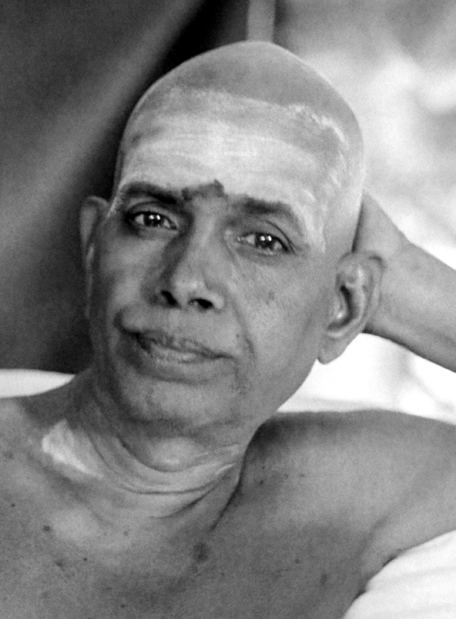
 Tom Das