All teachers and teachings are illusory, empty.
No need to pay them too much attention.
Instead be with your-Self.
Instead be with your-Self.


This is a beautiful and instructive post from Robert Adams outlining a wonderful path to Self-Realisation. It was originally put together and posted by someone else on Facebook but I thought is was such a nice post that I’ve blogged it here for the benefit of you all.
The essential points below are:
1. Do not attempt to change whatever is happening.
2. Instead adopt an attitude of love, forgiveness and mercy throughout your daily life
3. Don’t worry too much about the body, mind and world or whatever experiences arise. No need to suppress either, just let things be and occur by themselves as much as you are able to. Allow life to take care of life.
4. When you are filled with love and forgiveness and mercy, perform self-enquiry again and again. This practice is emphasised below with instructions on how to do this.
5. Rest in the resultant Silence and allow yourself to ‘become’ That, watch yourself become more joyful and less concerned about thoughts and the world. Soon you will realise there is only That 
Now read the words from Robert Adams below. Take your time to read it properly as there are some beautiful variations of the teachings which are very potent. I think it’s really worth spending a few days or weeks just reading this, absorbing the message and actually practicing it. But, as always, do what feels right for you.

Robert Adams:
You come under the law of karma […] when you believe you’re not awakened, you’re not free, you’re not liberated when you react to person, place or thing. […] I know there are many people in Advaita Vedanta who tell me, “Well you know Robert karma does not exist. Only the Self exists. Only effortless pure awareness exists. So why are you telling us about karma?” In truth you have to look at yourself and ask yourself, “Have I experienced pure awareness? Have I experienced absolute reality? I can’t afford to put on an act. It will only go against me.” […] So while we’re on the path to liberation we have to be very careful what we do with our lives. Every little thing is karmic. It is only when you awaken, when you are liberated that none of this exists. This is why I tell you so often, “Do not fool yourself.” Look at how many times a day you become angry. You feel cheated, you feel exploited. You feel something is wrong someplace. You feel depressed. You go and do something to cause this condition to stop and whatever you do you’re accruing karma. There is only one way to overcome this. And that is to forget about the world, forget about your body, forget about situations and go deep within yourself inquiring, “To whom does this come? Who is experiencing karma?”
[…]
Karma seems to be real and you’re affected with it all day long. Whatever you do, wherever you go you’re always affected by karma. It is karma that moves your body. It is karma that makes you do things. It is karma that causes situations to come into your life. Do not try to change a condition. Do not intend to change the situation. For you may appear to change it but this is only an appearance. It will come back again in full force. There is only one way to get rid of it and that is to transcend it by forgiveness, mercy and love. And as you practice forgiveness, mercy and love you inquire,
“To whom all this is coming to?
Who is experiencing these things?
Who is going through all these things?”
And again you will discover the I-thought,
“I am. I am going through all of these things. I appear to be going through karma. I appear to be suffering. I appear to want to get even with someone.”
You’re beginning to realize it’s not you. It is the I. Which is only a thought. Just knowing this alone makes you feel good. For you begin to see that you are free. You are bright and shining. You are sat-chit-ananda, nirvana, ultimate oneness.
.
It is the I that appears to have the problems. You separate yourself from the I, by self-inquiry. And then you can go further by inquiring,
“Where did the I come from?”
You never answer that question. By inquiring that is sufficient. And you will find that you’re in the silence, the void. Just by going this far you will feel better than you’ve felt in years. You will feel such joy and such peace. This has nothing to do with enlightenment. But you’re going to feel joy and peace. More so than you ever felt before. Just by inquiring,
“Where does the I come from?”
The reason that you feel such joy and peace is because you begin to realize that you are not the I. You have absolutely nothing to do with the problems of the I. It is the I that feels anger. It is the I that feels pain. It is the I that feels rejection. But you ask yourself,
“What have I got to do with I? I have absolutely nothing to do with the I.”
Therefore again you ask,
“Then where did the I come from? Who gave it birth? What is its source?”
And you keep quiet. A feeling of total love will overpower you. For you’re learning to sit in the silence.
.
That’s the most important point. You want to get to the place where thoughts do not bother you, where things do not annoy you. Where there are no problems and there are no solutions. Where there is no good and there’s no bad. You want to get beyond duality and rest in the silence. Many of you are getting a glimpse of what I’m talking about right now, as you rest in the silence. You’re not thinking about it, you’re not trying to analyze it, you’re not trying to make it happen, you’re just resting in the silence. Perfectly still. All of a sudden thoughts come up again. You start over again. You begin again. You inquire,
“To whom do these thoughts come?
Who is thinking these thoughts?
I am?
If I is thinking these thoughts then it has absolutely nothing to do with me. It appears to me as if everything is attached to the I. All of the emotions, the fears, the frustrations, it’s all attached to the I.”
Again you say,
“Where did the I come from?
What is the source of I?
Who gave it birth?”
You never attempt to answer. You sit in the silence.
.
Some of you are beginning to feel how good it is to sit in the silence right now. The mind is completely empty. The fears are gone. There is nothing left to tell you anything. You are quiet, still. Thoughts pop up again. It makes no difference if they’re good thoughts, bad thoughts or in-between. The whole idea is to empty the mind of all thoughts. You inquire again,
“Who is thinking these thoughts?
I am?
Who am I?
What is the source of I?
Who gave it birth?
Where does this I come from that is giving me all this trouble and keeps thinking and thinking?
And bringing up to me all these morbid thoughts, all sorts of happy thoughts, all sorts of thoughts.
Where did this I come from?
What is its source?”
And again you enter the silence. Where everything is totally still. Where there is no movement. The vasanas have disappeared. There is just perfect stillness. You’re beginning to discover something very interesting. You’re beginning to discover that you´re able to sit in the silence for longer and longer periods without thought. It’s taking longer and longer before a thought comes to you.
.
Yet you are not falling asleep. You’re feeling a peace that you’ve never felt before. You’re beginning to feel an all encompassing love. You begin to experience that the whole universe is an emanation of your own mind. And what you have done is you have pulled the entire universe into your heart, everything! All of the galaxies, the milky ways, the planets, the earth with all of it’s manifestations, everything has vanished. That’s total silence. […] […] When you’re sitting in the silence and the world is still available to you that is not silence. That’s a false silence. The true silence is when the whole world, the whole universe, people, places and things have all disappeared. You have pulled them back into the heart centre. That is the true silence. For there is no longer anything to think about. Everything is gone. There is just the void. The beautiful precious void. And you’re beginning to sit in that void, in that silence for longer and longer periods. When you come out of it the world appears to you again but it’s different. It begins to be different for you. You no longer look at the world in the same way. You no longer see the universe in the same way. You begin to feel everything as an image. You see images on the screen of life. The images keep changing, changing, changing but the screen is always the same. And something begins to tell you that you are that screen. You have always been the screen. Unchanging, absolute pure reality.
.
But you are not free yet. This comes and it goes. Little by little the thoughts come back again. You begin to feel anger again but less than you did before. You begin to have less interest in your body. The things about your body that used to bother you stop bothering you, stop annoying you. People no longer make you angry or frustrated. This happens little by little. And you can’t wait to practice again. When you are by yourself and you’re not disturbed you sit down in your favorite chair and you begin to inquire,
“To whom do these thoughts come?
Why they come to me. I still feel thoughts. Maybe less than I did before but I still feel things,”
you further inquire,
“who is the I that feels these things?
Where did the I come from?
Who gave birth to this feeling I?
What is its source?”
And now you begin to feel that the I is only a thought. It is one of the thoughts that you’ve been thinking about all these years called the I-thought. Yet everything is attached to it and you keep seeing it and thinking about it. But now you’re inquiring,
“To whom does it come?
Who’s feeling it?
What is its source?”
.
And you go back into the silence. Now every time you get into the silence you feel better and better. You feel lighter and lighter. The world again, the universe they’re getting sucked into your heart. The whole universe has gone. All existence has disappeared. Including yourself. There is nothing but the silence.
(long silence)
(…)
Om … shanti, shanti, shanti, peace.
— The above is taken from Robert Adams Collected Works, Talk 136: The True Silence

Visitor: Is renunciation necessary for Self-realisation?
Bhagavan: Renunciation and realisation are the same. They are different aspects of the same state. Giving up the non-self is renunciation. Inhering in the Self is jnana or Self-realisation. One is the negative and the other the positive aspect of the same, single truth.
Bhakti, jnana, yoga — are different names for Self-realisation or mukti which is our real nature. These appear as the means first. They eventually are the goal.
So long as there is conscious effort required on our part to keep up bhakti, yoga, dhyana, etc., they are the means. When they go on without any effort on our part, we have attained the goal.
There is no realisation to be achieved. The real is ever as it is. What we have done is, we have realised the unreal, i.e., taken for real the unreal. We have to give up that. That is all that is wanted.
Visitor: How has the unreal come? Can the unreal spring from the real?
Bhagavan: See if it has sprung. There is no such thing as the unreal, from another standpoint.
The Self alone exists. When you try to trace the ego, based on which alone the world and all exist, you find the ego does not exist at all and so also all this creation.
(The above excerpt is from Day by Day with Bhagavan, page 87)
Tom’s comments:
Here in the above passage we find three central facets of Bhagavan Ramana’s teachings.
1. Firstly the non-self must be given up or let go of. By non-self, it is meant everything that is perceived. This includes the entire mental realm of thoughts, feelings and imaginings as well as the so-called physical world of the body and objects – i.e all experiences. This is the way the term is used in classical advaita vedanta. By given up it is meant do not be attached, or let go of all appearances. Allow all to come and go in your being.
Initially this renunciation or letting go is something you do, a practice, or as he states above, ‘the means’. Eventually this becomes natural as the habitual tendency (vasana) to identify with the non-self is dissolved through the practice (sadhana). At this point, when the vasanas have been removed, this is realisation.
2. Secondly Bhagavan then reminds us that realisation is not something to be attained. Realisation is who we are, it is our very nature, it is always and already here, so why do we need to attain that which we already are? (We don’t!). We just have to give up the wrong ideation we have, namely the fixation on the non-self and taking ourself to be the body-mind. When we give up everything, the only thing we lose is our illusions, that which is false. That which is real, the Self, can never be lost, and it is ever-realised.
3. Thirdly, when Bhagavan is asked about how the unreal can come from the real, bhagavan states in reality the unreal never was. The self alone is. Here he briefly describes his teaching of self-enquiry, namely that when you try to find the ego, you cannot find it. He then, in very concise form, states that the appearance of the world is dependent upon the false belief in ego. When the ego cannot be found and has been seen to be non-existent, you also realise that the world too is non-existent, that the entire thing is an illusion. This too is realisation! This too is renunciation of non-self! This too is jnana, bhakti and yoga!
Of note, the first point I mentioned above dealing with removal of vasanas is the purification part of the teaching, in which we let go of non-self or ‘the world’ (including the mind and body) through spiritual sadhana (practice), at least initially. Points two and three refer to what I call the insight aspect of the teachings in which the unreal is seen to be false or non-existent. These two aspects of the teachings go together beautifully, with insight naturally leading to renunciation (letting go of non-self/abiding as self) and sadhana enhancing insight and abiding as self and removing the vasanas (habitual tendencies) towards ignorance (of self) and taking hold of non-self.

Following a post here:
I received several questions like this, here:
The following excerpt is taken from ‘Be As You Are’ by David Godman
Question: For controlling the mind, which of the two is better, performing japa of the ajapa [unspoken] mantra or of omkar [the sound of `om’]?
Ramana Maharshi: What is your idea of unspoken and involuntary japa [ajapa]? Will it be ajapa if you go on repeating with the mouth `soham, soham’ [`I am he, I am he’]? Ajapa really means to know that japa which goes on involuntarily without being uttered through the mouth. Without knowing this real meaning people think that it means repeating with the mouth the words `soham, soham’ hundreds of thousands of times, counting them on the fingers or on a string of beads.
Before beginning a japa breath control is prescribed. That means, first do pranayama [regulating of breath] and then begin repeating the mantra. Pranayama means first closing the mouth, doesn’t it? If, by stopping the breath, the five elements in the body are bound down and controlled, what remains is the real Self. That Self will by itself be repeating always `aham, aham’ [`I, I’]. That is ajapa.
Knowing this, how could that which is repeated by mouth be ajapa? The vision of the real Self which performs japa of its own accord involuntarily and in a never-ending stream, like the flowing down continuously of oil, is ajapa, gayatri and everything. If you know who it is that is doing japa you will know what japa is. If you search and try to find out who it is that is doing japa, that japa itself becomes the Self.
Question: Is there no benefit at all in doing japa with the mouth?
Ramana Maharshi: Who said there is no benefit? Such japa will be the means for chitta suddhi [purifying the mind]. As the japa is done repeatedly the effort ripens and sooner or later leads to the right path. Good or bad, whatever is done never goes to waste. Only the differences and the merits and demerits of each will have to be told, looking to the stage of development of the person concerned.
Question: Is not mental japa better than oral japa?
Ramana Maharshi: Oral japa consists of sounds. The sounds arise from thoughts, for one must think before one expresses the thoughts in words. The thoughts are form the mind. Therefore mental japa is better than oral japa.
Question: Should we not contemplate the japa and repeat it orally also?
Ramana Maharshi: When the japa becomes mental, where is the need for the sounds? Japa, becoming mental, becomes contemplation. Dhyana, contemplation and mental japa are the same. When thoughts cease to be promiscuous and one thought persists to the exclusion of all others, it is said to be contemplation. The object of japa or dhyana is the exclusion of several thoughts and confining oneself to one single thought. Then that thought too vanishes into its source – absolute consciousness. The mind engages in japa and then sinks into its own source.
Question: The mind is said to be from the brain.
Ramana Maharshi: Where is the brain? It is in the body. I say that the body itself is a projection of the mind. You speak of the brain when you think of the body. It is the mind which creates the body, the brain in it and also ascertains that the brain is its seat.
Question: Sri Bhagavan has said that the japa must be traced to its source. Is it not the mind that is meant?
Ramana Maharshi: All these are only the workings of the mind. Japa helps to fix the mind on a single thought. All other thoughts are first subordinated until they disappear. When it becomes mental it is called dhyana. Dhyana is your true nature. It is however called dhyana because it is made with effort. Effort is necessary so long as thoughts are promiscuous. Because you are with other thoughts, you call the continuity of a single thought meditation or dhyana. If that dhyana becomes effortless it will be found to be your real nature.
Question: People give some names to God and say that the name is sacred and that repetitions of the name bestow merit on the individual. Can it be true?
Ramana Maharshi: Why not? You bear a name to which you answer. But your body was not born with that name written on it, nor did it say to anyone that it bore such and such a name. And yet a name is given to you and you answer to that name, because you have identified yourself with the name. Therefore the name signified something and it is not a mere fiction. Similarly, God’s name is effective. Repetition of the name is remembrance of what it signifies. Hence its merit.
Question: While making japa for an hour or more I fall into a state like sleep. On waking up I recollect that my japa has been interrupted. So I try again.
Ramana Maharshi: `Like sleep’, that is right. It is the natural state. Because you are now associated with the ego, you consider that the natural state is something which interrupts your work. So you must have the experience repeated until you realize that it is your natural state. You will then find that japa is extraneous but still it will go on automatically. Your present doubt is due to that false identity, namely of identifying yourself with the mind that does the japa. Japa means clinging to one thought to the exclusion of all other thoughts. That is its purpose. It leads to dhyana which ends in Self-realization or jnana.
Question: How should I carry on japa?
Ramana Maharshi: One should not use the name of God mechanically and superficially without the feeling of devotion.
Question: So mechanical repetition is unproductive?
Ramana Maharshi: Acute diseases will not be cured merely by repeating the name of the medicine but only by drinking the medicine. Similarly, the bonds of birth and death will not cease merely by doing many repetitions of mahavakyas such as `I am Siva’. Instead of wandering about repeating `I am the supreme’, abide as the supreme yourself. The misery of birth and death will not cease by vocally repeating countless times `I am that’, but only by abiding as that.
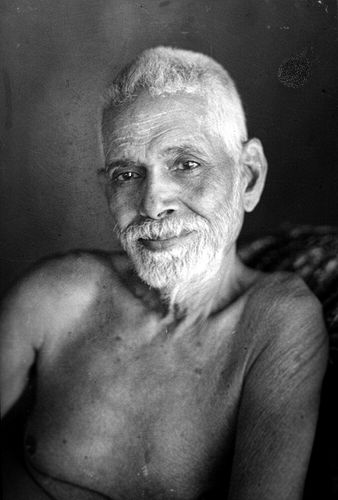
One of the many things I admire about Ramana Maharshi is that he didn’t try to re-invent the wheel. He used to frequently refer people to traditional texts if it was relevant to their path, and even translated a number scriptures into Tamil for those who were unable to read or understand classical Sanskrit.
For me this was really brought home to me when reading Ramana’s Supplement to 40 Verses on Reality. This is a collection of 40 verses that Ramana composed, except that he didn’t compose all of the verses himself. Several were taken from other scriptures, but, I assume, as they said what he wanted to convey, he just copied the verses and gave the reference of where he took them from.
Here are the first 5 verses of Ramana’s Supplement to 40 Verses on Reality. Note how he places emphasis on the role of the guru and the guru’s power to lead those around him/her into freedom through darshan:
Verse 1
In the company of sages, attachment vanishes; and with attachment, illusion. Freed from illusion, one attains stability, and thence liberation while yet alive. Seek therefore the company of sages.
from Bhajagovindam by Shankaracharya
Verse 2
Not by listening to preachers, nor by study of books, not by meritorious deeds nor by any other means can one attain that Supreme State, which is attainable only through association with the sages and the clear quest of the Self,
from Yoga Vasishta
Verse 3
When one has learned to love the company of sages, wherefore all these rules of discipline? When a pleasant, cool southern breeze is blowing, what need is there for a fan?
from Yoga Vasishta
Verse 4
Fever is overcome by the cool light of the moon; want, by the good wish-yielding tree; and sin by the Holy Ganges. Those three — fever and want and sin — all flee at the august sight of the peerless sage.
from Subhashita Ratna Bhandargara, chapter 3 verse 6
Verse 5.
Holy rivers, which are only water, and idols, which are made of stone and clay, are not as mighty as the sages. For while they make one pure in course of countless days, the sage’s eyes by a mere glance purify at once.
from Srimad Bhagavatam, Tenth canto, chapter 48 verse 31

Variations of this practice are found in both Buddhism and Vedanta, and it is so simple yet highly effective, so without further delay:
 Tom Das